> ## Documentation Index
> Fetch the complete documentation index at: https://notes.kodekloud.com/llms.txt
> Use this file to discover all available pages before exploring further.
# Embracing a growth mindset and learning from experiences
> Promoting a growth mindset in DevOps to foster continuous learning, experimentation, blameless postmortems, psychological safety, practical strategies, and measurable team and technical improvement.
Welcome back. This lesson focuses on the final element of continuous improvement: embracing a growth mindset and intentionally learning from experience. In both communication and technical practice, a growth mindset enables ongoing development through experimentation, feedback, and collaboration — all central to effective DevOps.
This lesson covers:
* What a growth mindset is and how it differs from a fixed mindset
* Why a growth mindset matters in DevOps
* Practical strategies to build this mindset
* How to learn systematically from experience
* Common obstacles and how to overcome them
* Concrete ways to measure the impact of growth and learning
## Understanding a growth mindset
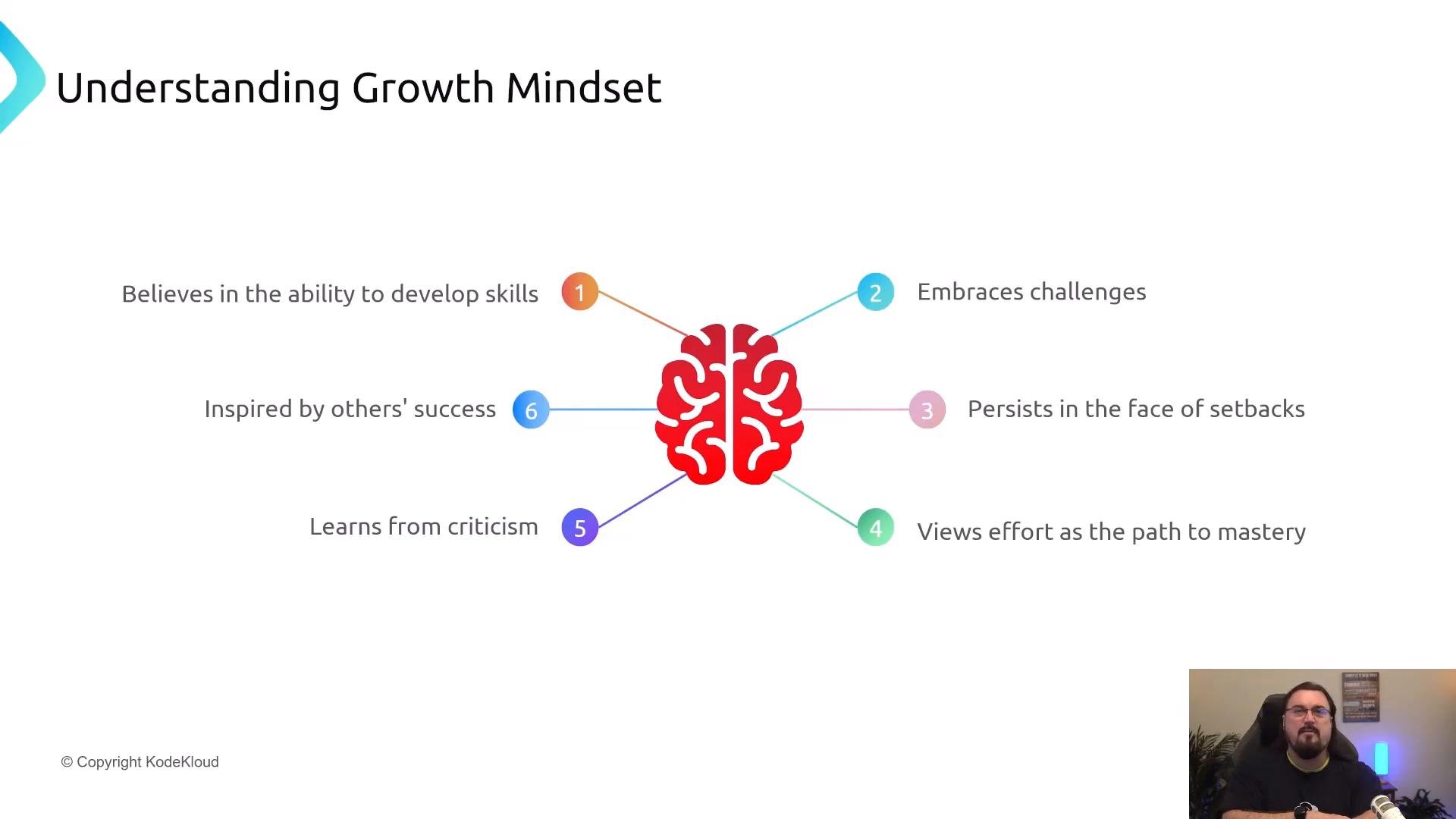
A growth mindset is the belief that abilities and intelligence can be developed through effort, practice, and feedback. People and teams that adopt this mindset:
* Embrace challenges and treat them as learning opportunities
* Persist through setbacks instead of giving up
* View effort as a path to mastery rather than a sign of weakness
* Use constructive feedback and criticism to improve
* Learn from others’ successes rather than seeing them as threats
* Believe that skills and knowledge can be developed over time
 ## Fixed mindset vs growth mindset
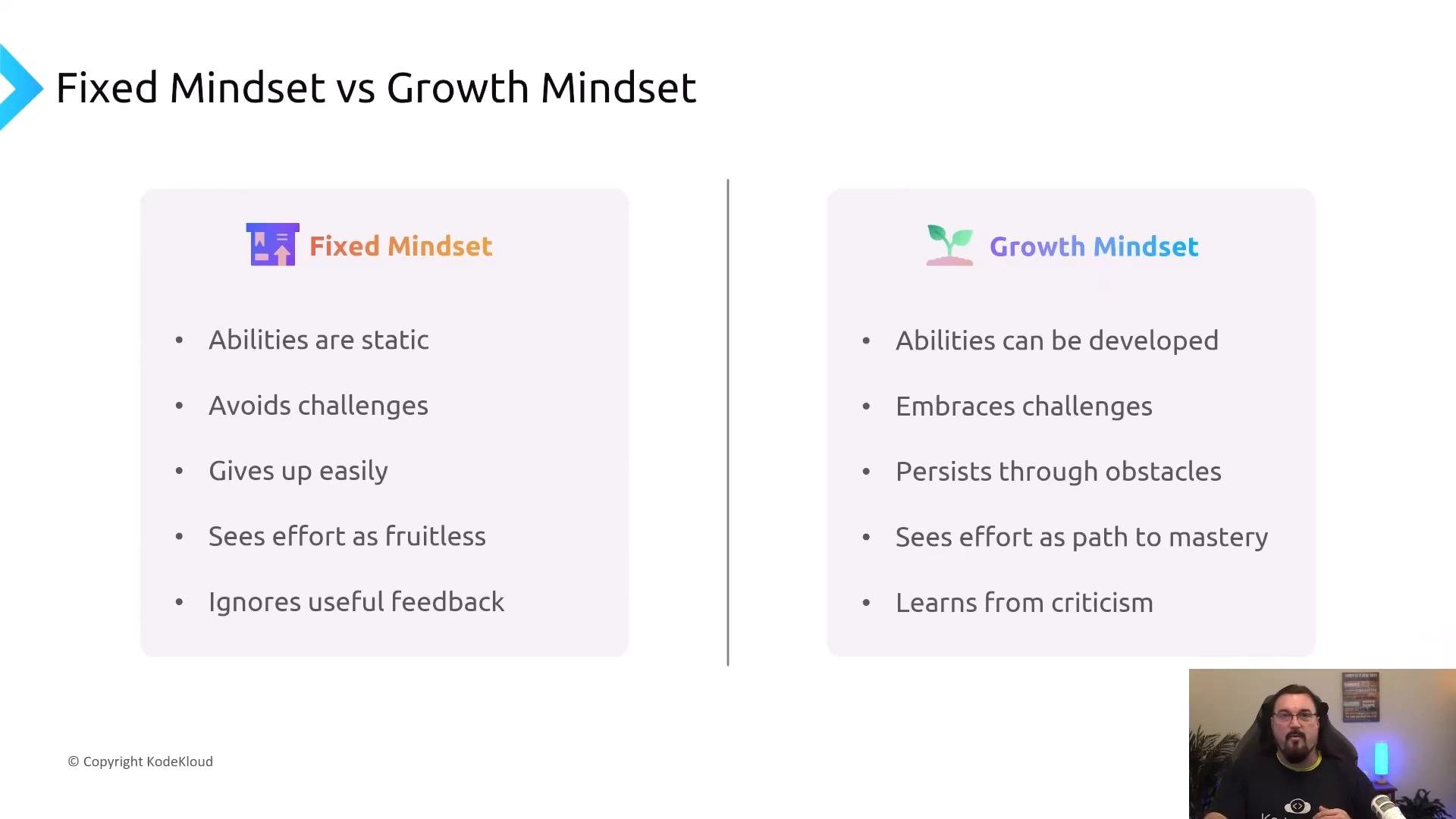
A fixed mindset treats skills as static: people with this outlook tend to avoid challenges, resist feedback, and give up early when progress stalls. A growth mindset sees skills as improvable, embraces challenge, and treats feedback as actionable data.
 ## Why a growth mindset benefits DevOps
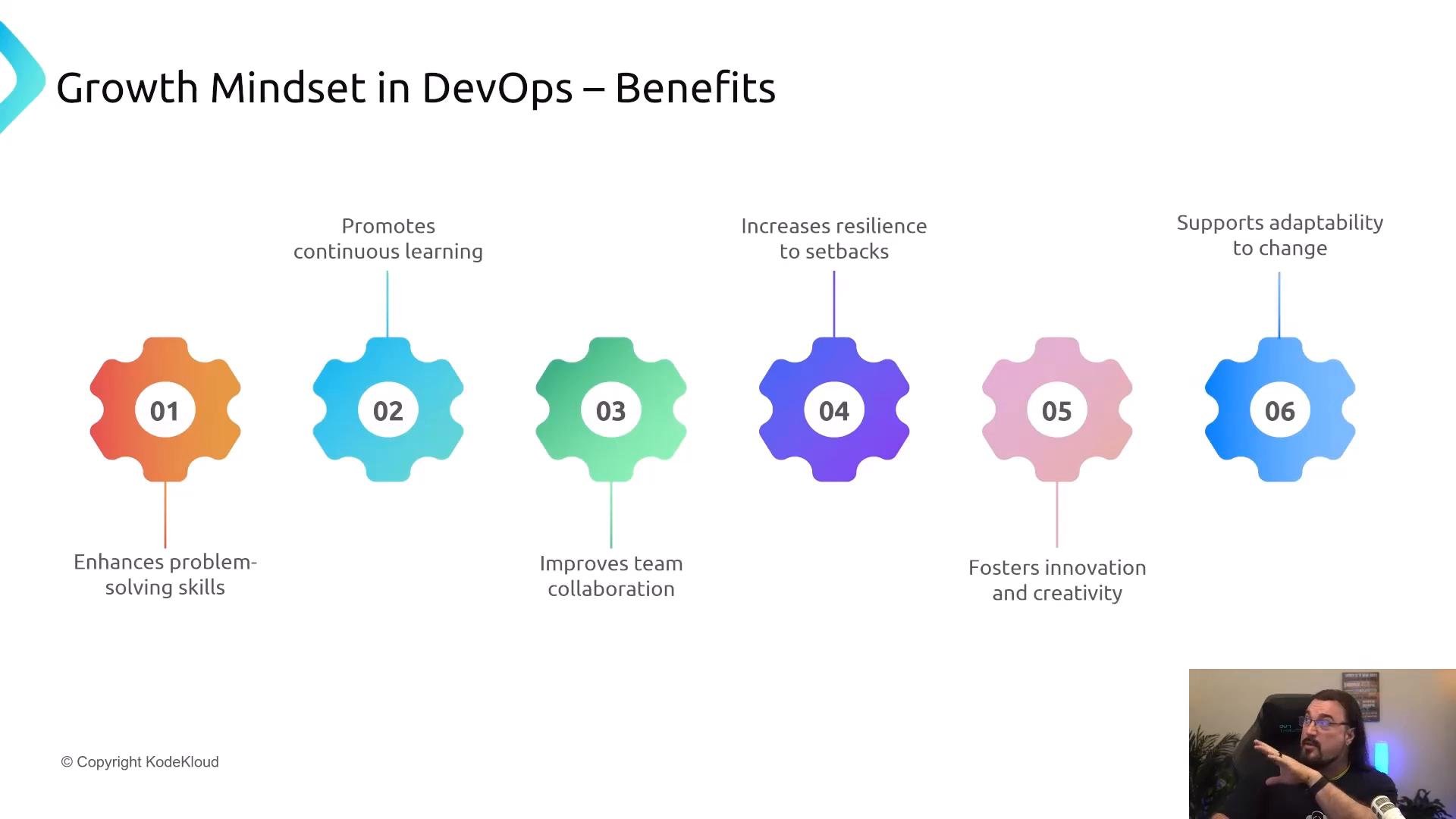
In DevOps, the growth mindset directly supports core practices and outcomes:
* Better problem solving through iterative learning
* Continuous improvement and ongoing learning
* Stronger team collaboration and shared responsibility
* Greater resilience when incidents occur
* More innovation through safe experimentation
* Faster adaptation to change and new technology
These benefits align with DevOps principles such as rapid feedback loops and shared ownership of reliability and delivery.
 ## Practical strategies to cultivate a growth mindset
Apply these concrete approaches to make growth part of daily work:
* Reframe challenges: Treat problems as experiments and opportunities for learning rather than threats.
* Reframe failure: Use language like “I haven’t figured this out yet” to emphasize progress.
* Focus on process: Reward iteration and the learning journey, not just polished outcomes.
* Create purpose: Connect experiments and tasks to customer value, product quality, or organizational goals.
* Celebrate progress: Recognize effort, small wins, and incremental improvements.
Cultivate psychological safety: make it safe to experiment, surface mistakes, and share lessons learned. Teams that feel safe learn faster and take productive risks.
## Learning from experiences in DevOps
DevOps provides structured ways to turn experience into organizational learning:
* Retrospectives and blameless postmortems: Analyze incidents and outages to identify systemic improvements without assigning individual blame.
* Experimentation: Run small, measurable experiments (canary releases, feature flags, A/B tests) and collect data.
* Knowledge sharing: Publish results (both successes and failures) so the whole organization can benefit.
* Reflective practice: Convert concrete experiences into hypotheses, test them, and iterate.
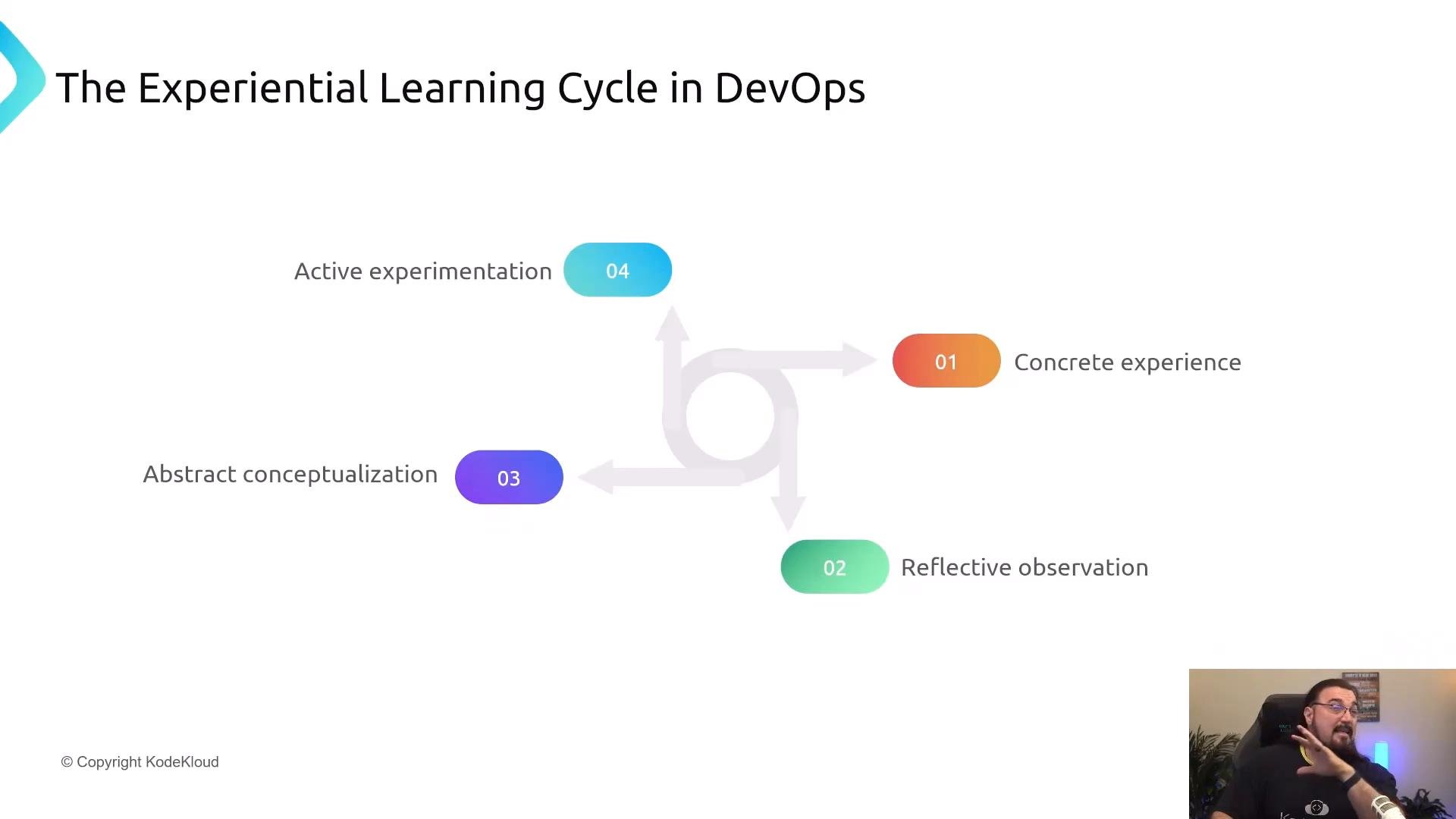
These steps follow the experiential learning cycle: concrete experience → reflective observation → abstract conceptualization → active experimentation.
 ## Common challenges and how to overcome them
* Fixed-mindset moments: Everyone slips into fixed thinking sometimes. Notice the pattern and consciously reframe.
* Fear of failure: Treat failures as data for improvement — what worked, what didn’t, and why.
* Perfectionism: Replace “perfect” with “better” by establishing small, measurable improvement goals.
* Risk aversion: Encourage controlled, incremental risk-taking with clear rollback plans.
* Unsupportive culture: Establish team norms that reward learning and transparency over blame.
Encouraging controlled risk-taking and a supportive environment accelerates innovation and learning.
## Measuring impact
Track both qualitative and quantitative signals to make learning visible and actionable.
| Metric | How to measure | Example |
| - | - | - |
| Team satisfaction & engagement | Regular pulse surveys and retrospectives | Quarterly NPS or engagement surveys |
| Learning & development | Training completions, certifications, internal knowledge articles | Number of courses completed per quarter |
| Experimentation rate | Count of experiments, rollouts, and rollbacks | Experiments per quarter; % resulting in improvements |
| Technology & practice adoption | Percentage of services using new practices/tools | `% services using CI/CD pipelines` |
| Performance trends | DORA-style metrics (MTTR, deployment frequency), incident recurrence | `Mean Time To Recovery (MTTR)`, deployments/day |
Quantify progress where possible (e.g., number of experiments run, certifications earned) and combine these with qualitative indicators like psychological safety and team narratives.
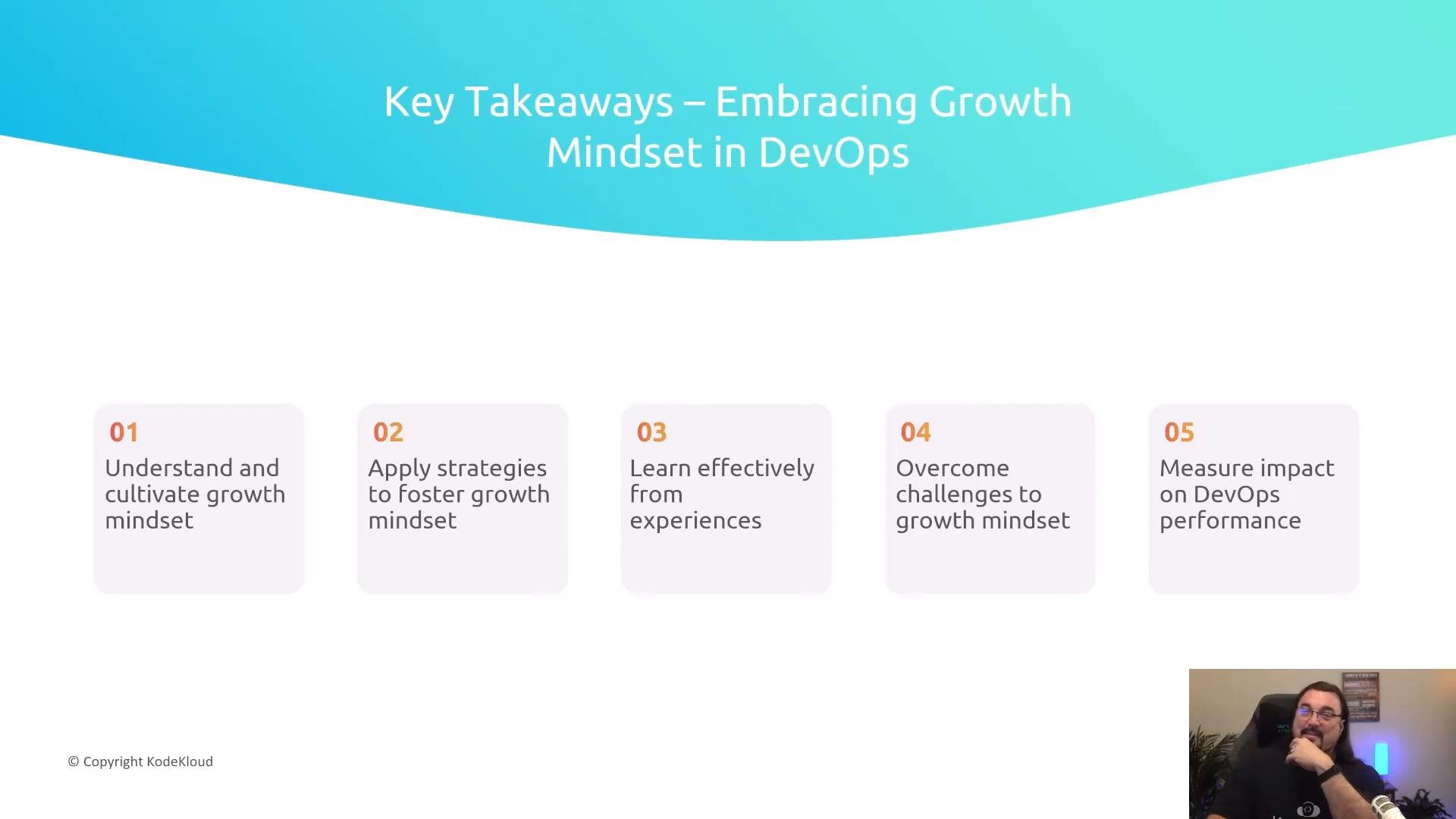
## Key takeaways
* Choose a growth mindset over a fixed mindset to enable continuous improvement.
* Use practical strategies: reframe challenges, normalize iterative learning, and celebrate progress.
* Learn systematically: conduct blameless postmortems, run experiments, and share results.
* Address common barriers (fear of failure, perfectionism, risk aversion) by promoting safe, incremental risk-taking.
* Measure impact using a mix of qualitative and quantitative metrics to make growth visible and guide decisions.
 Thanks for following this lesson.
Further reading and references:
* [What is DevOps? — AWS](https://aws.amazon.com/devops/what-is-devops/)
* [DORA: The Four Keys to DevOps Performance — Google Cloud blog](https://cloud.google.com/blog/products/devops-sre/dora-four-keys-of-devops-performance)
* [Creating psychological safety — Harvard Business Review overview](https://hbr.org/2017/08/high-performing-teams-need-psychological-safety)
This documentation is built and hosted on [Mintlify](https://mintlify.com), a developer documentation platform.