> ## Documentation Index
> Fetch the complete documentation index at: https://notes.kodekloud.com/llms.txt
> Use this file to discover all available pages before exploring further.
# Anticipating common objections and concerns from non technical stakeholders
> How to anticipate and address non-technical stakeholder objections by translating technical proposals into business outcomes covering cost, risk, benefits, complexity, integration, security, and adoption plans
Welcome — this lesson shows how to anticipate and respond to the most common objections and concerns from non-technical stakeholders. The objective is simple: present technical proposals in business terms stakeholders care about—cost, risk, outcomes, timeline, and people impact—so they can make informed decisions.
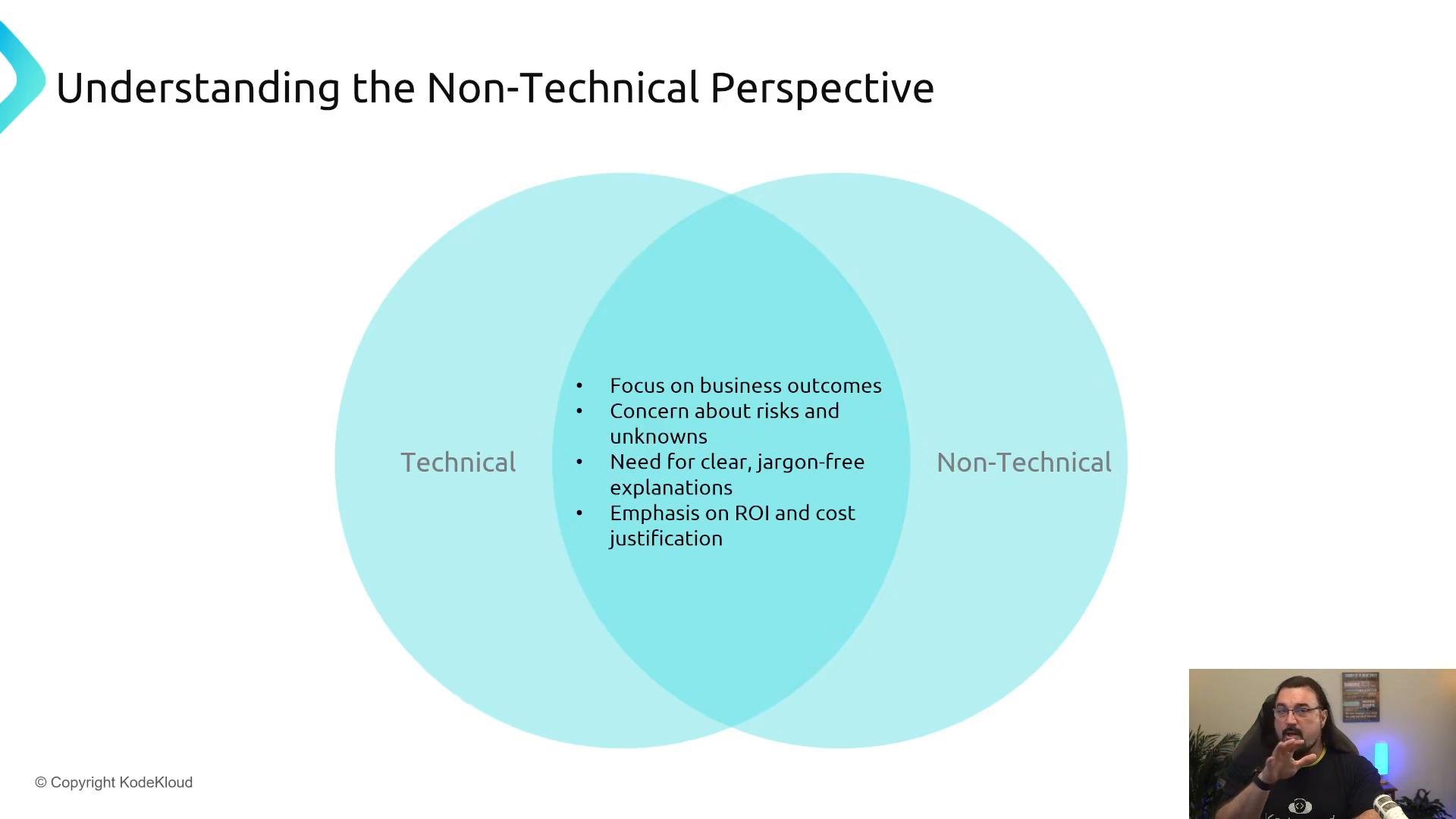
Non-technical stakeholders typically focus on business outcomes and risks rather than implementation details. When you prepare, translate technical benefits into measurable business outcomes.
Start with empathy. Learn the stakeholder’s priorities and vocabulary before you present. Typical priorities include ROI, operational risk, ease of adoption, and compliance. Use plain language, avoid unnecessary jargon, and frame technical choices in terms of business value.
 Common objections and concise responses
1. Cost / Value: "This is too expensive."
* What they really mean: What return will we get for this spend? Is the spend justified vs. other priorities?
* How to respond: Provide a clear cost breakdown and, crucially, the expected benefits—time saved, revenue uplift, reduced incident costs, or operational efficiency gains. Where possible, include estimated payback time and sensitivity ranges.
* Evidence to bring: case studies, before/after metrics, and one or two clear success metrics (e.g., reduce downtime by X% or save Y engineering hours per week).
2. Unclear benefits: "What tangible benefits does this deliver?"
* What they really mean: How does this improve the bottom line, customer experience, or competitive position?
* How to respond: Translate technical improvements into measurable business outcomes. Offer acceptance criteria and specific success metrics (e.g., faster feature delivery, lower infrastructure costs, higher user retention).
* Evidence to bring: examples of improved conversion, cycle time reduction, or customer satisfaction scores.
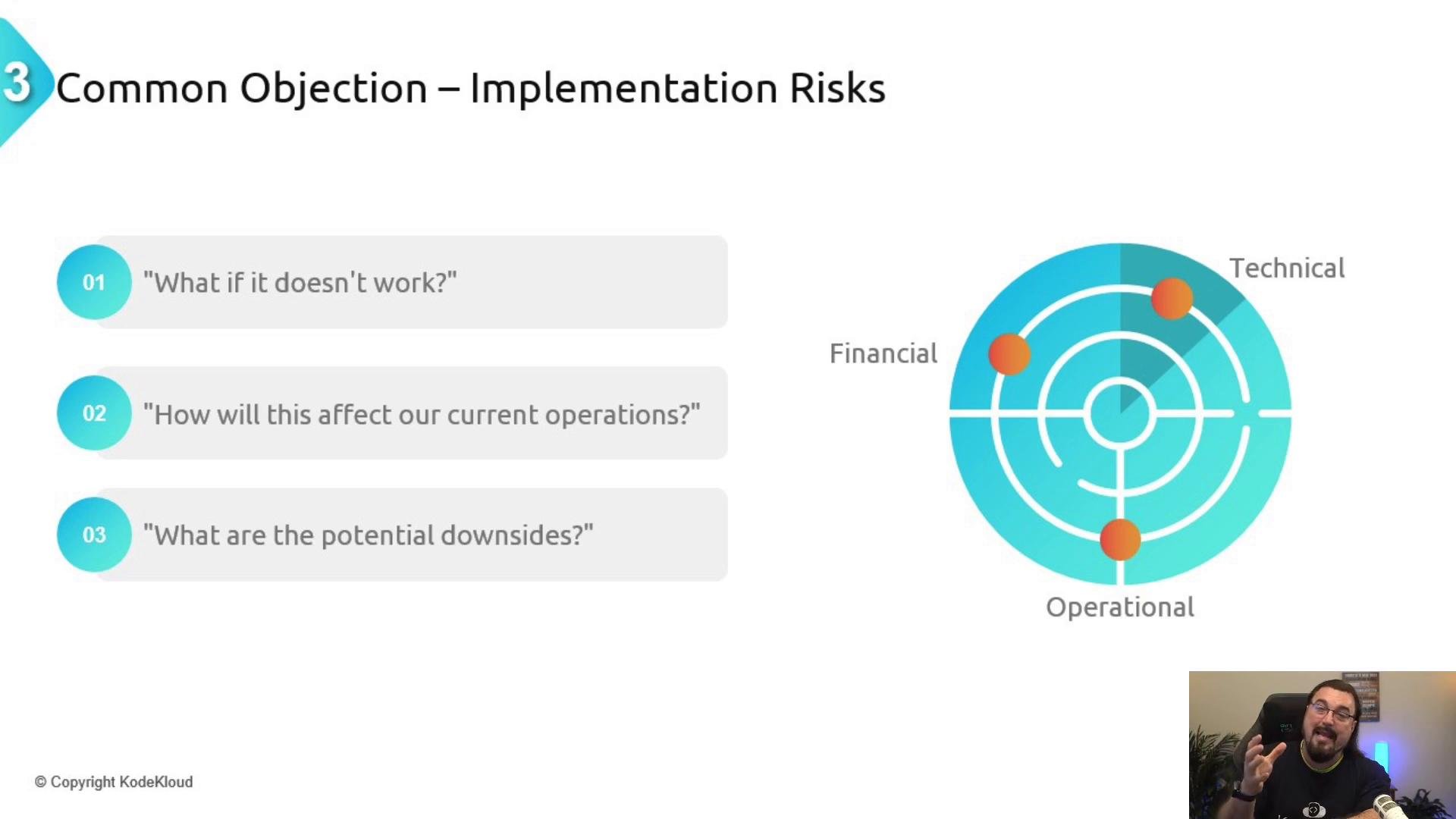
3. Risk and failure modes: "What if it doesn't work?"
* What they really mean: How will this affect day-to-day operations and what are the downside scenarios?
* How to respond: Present a risk register and mitigation plan. Explain testing, QA, rollout strategy, monitoring, and rollback procedures. Show likelihood and impact assessments and how each risk will be minimized.
* Evidence to bring: test results, staging/production canary plans, monitoring dashboards, and rollback playbooks.
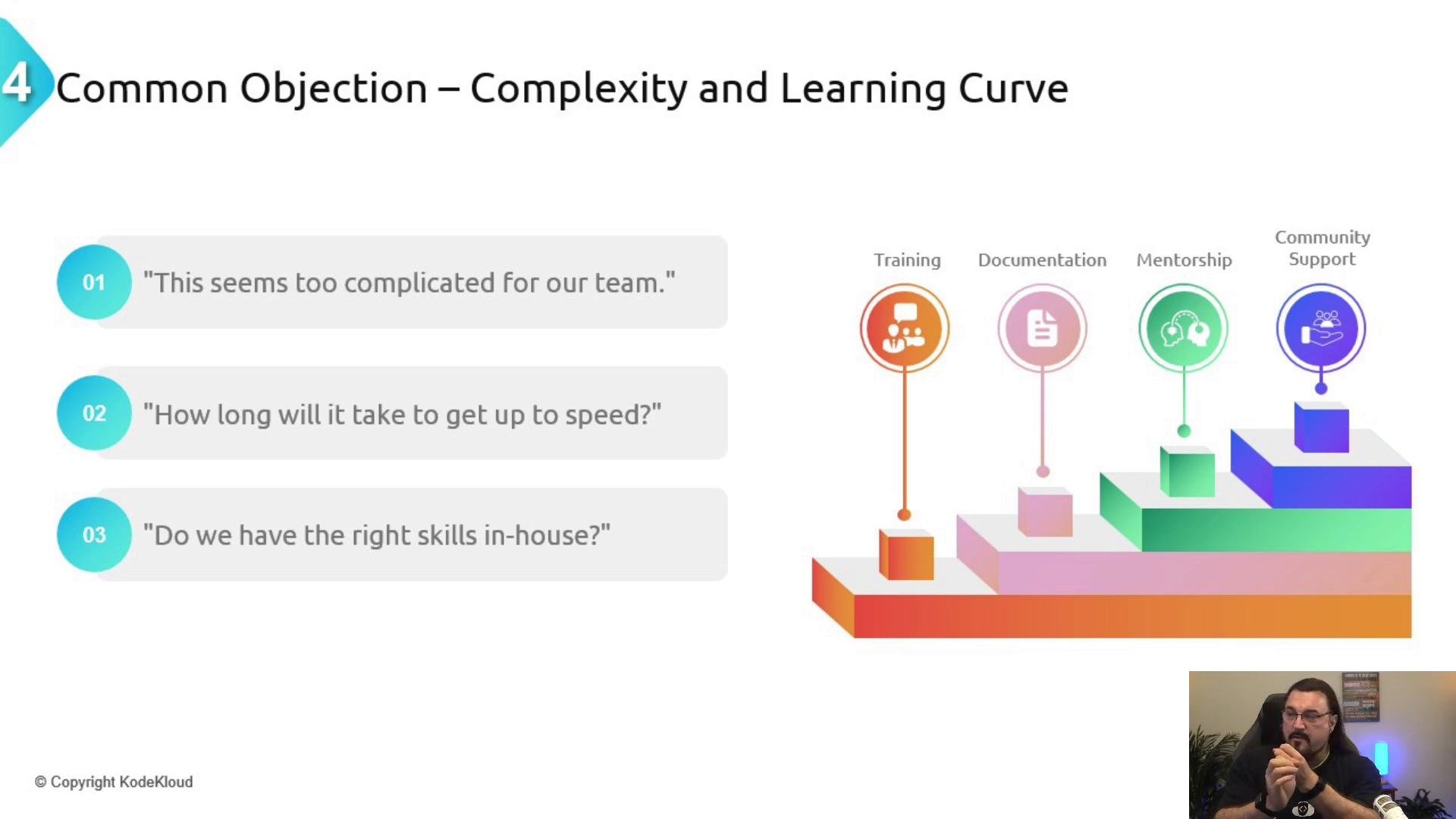
 4. Complexity and learning curve: "This seems too complicated."
* What they really mean: Can our team adopt and maintain this? How long will ramp-up take and what are hidden operational costs?
* How to respond: Provide an adoption plan with training, documentation, mentorship, and staged automation. Break the project into smaller milestones and quick wins so stakeholders see value early.
* Evidence to bring: a training calendar, documentation ownership plan, mentorship pairings, and automation roadmaps. Use realistic timelines—e.g., planned sprints or phased rollouts—and compare to similar enterprise migrations if helpful.
 5. Integration with existing systems: "Will this fit with our systems and data?"
* What they really mean: Will introducing this solution disrupt current workflows or require a full replacement?
* How to respond: Present a clear integration and migration plan that preserves existing workflows and data. Emphasize backward compatibility, data migration strategies, and how the solution will interoperate with current systems. Explain sequencing and minimal-disruption patterns (e.g., canary releases, dual-running, adapters).
* Evidence to bring: interface maps, data migration runbooks, API compatibility matrices, and a phased cutover plan.
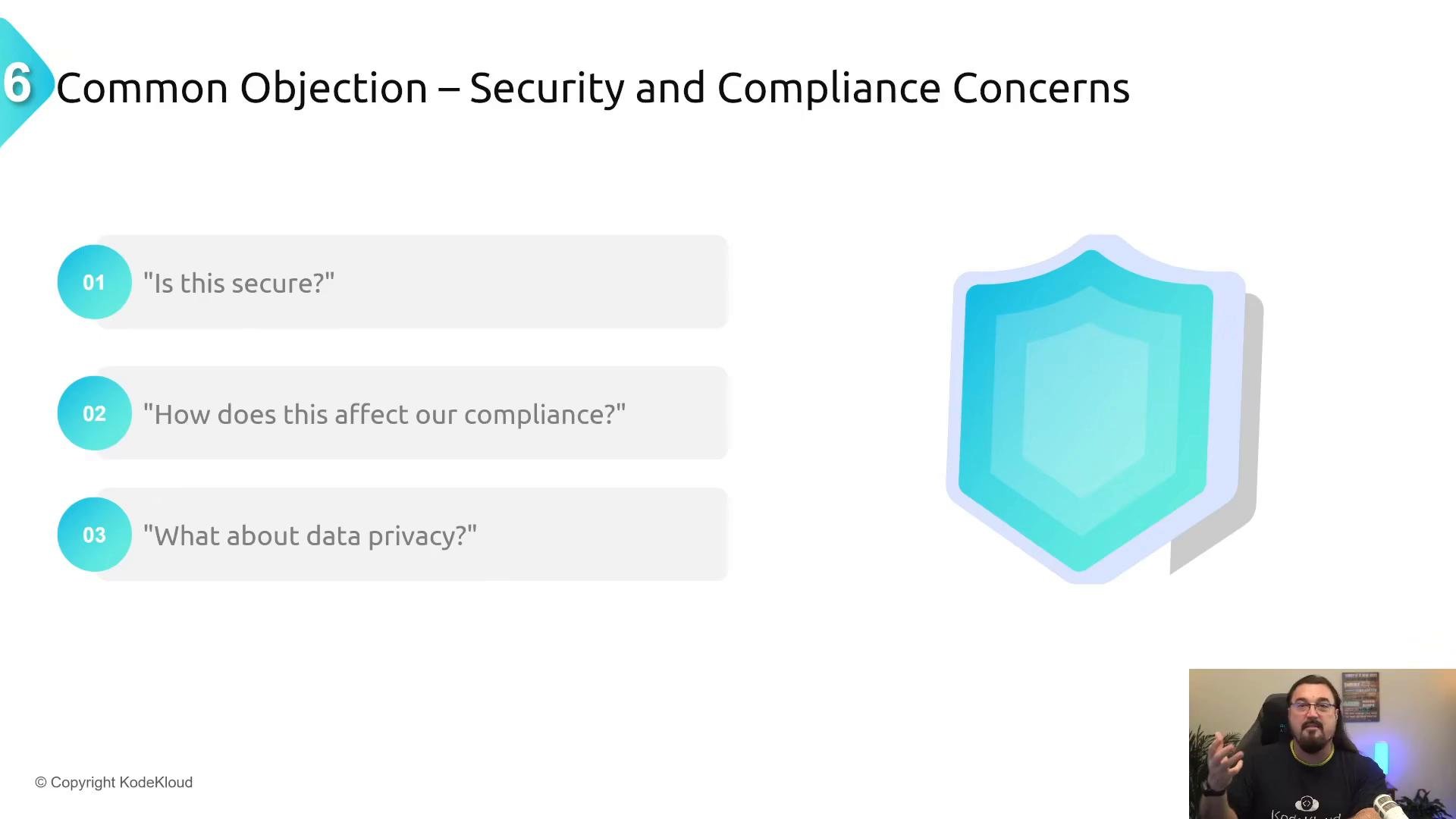
6. Security and compliance: "Is this secure and compliant?"
* What they really mean: How will this change affect our security posture and regulatory obligations?
* How to respond: Provide security controls, threat-modeling outcomes, encryption practices (in transit and at rest), access control and least-privilege design, audit trails, and mappings to relevant regulations. Share penetration-test or audit results and outline ongoing monitoring and incident response.
* Evidence to bring: security assessment reports, compliance checklists (e.g., SOC 2, GDPR mappings), and monitoring/alerting examples.
 Quick-reference table: objections, core question, and quick evidence
| Objection | Core question | Quick response | Typical artifacts to include |
| - | - | - | - |
| Cost / Value | What ROI will we see? | Show cost vs. benefit, payback timeline | Cost breakdown, ROI calc, case studies |
| Unclear benefits | How does this affect revenue/experience? | Translate to business KPIs and acceptance criteria | Success metrics, before/after data |
| Risk / Failure modes | What if it fails? | Show mitigation, rollback, monitoring | Risk register, canary plan, runbooks |
| Complexity / Learning curve | Can our team adopt this? | Provide training & phased milestones | Training plan, docs, mentorship schedule |
| Integration | Will it break current systems? | Show compatibility & phased migration | API maps, migration plan, compatibility tests |
| Security / Compliance | Is it safe and auditable? | Present controls and compliance mapping | Threat model, audit reports, compliance checklist |
Practical preparation checklist
* Map each stakeholder to their primary concern (cost, risk, compliance, ops).
* Prepare 2–3 business-focused talking points for each stakeholder.
* Produce lightweight artifacts: one-page ROI, a one-paragraph risk summary, and a 1–2 week phased rollout plan.
* Highlight first milestones and quick wins so stakeholders see early value.
* Keep monitoring and rollback plans visible and rehearsed.
Key takeaways
* Expect the same six themes: cost/value, unclear benefits, risk, complexity, integration, and security/compliance.
* Always translate technical work to business outcomes and measurable success criteria.
* Bring concrete artifacts: cost/benefit analyses, risk/mitigation plans, integration/migration steps, training and adoption plans, and security/compliance evidence.
* Address these concerns proactively to build trust, reduce friction, and speed decision-making.
This list isn’t exhaustive, but it covers the most frequent concerns when technical proposals meet non-technical stakeholders. Frame discussions around outcomes, timelines, mitigations, people impact, and how the change will operate alongside existing systems.
I'm Michael Forrester—thanks for completing this lesson.
Links and references
* [Canary releases and progressive delivery overview](https://martinfowler.com/bliki/CanaryRelease.html)
* [Threat modeling fundamentals](https://owasp.org/www-community/Threat_Modeling)
* [Measuring ROI for engineering initiatives (guidance)](https://hbr.org/2019/04/how-to-measure-the-roi-of-your-innovation-efforts)
This documentation is built and hosted on [Mintlify](https://mintlify.com), a developer documentation platform.