> ## Documentation Index
> Fetch the complete documentation index at: https://notes.kodekloud.com/llms.txt
> Use this file to discover all available pages before exploring further.
# Techniques for addressing objections and finding common ground
> Practical techniques to reframe stakeholder objections, find shared goals, and co-create actionable solutions.
Welcome back. This lesson focuses on practical techniques you can use immediately when you face resistance from stakeholders. The objective is to help you reframe conflict into constructive outcomes by uncovering the underlying interests behind positions and translating those interests into actionable plans.
Conflict usually arises from the situation, not the people. Your role is to convert adversarial positions into collaborative problem statements by asking what the objection is trying to protect or enable.
## Common underlying interests
Use the table below to map stakeholder groups to their core concerns and typical engineering or process responses. This helps you translate objections into concrete requirements.
| Stakeholder | Primary concern | Typical technical / process response |
| -: | - | - |
| Security | Reduce or control risk to the business | `Encryption`, `access controls`, threat modeling, audits |
| Operations | Stability and predictable systems | `SLA`, runbooks, automation, monitoring |
| Developers | Fast delivery and iteration | CI/CD pipelines, feature flags, test environments |
| Project managers | Meeting deadlines and coordinating teams | Roadmaps, milestones, risk registers |
| Executives | Strategic outcomes and ROI | Metrics, business-case alignment, KPIs |
Shift the conversation from positions ("We can't do this") to needs ("What risk are we trying to mitigate?"). Ask: what is the policy intended to protect or enable, and how might the proposed solution satisfy that underlying need?
Reframing objections by assuming positive intent helps. Most people raising objections aim to protect the business, not to be blockers. Restating concerns constructively usually defuses tension and guides the discussion toward options and trade-offs.
Example
* Objection: "There's no way this will work — it has no data-at-rest protection."
* Constructive restatement: "It sounds like data-at-rest protection is a core requirement. Can we add encryption or other protections to meet that need?"
By restating the concern and proposing a concrete remediation, you convert a blanket "no" into a focused engineering requirement and a collaborative discussion about options.
Another common reframe: when stakeholders say, "This project has taken too long and is costing too much," try a diagnostic restatement such as, "How can we improve efficiency and stay on schedule within budget?" That invites concrete trade-offs and prioritization.
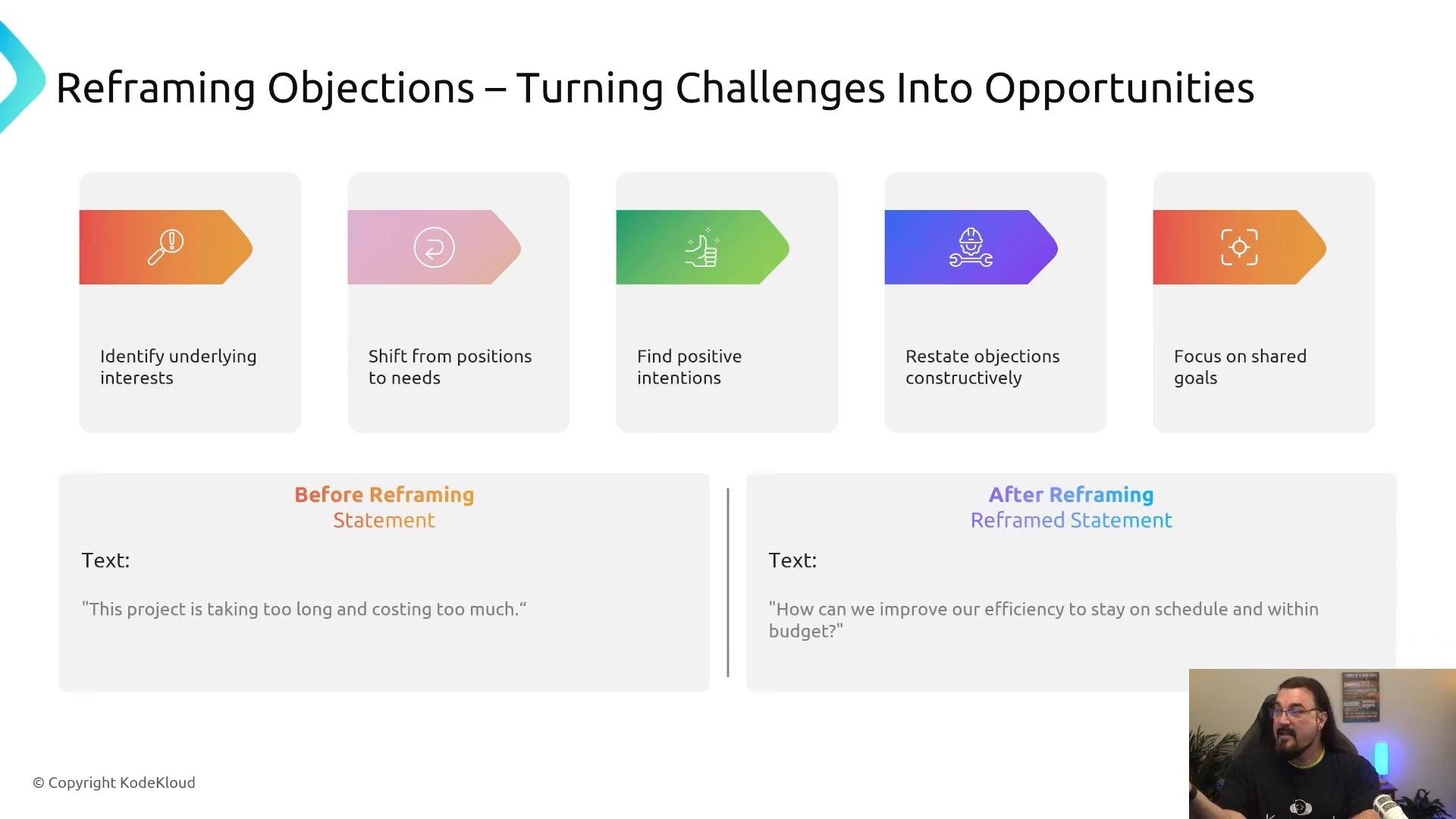 This before-and-after reframing example shows how to move from adversarial positions to collaborative problem statements.
## Align interests by finding shared goals
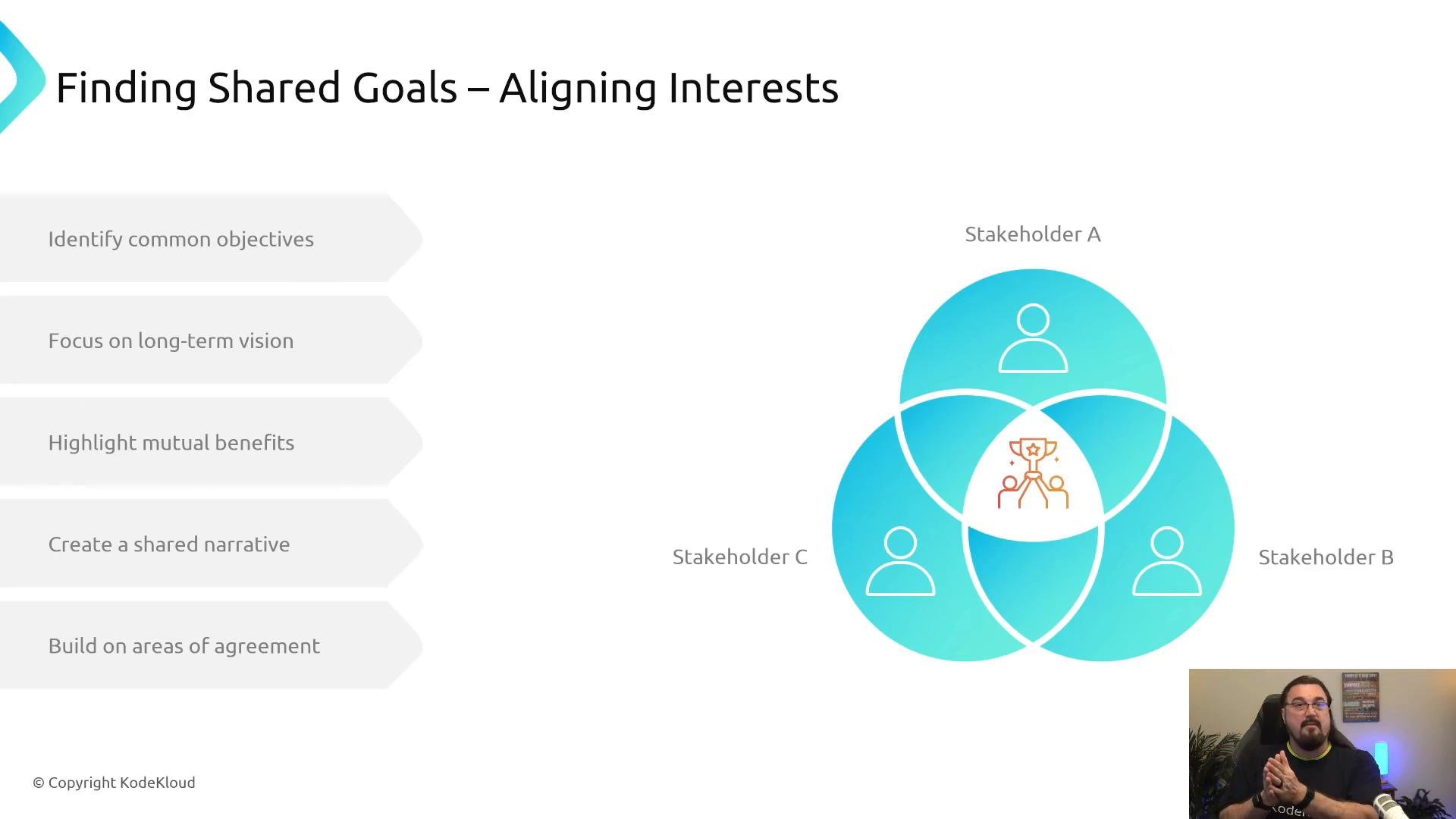
Stakeholders A, B, and C may prioritize different outcomes, but typically there is overlap—improved competitiveness, reduced risk, and higher customer satisfaction are common ground. Build a narrative that highlights how proposed changes advance multiple stakeholder goals.
When an objection arises, look for ways to incorporate the concern into changes that produce shared benefits. Focus on:
* Identifying common objectives
* Emphasizing long-term goals and vision
* Highlighting mutual benefits
* Building on areas of agreement
If everyone agrees the project is important, ask: how can we get it back on track while addressing operational and security concerns, reducing risk, and increasing value?
You do not have to solve this alone.
 ## Co-create solutions and use "yes, and" thinking
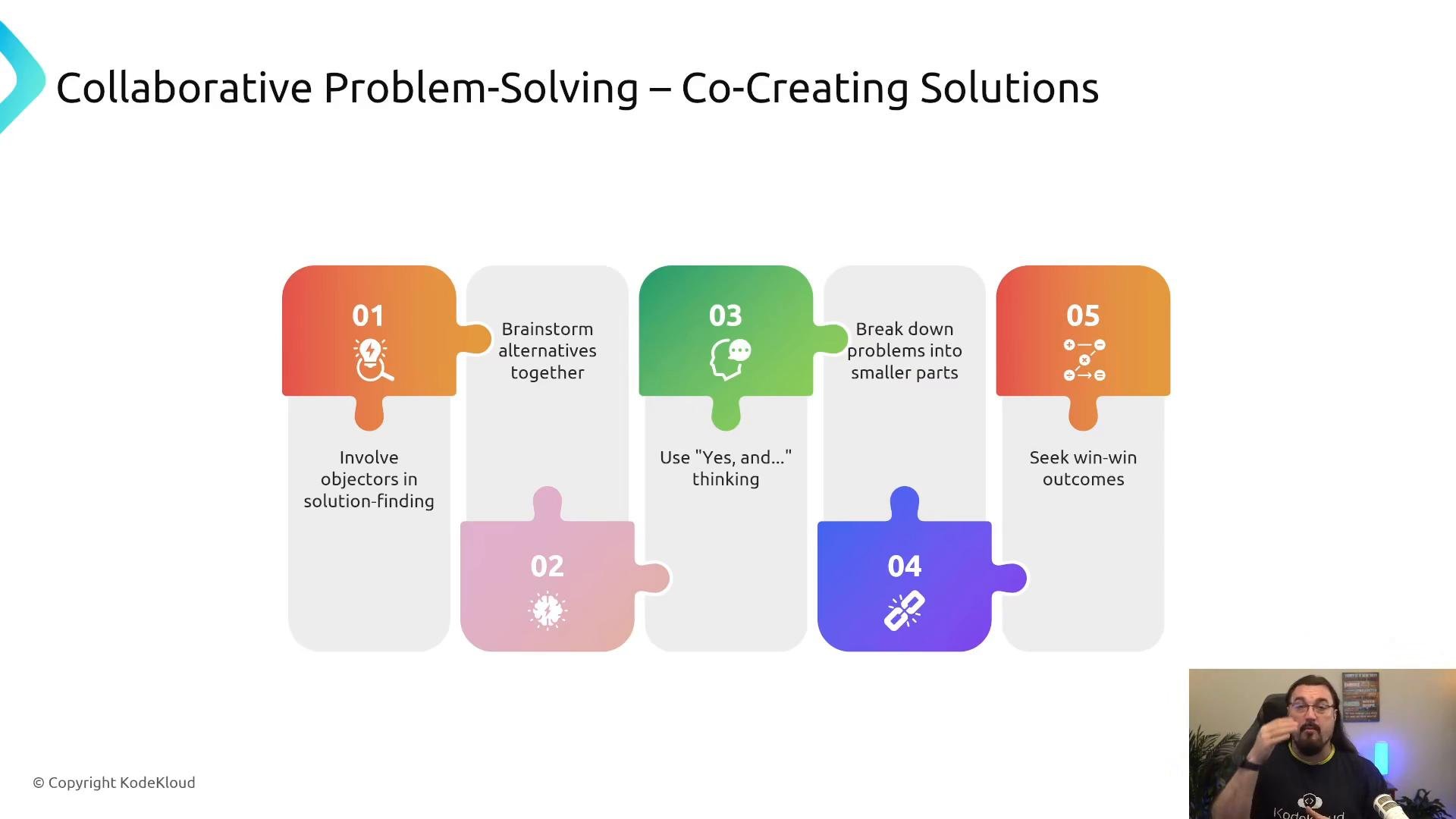
Invite objectors into solution-finding using collaborative techniques:
* Brainstorm alternatives together.
* Partition work into smaller, testable increments.
* Prioritize the stakeholder's most important goal when you can't have everything.
* Use feature flags, prototypes, or proofs-of-concept to reduce perceived risk.
These patterns reduce friction by making trade-offs explicit and testable.
 ## Use the AAP technique: Align, Analyze, Plan
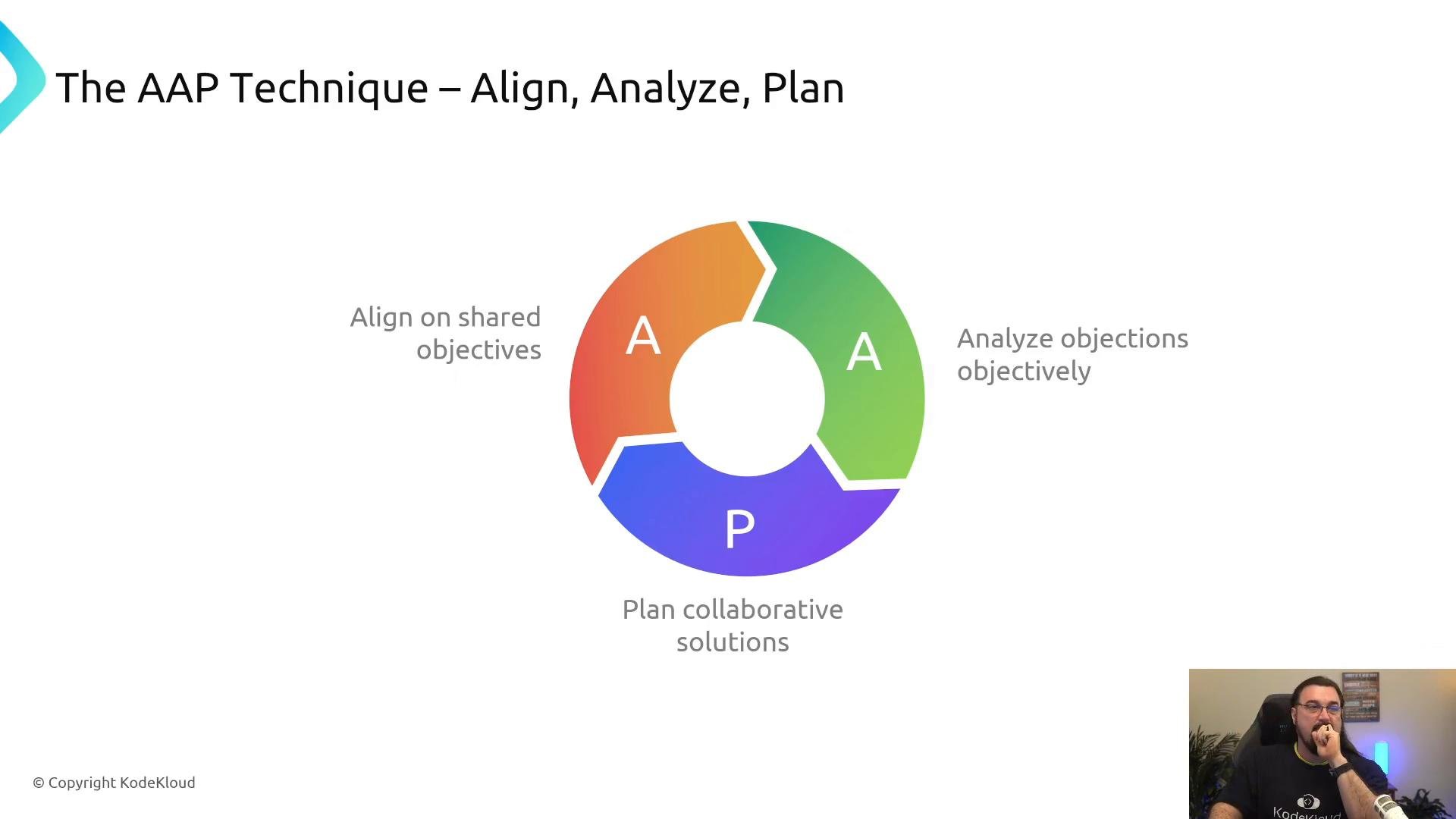
AAP gives a clear, repeatable path from disagreement to action:
* Align: Acknowledge shared objectives and surface assumptions.
* Analyze: Objectively examine the objection and the need behind it (risks, impacts, constraints).
* Plan: Co-design a solution that addresses the need, splits work into increments, and distributes benefits.
This technique helps turn vague objections into measurable acceptance criteria and implementation steps.
 ## Recognize and manage emotions
Emotions can drive objections as strongly as facts do. Manage emotional dynamics to keep the conversation productive:
* Distinguish emotion-driven objections from fact-driven ones.
* Maintain composure; calmness de-escalates, agitation escalates.
* Use "I" statements and empathetic listening: "I hear you. This sounds frustrating. Can we take a short break and come back to discuss the specifics?"
* Give emotional charge time to dissipate, then return to data and trade-offs.
* If anyone feels unsafe or threatened, disengage and escalate.
If you or someone else feels physically threatened or unsafe during a discussion, stop the conversation immediately and involve appropriate support or security. Emotional management techniques are for de-escalation, not for tolerating abuse.
## Advanced techniques to overcome an impasse
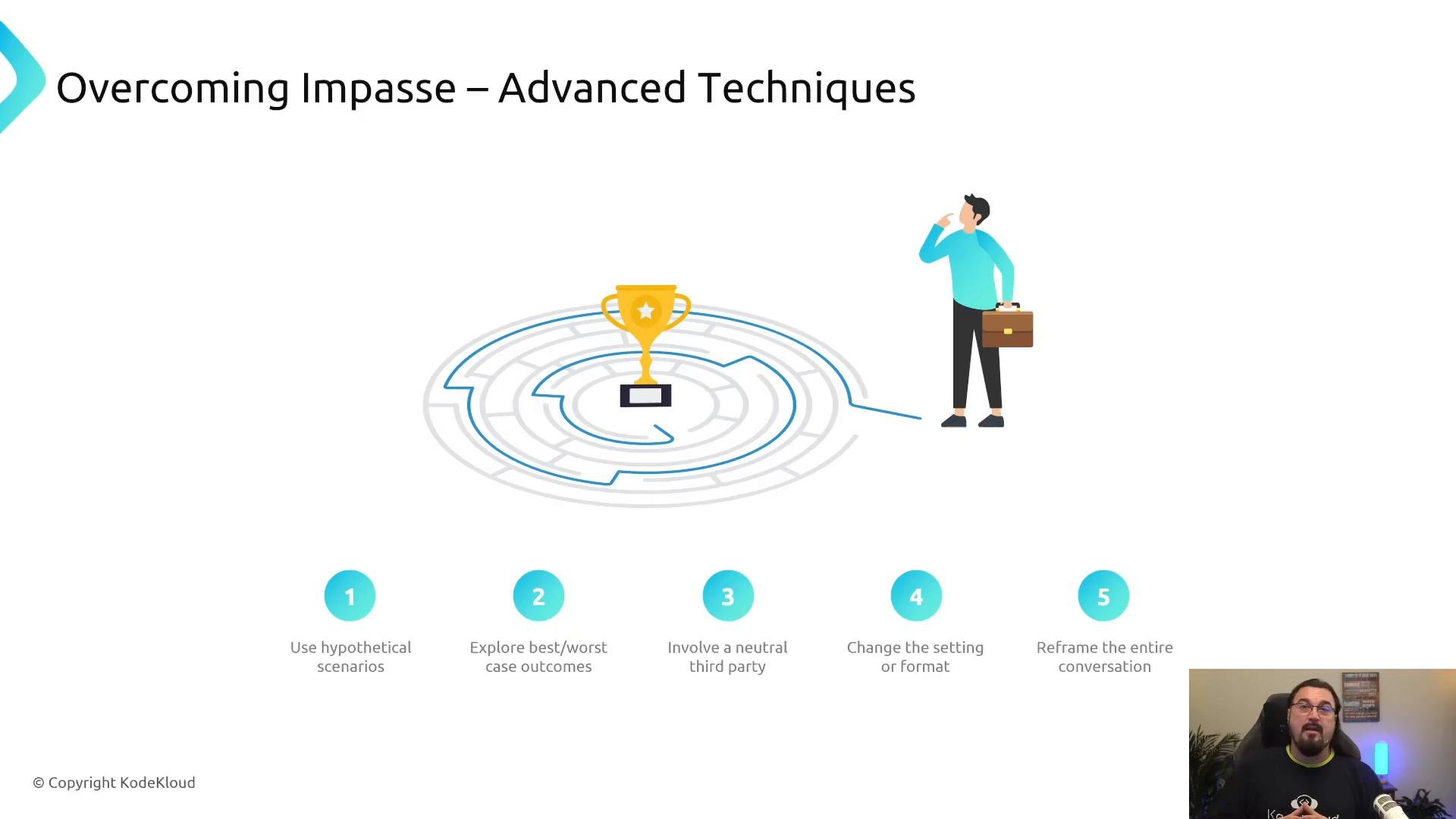
When basic reframing and co-creation stall, try higher-leverage approaches:
* Explore hypothetical scenarios (best- and worst-case) to map trade-offs.
* Bring in a neutral moderator or domain expert to reframe the facts.
* Change the meeting format or setting (e.g., walking meeting, workshop) to alter dynamics.
* Use negotiation tactics: mirroring, labeling, calibrated questions (see Chris Voss / Black Swan Group for applied methods).
 ## Quick reference: When to use each technique
| Situation | Recommended approach |
| - | - |
| Broad, vague objection | Reframe to identify the underlying need; ask clarifying questions |
| Technical risk concern | Propose mitigations (encryption, RBAC, audits) and a prototype |
| Schedule/budget complaint | Partition scope, prioritize MVP, propose time-boxed experiments |
| Emotional escalation | Pause the conversation, use empathetic listening, then refocus |
| Stalemate between stakeholders | Bring a neutral facilitator or domain expert; try hypotheticals |
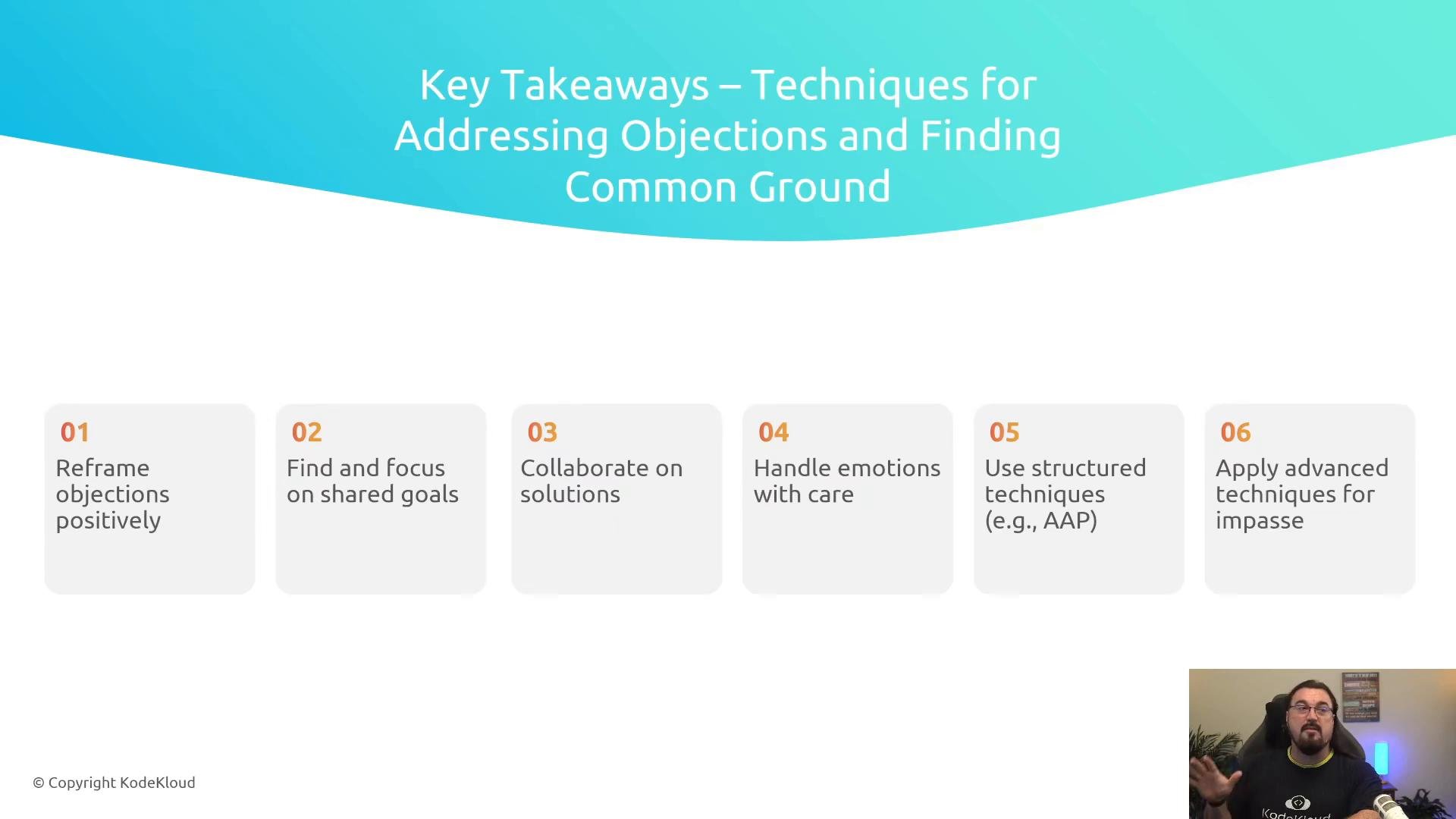
## Key takeaways
1. Reframe objections by identifying the underlying need rather than debating positions.
2. Emphasize common ground and shared goals to align stakeholders.
3. Co-create solutions: brainstorm, break problems into increments, and prioritize.
4. Manage emotions with care: stay professional, present, and de-escalate when needed.
5. Use structured techniques (AAP, mirroring, labeling, reflective listening) to guide the conversation.
6. Apply advanced tactics (hypotheticals, moderators, environment changes) when impasses persist.
 For deeper study, consider extended DevOps soft-skills curricula and negotiation training such as the [Black Swan Group (Chris Voss)](https://www.blackswanltd.com/) to learn practical negotiation tactics and behavior-change techniques.
Thanks for reading.
This documentation is built and hosted on [Mintlify](https://mintlify.com), a developer documentation platform.