> ## Documentation Index
> Fetch the complete documentation index at: https://notes.kodekloud.com/llms.txt
> Use this file to discover all available pages before exploring further.
# Using analogies and metaphors to explain technical concepts
> Guide to using analogies and metaphors to explain technical concepts, with examples, creation steps, pitfalls, and tips for clear, accurate comparisons.
Welcome back. Michael Forrester here — in this lesson we’ll cover how to use analogies and metaphors to translate technical concepts into clear, memorable explanations. This guide focuses on practical techniques you can apply when teaching, presenting, or documenting technical topics so your audience grasps the core idea quickly and retains it longer.
Why use analogies and metaphors?
Analogies and metaphors are storytelling tools that link abstract, unfamiliar technical concepts to everyday experiences. That link speeds comprehension, improves recall, and often increases engagement by creating an emotional or visual association with the idea.
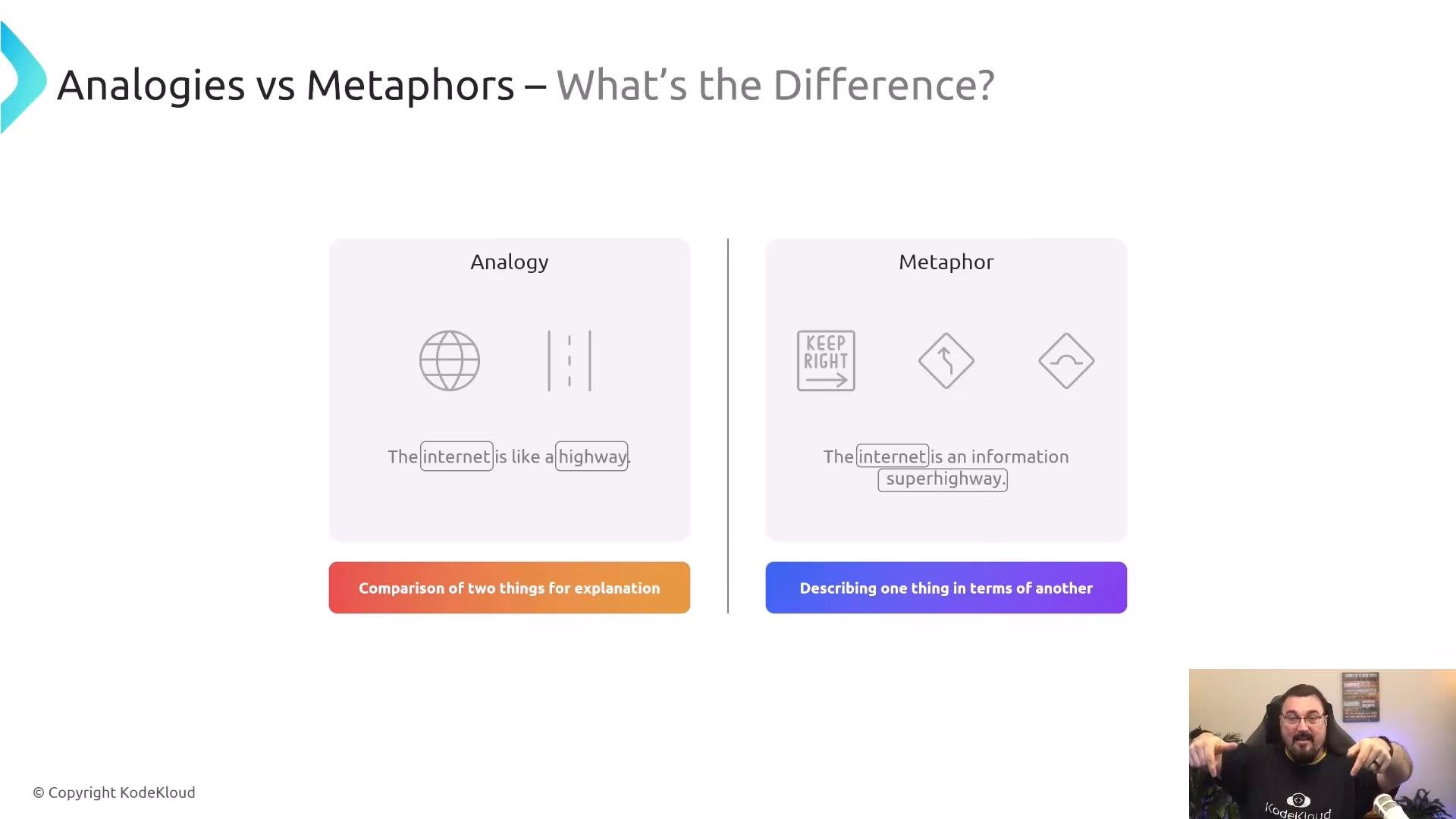
 What’s the difference between an analogy and a metaphor?
* Analogy — explicitly compares two different things to highlight similarities. Often uses “like” or “as.”\
Example: “The internet is like a highway.”
* Metaphor — describes one thing as if it were another; it equates rather than compares.\
Example: “The internet is an information superhighway.”
Both are powerful when used appropriately: analogies signal a comparison between distinct ideas; metaphors invite listeners to think of one concept in terms of another, often more vividly.
 Examples you can use
Use the table below as a quick reference of common analogies and metaphors that map well to technical ideas.
| Type | Examples |
| - | - |
| Analogy (uses “like” / “as”) | The internet is like a highway; A firewall is like a security guard; A CPU is like a brain; Cloud storage is like a virtual filing cabinet; Software updates are like car maintenance |
| Metaphor (uses “is”) | The internet is an information superhighway; Data is the new oil; A computer virus is a silent invader; The cloud is a digital locker |
Quick tip: Phrases with “like” typically indicate analogies; phrases with “is” typically form metaphors.
Choosing effective analogies and metaphors
Good analogies and metaphors:
* Map to your audience’s experience — choose domains they know well.
* Simplify the concept while preserving the core meaning.
* Explicitly state the comparison’s boundaries so listeners don’t overgeneralize.
A simple process to follow:
1. Identify the concept’s essential attributes.
2. Brainstorm familiar domains that share those attributes.
3. Pick the most accurate, relatable parallel.
4. Explain the analogy and call out where it breaks down.
5. Test with representative users and refine.
Choose analogies that map closely to the technical concept and explicitly state where the comparison ends. Doing so reduces misunderstandings and prevents false assumptions.
Common analogies and metaphors used in engineering and operations
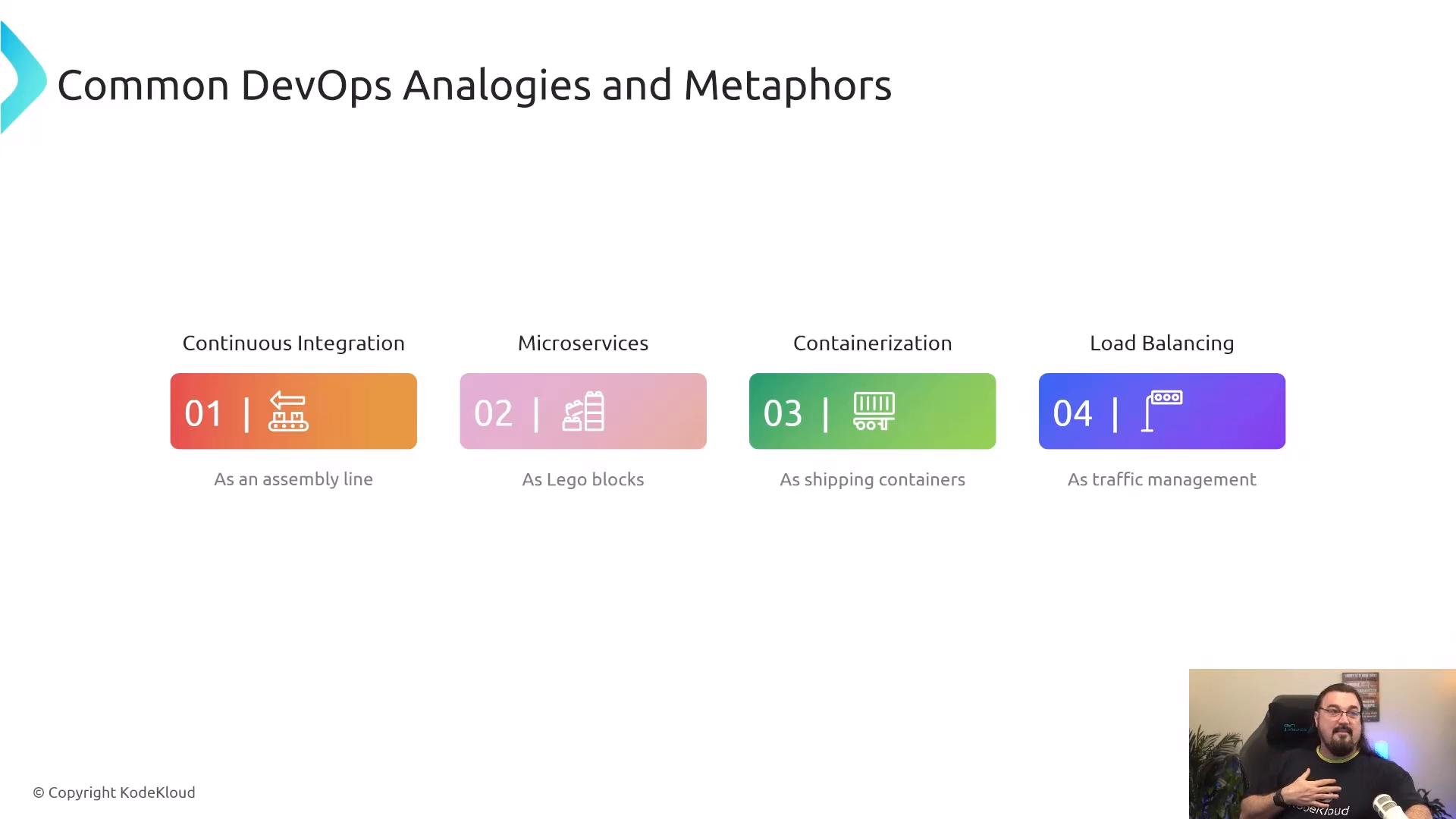
These comparisons are popular because they highlight structure, behavior, or purpose in a relatable way:
* Continuous integration: like an assembly line — small, frequent integrations are assembled and tested continuously.
* Microservices: like Lego blocks — small, interchangeable components that you can combine and reconfigure.
* Containerization: like shipping containers — standardized packaging that isolates contents and makes them portable.
* Load balancing: like traffic management — distributes requests to avoid congestion and improve throughput.
 Creating your own analogies
Follow these steps to craft original, effective comparisons:
1. Identify the key attributes that make the technical concept unique.
2. Brainstorm familiar domains that share those attributes (e.g., cooking, transportation, sports).
3. Select the most accurate and relatable parallel.
4. Explain the analogy and explicitly state its limits.
5. Test it with a sample of your target audience and refine based on feedback.
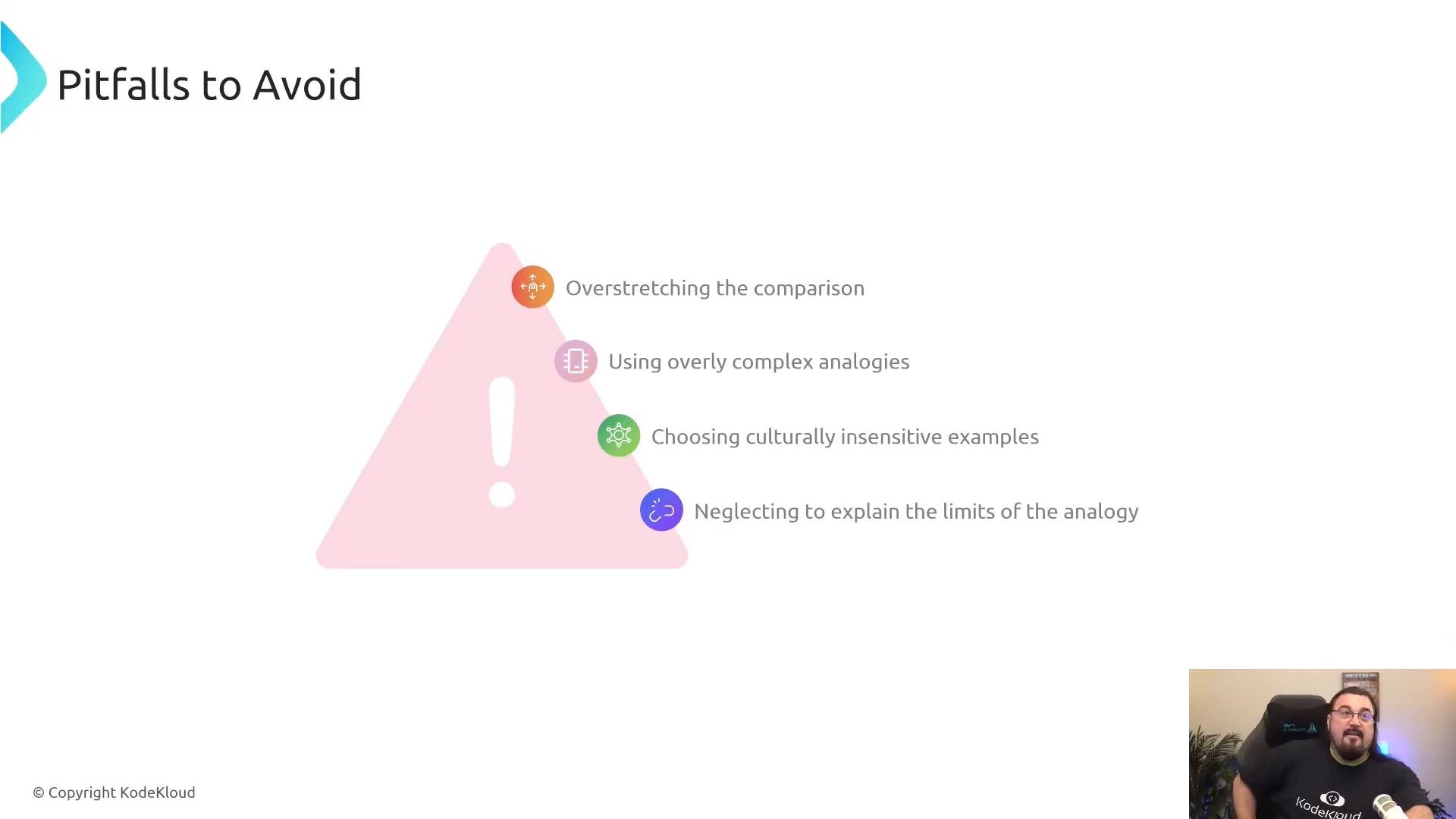
Pitfalls to avoid
* Overextending an analogy so it implies properties the original concept doesn’t have.
* Mixing metaphors, which can create confusion.
* Using culturally insensitive or obscure comparisons.
* Choosing analogies that require more explanation than the concept itself.
 Always state the limits of your analogy. If listeners assume the comparison covers every detail, they may form incorrect mental models.
Key takeaways
* Analogies and metaphors are effective tools for translating complex technical ideas into familiar, memorable terms.
* Select comparisons that are relevant, simple, and accurate for your audience.
* Explicitly note where the analogy breaks down to prevent misconceptions.
* Practice and validate your analogies with real users; refine them based on feedback.
Thanks for reading the lesson.
This documentation is built and hosted on [Mintlify](https://mintlify.com), a developer documentation platform.