> ## Documentation Index
> Fetch the complete documentation index at: https://notes.kodekloud.com/llms.txt
> Use this file to discover all available pages before exploring further.

# Empathy and active listening techniques

> Practical empathy and active listening techniques to build trust, improve communication, and foster collaboration between technical and nontechnical team members.

Welcome back — I'm Michael Forrester. In this lesson we'll deepen our understanding of empathy and active listening techniques, focusing on practical behaviors you can use to make conversations more productive, trust-building, and outcome-driven.

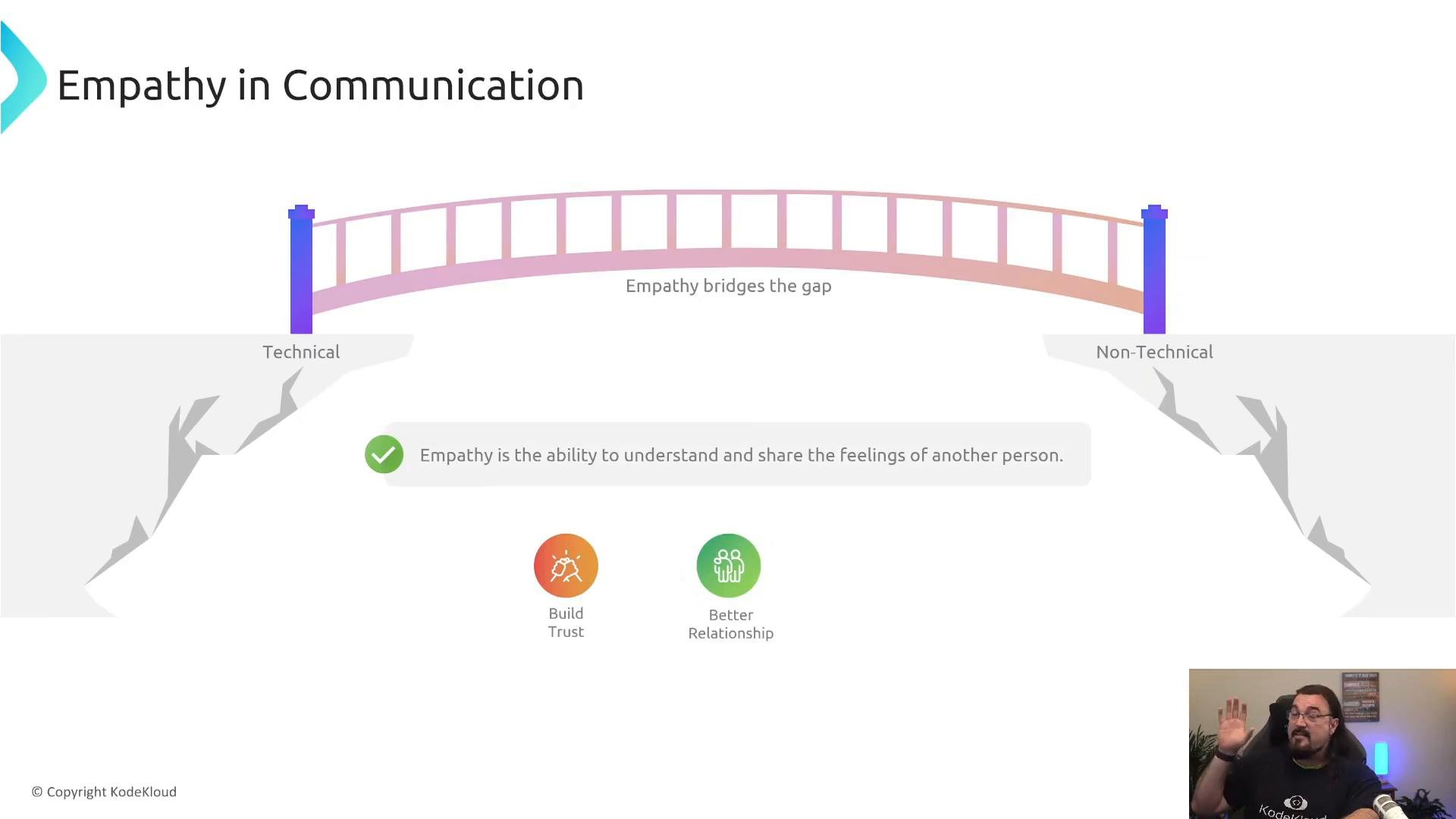
Empathy and clear communication help bridge the gap between technical and non-technical audiences. When you demonstrate that you understand another person’s perspective, you make it easier to translate technical concerns into relatable terms and increase the likelihood that people will listen and collaborate.
<Frame>
  <img src="https://mintcdn.com/kodekloud-c4ac6d9a/Spd9z98HpHg_qvxj/images/DevOps-Soft-Skills-Speaking-Value-to-Non-Technical-Audiences/Understanding-Your-Audience/Empathy-and-active-listening-techniques/empathy-bridges-technical-nontechnical-slide.jpg?fit=max&auto=format&n=Spd9z98HpHg_qvxj&q=85&s=9cfa1534ecc1d08497a091c0a30d32d3" alt="A presentation slide titled &#x22;Empathy in Communication&#x22; showing a colorful bridge labeled &#x22;Empathy bridges the gap&#x22; connecting &#x22;Technical&#x22; and &#x22;Non-Technical&#x22; sides with icons for benefits like building trust and better relationships. In the bottom-right corner a person appears in a small webcam window waving." width="1920" height="1080" data-path="images/DevOps-Soft-Skills-Speaking-Value-to-Non-Technical-Audiences/Understanding-Your-Audience/Empathy-and-active-listening-techniques/empathy-bridges-technical-nontechnical-slide.jpg" />
</Frame>

## What is empathy and why it matters

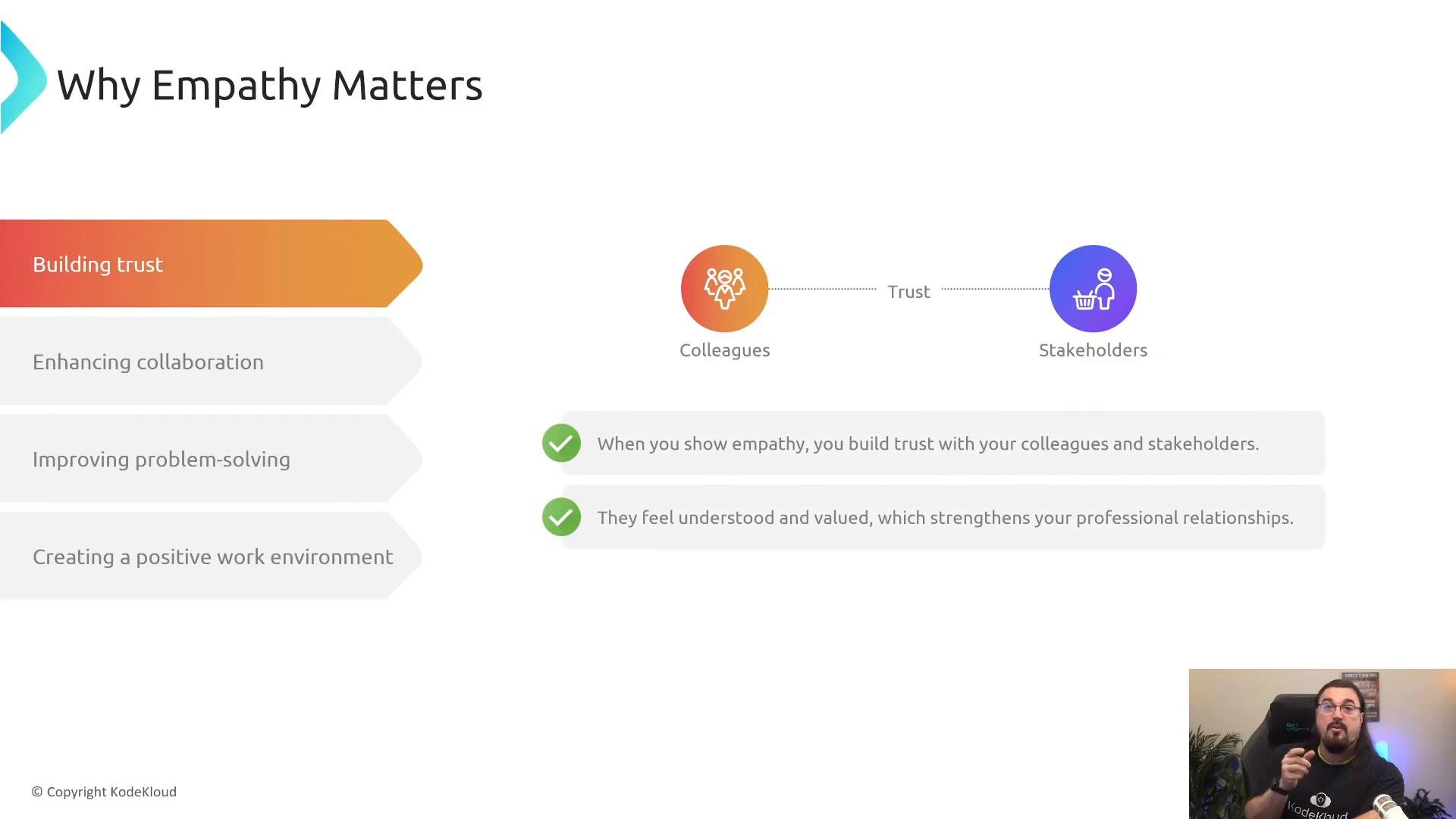
Empathy is the ability to understand and share another person’s feelings and perspective. In professional settings, practicing empathy builds trust, strengthens relationships, and enables better collaboration and decision-making.

When you show empathy you:

* Build trust with colleagues and stakeholders
* Improve teamwork and cross-functional collaboration
* Encourage diverse perspectives that improve problem solving
* Create a safer, more positive work environment that increases engagement and productivity

Showing empathy makes people feel valued and understood, which supports better outcomes and long-term partnerships.
<Frame>
  <img src="https://mintcdn.com/kodekloud-c4ac6d9a/Spd9z98HpHg_qvxj/images/DevOps-Soft-Skills-Speaking-Value-to-Non-Technical-Audiences/Understanding-Your-Audience/Empathy-and-active-listening-techniques/why-empathy-matters-building-trust.jpg?fit=max&auto=format&n=Spd9z98HpHg_qvxj&q=85&s=473e69324741335226af1ff444c3097f" alt="A presentation slide titled &#x22;Why Empathy Matters&#x22; highlighting benefits like &#x22;Building trust&#x22; with icons linking colleagues to stakeholders and check-marked notes about empathy strengthening relationships. A small video thumbnail of a presenter appears in the bottom-right corner." width="1920" height="1080" data-path="images/DevOps-Soft-Skills-Speaking-Value-to-Non-Technical-Audiences/Understanding-Your-Audience/Empathy-and-active-listening-techniques/why-empathy-matters-building-trust.jpg" />
</Frame>

## Active listening: definition and core actions

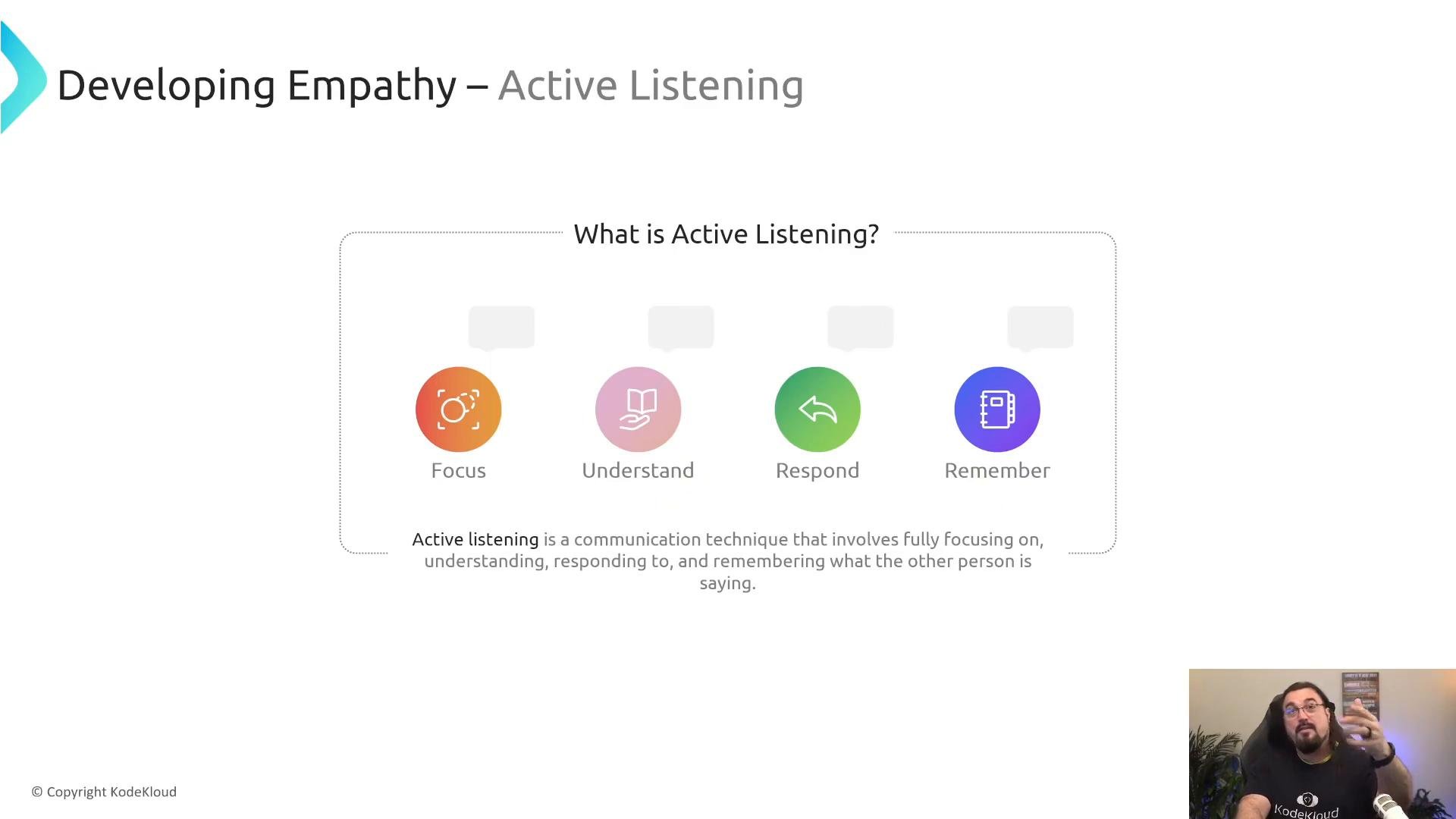
Active listening is a communication skill where you fully focus on, understand, respond to, and remember what the speaker says. It goes beyond hearing words — it signals engagement and understanding.

The four core actions of active listening are:

* Focus — give your full attention to the speaker
* Understand — reflect and clarify to ensure you grasp their meaning
* Respond — provide feedback that demonstrates comprehension
* Remember — retain key points and summarize them for confirmation
<Frame>
  <img src="https://mintcdn.com/kodekloud-c4ac6d9a/Spd9z98HpHg_qvxj/images/DevOps-Soft-Skills-Speaking-Value-to-Non-Technical-Audiences/Understanding-Your-Audience/Empathy-and-active-listening-techniques/active-listening-empathy-slide.jpg?fit=max&auto=format&n=Spd9z98HpHg_qvxj&q=85&s=f63bb9198c1f5d88092ad4c451d97ab2" alt="A presentation slide titled &#x22;Developing Empathy – Active Listening&#x22; showing four icons labeled Focus, Understand, Respond, and Remember, with a brief definition of active listening beneath. A small video thumbnail of a presenter appears in the bottom-right corner." width="1920" height="1080" data-path="images/DevOps-Soft-Skills-Speaking-Value-to-Non-Technical-Audiences/Understanding-Your-Audience/Empathy-and-active-listening-techniques/active-listening-empathy-slide.jpg" />
</Frame>

## Putting active listening into practice

Use these practical behaviors while someone is speaking to show genuine attention and to improve mutual understanding:

* Focus on the person: maintain natural eye contact \~60–70% of the time, nod occasionally, and avoid appearing distracted.
* Reflect and paraphrase: restate what you heard in your own words. Example: “So what I hear you saying is that this spreadsheet will be important for the next phase of development.”
* Clarify: ask targeted questions when something is unclear. Example: “When you say we’re not active in that area, do you mean we’ve never worked there or that it’s deprioritized?”
* Summarize: recap the speaker’s main points to confirm understanding: “To summarize, you want to use this as an infographic to categorize strategy.”
* Use nonverbal signals: facial expressions, posture, tone of voice, and small gestures like thumbs-up in remote meetings reinforce engagement.

Nonverbal cues are often as informative as the words themselves, so align your body language with the message you want to send.
<Frame>
  <img src="https://mintcdn.com/kodekloud-c4ac6d9a/Spd9z98HpHg_qvxj/images/DevOps-Soft-Skills-Speaking-Value-to-Non-Technical-Audiences/Understanding-Your-Audience/Empathy-and-active-listening-techniques/developing-empathy-imagine-perspective.jpg?fit=max&auto=format&n=Spd9z98HpHg_qvxj&q=85&s=3a91a3d04b67c8dfe1cd87600a944b6e" alt="A presentation slide titled &#x22;Developing Empathy — Imagine Their Perspective&#x22; showing two stylized user icons with thought bubbles and prompts about imagining the other person's viewpoint. A small video of a presenter appears in the bottom-right corner." width="1920" height="1080" data-path="images/DevOps-Soft-Skills-Speaking-Value-to-Non-Technical-Audiences/Understanding-Your-Audience/Empathy-and-active-listening-techniques/developing-empathy-imagine-perspective.jpg" />
</Frame>

## Put yourself in their shoes

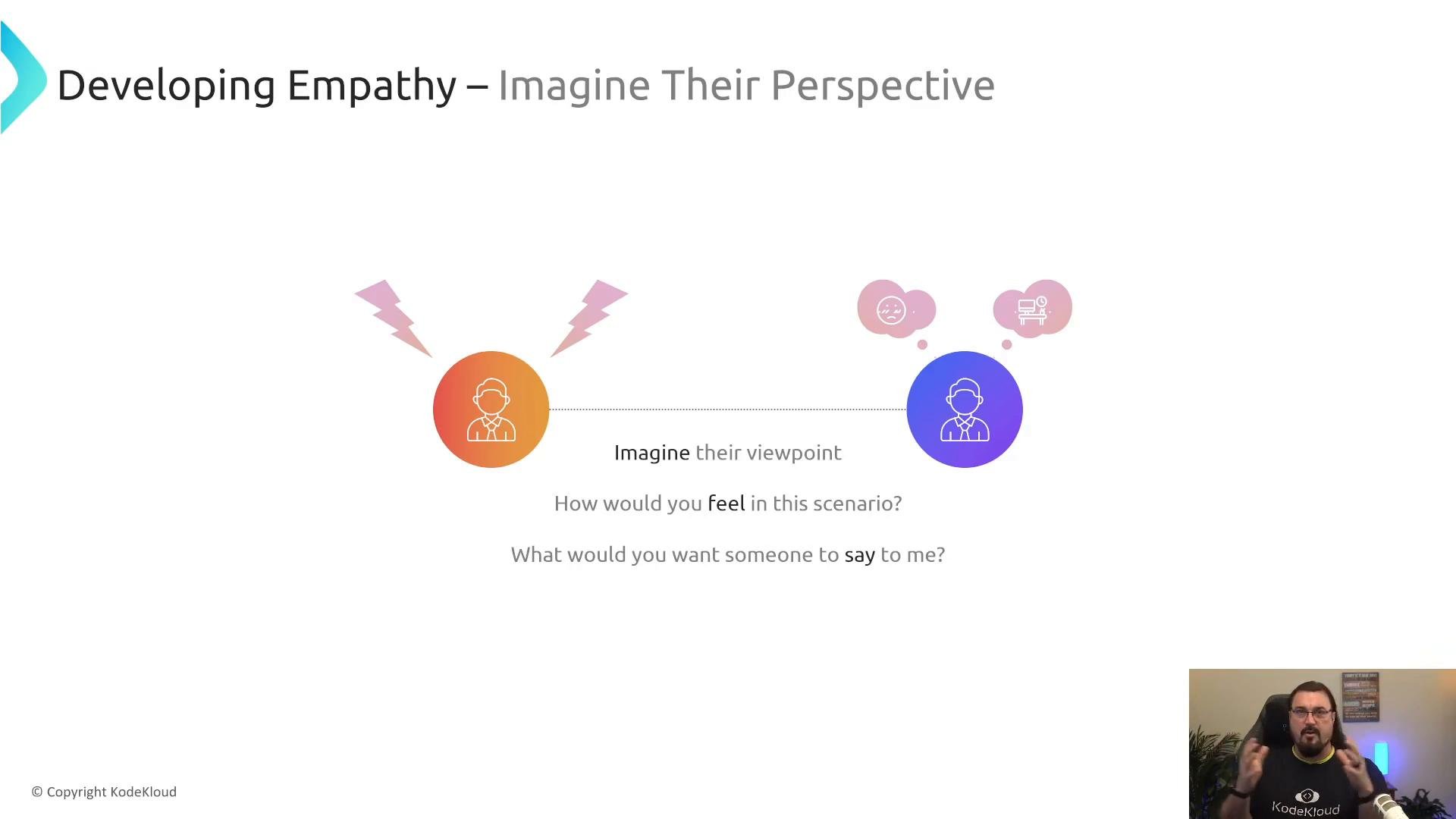
Imagining the other person’s perspective helps you ask questions that align with their priorities. Before or during a conversation, consider:

* Who is this person and what is their role?
* What outcomes matter most to them?
* How would I feel in their situation?

Use that viewpoint to tailor your questions and responses. Example question: “Do you want to use this for strategy?” — this checks assumptions and signals understanding.
<Frame>
  <img src="https://mintcdn.com/kodekloud-c4ac6d9a/Spd9z98HpHg_qvxj/images/DevOps-Soft-Skills-Speaking-Value-to-Non-Technical-Audiences/Understanding-Your-Audience/Empathy-and-active-listening-techniques/developing-empathy-talk-listen-slide.jpg?fit=max&auto=format&n=Spd9z98HpHg_qvxj&q=85&s=363b8a70de035333f0cca9b8e62841e3" alt="A presentation slide titled &#x22;Developing Empathy – Show Genuine Interest and Reactions&#x22; showing an orange icon for a person talking and a purple icon for a person listening with speech bubbles like &#x22;Can you tell me more?&#x22;. In the lower-right corner a presenter is visible speaking into a microphone." width="1920" height="1080" data-path="images/DevOps-Soft-Skills-Speaking-Value-to-Non-Technical-Audiences/Understanding-Your-Audience/Empathy-and-active-listening-techniques/developing-empathy-talk-listen-slide.jpg" />
</Frame>

## Be genuine

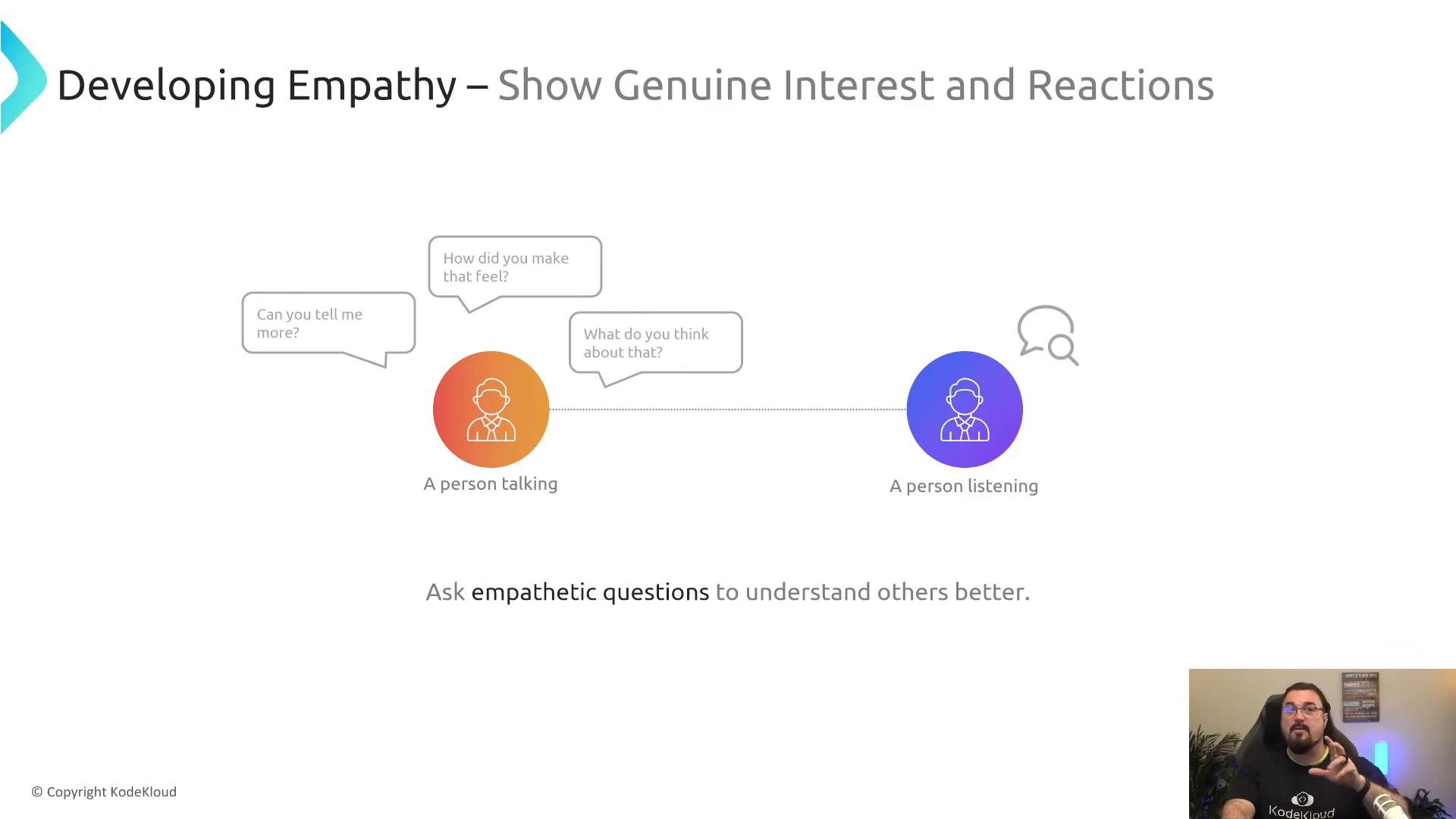
Only use empathetic techniques when you truly care about the conversation. If you are engaged, ask open-ended questions such as “Can you tell me more?” or “What do you think about that?” If you cannot engage authentically, it’s better to be honest or respectfully excuse yourself than to feign interest.

<Callout icon="warning" color="#FF6B6B">
  Do not fake interest. If you cannot engage genuinely, be honest about it or excuse yourself rather than using empathetic techniques insincerely.
</Callout>

## Where to apply empathy and active listening

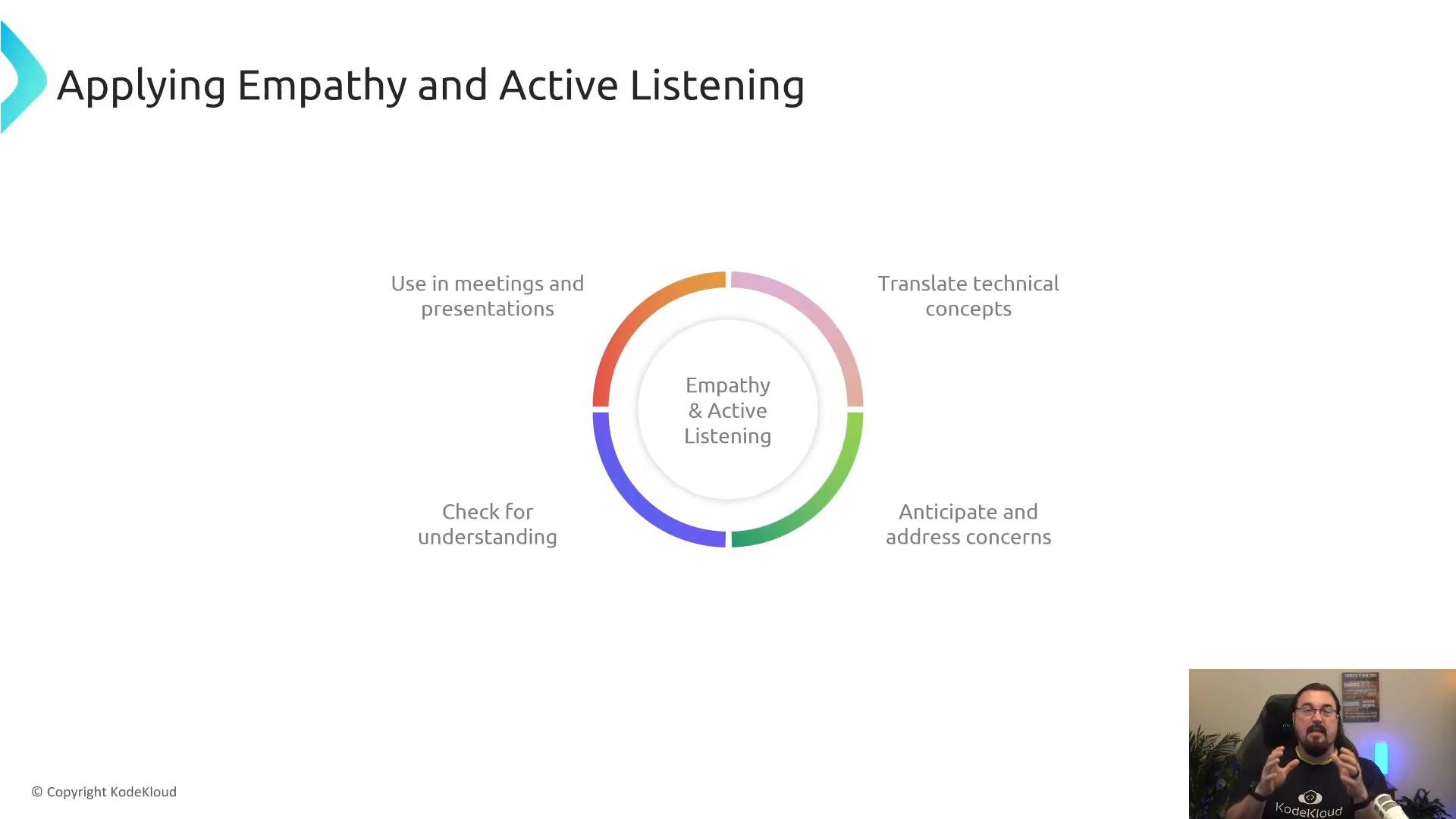
Apply these skills across everyday professional contexts:

| Situation | How to apply empathy & active listening |
| - | - |
| Meetings & presentations | Translate technical concepts into terms the audience cares about; check for understanding frequently |
| One-on-one conversations | Anticipate concerns, validate feelings, and address issues before they escalate |
| Cross-functional work | Confirm shared goals, clarify assumptions, and align priorities early |

Active engagement is a two-way process: express yourself clearly and receive information actively.
<Frame>
  <img src="https://mintcdn.com/kodekloud-c4ac6d9a/Spd9z98HpHg_qvxj/images/DevOps-Soft-Skills-Speaking-Value-to-Non-Technical-Audiences/Understanding-Your-Audience/Empathy-and-active-listening-techniques/empathy-active-listening-presentation-slide.jpg?fit=max&auto=format&n=Spd9z98HpHg_qvxj&q=85&s=5ce12515c9c23f04fd45a3a4a077bf28" alt="A presentation slide titled &#x22;Applying Empathy and Active Listening&#x22; with a colorful circular diagram showing segments like &#x22;Use in meetings and presentations,&#x22; &#x22;Translate technical concepts,&#x22; &#x22;Anticipate and address concerns,&#x22; and &#x22;Check for understanding.&#x22; A small video inset of a presenter appears in the bottom-right corner." width="1920" height="1080" data-path="images/DevOps-Soft-Skills-Speaking-Value-to-Non-Technical-Audiences/Understanding-Your-Audience/Empathy-and-active-listening-techniques/empathy-active-listening-presentation-slide.jpg" />
</Frame>

## Be aware of bias

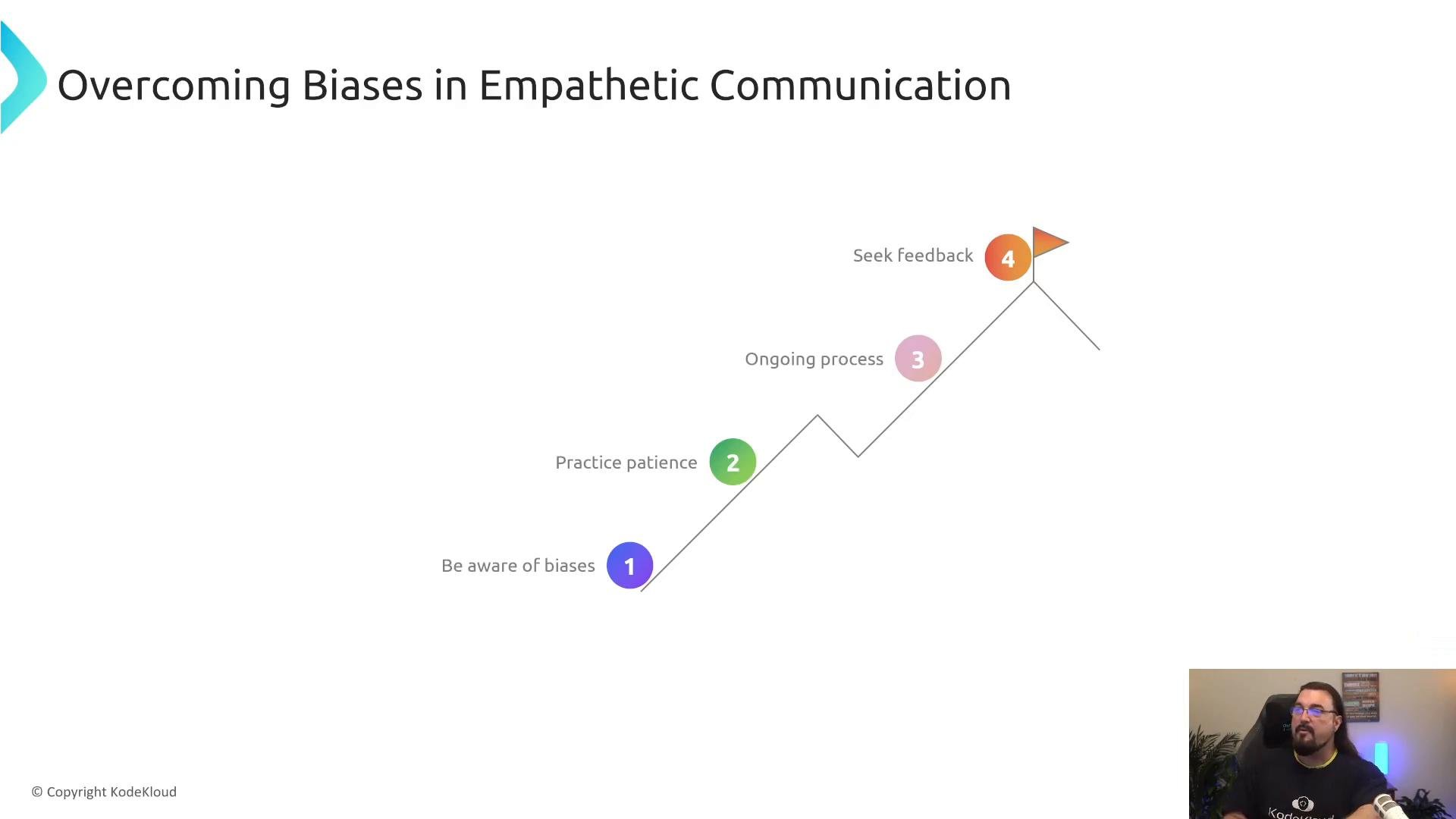
Biases can disrupt empathy. Watch for cultural bias, groupthink, interpersonal conflicts, and snap judgments. Practice patience, avoid assuming motives, and solicit feedback frequently. If you have unresolved conflict with someone, address it privately and respectfully rather than letting it undermine listening.

Judgment and dismissiveness block empathy. If you catch yourself thinking someone is “stupid” or “wrong,” acknowledge that reaction and intentionally refocus on understanding their viewpoint.
<Frame>
  <img src="https://mintcdn.com/kodekloud-c4ac6d9a/Spd9z98HpHg_qvxj/images/DevOps-Soft-Skills-Speaking-Value-to-Non-Technical-Audiences/Understanding-Your-Audience/Empathy-and-active-listening-techniques/overcoming-biases-empathetic-communication-slide.jpg?fit=max&auto=format&n=Spd9z98HpHg_qvxj&q=85&s=c152ca3e278456328d0a0d0509baa2b5" alt="A presentation slide titled &#x22;Overcoming Biases in Empathetic Communication&#x22; showing a four-step upward diagram: 1 Be aware of biases, 2 Practice patience, 3 Ongoing process, and 4 Seek feedback. A small webcam view of a presenter appears in the lower-right corner." width="1920" height="1080" data-path="images/DevOps-Soft-Skills-Speaking-Value-to-Non-Technical-Audiences/Understanding-Your-Audience/Empathy-and-active-listening-techniques/overcoming-biases-empathetic-communication-slide.jpg" />
</Frame>

## Quick checklist: Practice empathy and active listening

* Reflect and paraphrase what you hear
* Ask open-ended, clarifying questions
* Use nonverbal signals to show engagement
* Imagine the other person’s mindset and priorities
* Listen to understand, not to respond

Summary
Listening well is often more important than speaking. Seek to understand first; trust, alignment, and better outcomes follow.

Further reading and references

* [Nonviolent Communication](https://www.cnvc.org/) — principles for empathetic dialogue
* [Active Listening Techniques (MindTools)](https://www.mindtools.com/CommSkll/ActiveListening.htm) — practical listening strategies
* \[How to Win Friends and Influence People]\([https://www.dale](https://www.dale) Carnegie.com/) — classic resource on interpersonal influence

Thanks for reading — I’m Michael Forrester.

<CardGroup>
  <Card title="Watch Video" icon="video" cta="Learn more" href="https://learn.kodekloud.com/user/courses/devops-soft-skills-speaking-value-to-non-technical-audiences/module/7daef647-d312-4194-9b99-68d868b96e13/lesson/18ee91e6-837d-4d5c-907b-fd0c29ab5de4" />
</CardGroup>


This documentation is built and hosted on [Mintlify](https://mintlify.com), a developer documentation platform.