> ## Documentation Index
> Fetch the complete documentation index at: https://notes.kodekloud.com/llms.txt
> Use this file to discover all available pages before exploring further.
# Vulnerabilities Basics
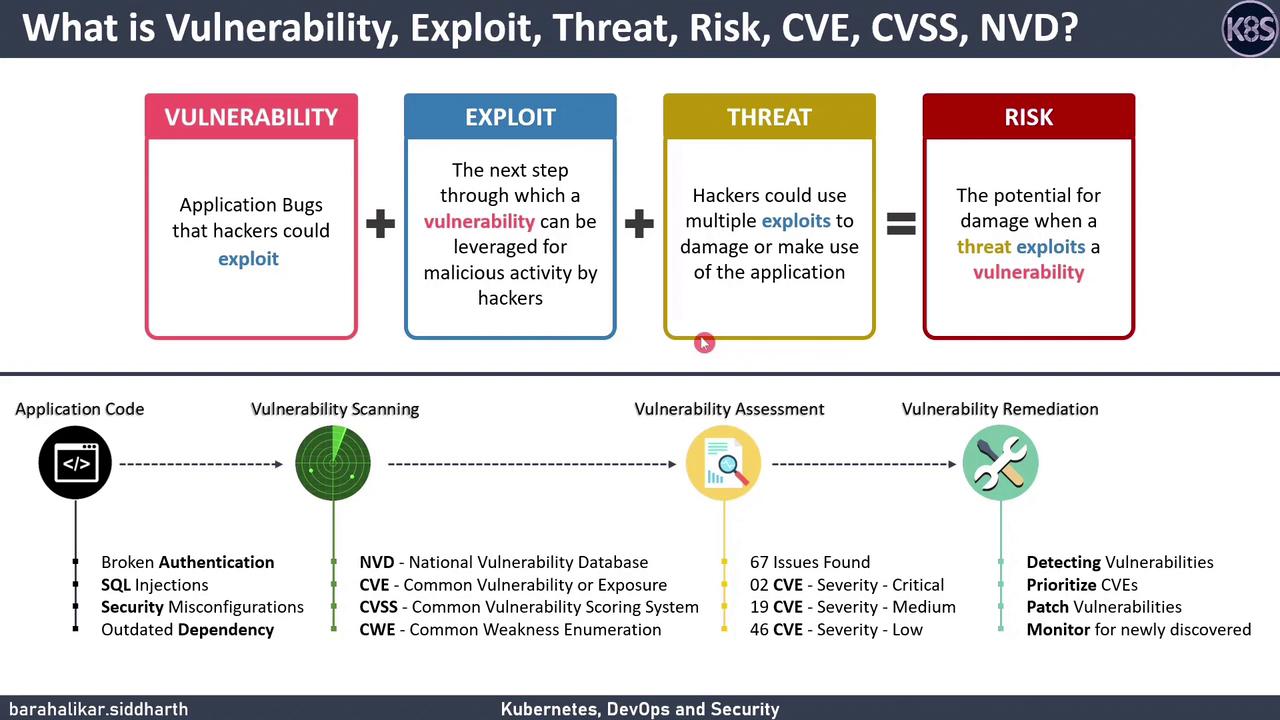
> This lesson defines vulnerabilities and explores their relationship to exploits, threats, and risks while outlining a process for scanning, assessing, and remediating them.
In this lesson, we’ll define vulnerabilities, explore their relationship to exploits, threats, and risks, and walk through a standard process for scanning, assessing, and remediating them. Future modules will provide hands-on examples using tools like [Dependency Check](https://owasp.org/www-project-dependency-check/), [Trivy](https://github.com/aquasecurity/trivy), [OPA Conftest](https://www.conftest.dev/), and [Kubesec](https://kubesec.io/) to secure application code, container images, and Kubernetes resources.
***
## Key Concepts
| Term | Definition | Example |
| ------------- | ----------------------------------------------------------------------------------------------------------- | ------------------------------------------- |
| Vulnerability | A flaw or bug in software that attackers can exploit. | SQL injection, broken authentication |
| Exploit | A script or technique that takes advantage of a vulnerability to perform malicious activity. | Remote code execution, unauthorized mining |
| Threat | Any potential cause of an unwanted security incident, such as an attacker or malware. | Phishing campaign, zero-day malware |
| Risk | The potential for loss or damage when a threat exploits a vulnerability. Calculated by severity and impact. | High-severity CVE in production environment |
A robust vulnerability management program reduces the window of exposure and lowers the overall security risk to your applications and infrastructure.
***
## Vulnerability Scanning & Databases
Vulnerability scanners inspect code, container images, and configuration files, then compare findings against public vulnerability repositories. Once confirmed, issues are catalogued with unique identifiers.
| Database / System | Description |
| ----------------------------------- | -------------------------------------------------------------------------------------------------- |
| [NVD](https://nvd.nist.gov/) | The U.S. government’s repository of publicly disclosed vulnerabilities. |
| [CVE](https://cve.mitre.org/) | Unique IDs for known cybersecurity flaws (e.g., CVE-2021-34527). |
| [CVSS](https://www.first.org/cvss/) | A scoring framework (0–10) that measures vulnerability severity and potential impact. |
| [CWE](https://cwe.mitre.org/) | A taxonomy of software weaknesses, helping teams understand root causes and prevention strategies. |
***
## Vulnerability Assessment
Once scanning completes, generate an assessment report that includes:
* **Severity**: CVSS score or custom risk rating
* **Vulnerability Age**: Time since public disclosure
* **Exploit Availability**: Whether proof-of-concept code exists
* **Remediation Guidance**: Patching instructions or workarounds
Always address high-severity vulnerabilities with known exploits before lower-risk items. Automate prioritization using your CI/CD pipeline.
***
## Remediation Workflow
1. **Prioritize**
* Rank CVEs by CVSS score, exploitability, and business impact.
2. **Remediate**
* Update or patch affected dependencies and configurations.
* Apply security fixes in code and container images.
3. **Verify & Monitor**
* Re-scan to confirm fixes.
* Implement continuous monitoring and alerting for new vulnerabilities.
***
***
## Next Steps
In the following lessons, you’ll perform real-world vulnerability scans and enforce security policies using:
* [Dependency Check](https://owasp.org/www-project-dependency-check/) for open-source libraries
* [Trivy](https://github.com/aquasecurity/trivy) for container and filesystem scanning
* [OPA Conftest](https://www.conftest.dev/) to test your Kubernetes manifests
* [Kubesec](https://kubesec.io/) for policy checks in Kubernetes
By integrating these tools into your DevSecOps pipeline, you’ll streamline the detection and remediation of security issues from code commit to production.