> ## Documentation Index
> Fetch the complete documentation index at: https://notes.kodekloud.com/llms.txt
> Use this file to discover all available pages before exploring further.
# Welcome and Course Introduction
> This course covers best practices for DevSecOps on Kubernetes, including environment setup, pipeline building, and advanced security techniques.
Hello, and welcome to the **Kubernetes DevOps and Security** course. In this lesson, we’ll cover the best practices for **DevSecOps** on Kubernetes. I’m Siddharth Barahalikar, your instructor for this journey.
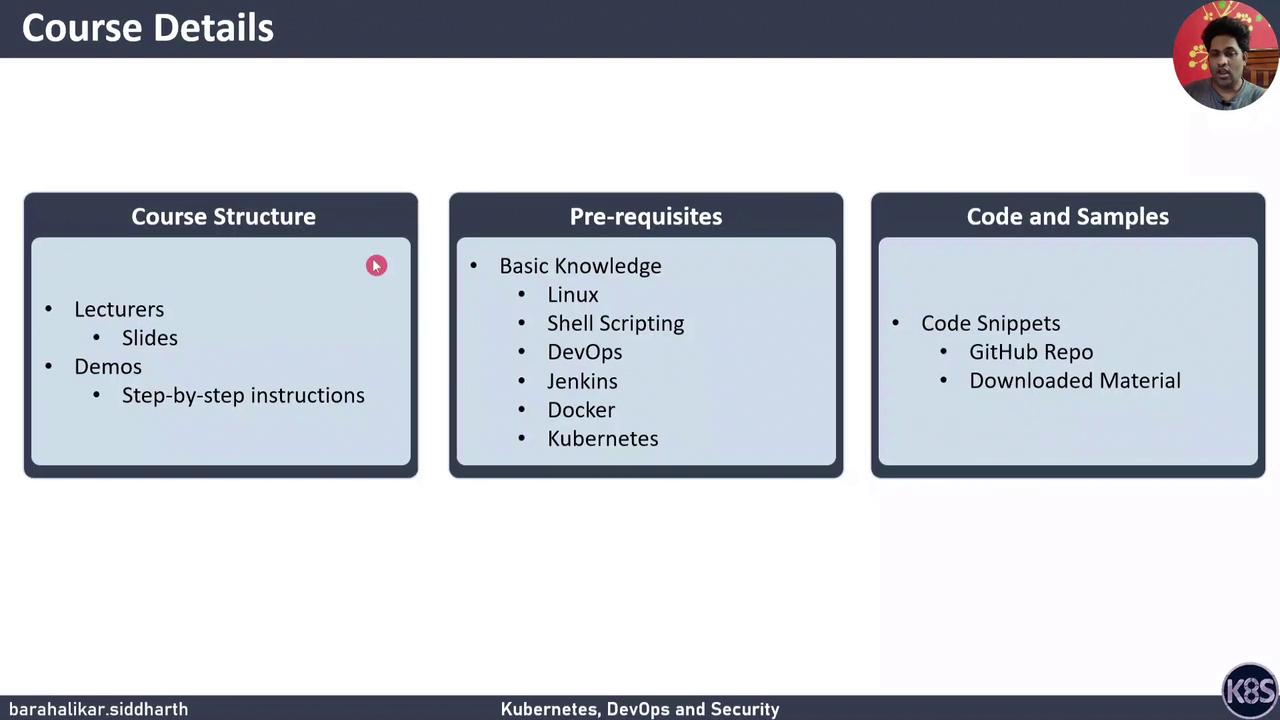
Before we dive in, make sure you have:
* Basic experience with Jenkins, Linux, shell scripting, and DevOps workflows
* Familiarity with Kubernetes and Docker
You should already have:
* A working shell environment
* A Docker installation
* Access to a Kubernetes cluster or the ability to provision one
All example code is hosted on GitHub and available for download.
***
## Course Objectives
We’ve structured this course into four focused sections. Each section begins with an animated slide overview, followed by hands-on demonstrations you can follow at your own pace.
| Section | Focus | Key Deliverables |
| ------- | ----------------------------- | -------------------------------------------------- |
| **1** | Introduction to DevSecOps | Definition, SDLC integration, tools overview |
| **2** | Environment Setup & Pipelines | Cloud environment, tool installs, basic CI/CD |
| **3** | Building a DevSecOps Pipeline | Security checks, notifications, pipeline expansion |
| **4** | Advanced Kubernetes Security | Policy enforcement, monitoring, service mesh |
***
### Section 1: Introduction to DevSecOps
In this section, we’ll define **DevSecOps**, explore its role in modern software delivery, and review the core tools and concepts used throughout the course.
***
### Section 2: Environment Setup and Simple DevOps Pipeline
We’ll set up your development environment in the cloud, install the necessary tools, deploy a Kubernetes cluster, and create a basic CI/CD pipeline using Jenkins.
***
### Section 3: Building a DevSecOps Pipeline
You’ll learn how to incorporate security checks and notifications into your workflow and extend the pipeline to handle more comprehensive automation.
***
### Section 4: Advanced Kubernetes Security
In the final section, we’ll cover advanced topics such as promoting workloads through different environments with enforced policies, monitoring and threat detection, and securing service-to-service communication with a service mesh.
***
#### Next Steps and Additional Content
Future updates will introduce more advanced topics like runtime security and policy enforcement. Each chapter includes:
* An animated slide overview
* Live demonstration lectures
* Hands-on exercises
All resources and code samples are available on GitHub. If you have questions, reach out via our support channels.
Let’s get started!
***
## Links and References
* [Azure Free Account](https://azure.microsoft.com/free)
* [Kubernetes Documentation](https://kubernetes.io/docs/)
* [Jenkins](https://www.jenkins.io/)
* [GitHub Repository](https://github.com/your-org/devsecops-kubernetes-course)