> ## Documentation Index
> Fetch the complete documentation index at: https://notes.kodekloud.com/llms.txt
> Use this file to discover all available pages before exploring further.
# Istio Basics
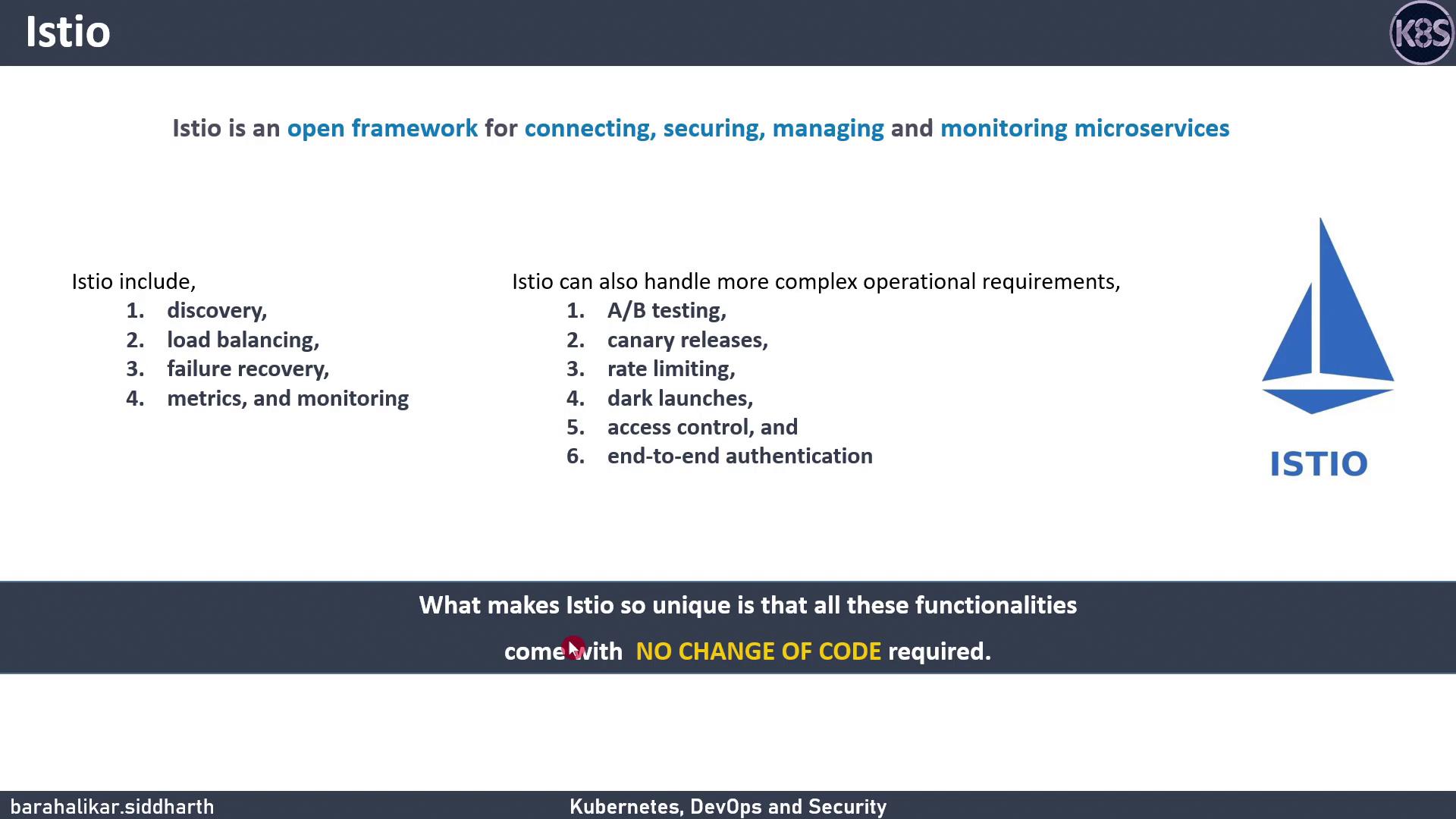
> Istio is an open-source service mesh that simplifies connecting, securing, managing, and monitoring microservices.
Istio is an open-source service mesh that simplifies connecting, securing, managing, and monitoring microservices. With Istio, you get:
* Automated **service discovery**, **load balancing**, and **failure recovery**
* Fine-grained **traffic control** for A/B testing, canary releases, and rate limiting
* **End-to-end security** with mutual TLS, policy enforcement, and telemetry
* Zero or minimal changes to application code
Istio works transparently alongside any application stack (Spring Boot, Node.js, Vert.x, etc.) by injecting an Envoy sidecar proxy into each pod.
## Architecture Overview
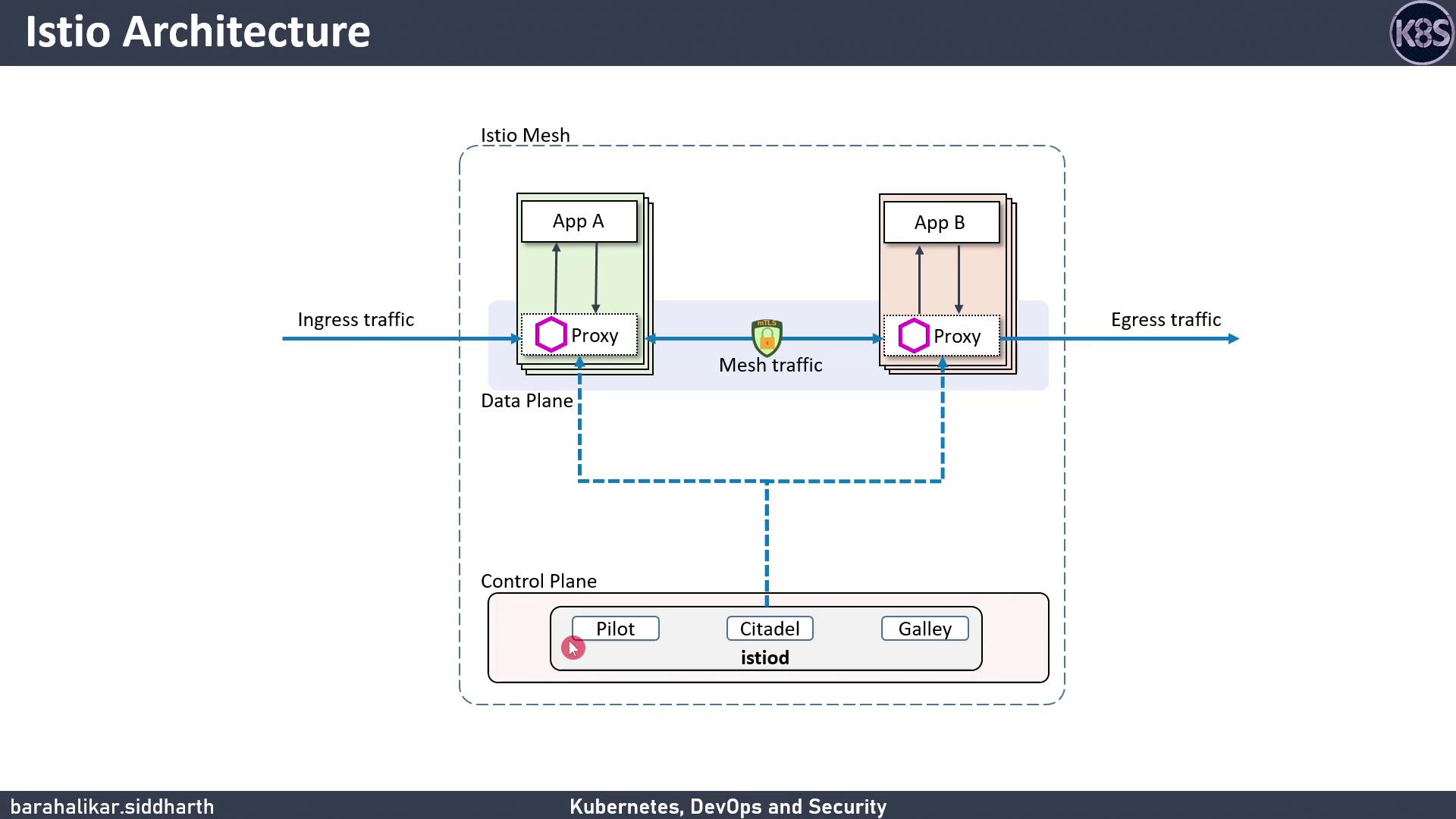
Istio’s design is split into two planes:
* **Data Plane**\
Consists of Envoy sidecar proxies that run next to application containers. They intercept all inbound/outbound traffic, enabling metrics collection, policy enforcement, and traffic routing.
* **Control Plane**\
Configures and manages the proxies, distributing routing rules, certificates, and configuration to ensure consistent behavior across the mesh.
Envoy is a high-performance proxy written in C++ that mediates all service-to-service communication within the mesh.
### Control Plane Components
| Component | Responsibility | Reference |
| --------- | -------------------------------------------------- | --------------------------------------------------------------------------- |
| Pilot | Service discovery, traffic management & routing | [Pilot Docs](https://istio.io/latest/docs/reference/commands/pilot/) |
| Citadel | mTLS-based authentication & certificate issuance | [Citadel Docs](https://istio.io/latest/docs/tasks/security/authentication/) |
| Galley | Configuration ingestion, validation & distribution | [Galley Docs](https://istio.io/latest/docs/reference/config/galley/) |
In Istio 1.5+, Galley and Pilot components were merged into `istiod`. Be sure to check your Istio version and configuration model.
## Sidecar Proxy Pattern
When you deploy Istio, each application pod includes an Envoy sidecar. The sidecar:
1. **Intercepts** all network traffic to/from the application
2. **Forwards** requests to the application container and relays responses
3. **Encrypts** traffic between pods using mutual TLS
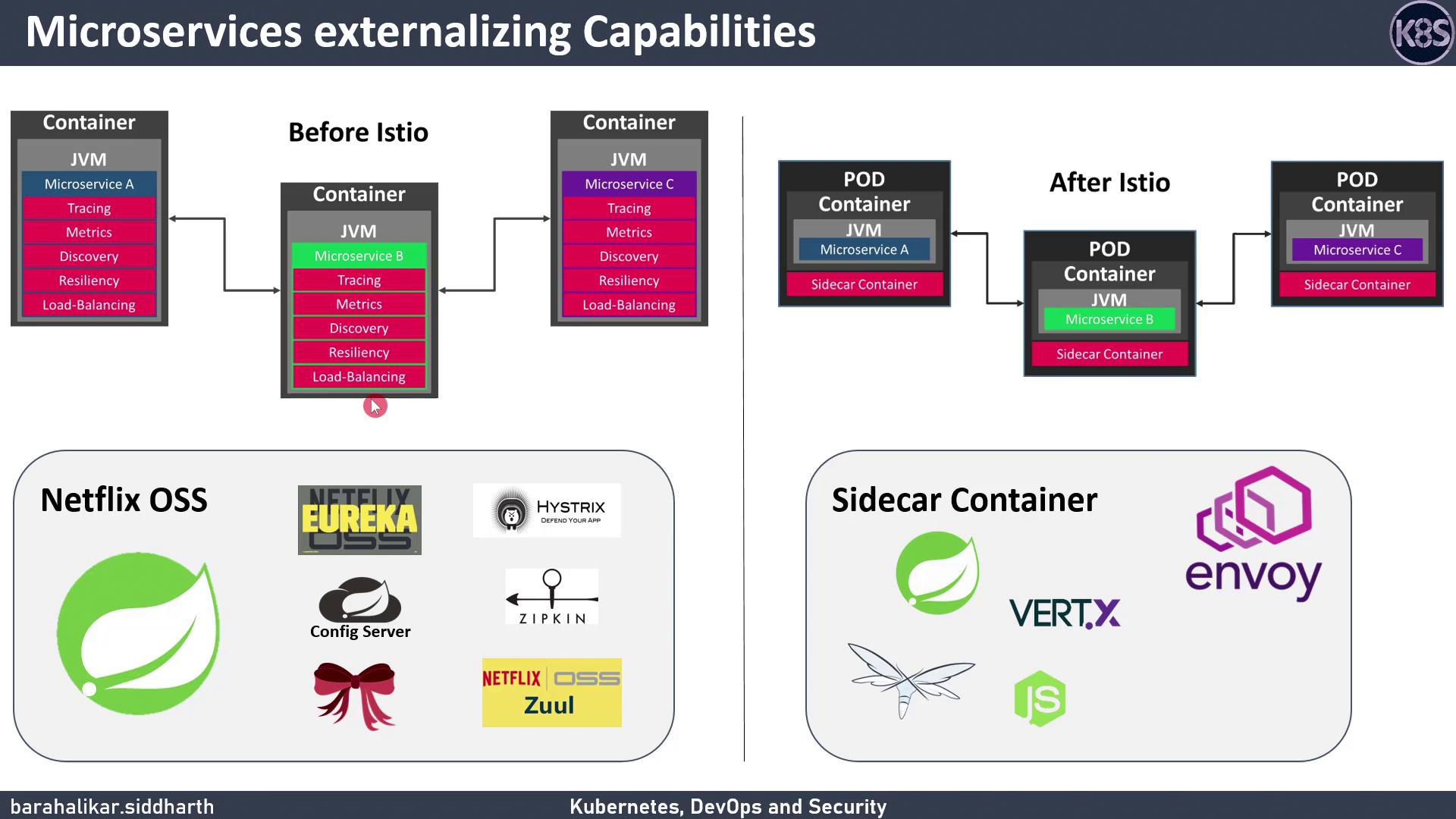
This pattern externalizes cross-cutting concerns—tracing, metrics, load balancing, and security—out of application code.
## From Netflix OSS to Istio
Before Istio, Spring Boot microservices often required embedding multiple Netflix OSS libraries:
| Netflix OSS Component | Use Case | Istio Equivalent |
| -------------------------- | ----------------------------- | ------------------------------ |
| Eureka | Service discovery | Envoy + Pilot |
| Spring Cloud Config Server | Centralized configuration | Galley / Config APIs |
| Ribbon | Client-side load balancing | Envoy load-balancer |
| Hystrix | Circuit breaking & resilience | Envoy retry & circuit-breakers |
| Zipkin | Distributed tracing | Envoy + Zipkin/Jaeger plugin |
| Zuul | API gateway | IngressGateway |
## Summary
Istio’s sidecar-based approach offloads critical infrastructure concerns from your code to a transparent proxy mesh. You gain unified **traffic management**, **security**, and **observability** with minimal disruption to your existing workflows.
## Links and References
* [Istio Official Website](https://istio.io/)
* [Envoy Proxy](https://www.envoyproxy.io/)
* [Kubernetes Service Mesh Concepts](https://kubernetes.io/docs/concepts/services-networking/service/)
* [Mutual TLS in Istio](https://istio.io/latest/docs/tasks/security/authentication/authn-policy/)