> ## Documentation Index
> Fetch the complete documentation index at: https://notes.kodekloud.com/llms.txt
> Use this file to discover all available pages before exploring further.
# Section 4 Topics
> This article discusses enhancing a DevSecOps pipeline by integrating security, observability, and notification features into a CI/CD workflow.
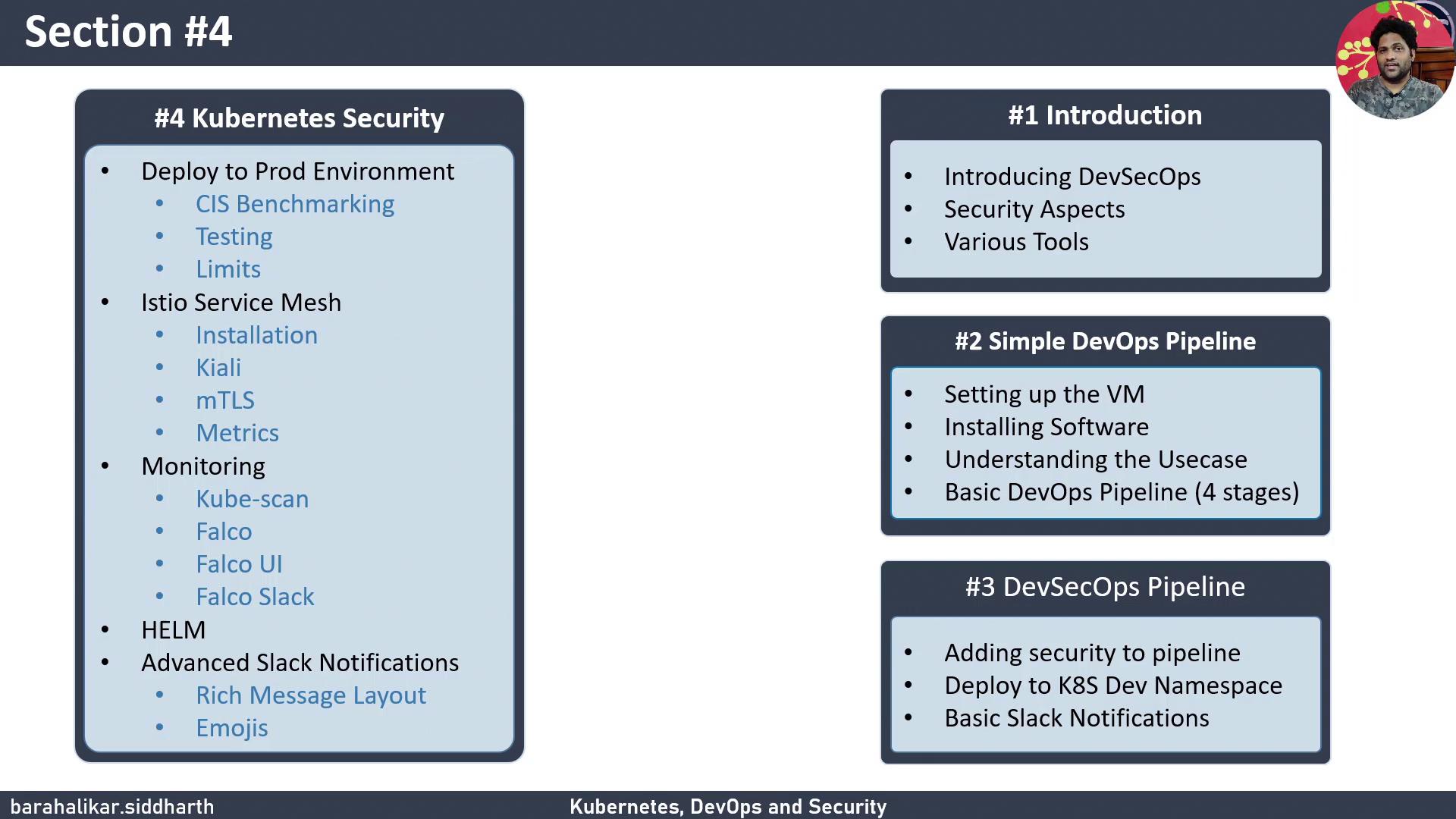
In this section, we’ll build on our existing CI/CD workflow by integrating security, observability, and notification features. You will learn how to:
* Integrate a CIS benchmark scan into your Jenkins pipeline
* Deploy the application into a dedicated Kubernetes production namespace
* Enforce mutual TLS and policy-driven traffic using Istio
* Monitor runtime security and compliance with Falco and KubeScan
* Publish detailed, content-rich notifications to Slack
Ensure you have the following already set up before proceeding:
* A Jenkins server with pipeline-as-code enabled
* Access to a Kubernetes cluster (production namespace created)
* `kubectl`, `helm`, and Istio CLI (`istioctl`) installed and configured
* Slack App credentials with incoming-webhook permissions
| Step | Tool(s) | Purpose |
| ------------------------- | ------------------------------------------------------------------------------------- | ----------------------------------------------------- |
| 1. CIS Benchmarking | [cis-scanner](https://www.cisecurity.org/) | Validate cluster configuration against CIS guidelines |
| 2. Kubernetes Deployment | `kubectl`, Helm | Deploy your app to the production namespace |
| 3. Istio Traffic Security | [Istio](https://istio.io/) | Enable mTLS and policy enforcement |
| 4. Cluster Monitoring | [Falco](https://falco.org/), [KubeScan](https://github.com/TetragonSecurity/kubescan) | Real-time security alerts and compliance checks |
| 5. Slack Notifications | Slack API | Send structured pipeline updates and alerts |
That's it for this overview. Let’s dive into Task 1: adding a CIS benchmarking stage to our Jenkins pipeline.
## Links and References
* [CIS Benchmarks (Official)](https://www.cisecurity.org/)
* [Istio Documentation](https://istio.io/latest/docs/)
* [Falco Project](https://falco.org/)
* [KubeScan on GitHub](https://github.com/TetragonSecurity/kubescan)
* [Slack Incoming Webhooks](https://api.slack.com/messaging/webhooks)