> ## Documentation Index
> Fetch the complete documentation index at: https://notes.kodekloud.com/llms.txt
> Use this file to discover all available pages before exploring further.
# Co creating and Mobbing
> Explains co-creating and mobbing collaboration practices in DevOps, their differences, benefits, trade-offs, and guidance for choosing and applying them to improve quality, onboarding, and incident response.
Welcome, Soft Skills students.\
This lesson (presented by Michael Forrester) explains two closely related collaboration practices used widely in DevOps and engineering teams: co-creating and mobbing. You’ll learn clear definitions, how they differ, when to choose each, and the trade-offs so you can apply them to improve code quality, incident response, onboarding, and team knowledge sharing.
Co-creating and mobbing both emphasize joint action and shared responsibility for a single problem, goal, or artefact. Teams that adopt these practices increase cross-functional knowledge, reduce defects, and create more predictable long-term velocity by standardizing approaches and spreading institutional memory.
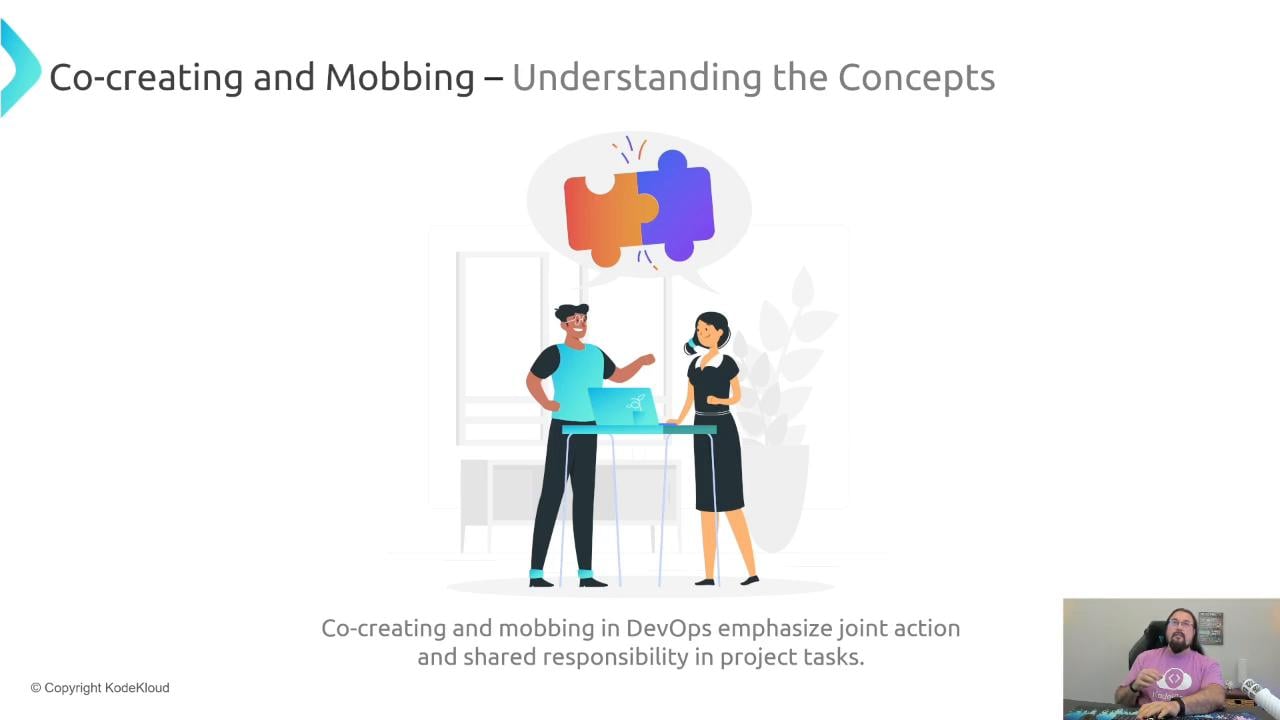 ## Definitions and key differences
* Co-creating
* A collaborative process where multiple team members actively contribute to the same artefact (code, documentation, design, runbook) at the same time.
* Contributors often work from their own workstations, adding ideas, code, or edits to a shared space in real time.
* Emphasizes distributed, parallel contribution and iterative refinement by many actors.
* Mobbing (mob programming / mobbing in troubleshooting)
* One person typically “drives” at a single workstation while the rest of the group observes, suggests, reviews, and proposes alternatives.
* Especially useful for debugging, scripting, incident response, or complex problem-solving where focused collective attention accelerates results.
* The group collectively owns the outcome even though inputs are often sequenced through a driver and assisting observers.
Both are collaborative but differ in mechanics: co-creating spreads hands-on work across participants simultaneously; mobbing centralizes hands-on interaction while leveraging broad team scrutiny.
## Definitions and key differences
* Co-creating
* A collaborative process where multiple team members actively contribute to the same artefact (code, documentation, design, runbook) at the same time.
* Contributors often work from their own workstations, adding ideas, code, or edits to a shared space in real time.
* Emphasizes distributed, parallel contribution and iterative refinement by many actors.
* Mobbing (mob programming / mobbing in troubleshooting)
* One person typically “drives” at a single workstation while the rest of the group observes, suggests, reviews, and proposes alternatives.
* Especially useful for debugging, scripting, incident response, or complex problem-solving where focused collective attention accelerates results.
* The group collectively owns the outcome even though inputs are often sequenced through a driver and assisting observers.
Both are collaborative but differ in mechanics: co-creating spreads hands-on work across participants simultaneously; mobbing centralizes hands-on interaction while leveraging broad team scrutiny.
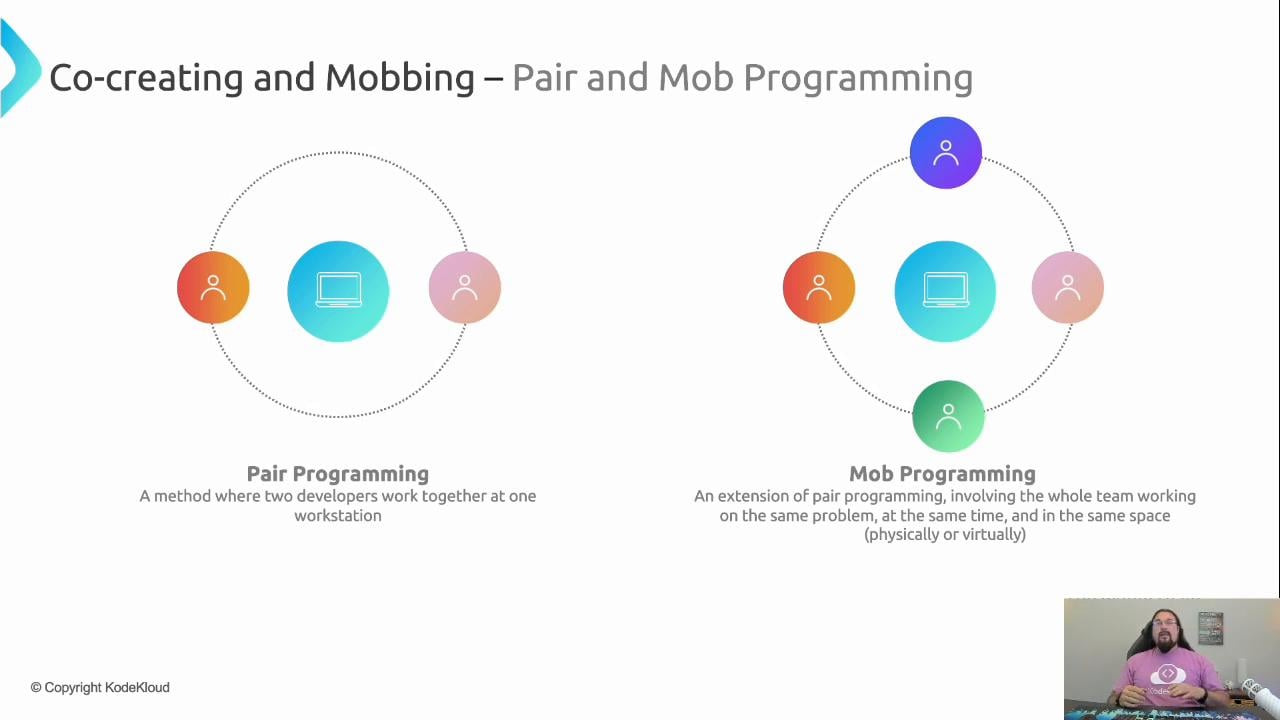 ## Pair programming vs mob programming
* Pair programming
* Two people collaborate at one workstation; roles of driver and navigator rotate frequently.
* Commonly used for mentoring, focused development of a feature, or when two perspectives produce faster, higher-quality output.
* Mob programming
* The entire team works on the same problem at the same time. One person drives while others act as navigators or commentators.
* Valuable for complex architecture decisions, onboarding in-context, or when you need rapid consensus and shared understanding.
These approaches can appear slower at the moment because multiple people focus on a single stream of work. The trade-off is fewer defects, reduced rework, faster onboarding, and broader team ownership over time.
## Pair programming vs mob programming
* Pair programming
* Two people collaborate at one workstation; roles of driver and navigator rotate frequently.
* Commonly used for mentoring, focused development of a feature, or when two perspectives produce faster, higher-quality output.
* Mob programming
* The entire team works on the same problem at the same time. One person drives while others act as navigators or commentators.
* Valuable for complex architecture decisions, onboarding in-context, or when you need rapid consensus and shared understanding.
These approaches can appear slower at the moment because multiple people focus on a single stream of work. The trade-off is fewer defects, reduced rework, faster onboarding, and broader team ownership over time.
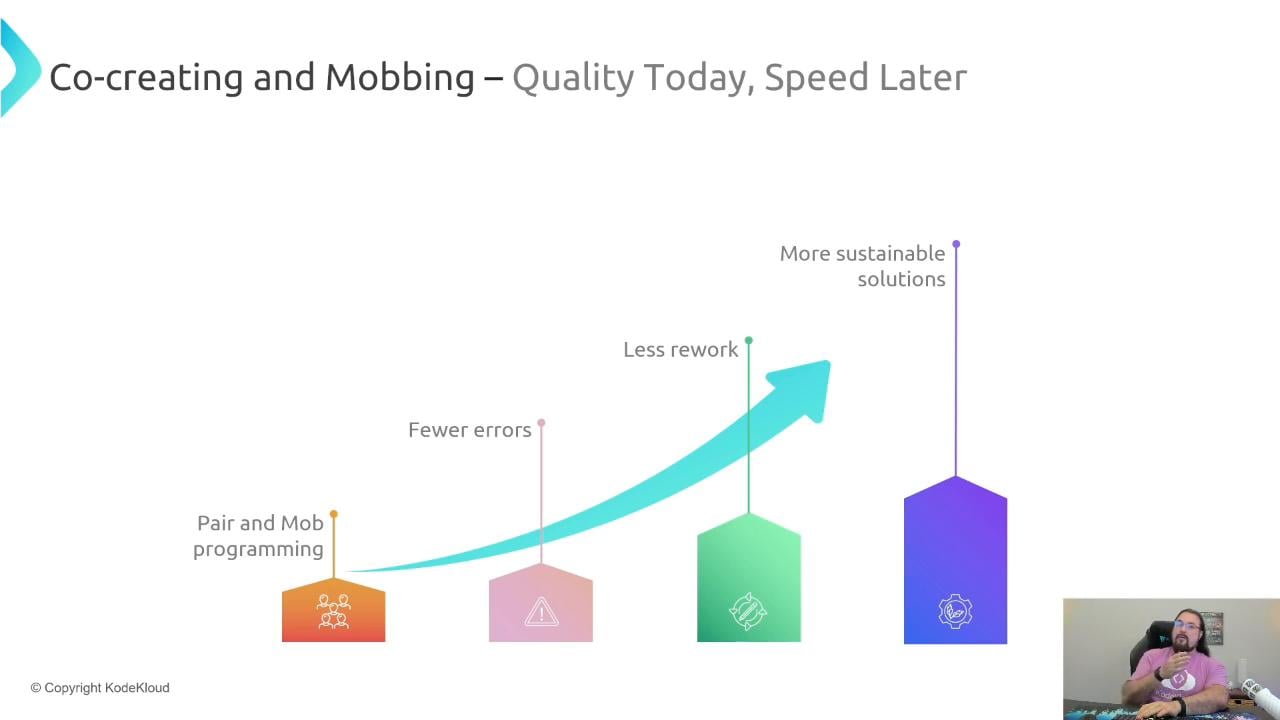 ## Benefits and trade-offs
| Category | Examples |
| -: | - |
| Immediate benefits | Higher artefact quality via continuous review; faster detection of edge cases and design flaws; stronger team cohesion and shared mental models. |
| Longer-term gains | Reduced rework and fewer production incidents; broader team familiarity with codebase, pipelines, and operational practices (lower bus-factor risk); faster onboarding for new or junior members. |
| Trade-offs | Per-person throughput may feel lower during sessions; requires discipline (clear roles, rotation, facilitation); not every task benefits—select contexts where shared learning and error reduction outweigh short-term speed loss. |
Use co-creating for collaborative design and living documentation; use mobbing when concentrated attention on a single system or problem will accelerate resolution or learning (for example: incident response, debugging sessions, or hands-on onboarding).
## When to choose which approach
* Use co-creating when:
* Multiple team members need to make parallel contributions to a shared artefact (e.g., documentation, design work, or working in a shared repo).
* You want rapid idea generation with distributed ownership.
* Use mobbing when:
* You need concentrated team focus to solve a tough bug, script an automation, run through an incident postmortem, or onboard someone with live walkthroughs.
* Fast consensus, shared situational awareness, or immediate knowledge transfer is critical.
Practical tips
* Define roles and rotate the driver frequently to avoid bottlenecks.
* Timebox sessions and agree the goals up-front.
* For remote teams, ensure good audio/video and a shared cursor or screen tool so everyone can follow and contribute.
* Capture decisions and action items in a shared place (PR, issue, or runbook) to preserve outcomes.
## Summary
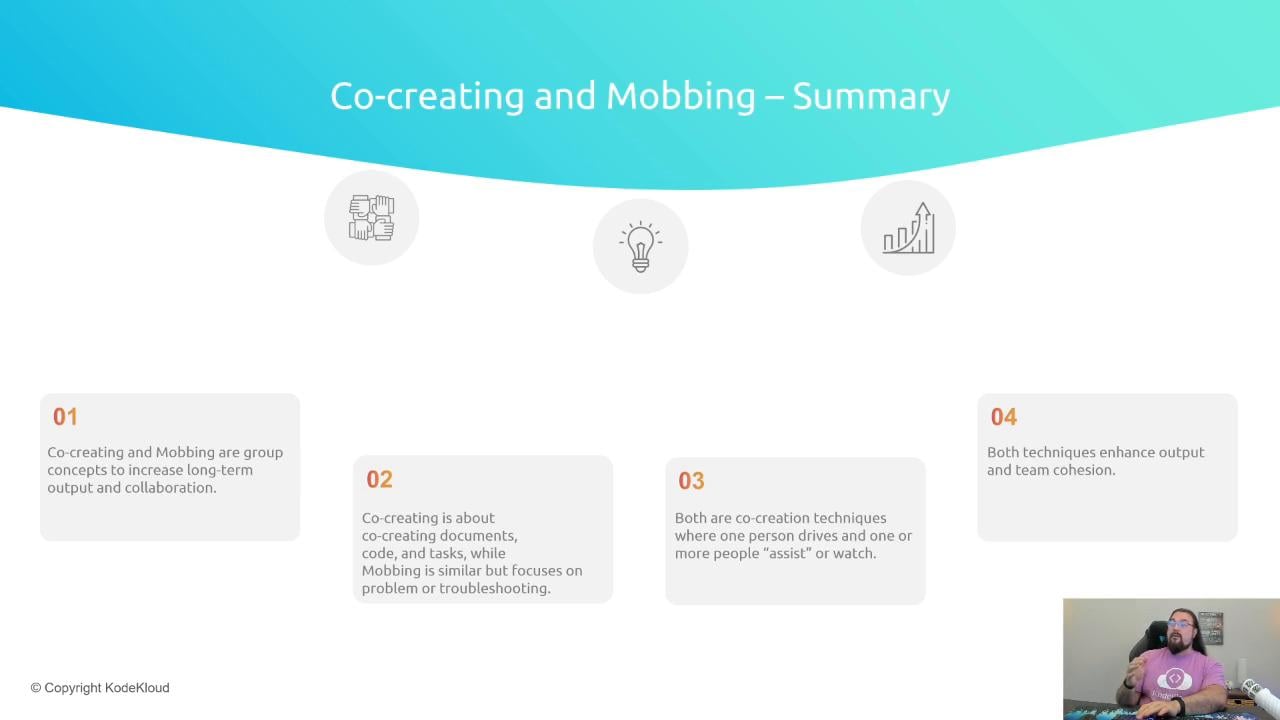
Co-creating and mobbing are complementary, group-centered practices that increase long-term quality, institutional knowledge, and team collaboration. Co-creating distributes contribution across participants working in parallel on a shared artefact; mobbing concentrates hands-on work while leveraging collective observation and guidance. Both trade short-term speed for higher immediate quality and yield faster long-term velocity by reducing defects and spreading knowledge.
## Benefits and trade-offs
| Category | Examples |
| -: | - |
| Immediate benefits | Higher artefact quality via continuous review; faster detection of edge cases and design flaws; stronger team cohesion and shared mental models. |
| Longer-term gains | Reduced rework and fewer production incidents; broader team familiarity with codebase, pipelines, and operational practices (lower bus-factor risk); faster onboarding for new or junior members. |
| Trade-offs | Per-person throughput may feel lower during sessions; requires discipline (clear roles, rotation, facilitation); not every task benefits—select contexts where shared learning and error reduction outweigh short-term speed loss. |
Use co-creating for collaborative design and living documentation; use mobbing when concentrated attention on a single system or problem will accelerate resolution or learning (for example: incident response, debugging sessions, or hands-on onboarding).
## When to choose which approach
* Use co-creating when:
* Multiple team members need to make parallel contributions to a shared artefact (e.g., documentation, design work, or working in a shared repo).
* You want rapid idea generation with distributed ownership.
* Use mobbing when:
* You need concentrated team focus to solve a tough bug, script an automation, run through an incident postmortem, or onboard someone with live walkthroughs.
* Fast consensus, shared situational awareness, or immediate knowledge transfer is critical.
Practical tips
* Define roles and rotate the driver frequently to avoid bottlenecks.
* Timebox sessions and agree the goals up-front.
* For remote teams, ensure good audio/video and a shared cursor or screen tool so everyone can follow and contribute.
* Capture decisions and action items in a shared place (PR, issue, or runbook) to preserve outcomes.
## Summary
Co-creating and mobbing are complementary, group-centered practices that increase long-term quality, institutional knowledge, and team collaboration. Co-creating distributes contribution across participants working in parallel on a shared artefact; mobbing concentrates hands-on work while leveraging collective observation and guidance. Both trade short-term speed for higher immediate quality and yield faster long-term velocity by reducing defects and spreading knowledge.
 Thanks for reading this lesson.
## Links and references
* Mob programming overview — [https://www.mobprogramming.org/](https://www.mobprogramming.org/)
* Pair programming (Agile Alliance) — [https://www.agilealliance.org/glossary/pair-programming/](https://www.agilealliance.org/glossary/pair-programming/)
* DevOps collaboration patterns — [https://devops.com/category/collaboration/](https://devops.com/category/collaboration/)
This documentation is built and hosted on [Mintlify](https://mintlify.com), a developer documentation platform.
Thanks for reading this lesson.
## Links and references
* Mob programming overview — [https://www.mobprogramming.org/](https://www.mobprogramming.org/)
* Pair programming (Agile Alliance) — [https://www.agilealliance.org/glossary/pair-programming/](https://www.agilealliance.org/glossary/pair-programming/)
* DevOps collaboration patterns — [https://devops.com/category/collaboration/](https://devops.com/category/collaboration/)
This documentation is built and hosted on [Mintlify](https://mintlify.com), a developer documentation platform.