> ## Documentation Index
> Fetch the complete documentation index at: https://notes.kodekloud.com/llms.txt
> Use this file to discover all available pages before exploring further.
# Beyond Installation The True Complexity of Managing Kafka
> Explains operational challenges of running Apache Kafka in production and compares self-managed versus managed options to reduce complexity, covering scaling, security, observability, and integration
Welcome back.
In this lesson we’ll go beyond installation and configuration to examine what it takes to run Apache Kafka reliably at scale. Installing Kafka is only the first step. Operating, securing, scaling, and integrating Kafka in a production environment introduces a separate set of engineering and organizational challenges that directly affect reliability, cost, and developer productivity.
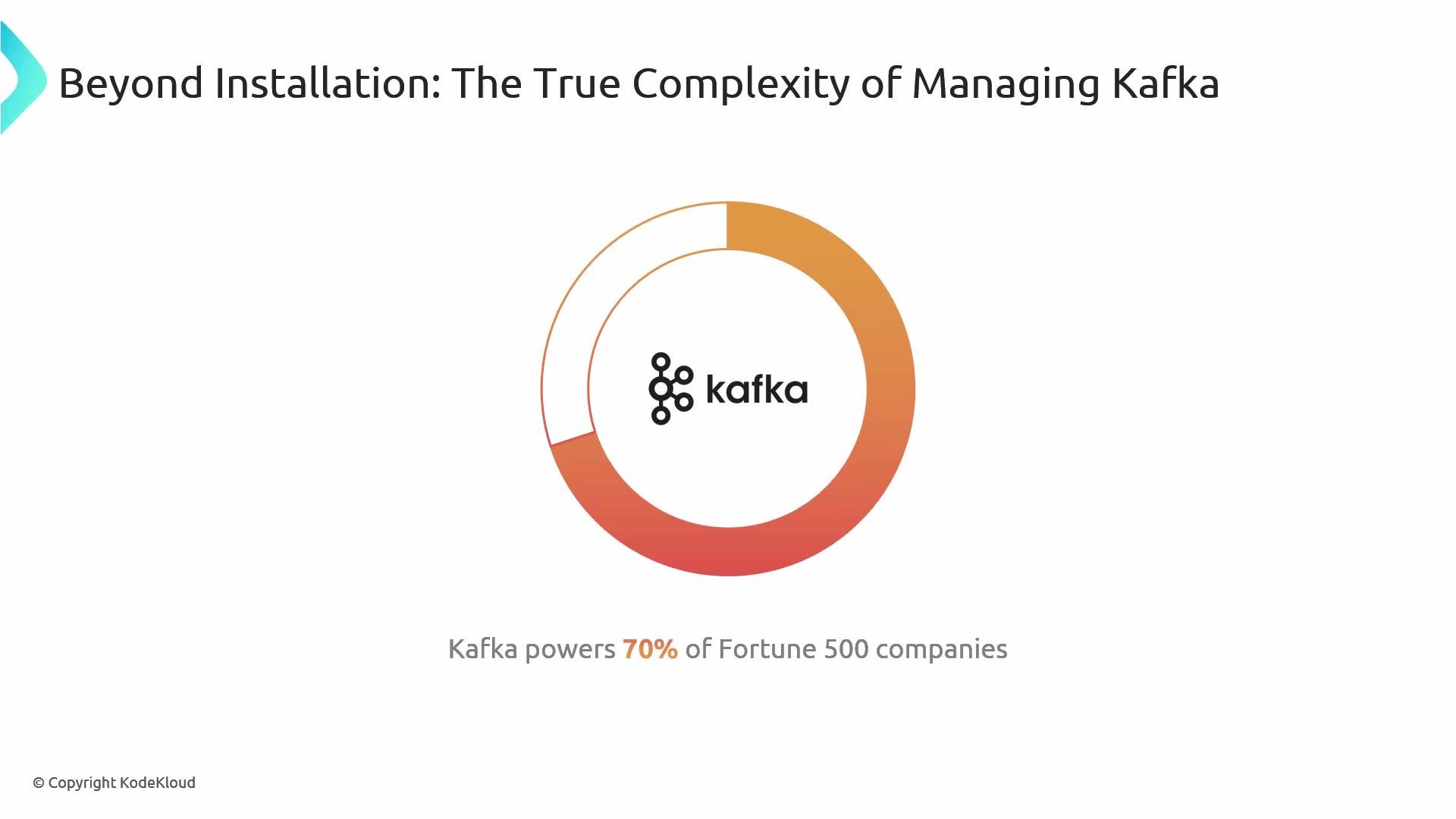
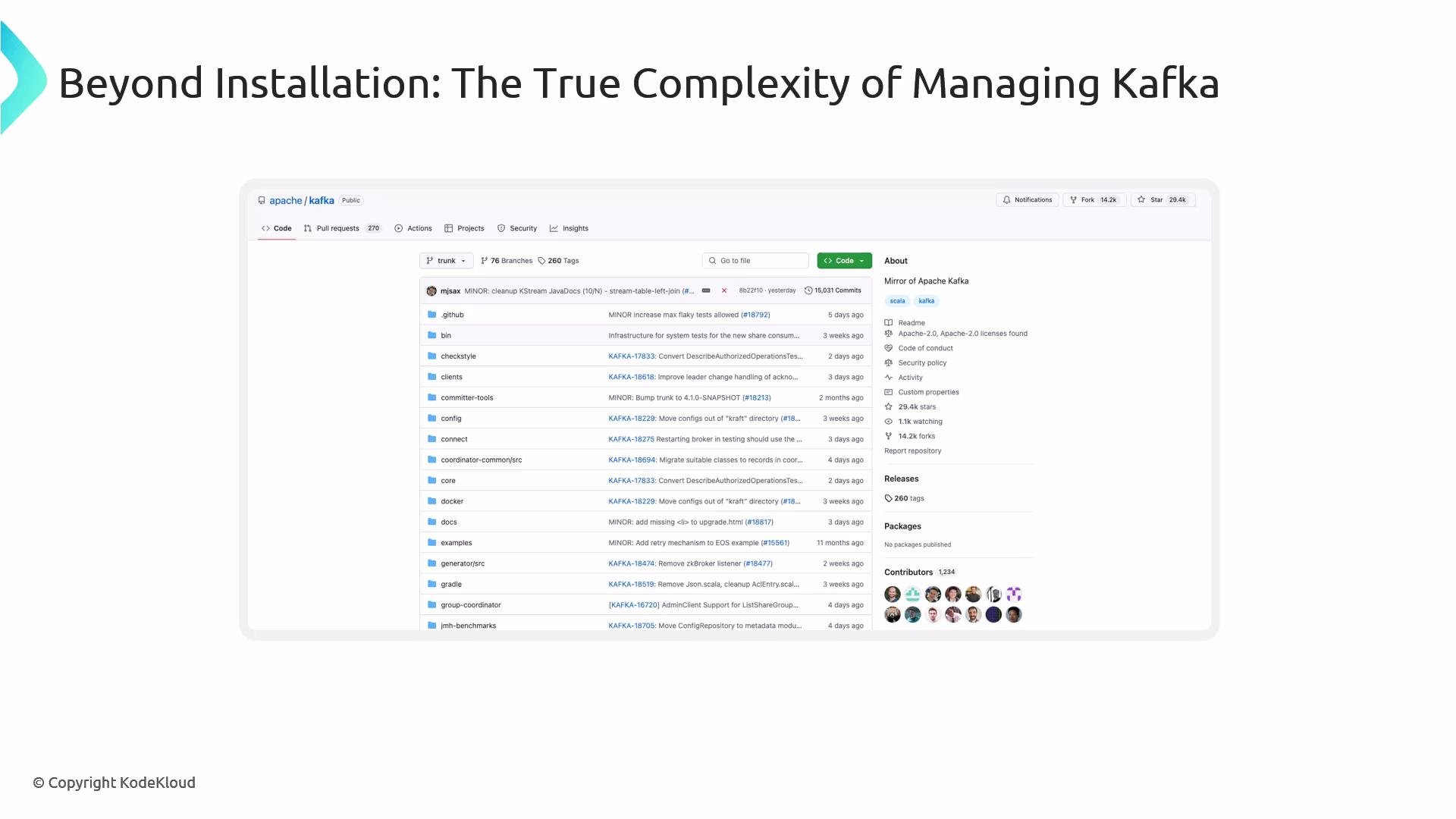 Apache Kafka powers event-driven architectures at many Fortune 500 companies because it can handle high-throughput, low-latency streaming. However, the vanilla open-source distribution focuses primarily on the core broker, client libraries, and protocol. It does not include the full operational toolset most enterprises require—monitoring, hardened security defaults, automated scaling, or integrated management.
Open-source Kafka offers flexibility and low upfront licensing cost, but you must account for the engineering effort to build production-grade monitoring, security, automation, and governance around it.
Apache Kafka powers event-driven architectures at many Fortune 500 companies because it can handle high-throughput, low-latency streaming. However, the vanilla open-source distribution focuses primarily on the core broker, client libraries, and protocol. It does not include the full operational toolset most enterprises require—monitoring, hardened security defaults, automated scaling, or integrated management.
Open-source Kafka offers flexibility and low upfront licensing cost, but you must account for the engineering effort to build production-grade monitoring, security, automation, and governance around it.
 ## Core problem areas in production Kafka
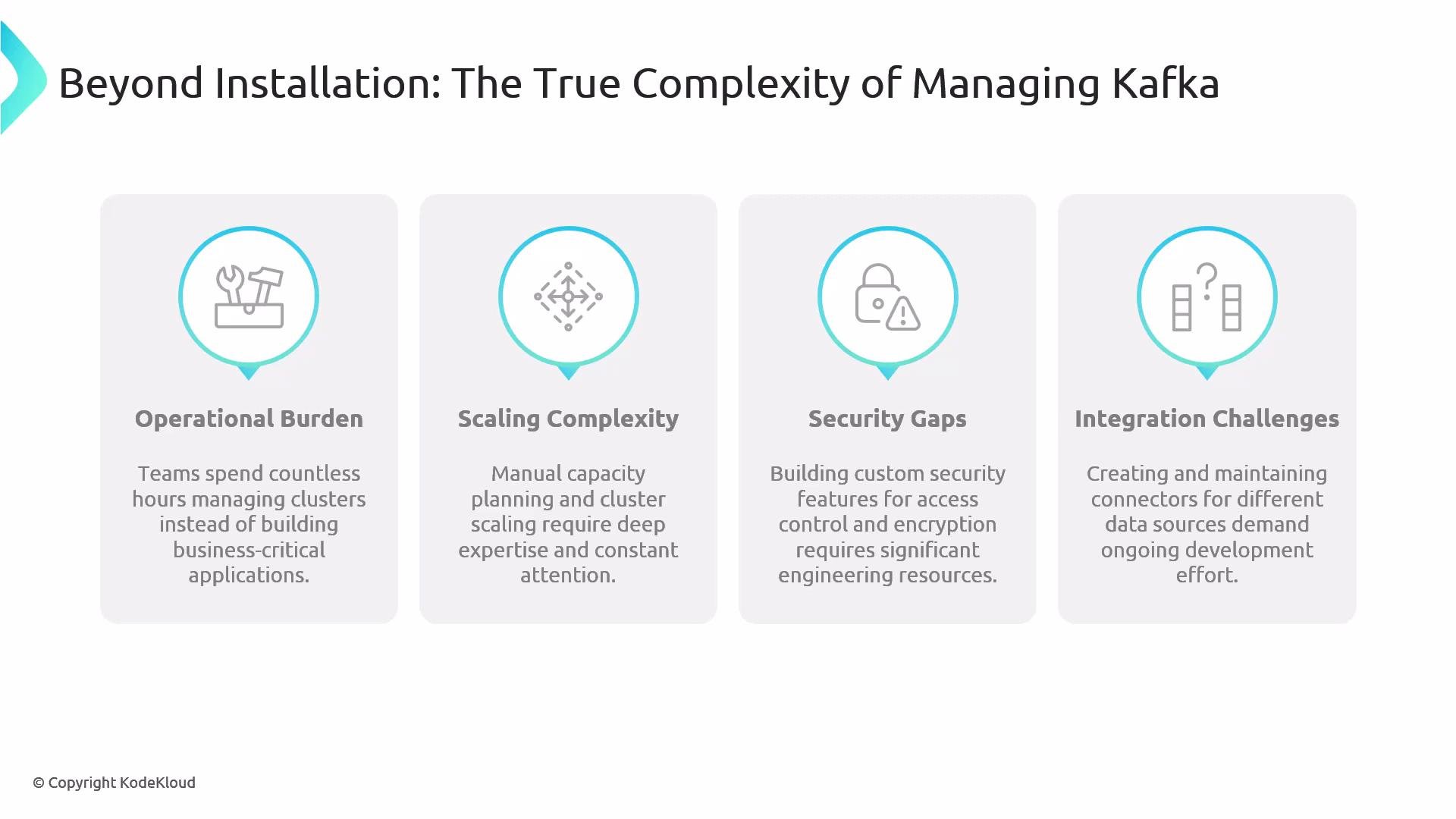
Teams running Kafka at scale commonly face four recurring challenge domains. Each increases total cost of ownership (TCO) for a self-managed deployment.
* Operational burden\
Tasks like tracking broker health, orchestrating broker restarts and upgrades, correcting configuration drift, and managing topics and partitions require ongoing attention. These maintenance activities often draw engineering time away from product development.
* Scaling complexity\
Capacity planning, provisioning brokers, defining partition counts, rebalancing replicas, and stateful scaling are tricky. Manual or ad-hoc scaling can be disruptive and error-prone without automation.
* Security gaps\
Secure, compliant deployments require implementing authentication (SASL), authorization (ACLs), encryption in transit (TLS), encryption at rest, key management, and audit logging. Open-source Kafka leaves these responsibilities to operators.
* Integration & ecosystem challenges\
Running producers, consumers, connectors, stream processors, schema registries, and observability tooling across teams introduces friction. Enforcing consistent schema evolution, retries, retention policies, and data governance is an ongoing coordination task.
## Core problem areas in production Kafka
Teams running Kafka at scale commonly face four recurring challenge domains. Each increases total cost of ownership (TCO) for a self-managed deployment.
* Operational burden\
Tasks like tracking broker health, orchestrating broker restarts and upgrades, correcting configuration drift, and managing topics and partitions require ongoing attention. These maintenance activities often draw engineering time away from product development.
* Scaling complexity\
Capacity planning, provisioning brokers, defining partition counts, rebalancing replicas, and stateful scaling are tricky. Manual or ad-hoc scaling can be disruptive and error-prone without automation.
* Security gaps\
Secure, compliant deployments require implementing authentication (SASL), authorization (ACLs), encryption in transit (TLS), encryption at rest, key management, and audit logging. Open-source Kafka leaves these responsibilities to operators.
* Integration & ecosystem challenges\
Running producers, consumers, connectors, stream processors, schema registries, and observability tooling across teams introduces friction. Enforcing consistent schema evolution, retries, retention policies, and data governance is an ongoing coordination task.
 ## Summary table — Challenges and operational impact
| Challenge | What it entails | Operational impact |
| ------------------------ | ---------------------------------------------------------------------------: | ------------------------------------------------ |
| Operational burden | Broker lifecycle (health, upgrades), topic ops, configuration drift | High ongoing engineering time |
| Scaling complexity | Capacity planning, partition strategy, automated rebalancing | Risk of downtime and uneven performance |
| Security & compliance | SASL, ACLs, TLS, auditing, key management | Compliance risk and maintenance overhead |
| Integration & governance | Connectors, schema enforcement, retention/retention differences across teams | Data inconsistency and higher coordination costs |
These four areas are the primary drivers of cost and risk when choosing to self-manage Kafka. Many organizations initially save on licensing but later face substantial operational expense to reach a production-grade posture.
## Typical engineering investments to address these gaps
* Observability: Prometheus + Grafana, alerting, broker and client metrics, end-to-end latency tracking.
* Automation: Infrastructure-as-code (Terraform), CI/CD for configuration, scripted broker upgrades.
* Scaling tools: Cruise Control or custom automation for partition rebalancing and load distribution.
* Security: TLS certificates, SASL mechanisms (SCRAM, GSSAPI), ACL lifecycle management, and central auditing.
* Ecosystem components: Schema Registry, Connect cluster management, JVM tuning, consumer lag tracking.
These investments represent non-trivial engineering projects. For organizations without dedicated Kafka teams, the cost of building and maintaining this stack can outweigh the perceived savings of self-hosting.
## Summary table — Challenges and operational impact
| Challenge | What it entails | Operational impact |
| ------------------------ | ---------------------------------------------------------------------------: | ------------------------------------------------ |
| Operational burden | Broker lifecycle (health, upgrades), topic ops, configuration drift | High ongoing engineering time |
| Scaling complexity | Capacity planning, partition strategy, automated rebalancing | Risk of downtime and uneven performance |
| Security & compliance | SASL, ACLs, TLS, auditing, key management | Compliance risk and maintenance overhead |
| Integration & governance | Connectors, schema enforcement, retention/retention differences across teams | Data inconsistency and higher coordination costs |
These four areas are the primary drivers of cost and risk when choosing to self-manage Kafka. Many organizations initially save on licensing but later face substantial operational expense to reach a production-grade posture.
## Typical engineering investments to address these gaps
* Observability: Prometheus + Grafana, alerting, broker and client metrics, end-to-end latency tracking.
* Automation: Infrastructure-as-code (Terraform), CI/CD for configuration, scripted broker upgrades.
* Scaling tools: Cruise Control or custom automation for partition rebalancing and load distribution.
* Security: TLS certificates, SASL mechanisms (SCRAM, GSSAPI), ACL lifecycle management, and central auditing.
* Ecosystem components: Schema Registry, Connect cluster management, JVM tuning, consumer lag tracking.
These investments represent non-trivial engineering projects. For organizations without dedicated Kafka teams, the cost of building and maintaining this stack can outweigh the perceived savings of self-hosting.
 ## Options to reduce operational burden
* Self-managed (DIY) Kafka\
Pros: Full control, no vendor lock-in, potentially lower license costs.\
Cons: High operational overhead, requires devoted engineering resources.
* Managed Kafka (cloud or vendor-managed)\
Pros: Offloads broker lifecycle, scaling, and many security tasks; built-in observability and SLA-backed availability.\
Cons: Vendor cost and potential constraints in customization.
* Hybrid approaches\
Use managed core (broker + storage) while operating connectors and applications in your environment. This balances control and operational overhead.
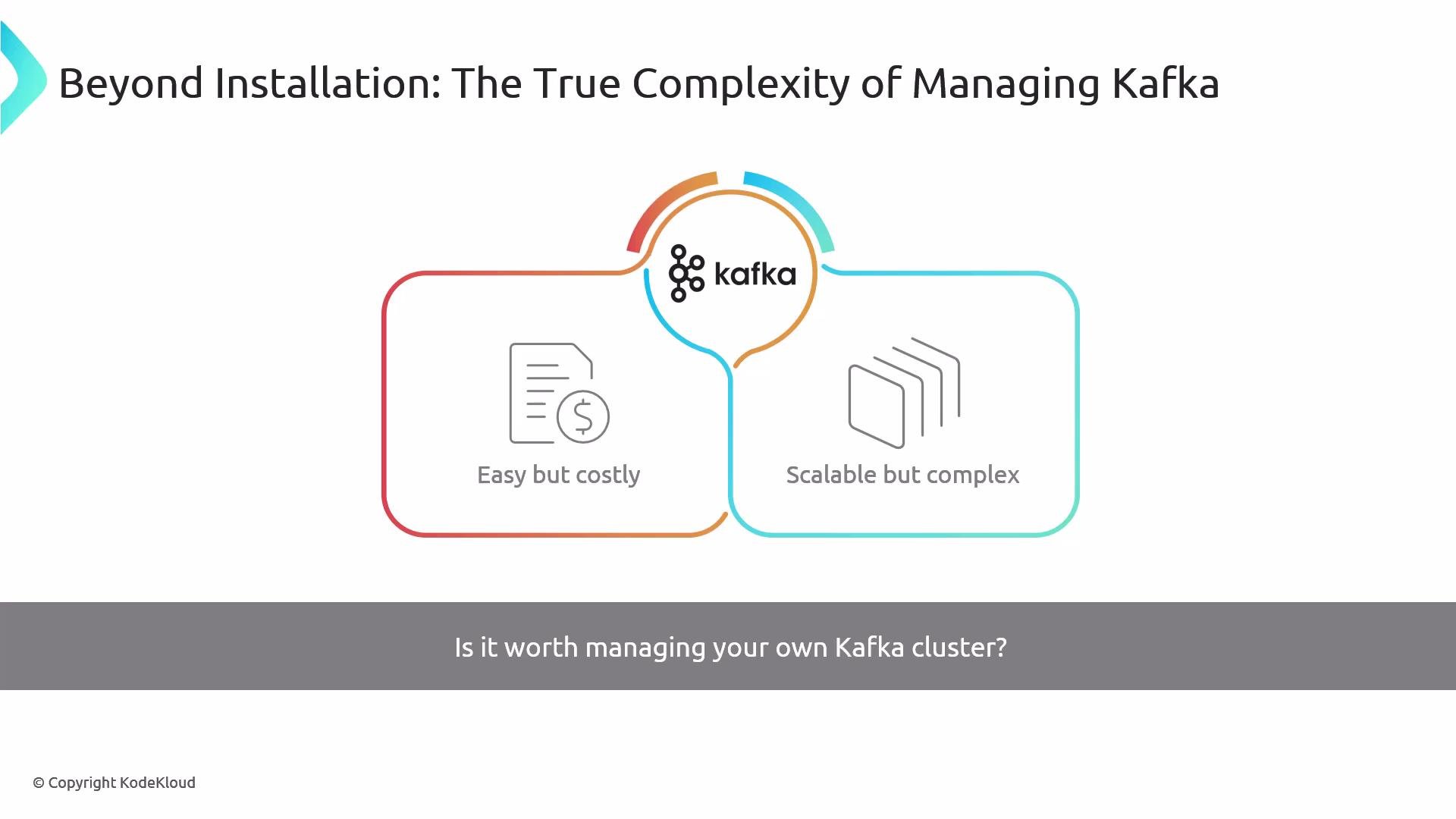
Confluent Cloud and other managed Kafka services are examples of options that can significantly reduce operational complexity. Consider evaluating managed services if your team prefers to focus on product features rather than cluster operations.
## Further reading and references
* Apache Kafka documentation: [https://kafka.apache.org/documentation/](https://kafka.apache.org/documentation/)
* Confluent Cloud: [https://www.confluent.io/confluent-cloud](https://www.confluent.io/confluent-cloud)
* Kafka Capacity Planning and Best Practices: [https://kafka.apache.org/documentation/#design](https://kafka.apache.org/documentation/#design)
That concludes this lesson. See you in the next one.
## Options to reduce operational burden
* Self-managed (DIY) Kafka\
Pros: Full control, no vendor lock-in, potentially lower license costs.\
Cons: High operational overhead, requires devoted engineering resources.
* Managed Kafka (cloud or vendor-managed)\
Pros: Offloads broker lifecycle, scaling, and many security tasks; built-in observability and SLA-backed availability.\
Cons: Vendor cost and potential constraints in customization.
* Hybrid approaches\
Use managed core (broker + storage) while operating connectors and applications in your environment. This balances control and operational overhead.
Confluent Cloud and other managed Kafka services are examples of options that can significantly reduce operational complexity. Consider evaluating managed services if your team prefers to focus on product features rather than cluster operations.
## Further reading and references
* Apache Kafka documentation: [https://kafka.apache.org/documentation/](https://kafka.apache.org/documentation/)
* Confluent Cloud: [https://www.confluent.io/confluent-cloud](https://www.confluent.io/confluent-cloud)
* Kafka Capacity Planning and Best Practices: [https://kafka.apache.org/documentation/#design](https://kafka.apache.org/documentation/#design)
That concludes this lesson. See you in the next one.