> ## Documentation Index
> Fetch the complete documentation index at: https://notes.kodekloud.com/llms.txt
> Use this file to discover all available pages before exploring further.
# Section Recap
> Summary of Kafka best practices covering offset management, handling poison pill messages, ZooKeeper versus KRaft architecture, and securing Kafka with TLS SASL and ACLs.
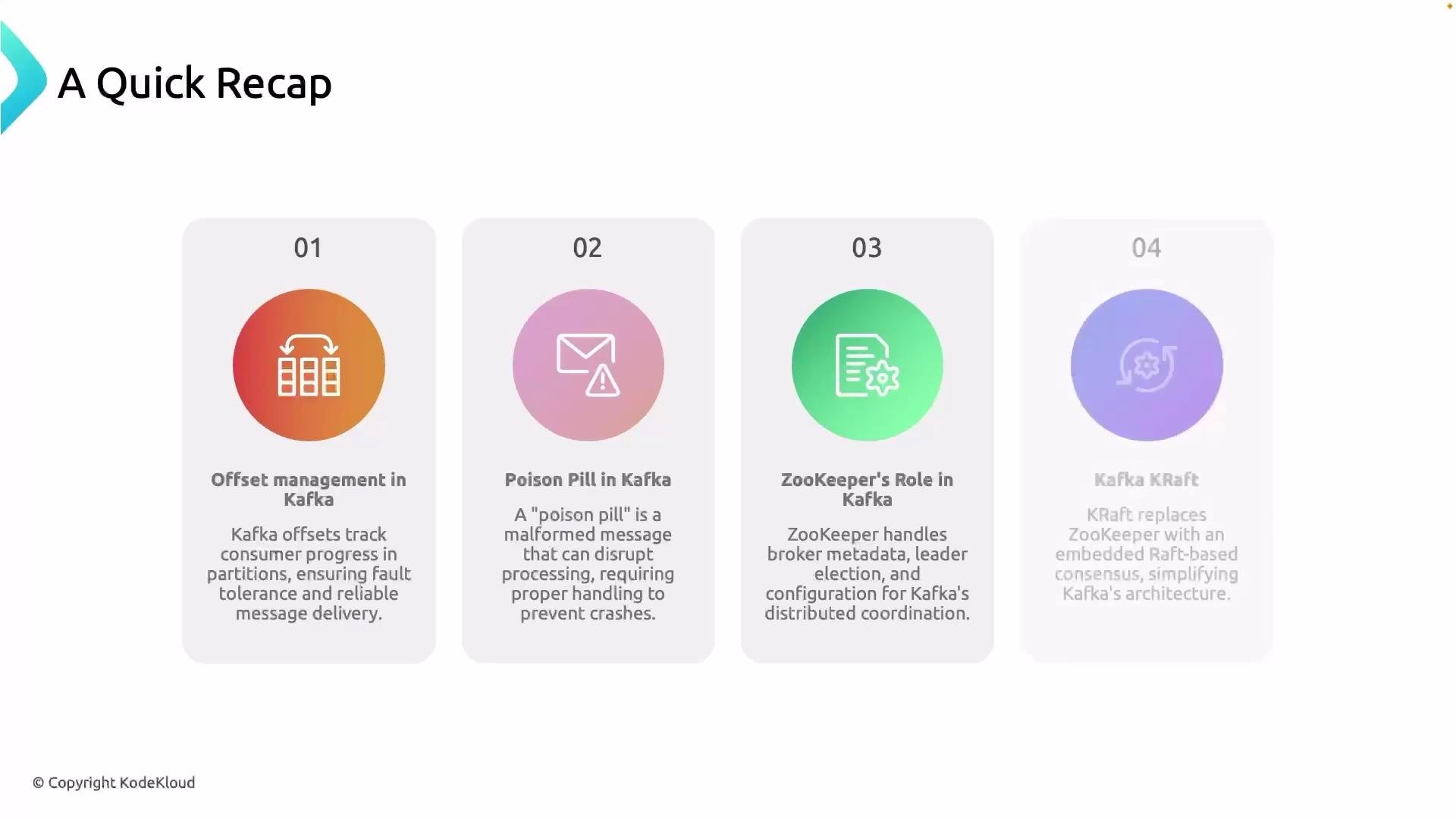
Welcome back — this concise recap consolidates the key Kafka concepts covered in the lesson. Use this as a quick reference for offset handling, poison pill strategies, the historical role of ZooKeeper, KRaft (Kafka Raft), and Kafka security best practices.
Quick tip: apply these concepts to design resilient consumers: explicit offset management, bounded retries, DLQs, and secure communications (TLS + SASL + ACLs).
## Offsets and offset management
* Offsets represent a consumer’s read position within a partition and are central to consumer fault tolerance.
* When a consumer restarts (or moves to another host), offsets let it resume processing from the last committed position.
* Kafka supports:
* Automatic commits (broker-managed) — easy but less control.
* Application-managed commits (manual) — more control over processing guarantees.
* Choosing commit strategy and frequency directly affects delivery semantics (at-most-once, at-least-once, effectively-once with additional processing logic).
Best practices:
* Use manual commits when processing is not idempotent, and you must ensure messages are processed before committing.
* Favor frequent, well-placed commits for critical progress tracking; avoid committing too often to reduce overhead.
* For complex processing pipelines, consider transactional producers/consumers or idempotent processing to approach exactly-once semantics.
Table: Offset commit strategies and trade-offs
| Strategy | Typical config / action | Pros | Cons |
| ------------------------ | -------------------------------------------------: | -------------------------------------------- | -------------------------------------------- |
| Auto-commit | `enable.auto.commit=true` | Simple to set up | Risk of message loss or duplicate processing |
| Manual commit | `consumer.commitSync()` / `consumer.commitAsync()` | Precise control over when offsets are saved | More application complexity |
| Transactional processing | Use Kafka transactions + transactional producer | Stronger guarantees for end-to-end atomicity | More complex and resource-heavy |
## Poison pill messages (failing messages)
* A poison pill is a malformed or unexpected message that repeatedly causes consumer processing to fail.
* If unhandled, a poison pill can crash or stall consumers, blocking the pipeline.
Recommended handling pattern:
* Catch processing exceptions and log full context (topic, partition, offset, payload metadata) for debugging.
* Apply bounded retries with exponential backoff for transient issues.
* After retry exhaustion, move irrecoverable messages to a dead-letter queue (DLQ) for later inspection and reprocessing.
Handle poison pills proactively: implement bounded retries with backoff and a DLQ so a single bad message doesn’t halt the entire consumer group.
## ZooKeeper's historical role in Kafka
* Historically, Kafka relied on [ZooKeeper](https://zookeeper.apache.org) to manage broker metadata, leader election, and topic configuration.
* ZooKeeper provided cluster coordination but increased operational complexity due to an extra distributed component to maintain.
 ## KRaft (Kafka Raft) — ZooKeeper replacement
* Newer Kafka versions introduced KRaft, an internal consensus mechanism based on the Raft protocol ([Raft](https://raft.github.io/)).
* KRaft embeds metadata and controller responsibilities inside Kafka brokers, eliminating the need for ZooKeeper.
* Benefits:
* Simplified architecture (fewer moving parts).
* Easier deployments and scaling, especially in dynamic environments like Kubernetes.
* Faster metadata propagation and controller failover via Raft election.
KRaft in practice:
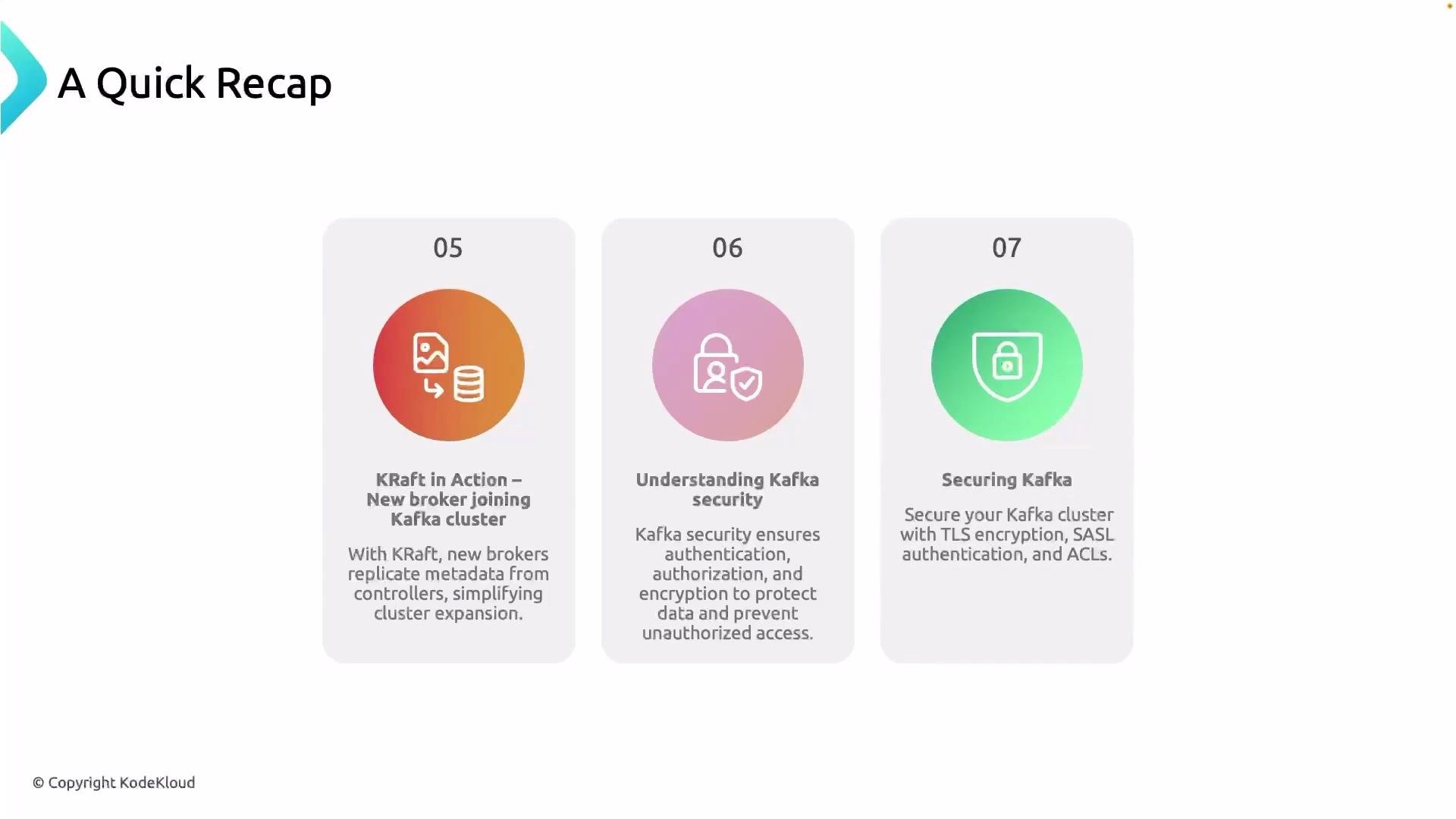
* Brokers fetch metadata from the elected controller (a broker running the controller role) rather than from ZooKeeper.
* The net result is fewer setup steps and faster cluster operations, improving maintainability and automation workflows.
Reference: For hands-on deployments and cluster orchestration examples, see resources such as Kubernetes-focused tutorials and operator guides.
## Security in Kafka
* Kafka supports multiple layers of security to protect data in transit and restrict access:
* TLS: encryption between clients and brokers and between brokers.
* SASL: pluggable authentication (SCRAM, GSSAPI/Kerberos, etc.); sometimes `PLAIN` over TLS for simple cases.
* ACLs: authorization control to define which principals can produce, consume, or manage topics.
* For production environments, combine TLS + SASL + least-privilege ACLs. Also evaluate encryption-at-rest and audit logging as required by compliance.
Practical tips:
* Use TLS for all external connections and inter-broker communication.
* Prefer SCRAM or Kerberos for strong authentication in enterprise deployments.
* Automate ACL lifecycle to align with application onboarding/offboarding.
## KRaft (Kafka Raft) — ZooKeeper replacement
* Newer Kafka versions introduced KRaft, an internal consensus mechanism based on the Raft protocol ([Raft](https://raft.github.io/)).
* KRaft embeds metadata and controller responsibilities inside Kafka brokers, eliminating the need for ZooKeeper.
* Benefits:
* Simplified architecture (fewer moving parts).
* Easier deployments and scaling, especially in dynamic environments like Kubernetes.
* Faster metadata propagation and controller failover via Raft election.
KRaft in practice:
* Brokers fetch metadata from the elected controller (a broker running the controller role) rather than from ZooKeeper.
* The net result is fewer setup steps and faster cluster operations, improving maintainability and automation workflows.
Reference: For hands-on deployments and cluster orchestration examples, see resources such as Kubernetes-focused tutorials and operator guides.
## Security in Kafka
* Kafka supports multiple layers of security to protect data in transit and restrict access:
* TLS: encryption between clients and brokers and between brokers.
* SASL: pluggable authentication (SCRAM, GSSAPI/Kerberos, etc.); sometimes `PLAIN` over TLS for simple cases.
* ACLs: authorization control to define which principals can produce, consume, or manage topics.
* For production environments, combine TLS + SASL + least-privilege ACLs. Also evaluate encryption-at-rest and audit logging as required by compliance.
Practical tips:
* Use TLS for all external connections and inter-broker communication.
* Prefer SCRAM or Kerberos for strong authentication in enterprise deployments.
* Automate ACL lifecycle to align with application onboarding/offboarding.
 ## Final takeaways
* Offsets are central to consumer resilience—pick commit strategies that match your processing guarantees.
* Protect the pipeline from poison pills using retries and a DLQ to preserve overall throughput and reliability.
* KRaft simplifies Kafka’s architecture by removing ZooKeeper, improving operability and scaling.
* Implement layered security (TLS + SASL + ACLs) and consider operational controls like encryption-at-rest and audits for enterprise-grade deployments.
Further reading and resources
* [ZooKeeper — Apache ZooKeeper](https://zookeeper.apache.org)
* [Raft — Distributed Consensus Protocol](https://raft.github.io/)
* Kafka official docs and security guides (search "Kafka security TLS SASL ACLs" for current best practices)
That’s it for this lesson — you should now have a clear, practical summary of offset management, poison pill handling, ZooKeeper vs KRaft, and Kafka security.
## Final takeaways
* Offsets are central to consumer resilience—pick commit strategies that match your processing guarantees.
* Protect the pipeline from poison pills using retries and a DLQ to preserve overall throughput and reliability.
* KRaft simplifies Kafka’s architecture by removing ZooKeeper, improving operability and scaling.
* Implement layered security (TLS + SASL + ACLs) and consider operational controls like encryption-at-rest and audits for enterprise-grade deployments.
Further reading and resources
* [ZooKeeper — Apache ZooKeeper](https://zookeeper.apache.org)
* [Raft — Distributed Consensus Protocol](https://raft.github.io/)
* Kafka official docs and security guides (search "Kafka security TLS SASL ACLs" for current best practices)
That’s it for this lesson — you should now have a clear, practical summary of offset management, poison pill handling, ZooKeeper vs KRaft, and Kafka security.