> ## Documentation Index
> Fetch the complete documentation index at: https://notes.kodekloud.com/llms.txt
> Use this file to discover all available pages before exploring further.
# Kafka in Finance Real time Transaction Processing
> Using Apache Kafka to enable real-time financial transaction processing, facilitating compliance, fraud detection, account updates, notifications, and auditable event streaming with scalable, low latency architecture
Welcome back.
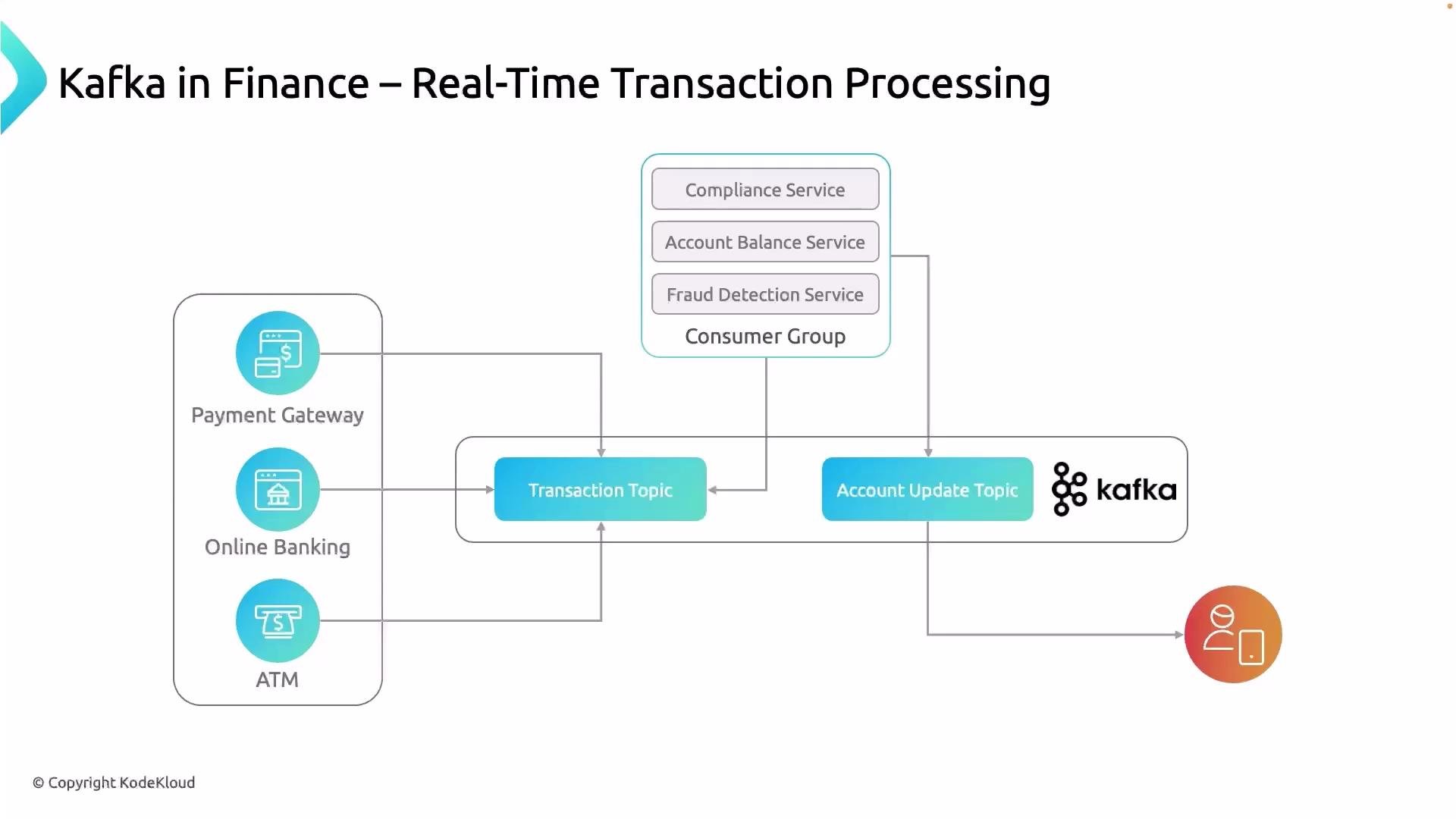
This lesson examines a practical financial use case for Apache Kafka: real-time transaction processing. You will see a clear architecture diagram and learn how events flow through Kafka to enable compliance checks, fraud detection, account updates, and customer notifications with low latency.
Why this matters: event streaming with Kafka lets banks process high volumes of transactions concurrently, persist events durably for auditability, and add new consumers (analytics, reporting, alerts) without changing producers.
Sources of transaction events
* Payment gateways (cards, UPI, QR-code scans)
* Online banking operations (web, mobile)
* ATM withdrawals and deposits
Each operation emits an event that must be recorded and processed immediately. In Kafka, producers write these events to a topic — a durable, append-only stream where related events are stored and consumed by multiple independent services.
A topic is a logical stream of similar events (for example, `transactions`). Producers write events to the topic, and multiple consumers or stream processors can read and react to the same stream independently.
How the processing flow typically works
1. Producers (payment gateways, banking systems, ATMs) publish transaction events to a Kafka topic (for example, `transactions`).
2. Multiple consumers or stream processors subscribe to that topic and perform separate tasks in parallel:
* Compliance service: validates transactions against regulatory and internal policies.
* Fraud detection service: runs real-time scoring and anomaly detection to flag suspicious behavior.
* Account-update service: applies the transaction to account balances and emits confirmation events.
3. After processing, services may publish derived events to other topics (for example, `account-updates`, `fraud-alerts`, `exceptions`), which downstream consumers (notifications, ledgers, analytics) use to complete the workflow.
 Example end-to-end event flow
* A payment gateway produces a transaction event to the `transactions` topic.
* Fraud detection consumes the event and scores it; if suspicious, it emits an alert to `fraud-alerts` or triggers a workflow to place a hold.
* Compliance consumes the same event and, if needed, writes to `exceptions` or `holds`.
* Account-update processor consumes `transactions`, updates balances, and writes a confirmation event to `account-updates`.
* Notification service consumes `account-updates` and sends a real-time SMS/push notification to the customer.
Sample transaction event (JSON):
```json theme={null}
{
"transaction_id": "txn_12345",
"account_id": "acct_98765",
"amount": 125.50,
"currency": "USD",
"timestamp": "2026-07-15T12:34:56Z",
"merchant": "Merchant A",
"method": "card"
}
```
Mapping of consumers to responsibilities
| Consumer / Processor | Responsibility | Output Topic / Action |
| -------------------- | ------------------------------------------------ | -------------------------------------------- |
| Fraud detection | Real-time scoring, anomaly detection, risk flags | `fraud-alerts` or workflow trigger |
| Compliance | Regulatory checks, policy validation, holds | `exceptions`, `holds` |
| Account-update | Apply transaction to balances, ledger write | `account-updates` |
| Notification service | Customer notifications (SMS, email, push) | N/A (external notifications) |
| Analytics / Auditing | Aggregations, reporting, historical analysis | Reads from `transactions`, `account-updates` |
Production considerations
| Concern | What to tune or choose |
| ------------------------- | ---------------------------------------------------------------------------------------- |
| Partitioning | Design partitions by key (e.g., `account_id`) for throughput and parallelism |
| Delivery guarantees | Choose between at-least-once vs exactly-once semantics depending on financial guarantees |
| Stream processing & state | Use Kafka Streams or ksqlDB for low-latency, stateful processing and joins |
| Latency & throughput | Scale brokers/partitions and use idempotent producers to balance throughput vs latency |
| Retention & auditability | Configure retention and tiered storage or archival to meet regulatory requirements |
Exactly-once semantics in distributed systems is complex. Use Kafka transactions and idempotent producers carefully and test end-to-end to ensure balance updates and compliance checks remain correct under failures.
Why Kafka is a good fit for real-time financial processing
* Durable, ordered event storage for audit and replay
* Multiple independent consumers can process the same stream without interfering
* High throughput and low latency with partitioning and parallel consumers
* Ease of scaling and adding new consumers (analytics, auditing) without changing producers
Further reading and references
* [Event Streaming with Kafka (course)](https://learn.kodekloud.com/user/courses/event-streaming-with-kafka)
* [ksqlDB — Streaming SQL for Kafka](https://ksqldb.io/)
* [Kafka Streams](https://kafka.apache.org/documentation/streams/)
* [Apache Kafka documentation](https://kafka.apache.org/documentation/)
This pattern—using Kafka as the central nervous system—enables banks to build resilient, auditable, and scalable real-time transaction platforms. There are many other Kafka use cases in finance worth exploring, such as market data distribution, payment reconciliation, and real-time analytics.
Example end-to-end event flow
* A payment gateway produces a transaction event to the `transactions` topic.
* Fraud detection consumes the event and scores it; if suspicious, it emits an alert to `fraud-alerts` or triggers a workflow to place a hold.
* Compliance consumes the same event and, if needed, writes to `exceptions` or `holds`.
* Account-update processor consumes `transactions`, updates balances, and writes a confirmation event to `account-updates`.
* Notification service consumes `account-updates` and sends a real-time SMS/push notification to the customer.
Sample transaction event (JSON):
```json theme={null}
{
"transaction_id": "txn_12345",
"account_id": "acct_98765",
"amount": 125.50,
"currency": "USD",
"timestamp": "2026-07-15T12:34:56Z",
"merchant": "Merchant A",
"method": "card"
}
```
Mapping of consumers to responsibilities
| Consumer / Processor | Responsibility | Output Topic / Action |
| -------------------- | ------------------------------------------------ | -------------------------------------------- |
| Fraud detection | Real-time scoring, anomaly detection, risk flags | `fraud-alerts` or workflow trigger |
| Compliance | Regulatory checks, policy validation, holds | `exceptions`, `holds` |
| Account-update | Apply transaction to balances, ledger write | `account-updates` |
| Notification service | Customer notifications (SMS, email, push) | N/A (external notifications) |
| Analytics / Auditing | Aggregations, reporting, historical analysis | Reads from `transactions`, `account-updates` |
Production considerations
| Concern | What to tune or choose |
| ------------------------- | ---------------------------------------------------------------------------------------- |
| Partitioning | Design partitions by key (e.g., `account_id`) for throughput and parallelism |
| Delivery guarantees | Choose between at-least-once vs exactly-once semantics depending on financial guarantees |
| Stream processing & state | Use Kafka Streams or ksqlDB for low-latency, stateful processing and joins |
| Latency & throughput | Scale brokers/partitions and use idempotent producers to balance throughput vs latency |
| Retention & auditability | Configure retention and tiered storage or archival to meet regulatory requirements |
Exactly-once semantics in distributed systems is complex. Use Kafka transactions and idempotent producers carefully and test end-to-end to ensure balance updates and compliance checks remain correct under failures.
Why Kafka is a good fit for real-time financial processing
* Durable, ordered event storage for audit and replay
* Multiple independent consumers can process the same stream without interfering
* High throughput and low latency with partitioning and parallel consumers
* Ease of scaling and adding new consumers (analytics, auditing) without changing producers
Further reading and references
* [Event Streaming with Kafka (course)](https://learn.kodekloud.com/user/courses/event-streaming-with-kafka)
* [ksqlDB — Streaming SQL for Kafka](https://ksqldb.io/)
* [Kafka Streams](https://kafka.apache.org/documentation/streams/)
* [Apache Kafka documentation](https://kafka.apache.org/documentation/)
This pattern—using Kafka as the central nervous system—enables banks to build resilient, auditable, and scalable real-time transaction platforms. There are many other Kafka use cases in finance worth exploring, such as market data distribution, payment reconciliation, and real-time analytics.