> ## Documentation Index
> Fetch the complete documentation index at: https://notes.kodekloud.com/llms.txt
> Use this file to discover all available pages before exploring further.
# Section Summary
> This article explores WebAssembly fundamentals, practical applications, and guides readers in building a simple module using C, C++, or Rust.
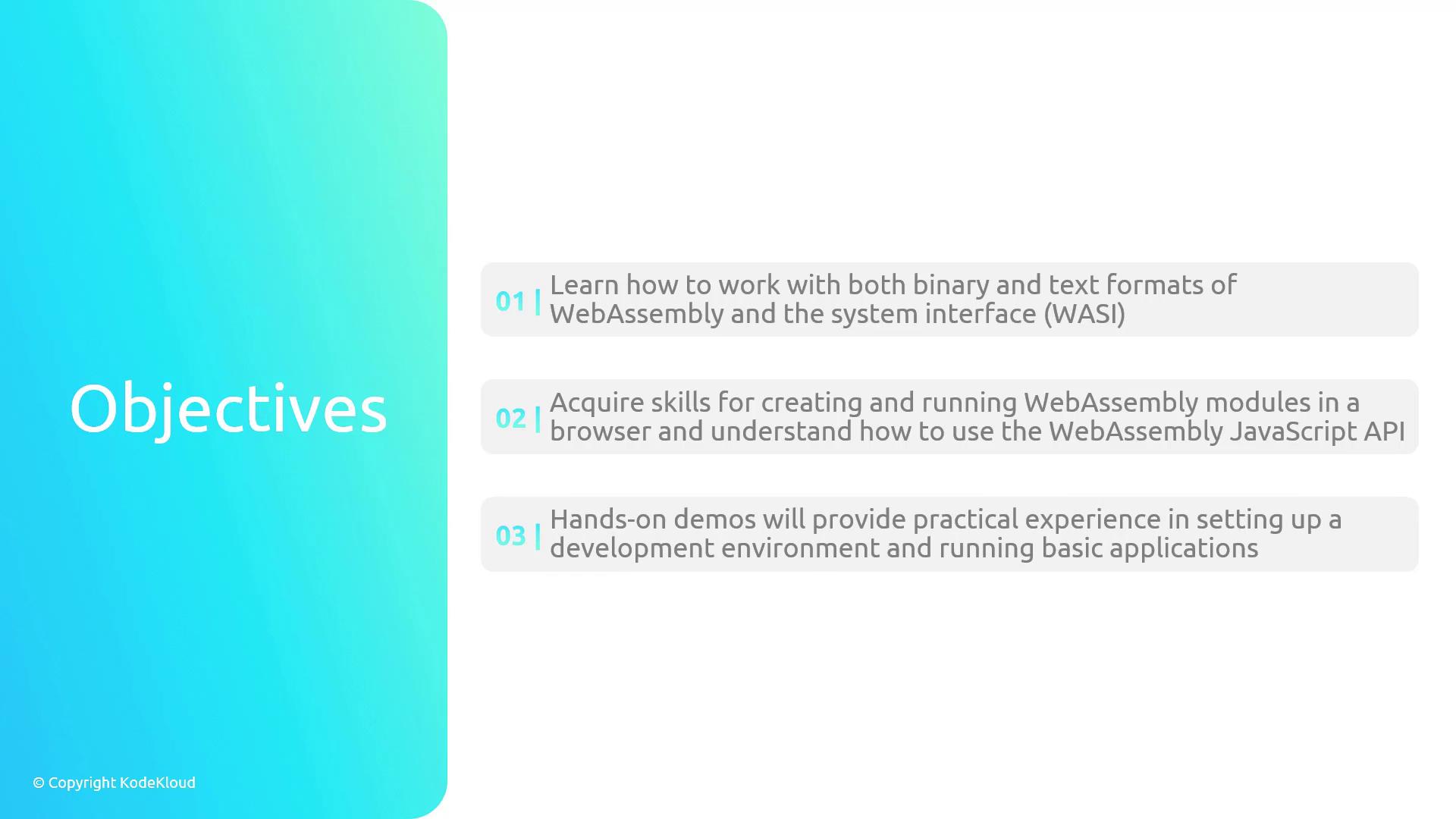
In this section, we’ll explore the fundamentals of WebAssembly and its practical applications:
* WebAssembly Binary Format (WASM)
* Human-readable Text Format (WAT)
* WebAssembly System Interface (WASI)
You’ll build a simple “Hello World” module in C, C++, or Rust, compile it to WASM, and embed it in a web page using the WebAssembly JavaScript API. Hands-on labs will guide you through environment setup, compilation, and execution in both browser and WASI runtimes.
## Key Topics
| Topic | Description | Reference |
| ---------------------------- | ---------------------------------------------------------------- | --------------------------------------------------------------------------------------------- |
| WebAssembly Binary Format | Compact bytecode optimized for performance | [WASM Spec](https://webassembly.github.io/spec/) |
| Text Format (WAT) | Readable s-expression syntax that assembles into WASM binary | [MDN WAT Guide](https://developer.mozilla.org/docs/WebAssembly/Understanding_the_text_format) |
| WebAssembly System Interface | POSIX-like APIs for file I/O and networking in WASI environments | [WASI Docs](https://wasi.dev/) |
| Module Creation & Execution | Compiling from Rust/C/C++ to WASM and running modules locally | [wasm-bindgen](https://github.com/rustwasm/wasm-bindgen) |
| JavaScript Integration | Loading and calling WASM functions via the WebAssembly JS API | [MDN WebAssembly API](https://developer.mozilla.org/docs/WebAssembly/JavaScript_interface) |
Make sure you have:
* Node.js (v14 or later)
* Rust/C/C++ toolchain with WebAssembly targets
* A modern browser supporting WASM
By the end of this lesson, you will be able to:
* Differentiate between WASM binary and text formats
* Compile and run WebAssembly modules locally and in the browser
* Leverage WASI for system-level interactions
* Embed and interact with WebAssembly modules from JavaScript
## Useful Resources
* [Official WebAssembly Documentation](https://webassembly.org/docs/)
* [MDN WebAssembly Guides](https://developer.mozilla.org/docs/WebAssembly)
* [Wasmtime Runtime](https://github.com/bytecodealliance/wasmtime)