> ## Documentation Index
> Fetch the complete documentation index at: https://notes.kodekloud.com/llms.txt
> Use this file to discover all available pages before exploring further.
# Memory and Tables
> This article explains the concepts of memory and tables in WebAssembly, highlighting their roles in data storage and function lookup.
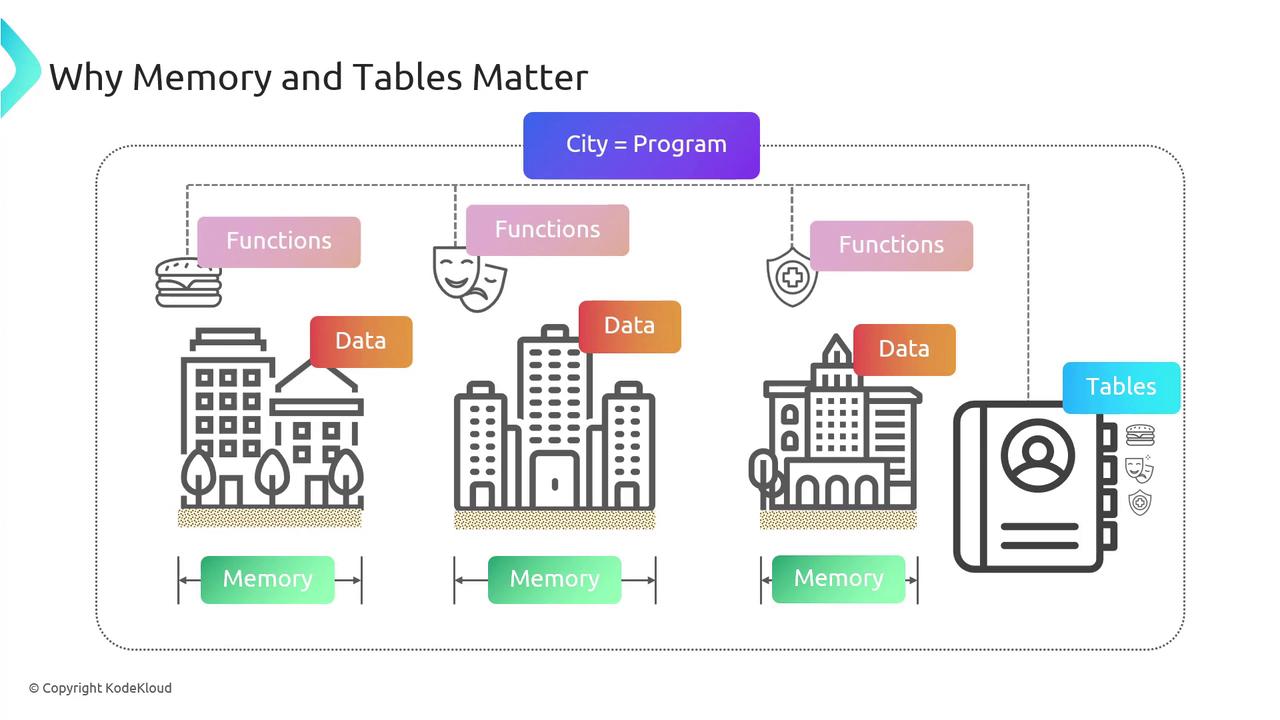
In the WebAssembly ecosystem, two core components—**memory** and **tables**—provide structured storage and dynamic function lookup. Think of your application as a city:
* **Memory** is the land where data “buildings” (variables, arrays, structs) stand.
* **Tables** are the city directory listing services (function references) for quick access.
## WebAssembly Memory
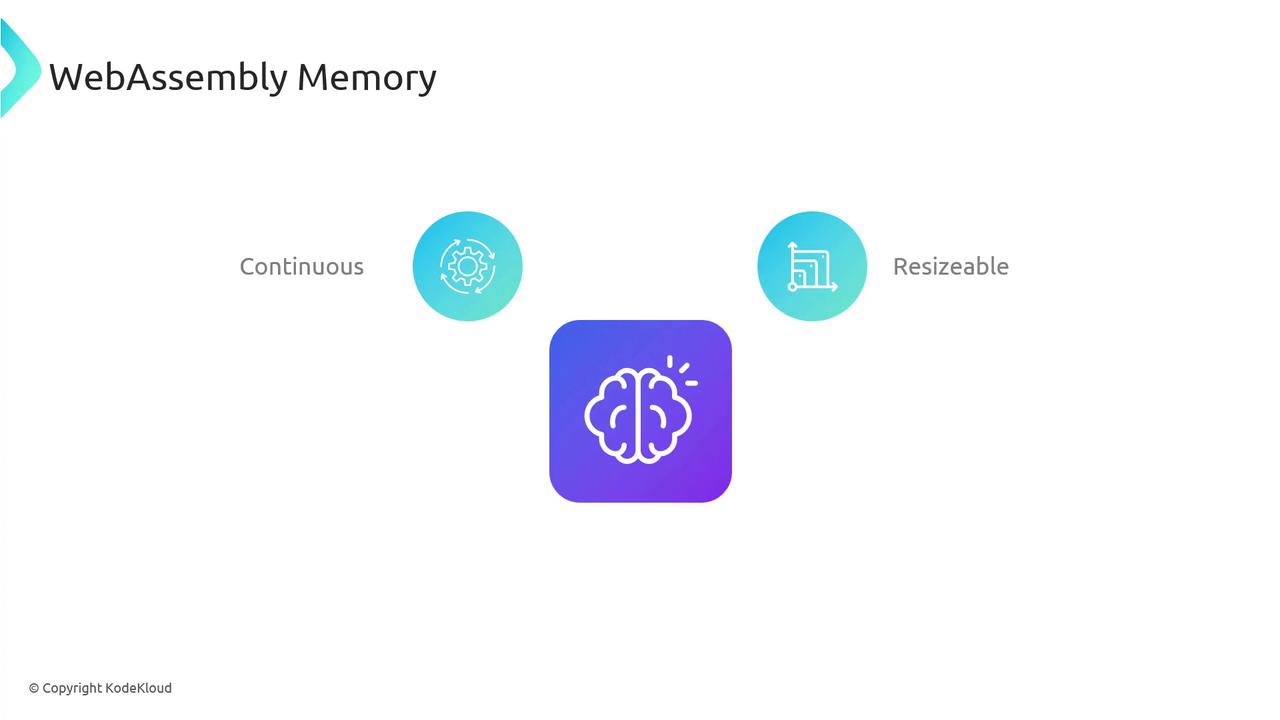
WebAssembly memory is a sandboxed, growable linear buffer of bytes. It holds everything from your module’s numeric data to string buffers.
| Feature | Description |
| ---------- | ------------------------------------------------------------ |
| Continuous | Represented as one contiguous array of bytes |
| Resizable | Can be expanded at runtime (within limits) |
| Isolated | Sandboxed to prevent corruption of the host or other modules |
Out-of-bounds memory accesses in WebAssembly always trap, ensuring that modules cannot read or write arbitrary host memory.
You can define memory in your `.wat` module like this:
```wat theme={null}
(module
(memory $mem 1 2) ;; initial size = 1 page (64KiB), max size = 2 pages
;; ...
)
```
And from JavaScript:
```js theme={null}
const wasm = await WebAssembly.instantiateStreaming(fetch('module.wasm'));
const memoryBuffer = new Uint8Array(wasm.instance.exports.memory.buffer);
// Read or write to memoryBuffer as needed
```
## WebAssembly Tables
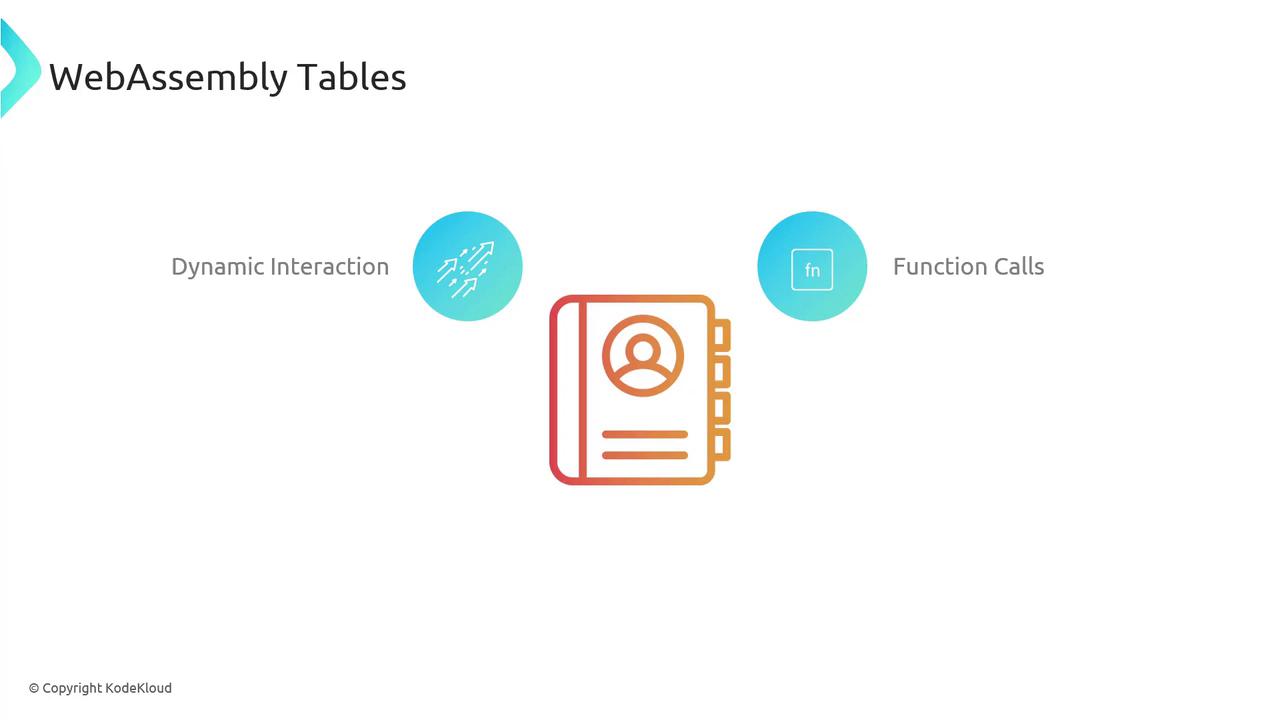
Tables are lookup structures for function references (and, with the **reference types** proposal, external references). They don’t contain code—only pointers—enabling **indirect calls** and dynamic dispatch.
For instance, define a table of `funcref` entries:
```wat theme={null}
(module
(table $t 2 funcref) ;; table with 2 function slots
(elem (i32.const 0) $f1 $f2) ;; initialize slots
(func $f1 (result i32) (i32.const 42))
(func $f2 (result i32) (i32.const 100))
(func (export "call_indirect") (param i32) (result i32)
(call_indirect (type $t) (local.get 0))
)
)
```
When you call `call_indirect` with `0` or `1`, WebAssembly jumps to `$f1` or `$f2` respectively—just like dialing a number on a menu.
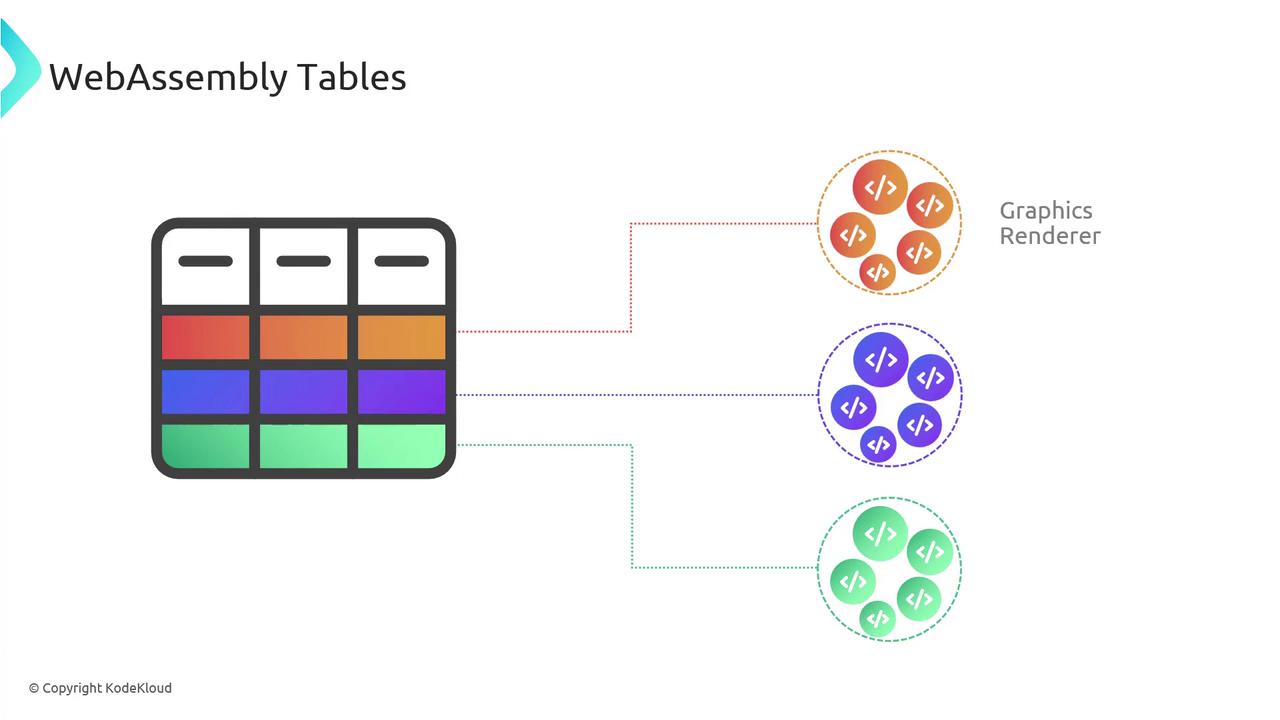
If you call an uninitialized or out-of-bounds table index, WebAssembly will trap immediately.
With the **`externref`** feature, tables can also hold references to host objects (e.g., JS DOM nodes or game entities). This powerful extension enables seamless interoperability between WebAssembly modules and their host environment.
## Summary
WebAssembly’s memory and tables provide:
* Secure, linear storage for all data
* Dynamic, sandboxed function dispatch
* Runtime growth and module evolution without rewriting callers
Mastering these primitives is essential for building high-performance, modular WebAssembly applications that integrate smoothly with JavaScript or other host environments.
***
## Further Reading
* [MDN WebAssembly Memory](https://developer.mozilla.org/en-US/docs/WebAssembly/Memory)
* [MDN WebAssembly Table](https://developer.mozilla.org/en-US/docs/WebAssembly/Table)
* [WebAssembly Reference Types Proposal](https://github.com/WebAssembly/reference-types)