> ## Documentation Index
> Fetch the complete documentation index at: https://notes.kodekloud.com/llms.txt
> Use this file to discover all available pages before exploring further.
# Demo BM25 vs Semantic Search
> Demonstration comparing BM25 token matching with sentence-transformer semantic retrieval and a weighted hybrid ranker, with runnable Jupyter notebook, code, and tuning guidance.
In this lesson we compare classic BM25 retrieval with true semantic search (using sentence-transformers), then build a simple hybrid ranker that blends both signals. This example is compact, corrected, and runnable in a Jupyter-friendly notebook.
BM25 is a token-statistics method that excels at matching exact terms and weighting important tokens, but it can miss synonyms, paraphrases, and deeper meaning. A bi-encoder (sentence-transformers) maps queries and documents to vectors and uses cosine similarity to retrieve semantically similar items. A hybrid approach combines both strengths and often yields more robust retrieval for real applications.
Quick links:
* SentenceTransformers: [https://www.sbert.net/](https://www.sbert.net/)
* rank\_bm25: [https://github.com/dorianbrown/rank\_bm25](https://github.com/dorianbrown/rank_bm25)
## Installation
Install the required Python packages (Jupyter-friendly):
```bash theme={null}
!pip install -q sentence-transformers rank-bm25 scikit-learn numpy
```
## Overview: how the demo works
1. Prepare a small document corpus and example queries.
2. Tokenize documents for BM25 and initialize the BM25 index.
3. Encode documents with a sentence-transformer to produce normalized embeddings.
4. For each query:
* Get BM25 scores (token overlap / importance).
* Get semantic scores (cosine similarity with embeddings).
* Normalize both score vectors to \[0,1] and combine them with a weighted linear blend: hybrid = alpha \* semantic + (1-alpha) \* bm25.
5. Compare the top-k results for BM25, semantic, and hybrid.
## Corpus, queries, and imports
```python theme={null}
from rank_bm25 import BM25Okapi
from sentence_transformers import SentenceTransformer, util
import numpy as np
docs = [
"Enable two-factor authentication (2FA) in your account settings to add an extra security step.",
"HbA1c measures long-term glucose; talk to your physician about tests for glycated hemoglobin.",
"Our PTO policy covers paid time off for vacations and sick leave.",
"How to fix engine misfires caused by bad spark plugs.",
"Kubernetes Ingress configuration for path-based routing.",
"Configure MFA with authenticator apps.",
"Doctor appointment scheduling policy."
]
queries = ["How do I set up 2FA?", "What does HbA1c mean?", "sick leave policy?"]
```
## Prepare BM25 and SentenceTransformer embeddings
```python theme={null}
# Prepare BM25
tokenized_corpus = [d.lower().split() for d in docs]
bm25 = BM25Okapi(tokenized_corpus)
# Choose a model (fast general-purpose)
model = SentenceTransformer('all-MiniLM-L6-v2')
doc_emb = model.encode(docs, convert_to_tensor=True, normalize_embeddings=True)
```
## Helper: show results for a query (BM25, semantic, and weighted hybrid)
```python theme={null}
def show_results(query, k=3, alpha=0.8):
"""
Show BM25 top-k, semantic top-k, and hybrid top-k for `query`.
alpha: semantic weight in [0,1] for hybrid. hybrid = alpha*semantic + (1-alpha)*bm25
"""
print(f"\nQUERY: {query}\n" + "="*60)
# BM25 scores
bm25_scores = np.array(bm25.get_scores(query.lower().split()))
top_bm25 = np.argsort(-bm25_scores)[:k]
print("BM25 top-k:")
for i in top_bm25:
print(f" [{i}] {bm25_scores[i]:.3f} {docs[i]}")
# Semantic (SentenceTransformer) scores (cosine similarity)
q_emb = model.encode([query], convert_to_tensor=True, normalize_embeddings=True)
cos = util.cos_sim(q_emb, doc_emb)[0].cpu().numpy()
top_st = np.argsort(-cos)[:k]
print("\nSemantic (SentenceTransformer) top-k:")
for i in top_st:
print(f" [{i}] {cos[i]:.3f} {docs[i]}")
# Normalize both scores into [0,1] to combine them
bm25_min, bm25_max = bm25_scores.min(), bm25_scores.max()
bm25_norm = (bm25_scores - bm25_min) / (bm25_max - bm25_min + 1e-9)
st_min, st_max = cos.min(), cos.max()
st_norm = (cos - st_min) / (st_max - st_min + 1e-9)
# Hybrid: semantic-weighted combination
hybrid = alpha * st_norm + (1.0 - alpha) * bm25_norm
top_h = np.argsort(-hybrid)[:k]
print(f"\nHybrid (BM25 + Semantic) top-k (alpha={alpha}):")
for i in top_h:
print(f" [{i}] {hybrid[i]:.3f} {docs[i]}")
```
## Run the demo for all queries (default semantic weight alpha=0.8)
```python theme={null}
for q in queries:
show_results(q, k=3, alpha=0.8)
```
## Discussion and example behavior
* BM25 relies on token overlap and term importance. It may favor documents that share surface words with the query (even if the meaning differs).
* SentenceTransformer returns semantically similar results by embedding meaning, so it better handles synonyms and paraphrases (e.g., mapping "2FA" to "two-factor authentication").
* The hybrid approach blends both signals using `alpha`. Values:
* `alpha > 0.5` favors semantic matching.
* `alpha < 0.5` favors BM25.
* Normalizing both score arrays to \[0,1] before combining allows a simple weighted linear blend that is robust to differing score scales. The small epsilon (`1e-9`) prevents division-by-zero for degenerate score distributions.
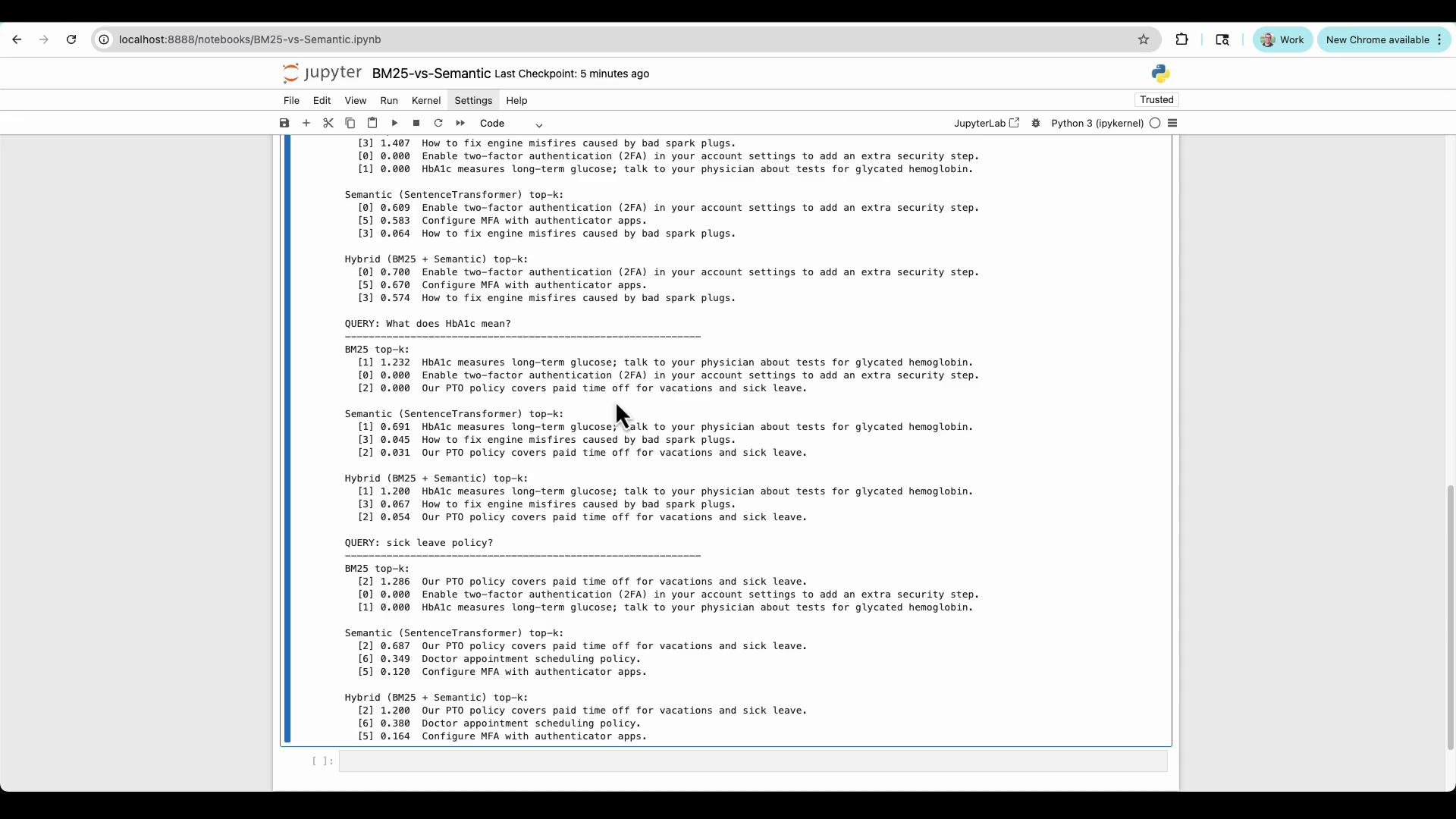 ## Sample (cleaned) output for illustration
```plaintext theme={null}
QUERY: How do I set up 2FA?
============================================================
BM25 top-k:
[3] 1.487 How to fix engine misfires caused by bad spark plugs.
[0] 0.000 Enable two-factor authentication (2FA) in your account settings to add an extra security step.
[5] 0.000 Configure MFA with authenticator apps.
Semantic (SentenceTransformer) top-k:
[0] 0.689 Enable two-factor authentication (2FA) in your account settings to add an extra security step.
[5] 0.583 Configure MFA with authenticator apps.
[3] 0.064 How to fix engine misfires caused by bad spark plugs.
Hybrid (BM25 + Semantic) top-k (alpha=0.8):
[0] 0.720 Enable two-factor authentication (2FA) in your account settings to add an extra security step.
[5] 0.670 Configure MFA with authenticator apps.
[3] 0.574 How to fix engine misfires caused by bad spark plugs.
```
## Tuning guidance
Tune `alpha` and experiment with different sentence-transformer models (for example, `all-MiniLM-L6-v2` for speed or `multi-qa-MiniLM-L6-cos-v1` for QA-style retrieval). Use a labeled validation set (queries with known correct docs) to measure precision/recall and choose alpha and model for your dataset. If BM25 returns many identical scores (common in small corpora), the semantic signal typically helps; if semantic matching over-generalizes in your domain, increase BM25 weight.
### Switching the embedding model (example)
```python theme={null}
# Example: use a QA-tuned model
model = SentenceTransformer('multi-qa-MiniLM-L6-cos-v1')
doc_emb = model.encode(docs, convert_to_tensor=True, normalize_embeddings=True)
# Re-run show_results with the new embeddings:
for q in queries:
show_results(q, k=3, alpha=0.8)
```
## Quick comparison
| Method | Strengths | When to use |
| --------------------- | ---------------------------------------------------------------- | --------------------------------------------------------------- |
| BM25 | Fast, interpretable, strong on exact matches and term importance | Short queries, domain with consistent terminology |
| Semantic (bi-encoder) | Handles synonyms, paraphrase, and deeper meaning | Natural-language queries, varied vocabulary |
| Hybrid (weighted) | Combines both signals, tunable with `alpha` | Real-world retrieval where both surface form and meaning matter |
## Final notes
* This demo uses a very small toy corpus for illustration. On larger corpora you'll get more stable BM25 distributions and richer semantic matches.
* Keep the retrieval pipeline configurable: `alpha`, `k`, and `model` selection should be part of your evaluation loop.
* Validate hybrid weighting with representative queries and metrics (e.g., recall\@k, MRR) before deploying to production.
References and further reading:
* [SentenceTransformers documentation](https://www.sbert.net/)
* [rank\_bm25 GitHub repository](https://github.com/dorianbrown/rank_bm25)
* [BM25 overview (Wikipedia)](https://en.wikipedia.org/wiki/Okapi_BM25)
## Sample (cleaned) output for illustration
```plaintext theme={null}
QUERY: How do I set up 2FA?
============================================================
BM25 top-k:
[3] 1.487 How to fix engine misfires caused by bad spark plugs.
[0] 0.000 Enable two-factor authentication (2FA) in your account settings to add an extra security step.
[5] 0.000 Configure MFA with authenticator apps.
Semantic (SentenceTransformer) top-k:
[0] 0.689 Enable two-factor authentication (2FA) in your account settings to add an extra security step.
[5] 0.583 Configure MFA with authenticator apps.
[3] 0.064 How to fix engine misfires caused by bad spark plugs.
Hybrid (BM25 + Semantic) top-k (alpha=0.8):
[0] 0.720 Enable two-factor authentication (2FA) in your account settings to add an extra security step.
[5] 0.670 Configure MFA with authenticator apps.
[3] 0.574 How to fix engine misfires caused by bad spark plugs.
```
## Tuning guidance
Tune `alpha` and experiment with different sentence-transformer models (for example, `all-MiniLM-L6-v2` for speed or `multi-qa-MiniLM-L6-cos-v1` for QA-style retrieval). Use a labeled validation set (queries with known correct docs) to measure precision/recall and choose alpha and model for your dataset. If BM25 returns many identical scores (common in small corpora), the semantic signal typically helps; if semantic matching over-generalizes in your domain, increase BM25 weight.
### Switching the embedding model (example)
```python theme={null}
# Example: use a QA-tuned model
model = SentenceTransformer('multi-qa-MiniLM-L6-cos-v1')
doc_emb = model.encode(docs, convert_to_tensor=True, normalize_embeddings=True)
# Re-run show_results with the new embeddings:
for q in queries:
show_results(q, k=3, alpha=0.8)
```
## Quick comparison
| Method | Strengths | When to use |
| --------------------- | ---------------------------------------------------------------- | --------------------------------------------------------------- |
| BM25 | Fast, interpretable, strong on exact matches and term importance | Short queries, domain with consistent terminology |
| Semantic (bi-encoder) | Handles synonyms, paraphrase, and deeper meaning | Natural-language queries, varied vocabulary |
| Hybrid (weighted) | Combines both signals, tunable with `alpha` | Real-world retrieval where both surface form and meaning matter |
## Final notes
* This demo uses a very small toy corpus for illustration. On larger corpora you'll get more stable BM25 distributions and richer semantic matches.
* Keep the retrieval pipeline configurable: `alpha`, `k`, and `model` selection should be part of your evaluation loop.
* Validate hybrid weighting with representative queries and metrics (e.g., recall\@k, MRR) before deploying to production.
References and further reading:
* [SentenceTransformers documentation](https://www.sbert.net/)
* [rank\_bm25 GitHub repository](https://github.com/dorianbrown/rank_bm25)
* [BM25 overview (Wikipedia)](https://en.wikipedia.org/wiki/Okapi_BM25)