> ## Documentation Index
> Fetch the complete documentation index at: https://notes.kodekloud.com/llms.txt
> Use this file to discover all available pages before exploring further.
# Vector Database Options for RAG
> Comparison and guidance on choosing vector databases for RAG, covering local, self-hosted, and managed options, trade-offs, benchmarks, and practical recommendations
Choosing the right vector database for Retrieval-Augmented Generation (RAG) requires weighing trade-offs between latency, recall, cost, and operational complexity. This article summarizes evaluation criteria, compares the major options across the local → self-hosted → managed spectrum, and gives practical recommendations for prototypes and production systems.
When evaluating vector stores, focus on measurable goals: latency targets (ms), recall/QPS, dataset size (vectors), and operational constraints (team skills, budget). Benchmarks against a realistic workload quickly expose practical trade-offs.
## Key considerations
* Latency versus recall: Small latency improvements can be critical in production; sometimes sacrificing a fraction of recall yields orders-of-magnitude gains in response time.
* Hybrid search: Combine vector similarity, keyword matching, and metadata filters to improve retrieval relevance in real-world applications.
* Scale: From millions to billions of vectors, indexing time, memory, and cluster architecture requirements change substantially.
* Operations model: Decide between self-hosting (control, predictable costs) and managed services (lower ops overhead, higher ongoing cost).
* Ecosystem fit: Evaluate SDKs, client libraries, integrations, monitoring, and community/support resources.
Landscape overview: local → self-hosted → managed
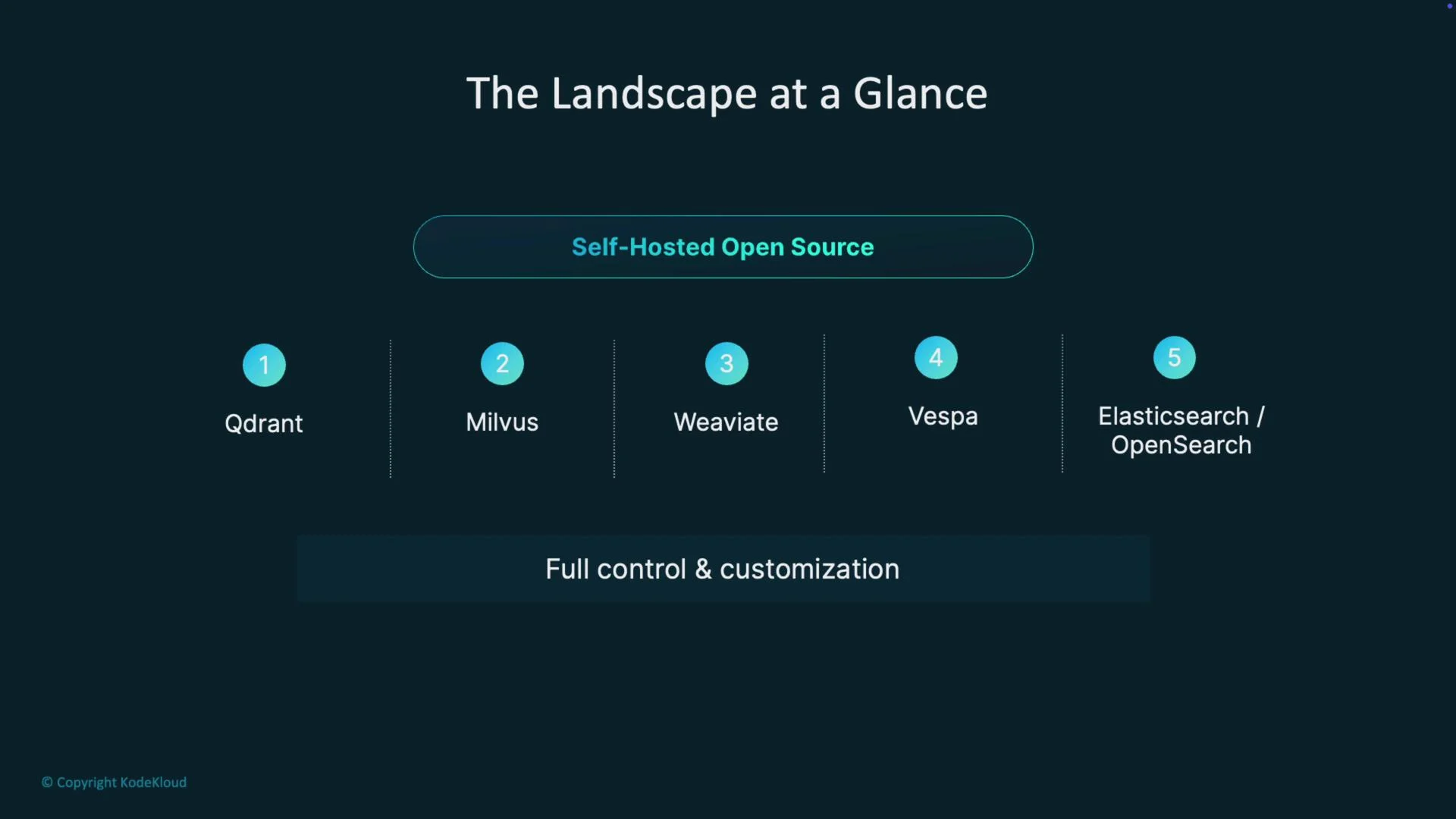
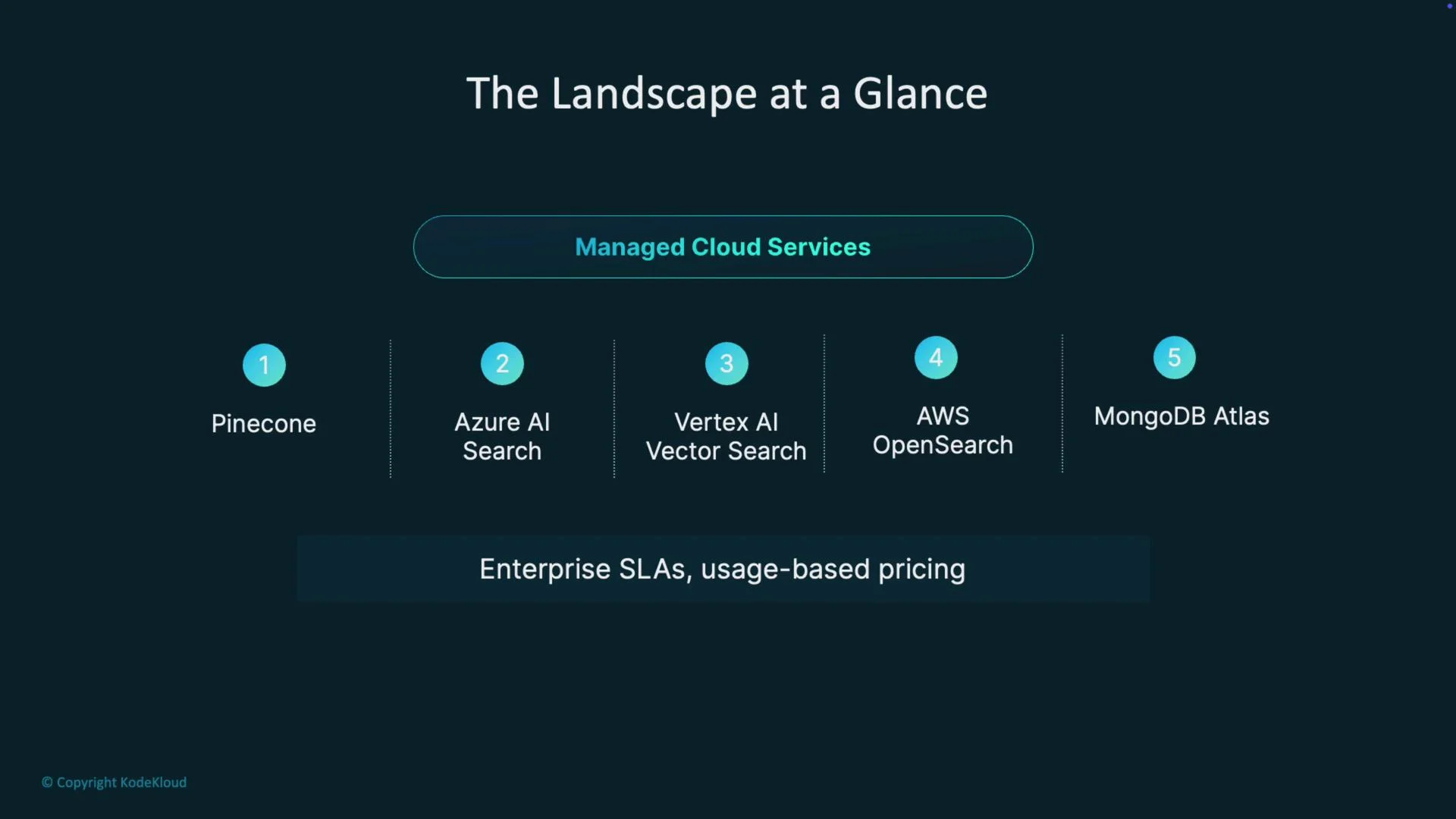
Local and embedded options (great for development and small POCs) run on a developer machine or a small VM with minimal infrastructure. Self-hosted open-source systems offer control and customization but require operational responsibility. Managed cloud services minimize ops overhead and accelerate time-to-production at the expense of usage-based pricing and potentially less infrastructure control.
 Managed options are typically easier to provision and maintain but come with usage-based pricing and potential vendor lock-in.
 A pragmatic path: start local/embedded for fast iteration, move to self-hosted for cost predictability and control, and adopt managed services when you need elastic scaling or want to offload operations.
## ChromaDB (local-first)
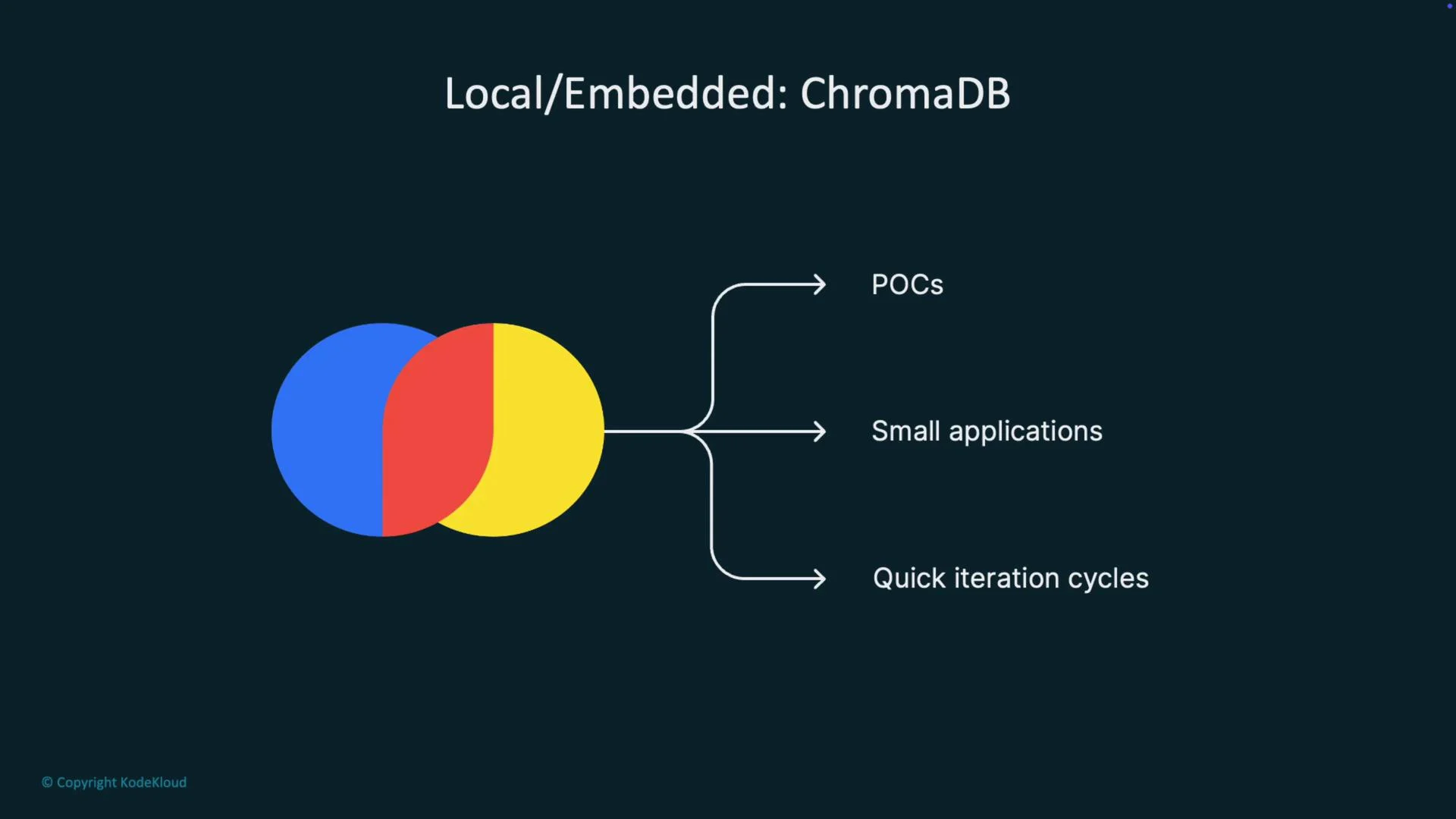
ChromaDB is a local-first vector store that embeds directly in your application process. It's ideal for quick prototyping, small POCs, and developer workflows because it provides RAG-friendly defaults and metadata filtering out of the box. As needs grow you’ll need to plan scaling and high-availability strategies beyond a single machine.
A pragmatic path: start local/embedded for fast iteration, move to self-hosted for cost predictability and control, and adopt managed services when you need elastic scaling or want to offload operations.
## ChromaDB (local-first)
ChromaDB is a local-first vector store that embeds directly in your application process. It's ideal for quick prototyping, small POCs, and developer workflows because it provides RAG-friendly defaults and metadata filtering out of the box. As needs grow you’ll need to plan scaling and high-availability strategies beyond a single machine.
 ## Local / embedded alternatives
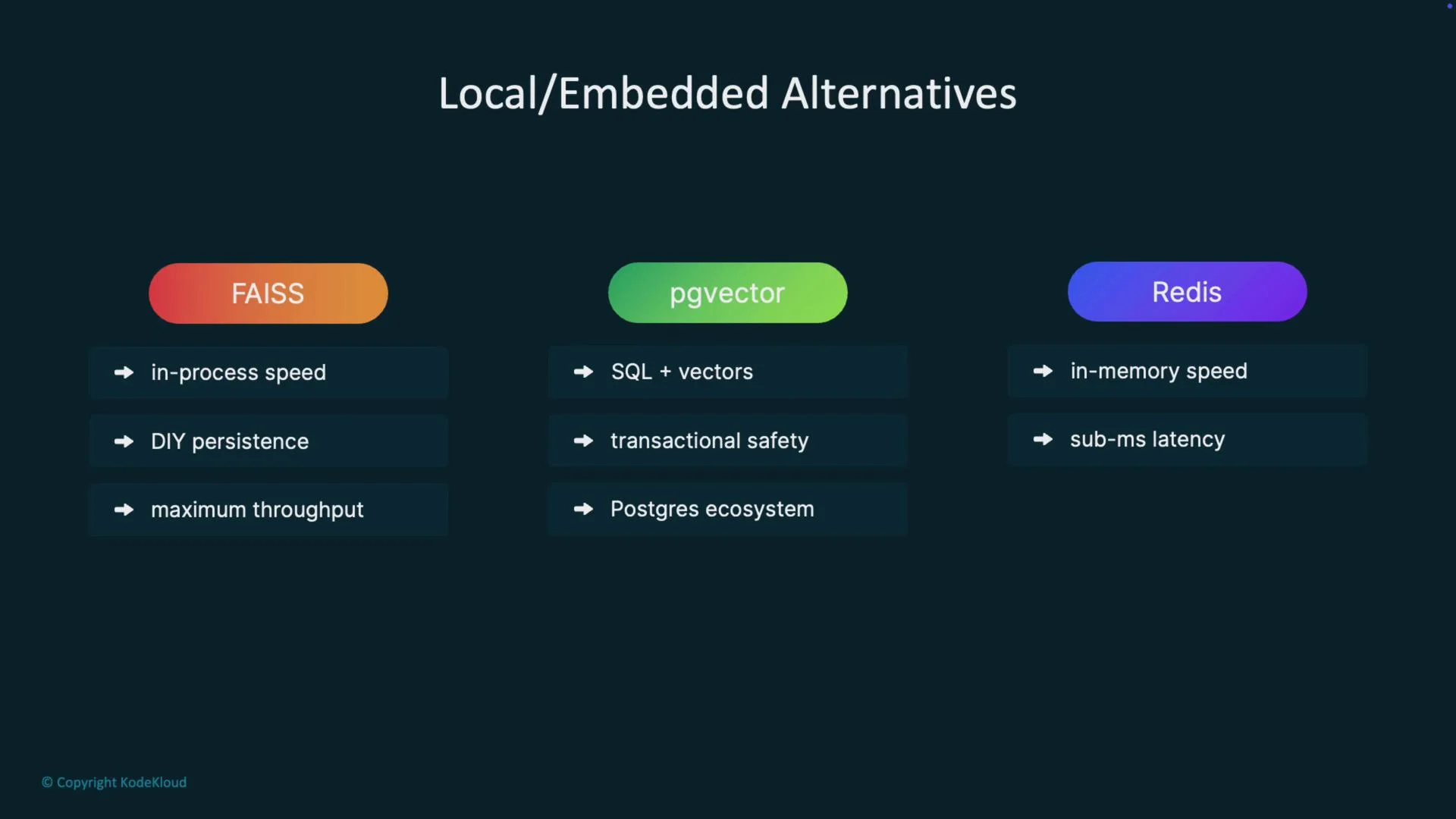
* FAISS: Extremely fast library-level nearest neighbor search with in-process performance. You must provide persistence, sharding, and state management for durability and distribution.
* pgvector: Adds vector support to Postgres. Ideal when your application already uses Postgres — benefits include ACID semantics and familiar tooling.
* Redis (with RedisSearch/RedisVector): In-memory vectors can achieve sub-millisecond latency for small working sets. Expect higher RAM costs; a common pattern is Redis as a hot cache plus a cold vector store.
## Local / embedded alternatives
* FAISS: Extremely fast library-level nearest neighbor search with in-process performance. You must provide persistence, sharding, and state management for durability and distribution.
* pgvector: Adds vector support to Postgres. Ideal when your application already uses Postgres — benefits include ACID semantics and familiar tooling.
* Redis (with RedisSearch/RedisVector): In-memory vectors can achieve sub-millisecond latency for small working sets. Expect higher RAM costs; a common pattern is Redis as a hot cache plus a cold vector store.
 ## Self-hosted solutions
* Qdrant: Rust-based, memory-efficient, HNSW indexing, strong payload/metadata filtering, and developer-friendly APIs. Flexible deployment — self-host or use their hosted offering.
* Milvus: Built for large distributed clusters and billion-scale datasets. Choose Milvus when you truly require massive scale; expect significant operational work.
* Hybrid systems (Weaviate, Vespa, Elasticsearch/OpenSearch): Provide native hybrid search combining vector and keyword relevance, schema management, aggregations, and advanced filtering. Powerful for enterprise search but more complex to operate.
## Managed services
Managed vector databases (e.g., Pinecone) provide the fastest path to production: simple APIs, elastic scaling, built-in observability, and enterprise SLAs. Trade-offs include usage-based pricing, potential vendor lock-in, and egress or query costs.
## Self-hosted solutions
* Qdrant: Rust-based, memory-efficient, HNSW indexing, strong payload/metadata filtering, and developer-friendly APIs. Flexible deployment — self-host or use their hosted offering.
* Milvus: Built for large distributed clusters and billion-scale datasets. Choose Milvus when you truly require massive scale; expect significant operational work.
* Hybrid systems (Weaviate, Vespa, Elasticsearch/OpenSearch): Provide native hybrid search combining vector and keyword relevance, schema management, aggregations, and advanced filtering. Powerful for enterprise search but more complex to operate.
## Managed services
Managed vector databases (e.g., Pinecone) provide the fastest path to production: simple APIs, elastic scaling, built-in observability, and enterprise SLAs. Trade-offs include usage-based pricing, potential vendor lock-in, and egress or query costs.
 ## Cloud-provider-managed options
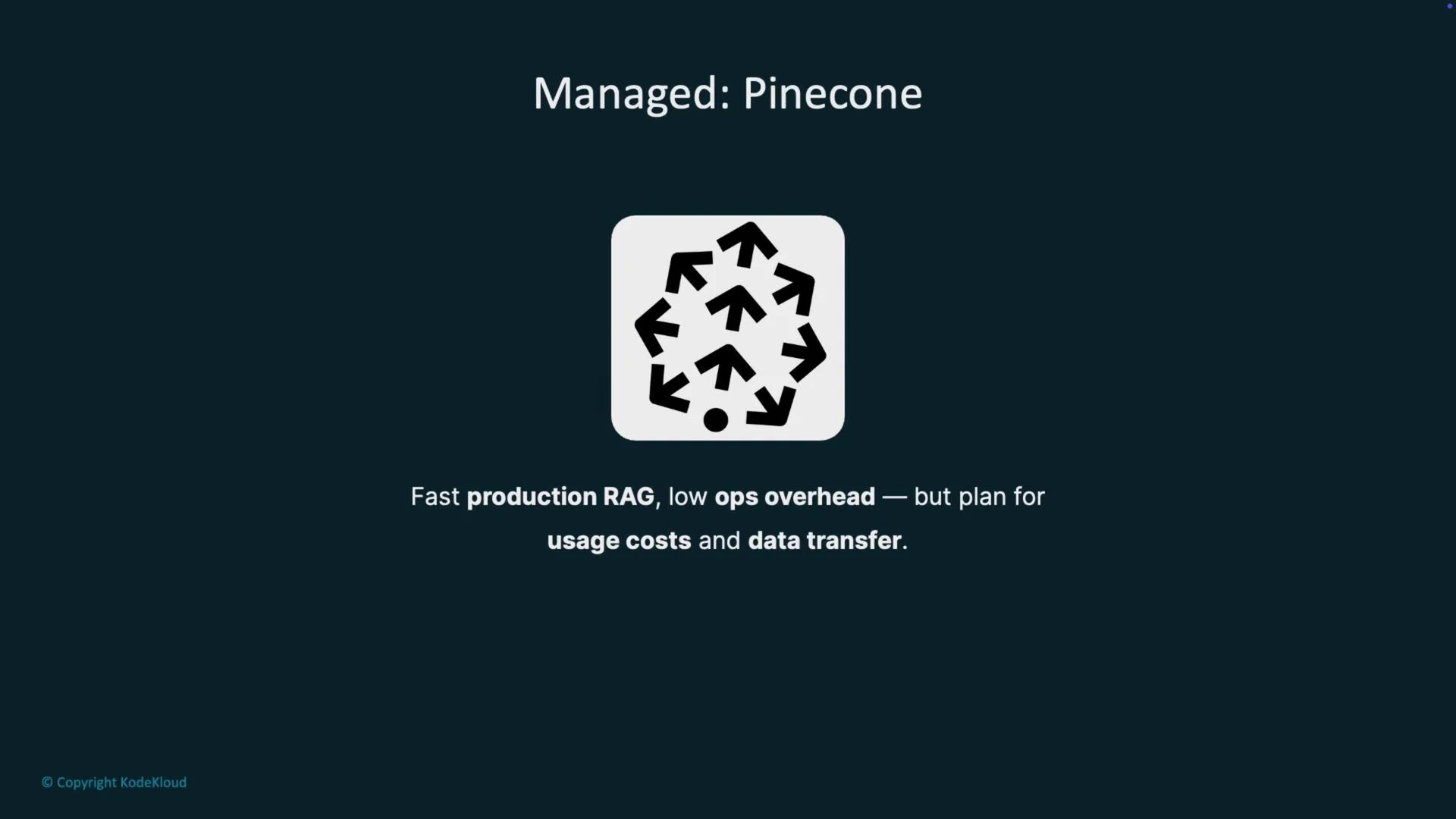
* Azure AI Search: Tight integration with the Azure ecosystem; a strong choice for Microsoft/.NET stacks and Azure-hosted workloads.
## Cloud-provider-managed options
* Azure AI Search: Tight integration with the Azure ecosystem; a strong choice for Microsoft/.NET stacks and Azure-hosted workloads.
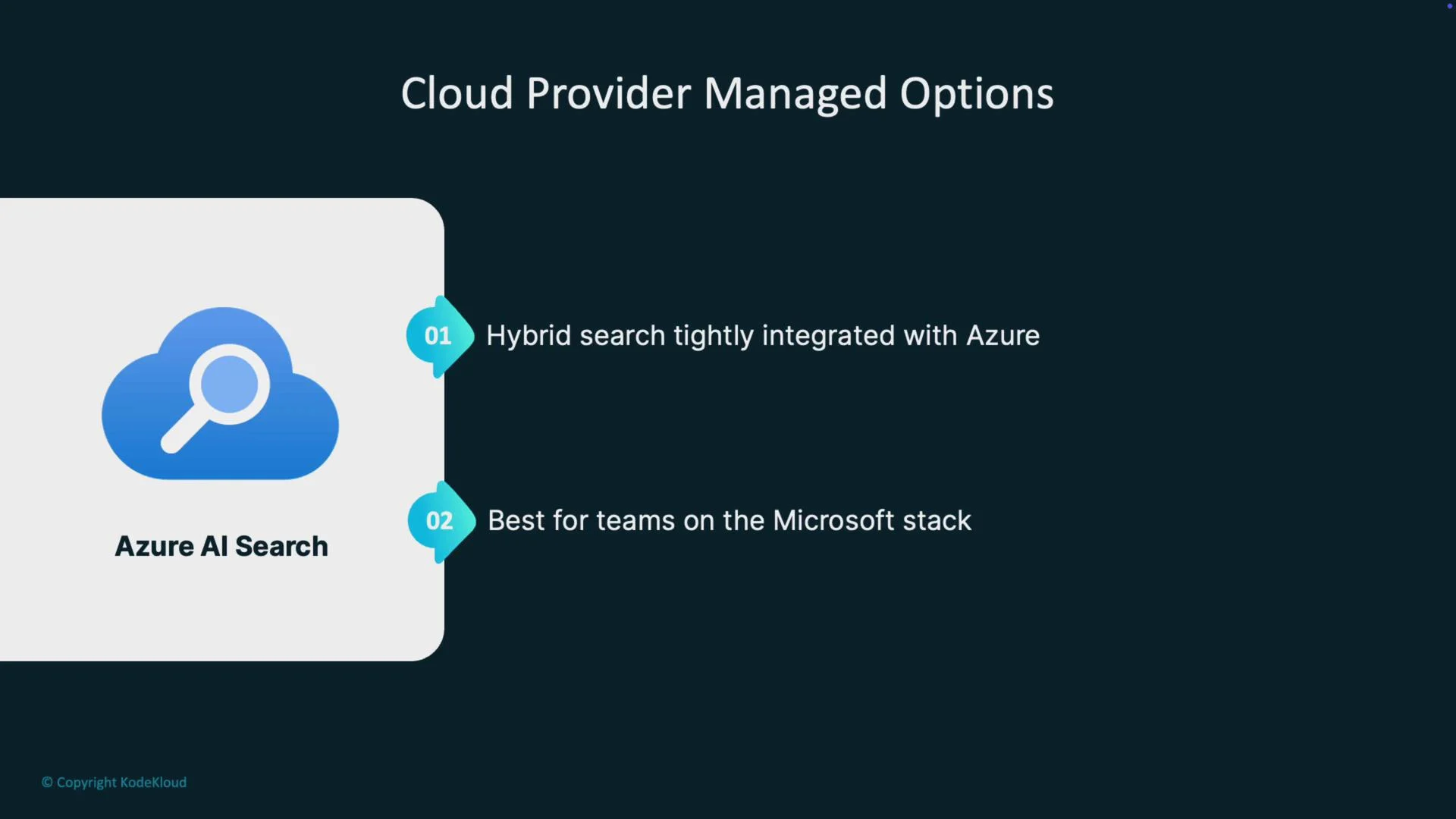 * Vertex AI Vector Search: Google Cloud’s managed vector search offering designed for massive-scale deployments, often leveraging ANN libraries like ScaNN for efficient billion-vector operations.
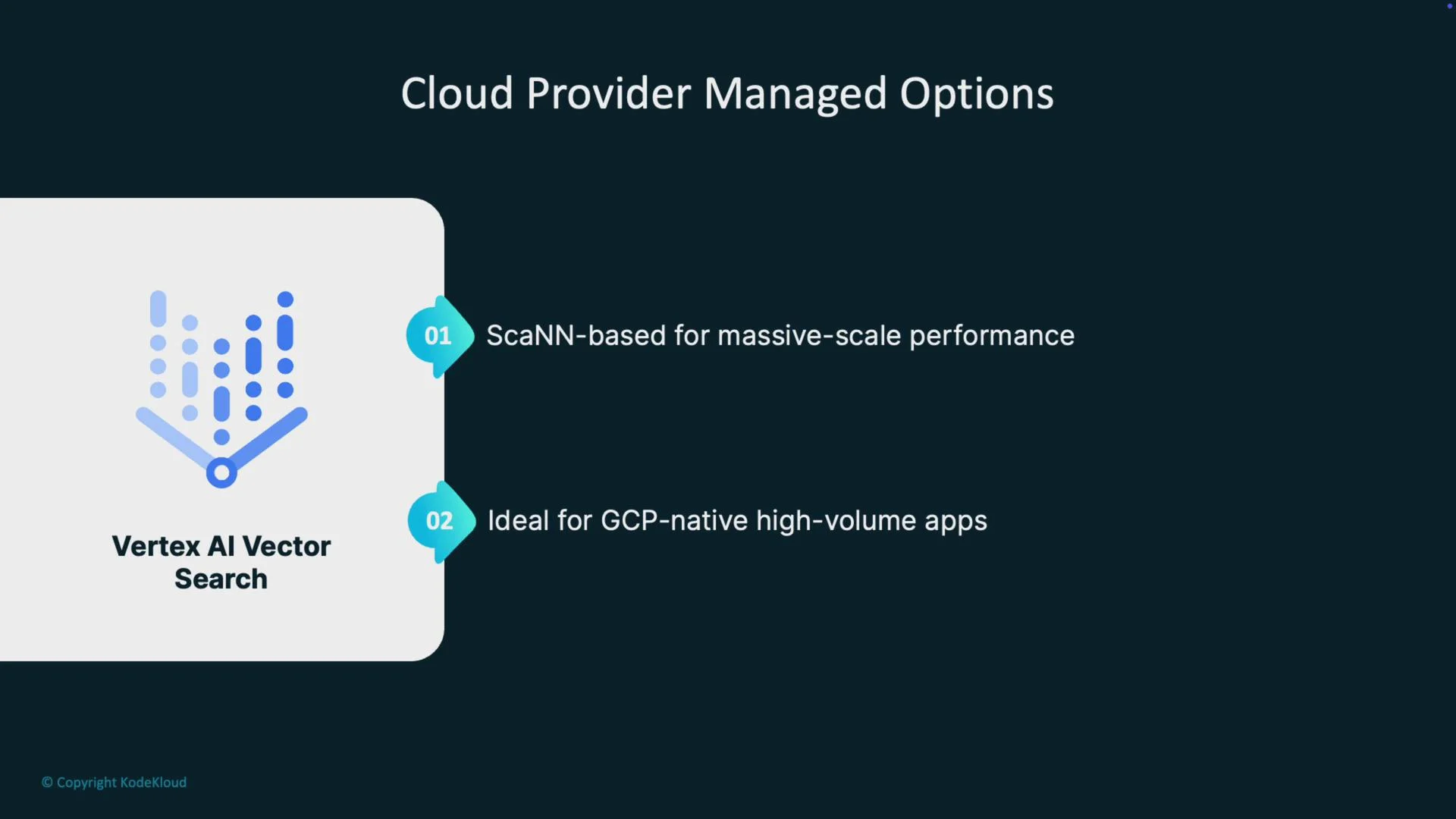 * AWS OpenSearch and MongoDB Atlas: Offer integrated vector search alongside traditional text search and database features. Use them when you need hybrid retrieval patterns and are already committed to the provider.
## Decision guide
Map specific product requirements to the right technology track:
* AWS OpenSearch and MongoDB Atlas: Offer integrated vector search alongside traditional text search and database features. Use them when you need hybrid retrieval patterns and are already committed to the provider.
## Decision guide
Map specific product requirements to the right technology track:
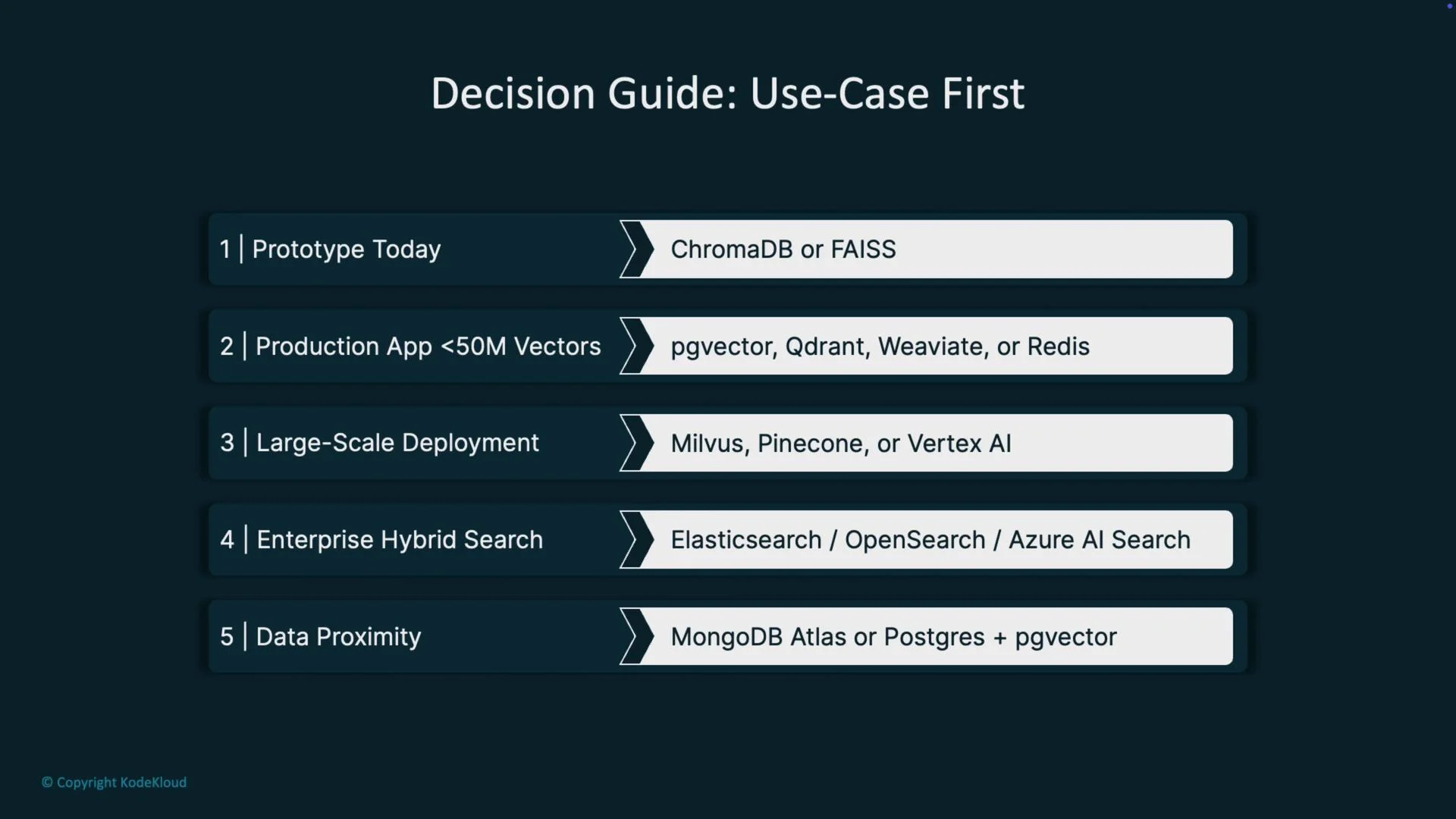 Use this quick table to align use cases to recommended choices:
| Use case | Recommended options | Why |
| --------------------------- | ----------------------------------------- | ------------------------------------ |
| Rapid prototype / local POC | ChromaDB, FAISS | Minimal infra, fast iteration |
| Production — quick path | Pinecone, Azure AI Search, Vertex AI | Low ops, SLA-backed scaling |
| OSS production | Qdrant (balanced), Milvus (massive scale) | Control, cost predictability |
| SQL-centric apps | Postgres + `pgvector` | Keep vectors near app data with ACID |
| Ultra-low-latency hot cache | Redis (RedisSearch/RedisVector) | Sub-ms latency for hot working sets |
## Pros and cons — quick summary
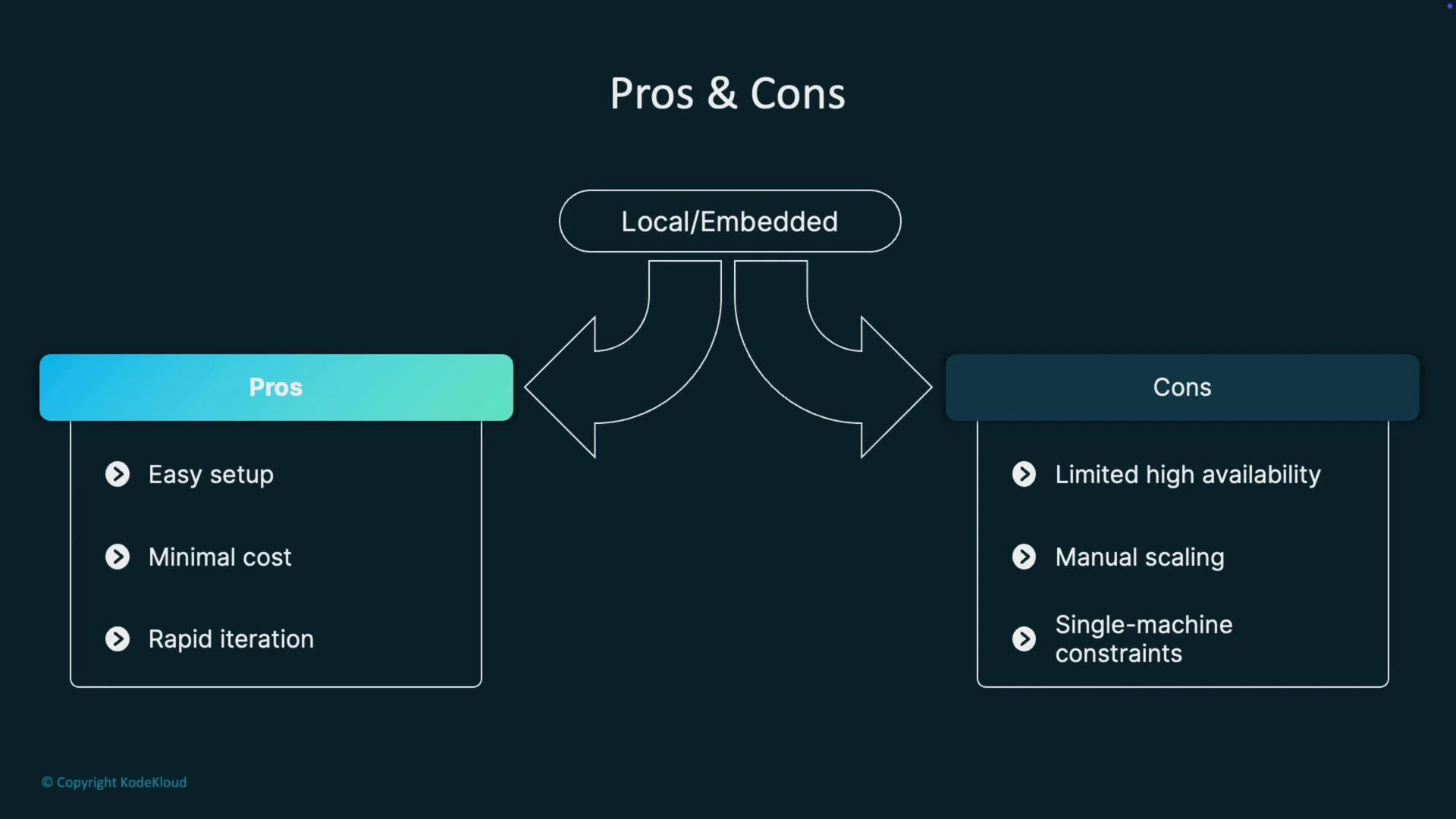
Local / Embedded
* Pros: Easy to set up, minimal cost, rapid iteration.
* Cons: Limited HA, manual scaling, single-machine constraints.
Use this quick table to align use cases to recommended choices:
| Use case | Recommended options | Why |
| --------------------------- | ----------------------------------------- | ------------------------------------ |
| Rapid prototype / local POC | ChromaDB, FAISS | Minimal infra, fast iteration |
| Production — quick path | Pinecone, Azure AI Search, Vertex AI | Low ops, SLA-backed scaling |
| OSS production | Qdrant (balanced), Milvus (massive scale) | Control, cost predictability |
| SQL-centric apps | Postgres + `pgvector` | Keep vectors near app data with ACID |
| Ultra-low-latency hot cache | Redis (RedisSearch/RedisVector) | Sub-ms latency for hot working sets |
## Pros and cons — quick summary
Local / Embedded
* Pros: Easy to set up, minimal cost, rapid iteration.
* Cons: Limited HA, manual scaling, single-machine constraints.
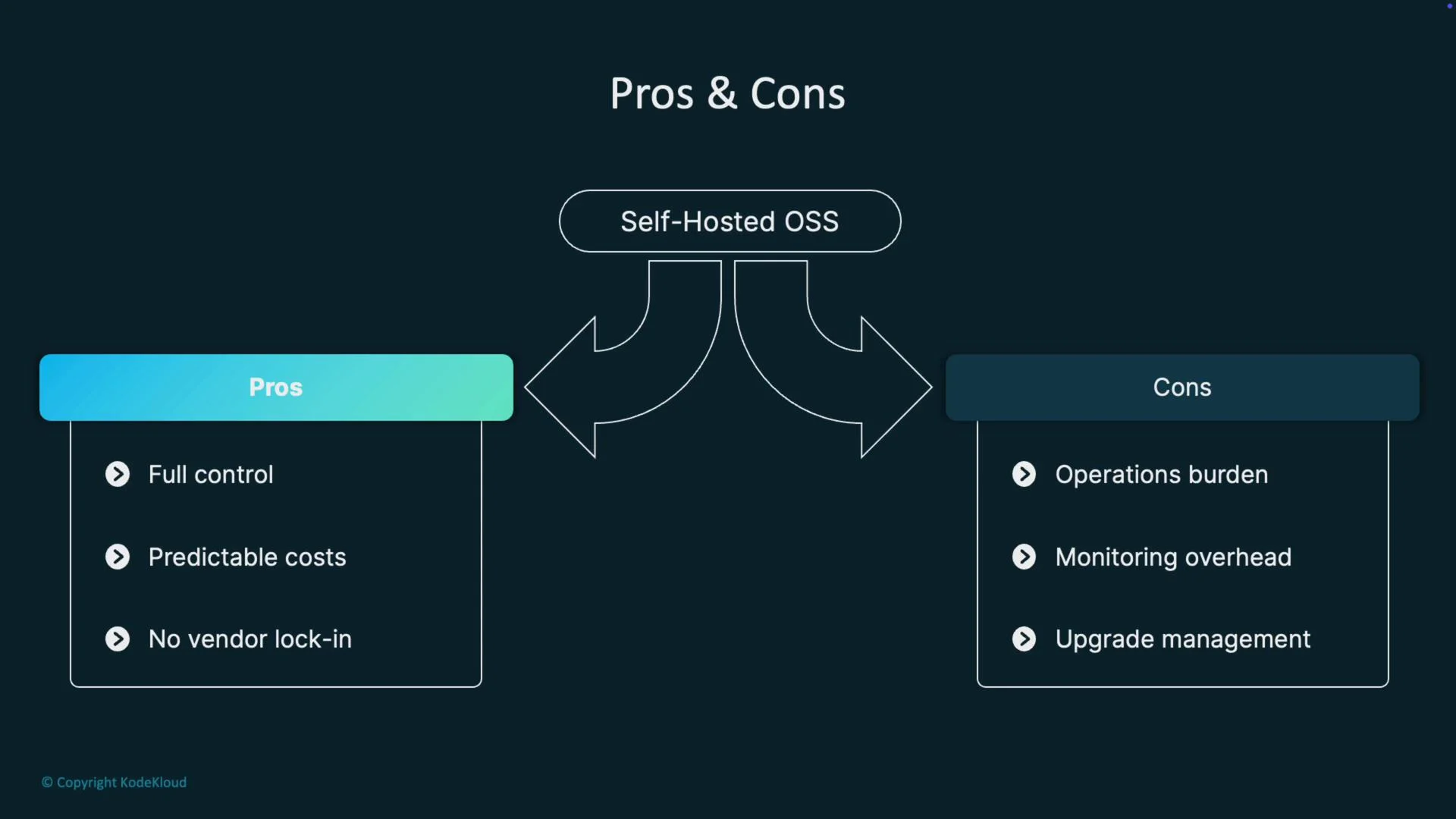
 Self-hosted open-source
* Pros: Full control, predictable costs, no vendor lock-in.
* Cons: Operational burden, monitoring and upgrade overhead.
Self-hosted open-source
* Pros: Full control, predictable costs, no vendor lock-in.
* Cons: Operational burden, monitoring and upgrade overhead.
 Managed cloud
* Pros: Fast deployment, enterprise SLAs, elastic scaling.
* Cons: Ongoing usage costs, potential vendor lock-in, less infrastructure control.
Hybrid engines
* Best for ranking quality and rich filtering at scale. Expect additional complexity and a steeper learning curve.
## Cost and scaling gotchas
* Index build memory and time: Initial indexing can require 2–3× steady-state memory. Plan capacity and expect long build times on very large datasets.
* Recall vs latency tuning: Parameters such as `efConstruction`, `efSearch` (HNSW), and `nprobe` (IVF) affect accuracy and latency. Budget time for parameter sweeps and A/B testing.
* Hybrid query pricing: Managed services may bill hybrid or multi-stage queries per request — query costs can add up quickly.
* Backup & recovery, schema changes, model updates: Re-indexing is often required after schema or model changes; include re-ingestion costs in your plan.
* Ingestion and experimentation costs: Embedding generation, storage, and query tuning require compute and experimentation budgets.
Re-indexing and embedding drift are real operational costs. If you retrain or update embeddings frequently, estimate the time and cost to re-ingest and validate results before committing to a solution.
## Recommendations (practical)
* Rapid POC: Start with ChromaDB and a small embedding model to validate the concept quickly.
* Fast route to production: Choose Pinecone, Azure AI Search, or Vertex AI to reduce operational overhead and speed delivery.
* OSS production: Pick Qdrant for balanced simplicity; use Milvus for genuine billion-scale workloads.
* All-SQL approach: Use Postgres + `pgvector` to keep vectors close to relational data.
* Cache-speed pattern: Use Redis for hot data plus a cold, cost-efficient vector store for bulk storage.
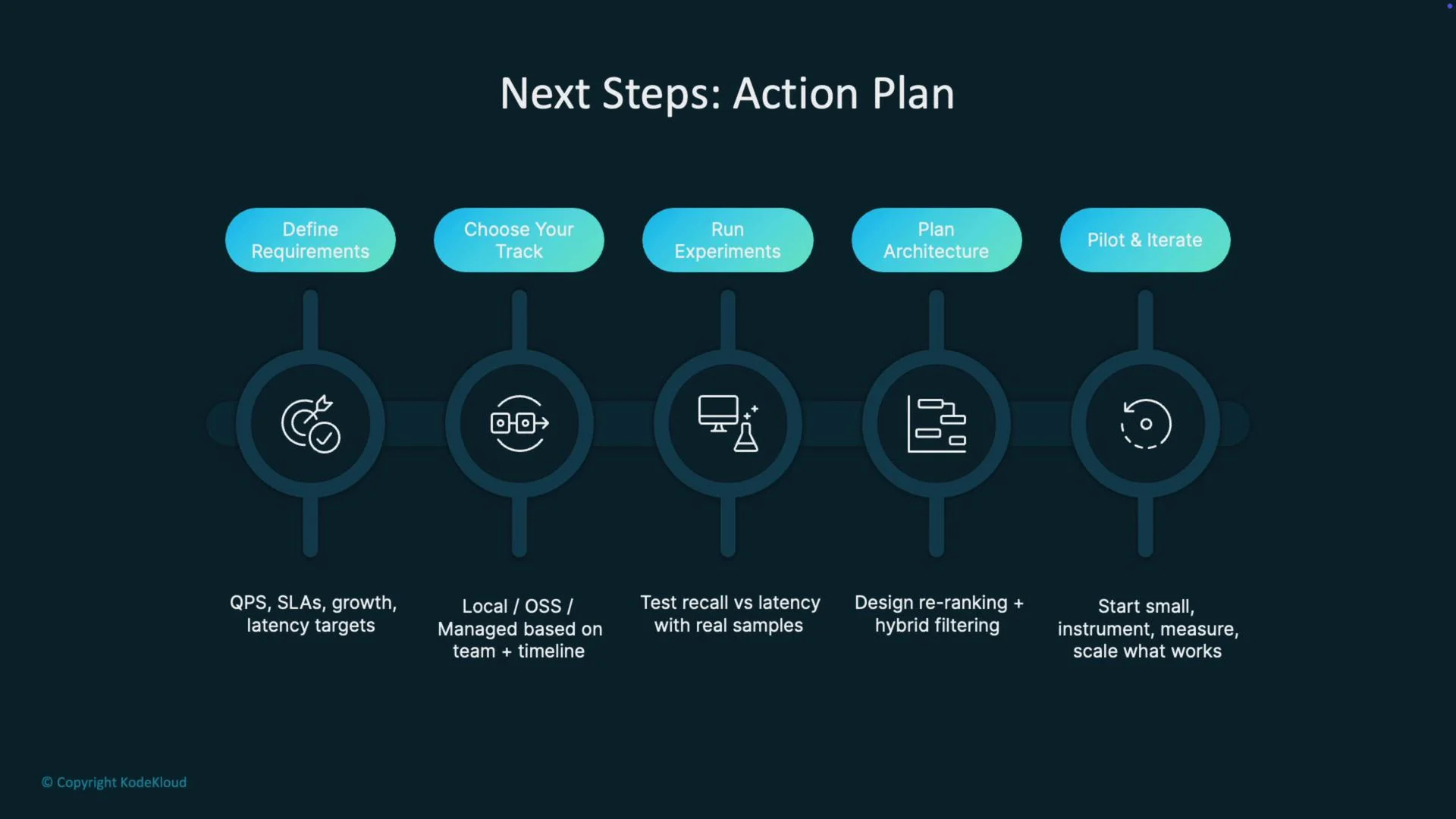
## Action plan (practical next steps)
1. Define requirements: latency targets (ms), recall goals, dataset size, cost constraints, and team skills.
2. Choose a track: local/embedded, self-hosted OSS, or managed service based on priorities.
3. Run experiments: benchmark recall vs. latency, tune search parameters, and measure costs.
4. Plan architecture: include re-ranking, hybrid filters, monitoring, backups, and disaster recovery.
5. Pilot & iterate: deploy a focused pilot with instrumentation and use observed metrics to guide the next steps.
Managed cloud
* Pros: Fast deployment, enterprise SLAs, elastic scaling.
* Cons: Ongoing usage costs, potential vendor lock-in, less infrastructure control.
Hybrid engines
* Best for ranking quality and rich filtering at scale. Expect additional complexity and a steeper learning curve.
## Cost and scaling gotchas
* Index build memory and time: Initial indexing can require 2–3× steady-state memory. Plan capacity and expect long build times on very large datasets.
* Recall vs latency tuning: Parameters such as `efConstruction`, `efSearch` (HNSW), and `nprobe` (IVF) affect accuracy and latency. Budget time for parameter sweeps and A/B testing.
* Hybrid query pricing: Managed services may bill hybrid or multi-stage queries per request — query costs can add up quickly.
* Backup & recovery, schema changes, model updates: Re-indexing is often required after schema or model changes; include re-ingestion costs in your plan.
* Ingestion and experimentation costs: Embedding generation, storage, and query tuning require compute and experimentation budgets.
Re-indexing and embedding drift are real operational costs. If you retrain or update embeddings frequently, estimate the time and cost to re-ingest and validate results before committing to a solution.
## Recommendations (practical)
* Rapid POC: Start with ChromaDB and a small embedding model to validate the concept quickly.
* Fast route to production: Choose Pinecone, Azure AI Search, or Vertex AI to reduce operational overhead and speed delivery.
* OSS production: Pick Qdrant for balanced simplicity; use Milvus for genuine billion-scale workloads.
* All-SQL approach: Use Postgres + `pgvector` to keep vectors close to relational data.
* Cache-speed pattern: Use Redis for hot data plus a cold, cost-efficient vector store for bulk storage.
## Action plan (practical next steps)
1. Define requirements: latency targets (ms), recall goals, dataset size, cost constraints, and team skills.
2. Choose a track: local/embedded, self-hosted OSS, or managed service based on priorities.
3. Run experiments: benchmark recall vs. latency, tune search parameters, and measure costs.
4. Plan architecture: include re-ranking, hybrid filters, monitoring, backups, and disaster recovery.
5. Pilot & iterate: deploy a focused pilot with instrumentation and use observed metrics to guide the next steps.
 A short, well-instrumented pilot will surface trade-offs far more effectively than lengthy debates. Use objective benchmarks tied to your SLA and cost targets to make the final decision.
## Links and references
* [Kubernetes Documentation](https://kubernetes.io/docs/) — for self-hosted orchestration patterns.
* [Pinecone](https://www.pinecone.io/) — managed vector DB.
* [Qdrant](https://qdrant.tech/), [Milvus](https://milvus.io/), [Weaviate](https://weaviate.io/) — popular open-source vector stores.
* [pgvector](https://github.com/pgvector/pgvector) — Postgres extension for vectors.
* [Redis](https://redis.io/) — RedisSearch and vector capabilities.
A short, well-instrumented pilot will surface trade-offs far more effectively than lengthy debates. Use objective benchmarks tied to your SLA and cost targets to make the final decision.
## Links and references
* [Kubernetes Documentation](https://kubernetes.io/docs/) — for self-hosted orchestration patterns.
* [Pinecone](https://www.pinecone.io/) — managed vector DB.
* [Qdrant](https://qdrant.tech/), [Milvus](https://milvus.io/), [Weaviate](https://weaviate.io/) — popular open-source vector stores.
* [pgvector](https://github.com/pgvector/pgvector) — Postgres extension for vectors.
* [Redis](https://redis.io/) — RedisSearch and vector capabilities.