> ## Documentation Index
> Fetch the complete documentation index at: https://notes.kodekloud.com/llms.txt
> Use this file to discover all available pages before exploring further.
# Production Readiness
> Guidelines for production readiness and release engineering ensuring safe, tested, observable, and reversible deployments through checklists, load testing, risk assessment, canaries, and SRE sign‑off
Hey there — welcome back. In this lesson we dive into the Release Engineering module.
In the previous module we covered incident management: preparing for outages, responding under pressure, and learning from failures. Release Engineering aims to prevent those incidents by making change safe. Most outages aren’t random hardware failures; they stem from change — an unsafe deployment, an untested configuration, or a vulnerable dependency. SREs focused on release engineering enable fast shipping while enforcing guardrails that protect users and the business.
This module covers production readiness, Infrastructure as Code, configuration management, securing releases, and safe deployment practices at scale. Think of it as building the foundation for “boring” releases: reliable, repeatable, and drama-free. Observability and monitoring then explain what happens once releases are live.
But first: production readiness. Before code reaches real users, we must ask: is it truly ready for production? This lesson is about building confidence that a system can handle real load, recover from problems, and avoid costly failures. Readiness goes beyond unit tests — it means the system is safe under realistic, production-like conditions.
 History shows the cost of ignoring production readiness. Large retailers have lost tens of millions in sales during peak outages. Trading firms have lost hundreds of millions from botched deployments. In 2017, GitLab suffered a six‑hour data-loss incident when backups failed. These examples emphasize that shipping code means protecting the business, not just launching features.
Production readiness requires a mindset shift: developers may say “it works on my machine,” while SREs ask, “will it work for millions of users?” SREs bridge the gap between code that builds locally and systems that survive real-world traffic and failure modes.
History shows the cost of ignoring production readiness. Large retailers have lost tens of millions in sales during peak outages. Trading firms have lost hundreds of millions from botched deployments. In 2017, GitLab suffered a six‑hour data-loss incident when backups failed. These examples emphasize that shipping code means protecting the business, not just launching features.
Production readiness requires a mindset shift: developers may say “it works on my machine,” while SREs ask, “will it work for millions of users?” SREs bridge the gap between code that builds locally and systems that survive real-world traffic and failure modes.
 SREs participate across the release lifecycle: before launch they verify and test, on launch day they monitor and respond, and after launch they analyze outcomes and iterate. Requiring SRE sign-off before a production launch is not red tape — it’s a safeguard learned from costly lessons. The best SREs say “no” to launches that aren’t ready; the worst say “yes” and end up firefighting at 3 a.m.
Require cross-functional sign-off (engineering, product, SRE) before production launches. Make sign-off traceable in the release ticket and tied to the readiness checklist.
SREs participate across the release lifecycle: before launch they verify and test, on launch day they monitor and respond, and after launch they analyze outcomes and iterate. Requiring SRE sign-off before a production launch is not red tape — it’s a safeguard learned from costly lessons. The best SREs say “no” to launches that aren’t ready; the worst say “yes” and end up firefighting at 3 a.m.
Require cross-functional sign-off (engineering, product, SRE) before production launches. Make sign-off traceable in the release ticket and tied to the readiness checklist.
 How do we know a system is ready? With checklists. Think of a readiness checklist like a pilot’s pre-flight inspection: routine but lifesaving. The four non-negotiable items are:
| Readiness Item | Why it matters | Practical example |
| ------------------ | -----------------------------------------------------------------------: | --------------------------------------------------------------------------------------------------- |
| Environment parity | Prevents misleading test results when staging differs from production | Match OS, runtime, config, feature flags, and external endpoints between staging and prod (use IaC) |
| Load testing | Ensures the system sustains realistic sustained traffic, not just spikes | Run tests at ≥3× expected peak with realistic data and session patterns (Gatling, k6, JMeter) |
| Monitoring hooks | Enables detection and diagnosis of failures | Emit metrics, structured logs, and traces for critical workflows; test alerting pathways |
| Rollback plan | Reduces MTTR when a change causes an outage | Document and rehearse rollback or fail‑open strategies; ensure runbooks and automation exist |
Pre-launch verification focuses on three critical questions: does the service start and operate end-to-end, can it handle real load, and does it integrate with external dependencies?
* Start (smoke test): Beyond an HTTP 200, verify core user workflows end-to-end: sign-in, purchases, uploads, and error paths. Smoke tests should exercise the user experience, not just health endpoints.
* Load (capacity test): Test at least 3× expected peak using realistic traffic patterns and representative data. Validate sustained throughput and resource usage (CPU, memory, I/O) over meaningful durations.
* Dependencies (integration validation): Confirm external APIs, databases, caches, third-party services, DNS, and network settings behave under production constraints (authentication, rate limits, timeouts).
Answering these three areas with confidence separates a safe launch from a risky one.
How do we know a system is ready? With checklists. Think of a readiness checklist like a pilot’s pre-flight inspection: routine but lifesaving. The four non-negotiable items are:
| Readiness Item | Why it matters | Practical example |
| ------------------ | -----------------------------------------------------------------------: | --------------------------------------------------------------------------------------------------- |
| Environment parity | Prevents misleading test results when staging differs from production | Match OS, runtime, config, feature flags, and external endpoints between staging and prod (use IaC) |
| Load testing | Ensures the system sustains realistic sustained traffic, not just spikes | Run tests at ≥3× expected peak with realistic data and session patterns (Gatling, k6, JMeter) |
| Monitoring hooks | Enables detection and diagnosis of failures | Emit metrics, structured logs, and traces for critical workflows; test alerting pathways |
| Rollback plan | Reduces MTTR when a change causes an outage | Document and rehearse rollback or fail‑open strategies; ensure runbooks and automation exist |
Pre-launch verification focuses on three critical questions: does the service start and operate end-to-end, can it handle real load, and does it integrate with external dependencies?
* Start (smoke test): Beyond an HTTP 200, verify core user workflows end-to-end: sign-in, purchases, uploads, and error paths. Smoke tests should exercise the user experience, not just health endpoints.
* Load (capacity test): Test at least 3× expected peak using realistic traffic patterns and representative data. Validate sustained throughput and resource usage (CPU, memory, I/O) over meaningful durations.
* Dependencies (integration validation): Confirm external APIs, databases, caches, third-party services, DNS, and network settings behave under production constraints (authentication, rate limits, timeouts).
Answering these three areas with confidence separates a safe launch from a risky one.
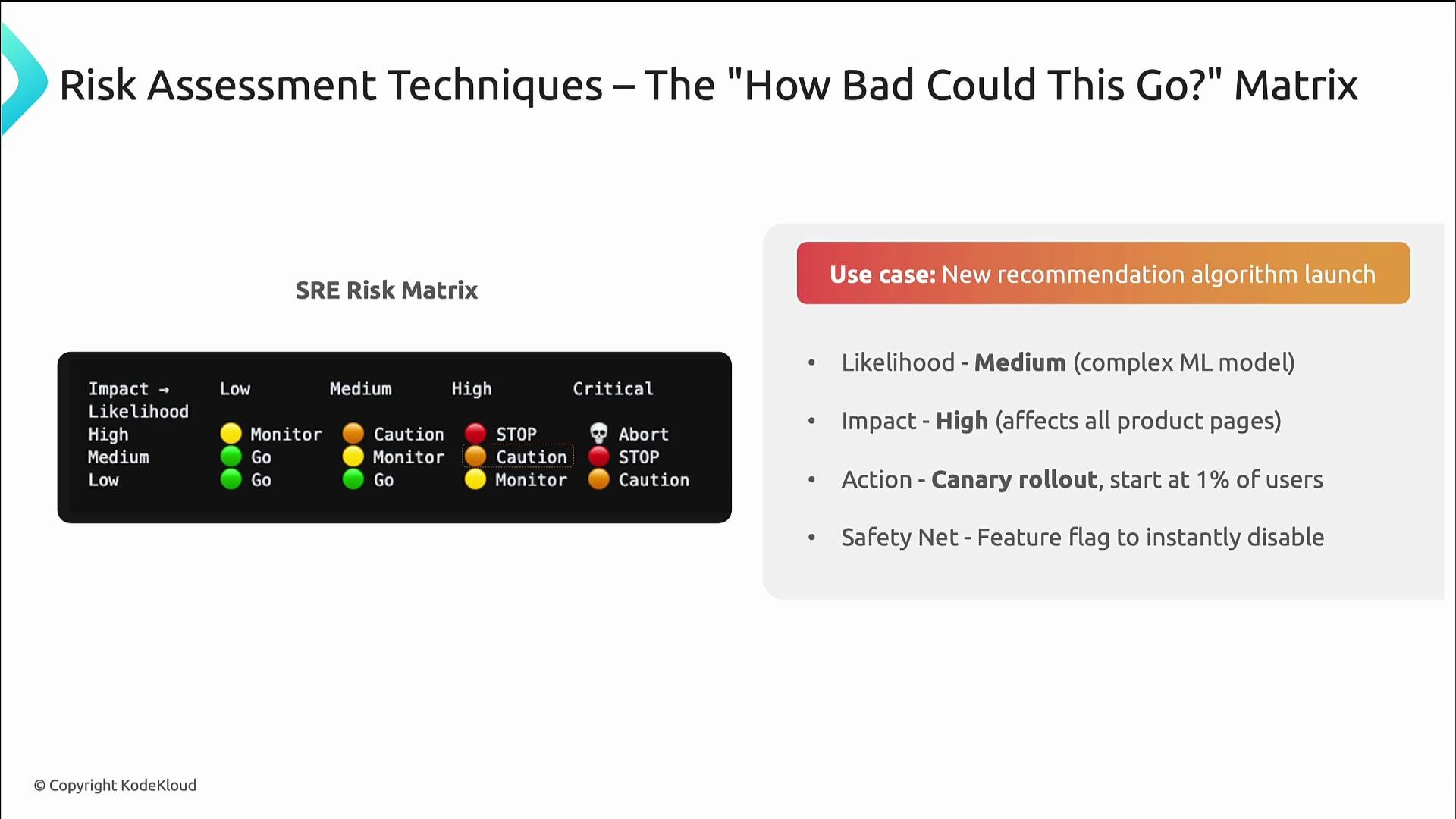
 Risk assessment determines the level of caution required for each change. Use a risk matrix (likelihood vs. impact) to guide rollout strategy and safety mechanisms. For example, a new recommendation algorithm (complex ML model) might have medium likelihood of issues and high impact because it touches every product page. The prudent approach: a canary rollout starting at 1% of users combined with a feature flag as an immediate kill switch.
 When assessing risk, ask practical, operational questions that map directly to mitigations:
| Question | Operational intent | Typical action |
| -------------------------------------------------- | ------------------------------: | ------------------------------------------------------------------------------------ |
| Blast radius: If it fails, what breaks? | Limit scope of impact | Use canaries, sharding, circuit breakers, and feature flags |
| Recovery time: How long to fix or rollback? | Reduce MTTR | Keep automated rollbacks and well-practiced runbooks |
| User impact: How many users are affected? | Control exposure | Start with small percentages (1–5%) then ramp based on metrics |
| Revenue impact: Dollar cost per minute of downtime | Decide tolerance and guardrails | Apply stricter controls (manual approvals, extended canaries) for high‑cost services |
When assessing risk, ask practical, operational questions that map directly to mitigations:
| Question | Operational intent | Typical action |
| -------------------------------------------------- | ------------------------------: | ------------------------------------------------------------------------------------ |
| Blast radius: If it fails, what breaks? | Limit scope of impact | Use canaries, sharding, circuit breakers, and feature flags |
| Recovery time: How long to fix or rollback? | Reduce MTTR | Keep automated rollbacks and well-practiced runbooks |
| User impact: How many users are affected? | Control exposure | Start with small percentages (1–5%) then ramp based on metrics |
| Revenue impact: Dollar cost per minute of downtime | Decide tolerance and guardrails | Apply stricter controls (manual approvals, extended canaries) for high‑cost services |
 Observability is the final arbiter of readiness: metrics that show when you’re slow, logs that explain why, and traces that pinpoint where latency or errors originate. Good observability lets you answer readiness SLAs:
* Can you determine service health within 30 seconds?
* Can you identify the root cause within 5 minutes?
* Will the right person be paged automatically, and are alerts actionable?
If the answers are “yes,” your system is close to true production readiness.
Avoid alert fatigue: alerts must be actionable and route to the correct on‑call. Test the full alerting pipeline during pre‑launch (alert → paging → runbook execution).
Observability is the final arbiter of readiness: metrics that show when you’re slow, logs that explain why, and traces that pinpoint where latency or errors originate. Good observability lets you answer readiness SLAs:
* Can you determine service health within 30 seconds?
* Can you identify the root cause within 5 minutes?
* Will the right person be paged automatically, and are alerts actionable?
If the answers are “yes,” your system is close to true production readiness.
Avoid alert fatigue: alerts must be actionable and route to the correct on‑call. Test the full alerting pipeline during pre‑launch (alert → paging → runbook execution).
 This concludes our introduction to release engineering and production readiness. Next we'll introduce Infrastructure as Code (IaC) — a crucial practice to make system changes declarative, reviewable, and testable so changes become repeatable and less error‑prone.
Further reading and references:
* [Kubernetes Basics](https://kubernetes.io/docs/concepts/overview/what-is-kubernetes/) — Useful for environment parity and deployment models.
* [GitLab Incident Postmortem (2017)](https://about.gitlab.com/blog/2017/01/31/gitlab-com-database-incident/) — Example of a production incident caused by backup/configuration failures.
* [Google SRE Practices](https://sre.google/) — Operational guidance and sign‑off discipline.
* Load testing tools: k6 ([https://k6.io/](https://k6.io/)), Gatling ([https://gatling.io/](https://gatling.io/)), JMeter ([https://jmeter.apache.org/](https://jmeter.apache.org/)).
If you want, I can convert the readiness checklist into a reusable release template (Markdown or checklist JSON) you can drop into your CI/CD pipeline.
This concludes our introduction to release engineering and production readiness. Next we'll introduce Infrastructure as Code (IaC) — a crucial practice to make system changes declarative, reviewable, and testable so changes become repeatable and less error‑prone.
Further reading and references:
* [Kubernetes Basics](https://kubernetes.io/docs/concepts/overview/what-is-kubernetes/) — Useful for environment parity and deployment models.
* [GitLab Incident Postmortem (2017)](https://about.gitlab.com/blog/2017/01/31/gitlab-com-database-incident/) — Example of a production incident caused by backup/configuration failures.
* [Google SRE Practices](https://sre.google/) — Operational guidance and sign‑off discipline.
* Load testing tools: k6 ([https://k6.io/](https://k6.io/)), Gatling ([https://gatling.io/](https://gatling.io/)), JMeter ([https://jmeter.apache.org/](https://jmeter.apache.org/)).
If you want, I can convert the readiness checklist into a reusable release template (Markdown or checklist JSON) you can drop into your CI/CD pipeline.