> ## Documentation Index
> Fetch the complete documentation index at: https://notes.kodekloud.com/llms.txt
> Use this file to discover all available pages before exploring further.
# Google Kubernetes Engine Architecture
> Explores the key concepts and architecture of Google Kubernetes Engine and its differences from a standard Kubernetes cluster.
Explore the key concepts and architecture of Google Kubernetes Engine (GKE), and see how they differ from a standard Kubernetes cluster.
## Kubernetes Cluster Overview
A Kubernetes cluster has two main parts:
* **Control Plane**: Manages the cluster’s state and schedules workloads.
* **Worker Nodes**: Run containerized applications in Pods.
### Control Plane Components
| Component | Description |
| ------------------------ | --------------------------------------------------------------------------------- |
| Cloud Controller Manager | Integrates cloud-provider APIs and isolates cloud-specific logic from Kubernetes. |
| Kube Controller Manager | Runs controllers like Node, Job, EndpointSlice, and ServiceAccount controllers. |
| Kube API Server | Exposes the Kubernetes API and serves as the control plane’s front end. |
| etcd | A distributed, highly available key-value store holding all cluster data. |
| Kube Scheduler | Assigns newly created Pods to appropriate nodes based on resource requirements. |
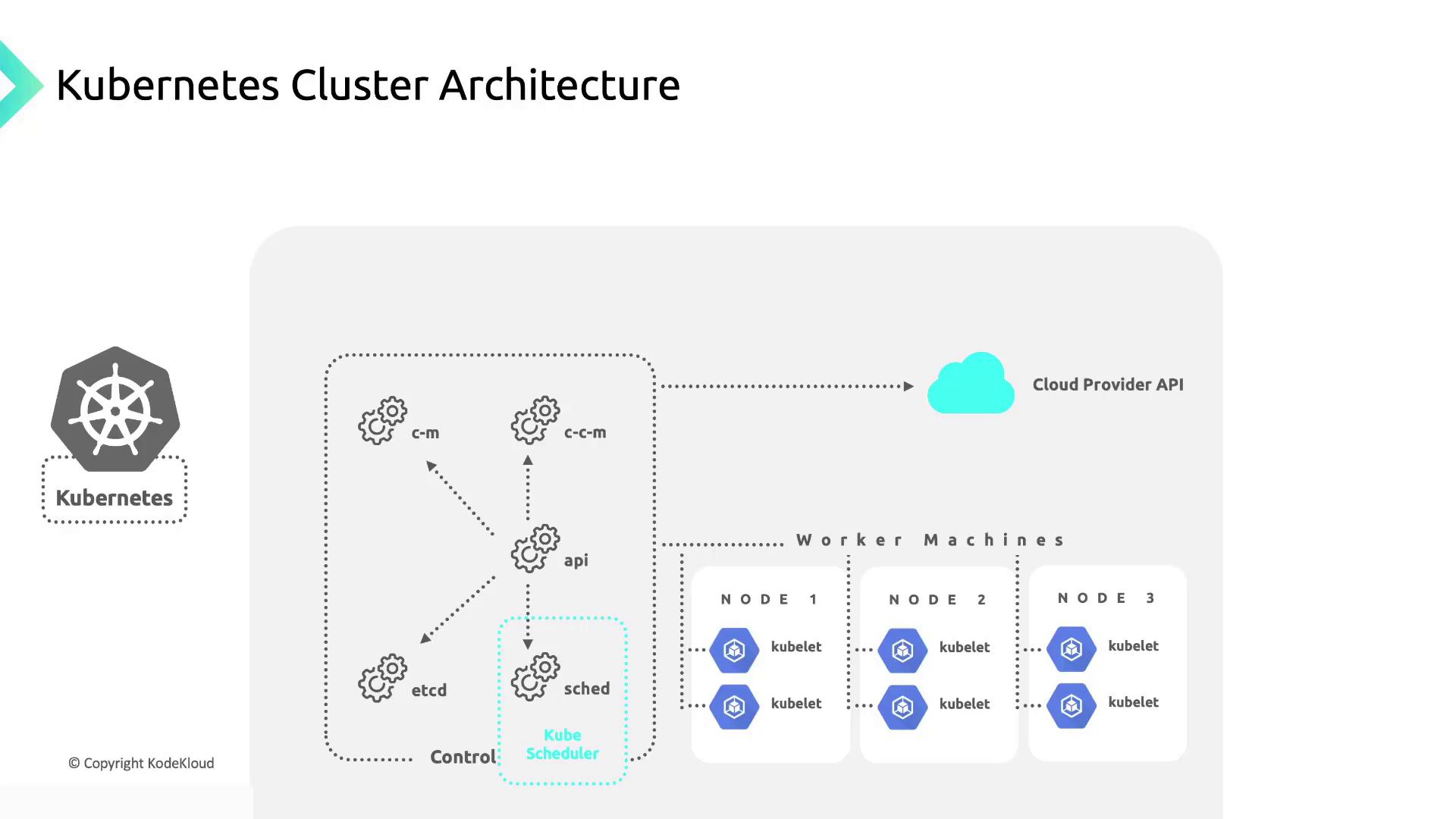
In a vanilla Kubernetes setup, you must provision and manage your own worker nodes—Kubernetes does not handle node creation.
## Google Kubernetes Engine (GKE) Cluster Architecture
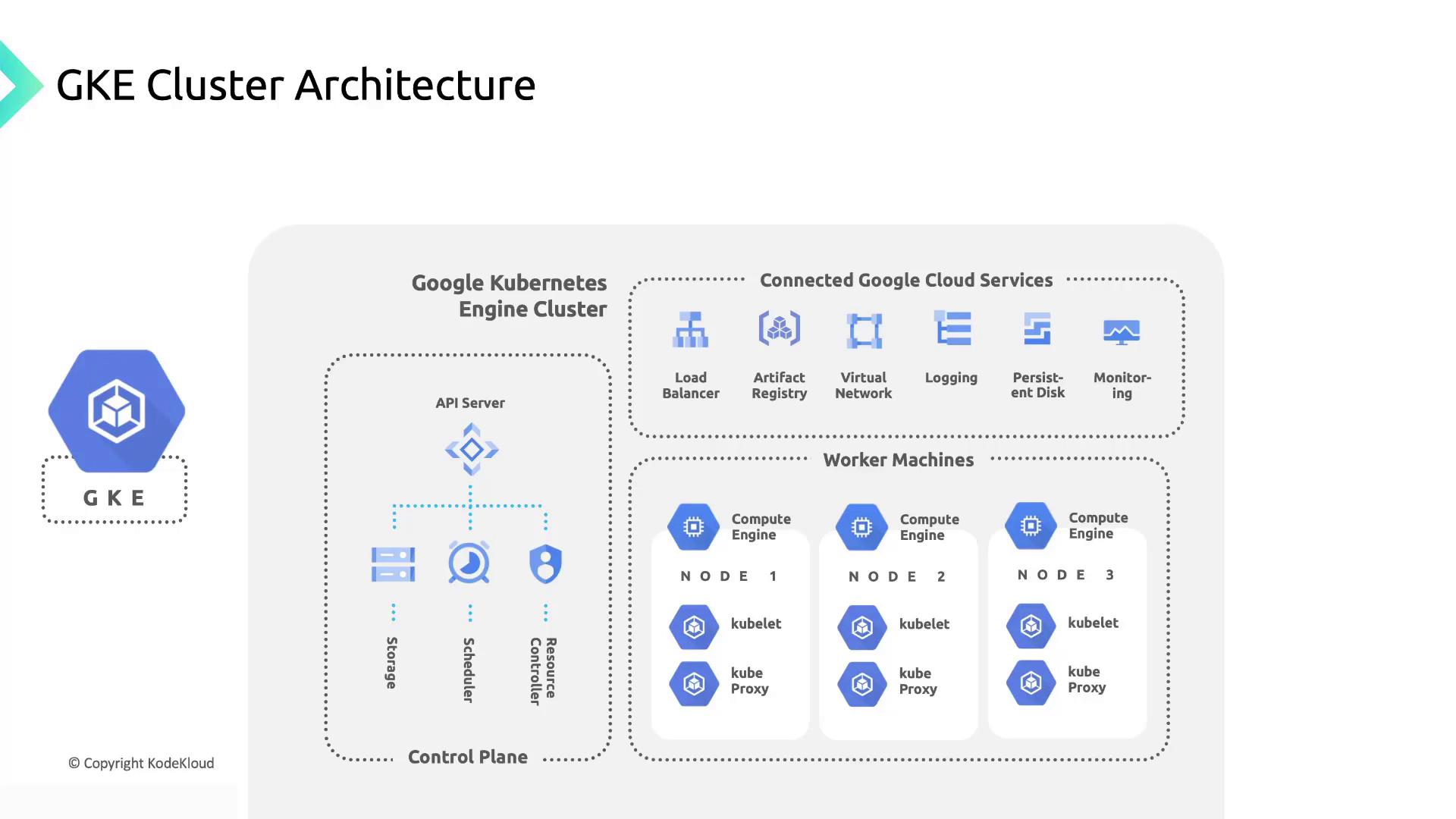
GKE simplifies cluster operations by managing both the control plane and worker nodes. It handles provisioning, upgrades, and system component maintenance.
### Managed Control Plane
GKE provisions and operates your control plane components on Google Cloud. You get a stable API endpoint for `kubectl` operations while GKE handles:
* Automatic upgrades for security patches and version updates
* High availability configuration across zones
* Monitoring and logging integration
### Automated Node Management
GKE launches Google Compute Engine VMs as worker nodes and configures:
* **kubelet**: Node agent that ensures containers are running
* **kube-proxy**: Maintains network rules for Pod communication
* **DaemonSet Pods**: System containers for logging, monitoring, and networking
#### Node Pools
Node pools are groups of nodes sharing the same machine type, labels, and autoscaling settings. Use multiple node pools to:
* Optimize cost by mixing CPU-optimized and memory-optimized VMs
* Run specialized workloads on nodes with GPU or high-memory instances
* Roll out updates with minimal disruption
In **Standard** mode, you’re responsible for node upgrades and autoscaling. Plan your maintenance windows and cluster autoscaler settings accordingly.
### Integration with Google Cloud Services
GKE seamlessly connects to other Google Cloud services:
* Pulls system container images from **Google Cloud Artifact Registry**
* Exports logs to **Cloud Logging** and metrics to **Cloud Monitoring**
* Leverages **VPC-native networking** for Pod-to-Pod and Pod-to-service communication
### Cluster Modes: Autopilot vs. Standard
| Mode | Control Plane Management | Node Management |
| --------- | ------------------------ | ---------------------------------------- |
| Autopilot | Fully managed by GKE | Nodes provisioned & scaled automatically |
| Standard | Managed by GKE | Nodes provisioned by user |
## Links and References
* [Kubernetes Basics](https://kubernetes.io/docs/concepts/overview/what-is-kubernetes/)
* [Google Cloud Artifact Registry](https://cloud.google.com/artifact-registry)
* [GKE Autopilot Overview](https://cloud.google.com/kubernetes-engine/docs/concepts/autopilot-overview)
* [Cloud Monitoring](https://cloud.google.com/monitoring)
* [Cloud Logging](https://cloud.google.com/logging)