> ## Documentation Index
> Fetch the complete documentation index at: https://notes.kodekloud.com/llms.txt
> Use this file to discover all available pages before exploring further.
# Workflow Deploy to Kubernetes Prod Environment
> This guide explains how to update a GitHub Actions workflow for deploying applications to a Kubernetes production environment.
Deploying to a Kubernetes production cluster involves extending your existing CI/CD pipeline. In this guide, we’ll walk through updating a GitHub Actions workflow to add production deployment jobs, enforce environment protection rules, and validate your release.
## 1. Workflow Skeleton
Begin by defining the workflow trigger, environment variables, and placeholders for your jobs:
```yaml theme={null}
name: Solar System Workflow
on:
workflow_dispatch:
push:
branches:
- main
- 'feature/*'
env:
MONGO_URI: 'mongodb+srv://supercluster.d83jj.mongodb.net/superData'
MONGO_USERNAME: ${{ vars.MONGO_USERNAME }}
MONGO_PASSWORD: ${{ secrets.MONGO_PASSWORD }}
jobs:
unit-testing: {}
code-coverage: {}
docker: {}
dev-deploy: {}
dev-integration-testing: {}
```
## 2. Reference: Development Jobs
Use these `dev-deploy` and `dev-integration-testing` jobs as templates. They build, deploy to a development namespace, and verify the app is live.
```yaml theme={null}
dev-deploy:
name: Dev Deploy
needs: docker
environment:
name: development
url: ${{ steps.set-ingress-host.outputs.APP_INGRESS_HOST }}
outputs:
APP_INGRESS_HOST: ${{ steps.set-ingress-host.outputs.APP_INGRESS_HOST }}
runs-on: ubuntu-latest
steps:
- name: Checkout Repository
uses: actions/checkout@v3
- name: Install kubectl
uses: azure/setup-kubectl@v3
- name: Determine Ingress Host
id: set-ingress-host
run: |
HOST=$(kubectl -n ${{ vars.NAMESPACE }} \
get ingress -o jsonpath='{.items[0].spec.tls[0].hosts[0]}')
echo "APP_INGRESS_HOST=$HOST" >> $GITHUB_OUTPUT
dev-integration-testing:
name: Dev Integration Testing
needs: dev-deploy
runs-on: ubuntu-latest
steps:
- name: Validate Live Status
env:
URL: ${{ needs.dev-deploy.outputs.APP_INGRESS_HOST }}
run: |
echo "Testing https://$URL/live"
curl https://$URL/live -s -k | jq -r .status | grep -i live
```
For more on kubectl commands, see the [kubectl Reference](https://kubernetes.io/docs/reference/kubectl/).
## 3. Adding Production Jobs
### 3.1 prod-deploy
Duplicate the `dev-deploy` job, adjust manifests, and target your production environment. This job also captures the load balancer IP for your Ingress controller.
```yaml theme={null}
prod-deploy:
name: Prod Deploy
needs: dev-integration-testing
environment:
name: production
url: https://${{ steps.set-ingress-host.outputs.APP_INGRESS_HOST }}
outputs:
APP_INGRESS_HOST: ${{ steps.set-ingress-host.outputs.APP_INGRESS_HOST }}
runs-on: ubuntu-latest
steps:
- name: Checkout Repository
uses: actions/checkout@v4
- name: Install kubectl
uses: azure/setup-kubectl@v3
- name: Capture Nginx Ingress IP
run: |
IP=$(kubectl -n ingress-nginx get svc ingress-nginx-controller \
-o jsonpath='{.status.loadBalancer.ingress[0].ip}')
echo "INGRESS_IP=$IP" >> $GITHUB_ENV
- name: Replace Tokens in Manifests
uses: cscheidlen/replace-tokens@v1
with:
tokenPrefix: '_'
tokenSuffix: '_'
files: ["kubernetes/production/*.yaml"]
env:
NAMESPACE: ${{ vars.NAMESPACE }}
REPLICAS: ${{ vars.REPLICAS }}
IMAGE: ${{ vars.DOCKERHUB_USERNAME }}/solar-system:${{ github.sha }}
INGRESS_IP: ${{ env.INGRESS_IP }}
- name: Preview Production Manifests
run: cat kubernetes/production/*.yaml
- name: Deploy to Production
run: kubectl apply -f kubernetes/production
- name: Determine Ingress Host
id: set-ingress-host
run: |
HOST=$(kubectl -n ${{ vars.NAMESPACE }} \
get ingress -o jsonpath='{.items[0].spec.tls[0].hosts[0]}')
echo "APP_INGRESS_HOST=$HOST" >> $GITHUB_OUTPUT
```
### 3.2 prod-integration-testing
Once the production deploy finishes, verify the live endpoint:
```yaml theme={null}
prod-integration-testing:
name: Prod Integration Testing
needs: prod-deploy
runs-on: ubuntu-latest
steps:
- name: Validate Production Live Status
env:
URL: ${{ needs.prod-deploy.outputs.APP_INGRESS_HOST }}
run: |
echo "Testing https://$URL/live"
curl https://$URL/live -s -k | jq -r .status | grep -i live
```
## 4. Consolidated Jobs Table
| Job Name | Description | Depends On |
| ------------------------ | --------------------------------- | ----------------------- |
| unit-testing | Run unit tests | – |
| code-coverage | Measure test coverage | unit-testing |
| docker | Build and push Docker image | code-coverage |
| dev-deploy | Deploy to development namespace | docker |
| dev-integration-testing | Smoke-test development deployment | dev-deploy |
| prod-deploy | Deploy to production namespace | dev-integration-testing |
| prod-integration-testing | Smoke-test production deployment | prod-deploy |
## 5. Running the Workflow
1. Commit and push your changes to `main` or a `feature/*` branch.
2. Trigger the workflow manually or via a push event.
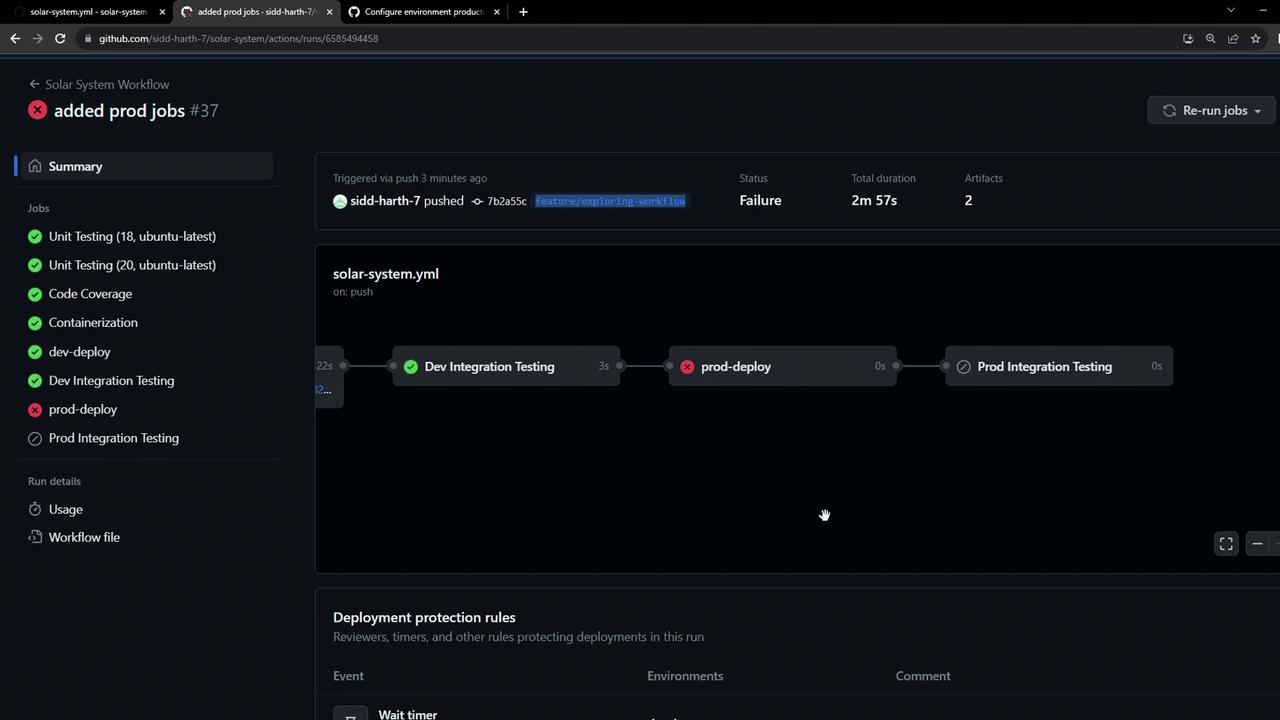
3. Monitor the sequential execution: dev jobs ➔ prod-deploy ➔ prod-integration-testing.
If `prod-deploy` is blocked by branch protection or environment rules, you’ll see an error and the integration test will be skipped.
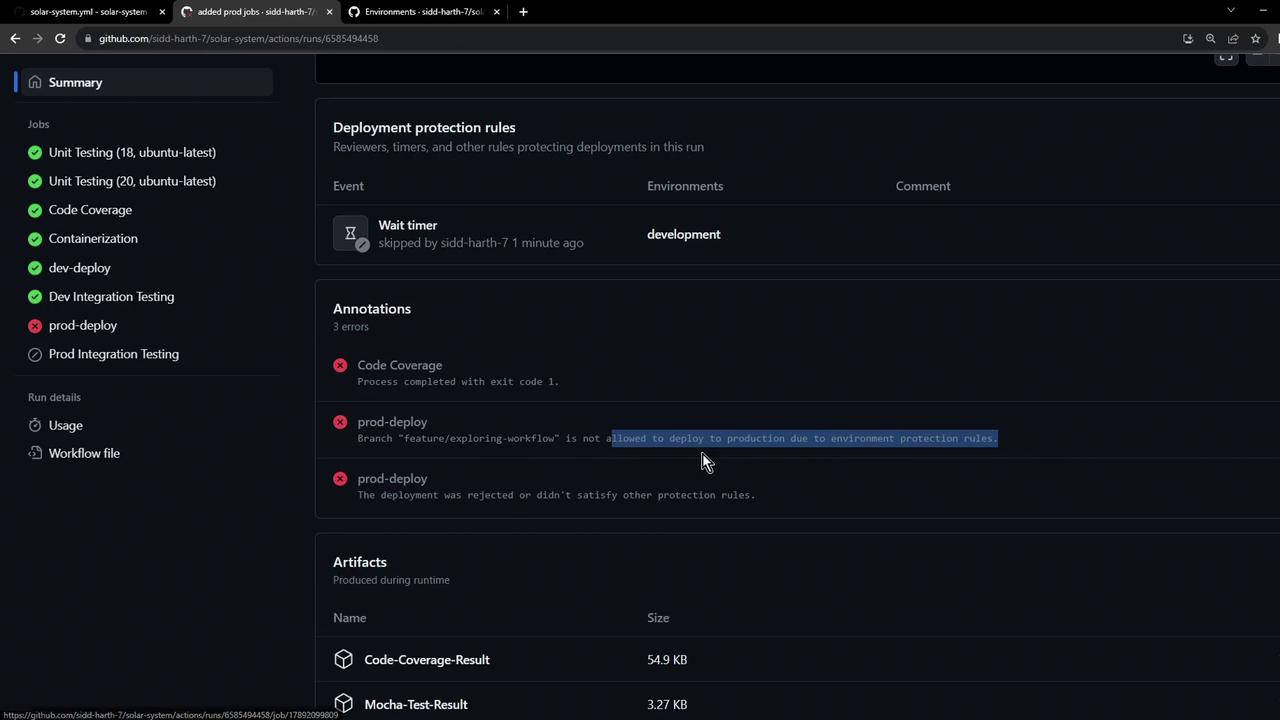
## 6. Environment Protection Rules
Configure deployment protection rules in your repository settings to enforce review policies, wait timers, or required approvals before production deployments.
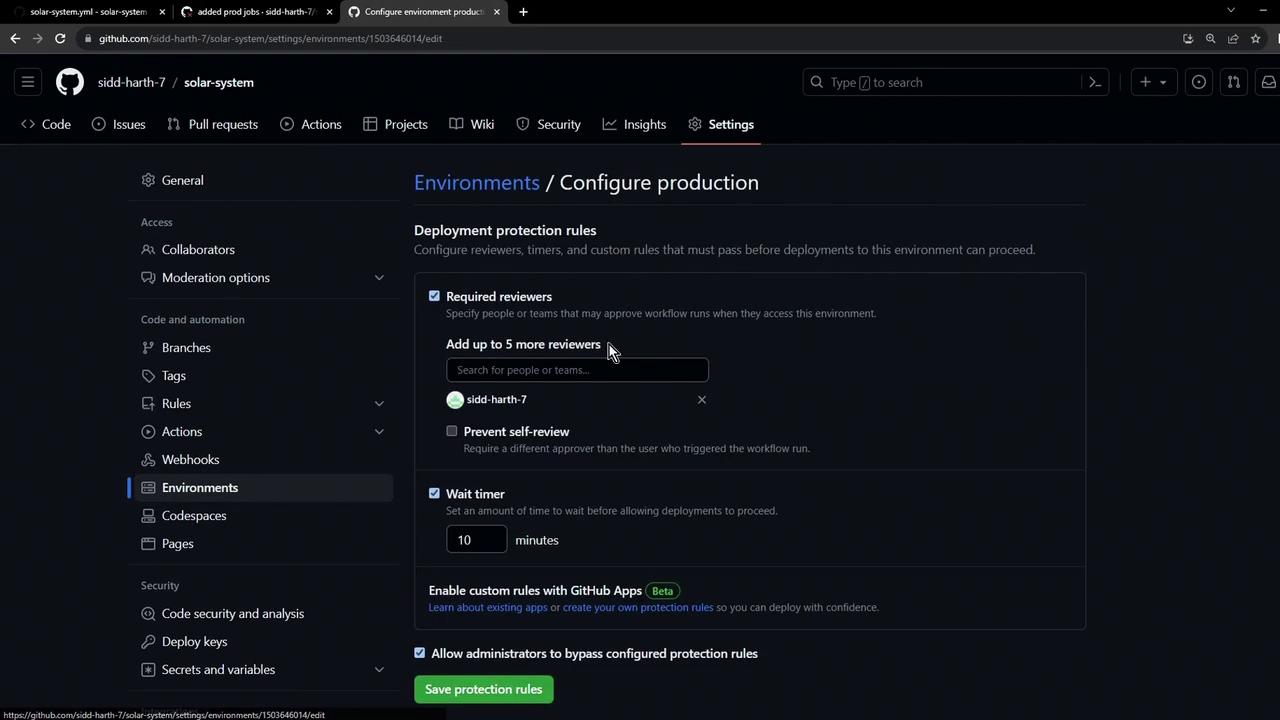
Triggering from an unauthorized branch (e.g., a feature branch without approval) will block `prod-deploy`. Subsequent jobs will be skipped.
***
## Links and References
* [GitHub Actions Documentation](https://docs.github.com/actions)
* [Kubernetes Basics](https://kubernetes.io/docs/concepts/overview/what-is-kubernetes/)
* [azure/setup-kubectl](https://github.com/Azure/setup-kubectl)
* [cscheidlen/replace-tokens GitHub Action](https://github.com/cscheidlen/replace-tokens)