> ## Documentation Index
> Fetch the complete documentation index at: https://notes.kodekloud.com/llms.txt
> Use this file to discover all available pages before exploring further.
# LoRA Fine Tuning
> LoRA fine-tuning customizes large language models efficiently by applying small patches instead of full retraining, reducing costs and speeding up the process.
LoRA (Low-Rank Adaptation) revolutionizes how we customize large language models (LLMs) like GitHub Copilot. Instead of costly full retraining, LoRA applies efficient “patches” to adapt a pre-trained model to specific coding standards, libraries, and architectural patterns—without rebuilding the entire network.
Full retraining of an LLM can require dozens of GPUs and take weeks, making it impractical for most teams. LoRA reduces compute requirements and speeds up iteration by training only a small set of additional parameters.
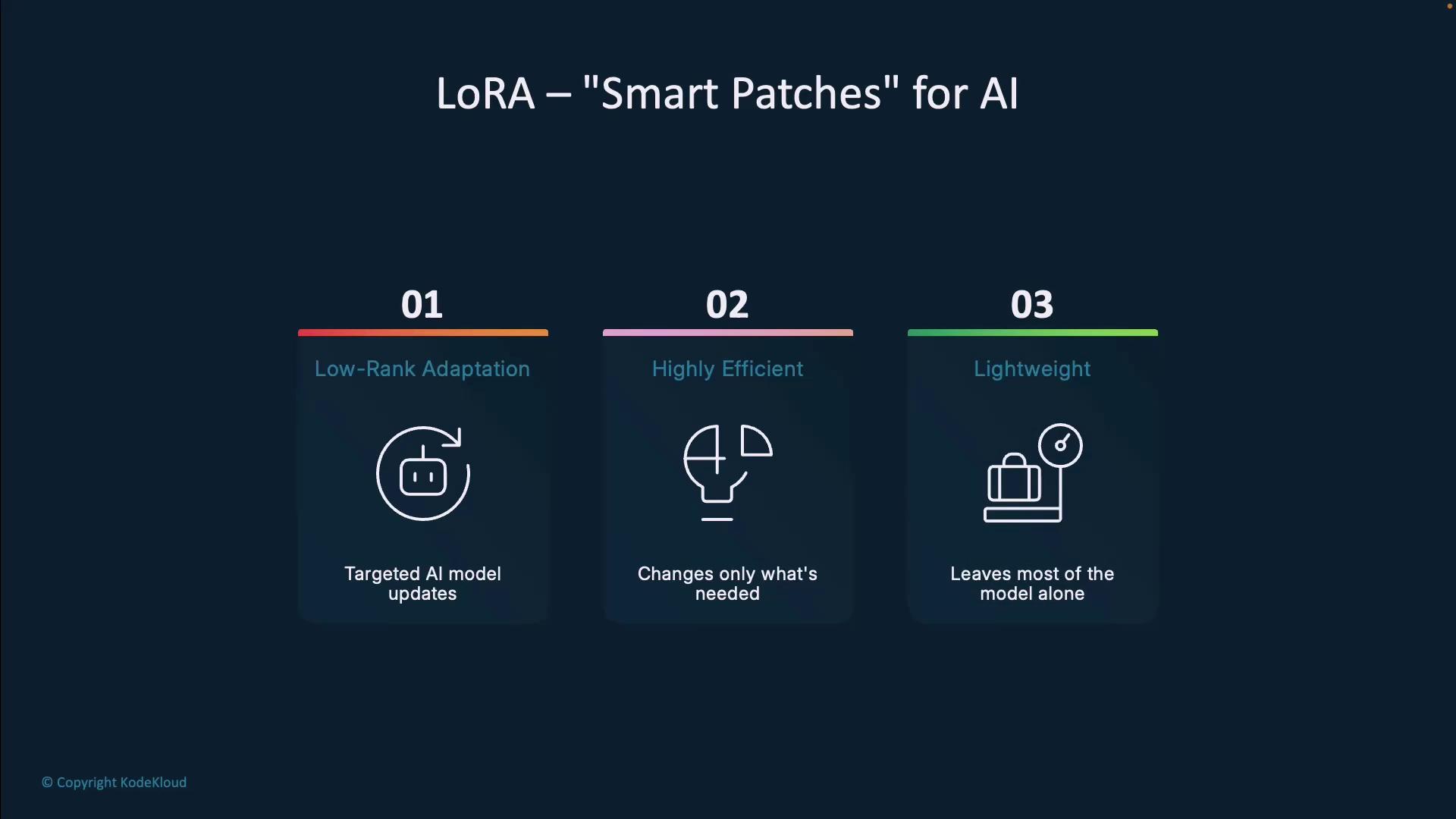
## How LoRA Works
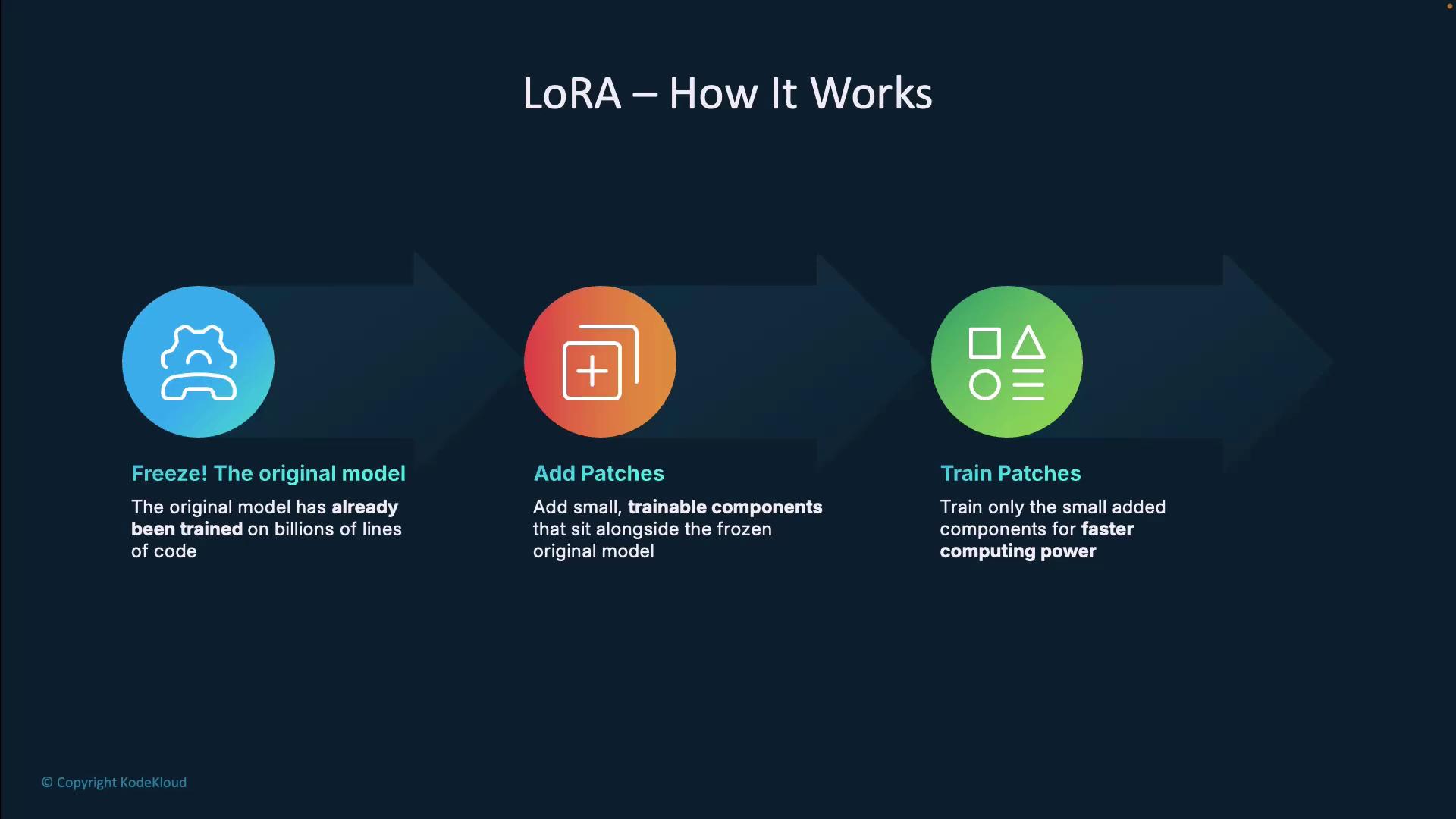
LoRA fine-tuning involves three straightforward steps:
1. **Freeze the Base Model**\
Keep the entire pre-trained LLM unchanged. This preserves its broad programming knowledge learned from billions of code examples.
2. **Inject Trainable Patches**\
Introduce small, low-rank adapters alongside existing model weights. These act like overlays on a GPS map—you keep the base map and add custom routes.
3. **Train Only the Adapters**\
Feed examples of your team’s coding style or preferences. During training, only the newly added parameters update, making the process much faster and more cost-effective.
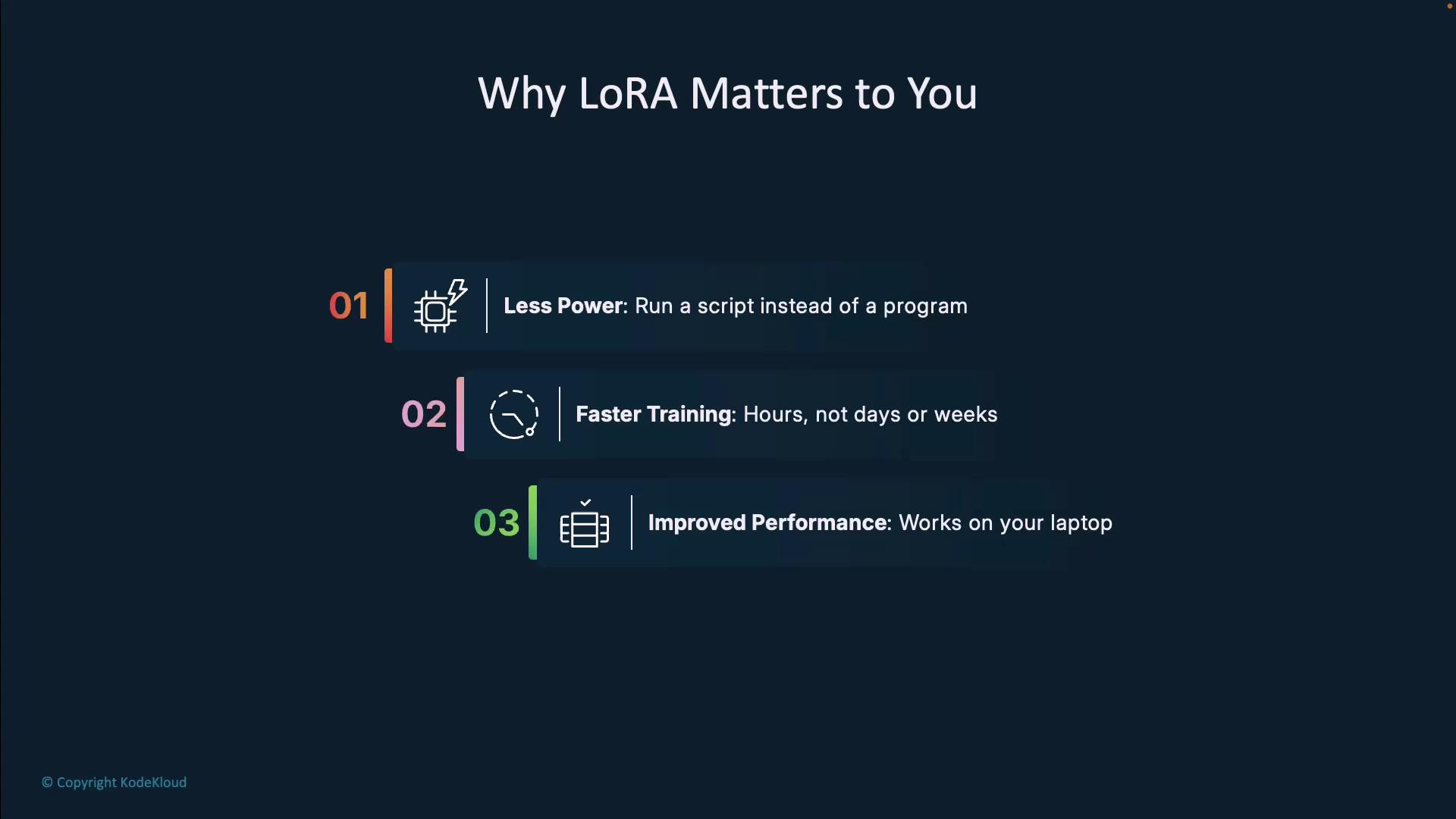
Because only a tiny fraction of parameters changes, LoRA fine-tuning completes in hours on modest hardware—compared to days or weeks for full model retraining.
## Key Benefits of LoRA
| Benefit | Description |
| -------------------------- | -------------------------------------------------------------------------- |
| Lower Compute Requirements | Train and deploy on standard GPUs or even high-end laptops. |
| Faster Iteration | Go from concept to customized model in hours, not weeks. |
| High Performance | Matches full fine-tuning accuracy while drastically cutting cost and time. |
## Customization Methods Compared
| Method | Compute Cost | Training Time | Performance |
| -------------------------- | ------------ | ------------- | ----------- |
| Full Retraining | Very High | Days to Weeks | Excellent |
| Adding Extra Layers | High | Several Hours | Good |
| LoRA (Low-Rank Adaptation) | Low | Hours | Excellent |
LoRA strikes the ideal balance—delivering full fine-tuning quality without the prohibitive resource demands.
Attempting full model retraining on consumer hardware can lead to out-of-memory errors and excessive cloud costs. Choose LoRA to keep budgets and timelines on track.
## Key Takeaways
* **Efficiency:** Train small adapter modules instead of the entire model.
* **Cost-Effectiveness:** Achieve full fine-tuning performance on standard GPUs.
* **Customization:** Tailor Copilot to your team’s conventions, libraries, and architecture in hours.
## References and Further Reading
* [GitHub Copilot Documentation](https://docs.github.com/en/copilot)
* [LoRA Paper: Low-Rank Adaptation of Large Language Models](https://arxiv.org/abs/2106.09685)
* [Transformer Model Architecture](https://huggingface.co/transformers/)