> ## Documentation Index
> Fetch the complete documentation index at: https://notes.kodekloud.com/llms.txt
> Use this file to discover all available pages before exploring further.
# Understanding AI pair programming
> Explains AI pair programming with GitHub Copilot, its benefits, workflow changes, use cases, risks, and best practices for combining AI suggestions with human oversight.
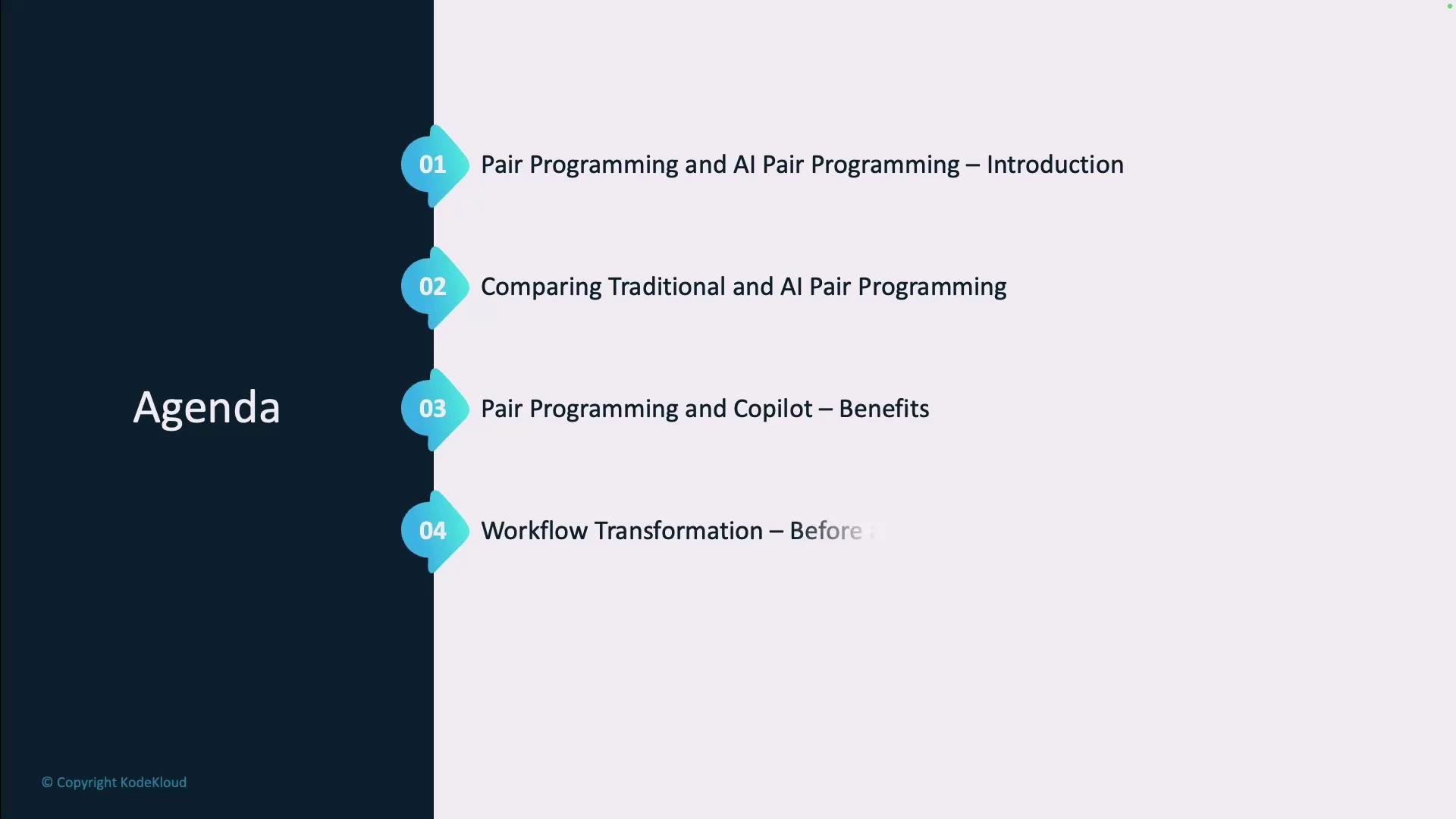
Welcome. In this lesson we explore an important evolution in software development: AI pair programming with [GitHub Copilot](https://github.com/features/copilot). This approach combines human creativity and judgment with AI assistance to boost productivity, reduce repetitive work, and keep learning inside the editor.
What you’ll learn:
* What pair programming is and how AI pair programming differs
* The benefits of GitHub Copilot
* How developer workflows change before and after Copilot
* Best practices: when to use Copilot and when to exercise caution
 ## What is pair programming?
Pair programming is a collaborative development practice where two people work together at the same workstation:
* Driver: writes the code
* Navigator: reviews the code, thinks ahead, spots edge cases, and suggests improvements
This model provides immediate feedback, encourages knowledge transfer, and often improves design decisions.
## What is AI pair programming?
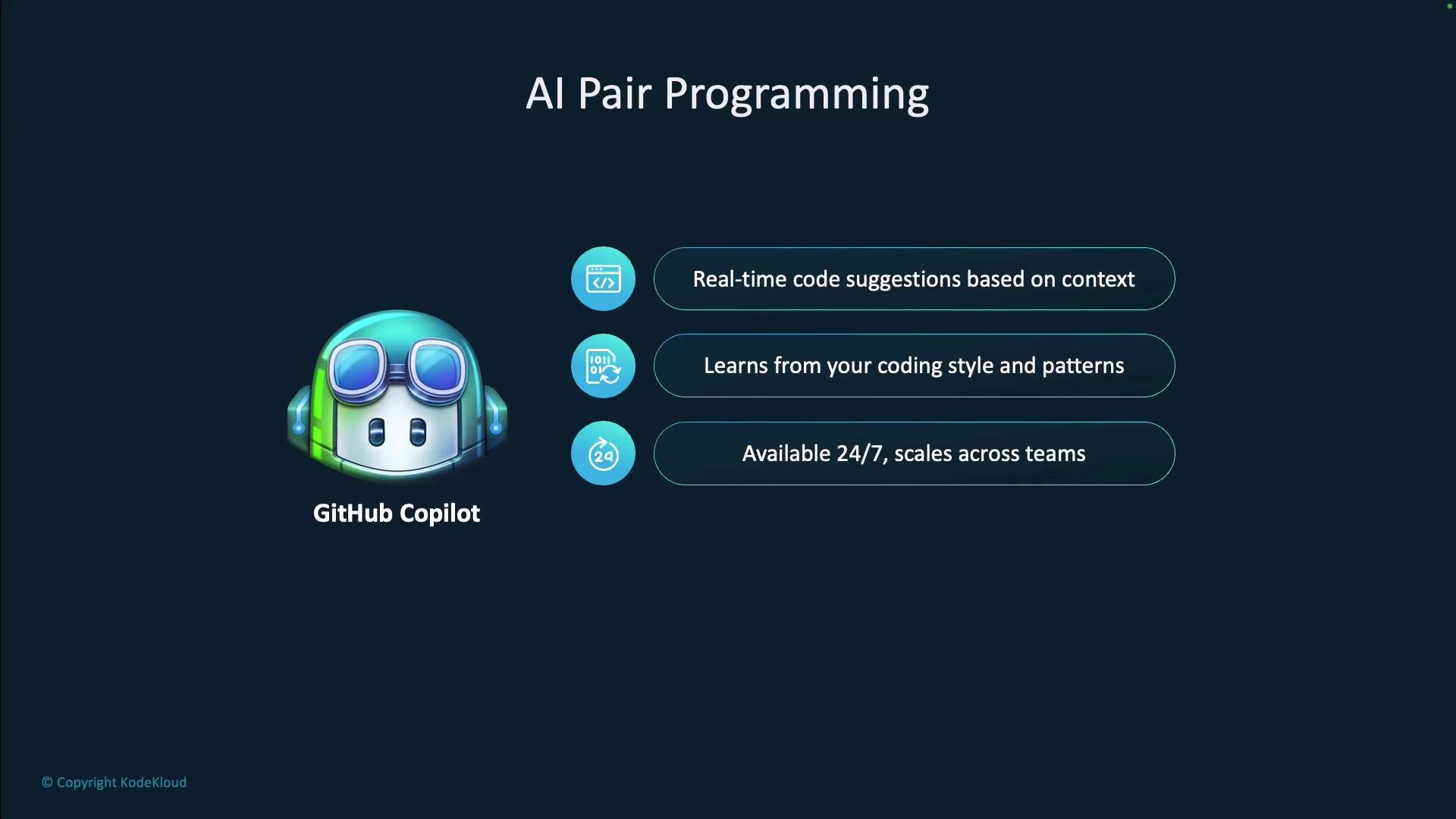
AI pair programming replaces—or augments—the human navigator with an AI partner. GitHub Copilot provides context-aware, inline suggestions based on the file you’re editing, the surrounding project, and patterns learned from large public codebases. Key differences from human partners:
* Available 24/7
* Scales across teams without scheduling
* Produces suggestions but does not make final decisions—you accept, modify, or reject outputs
## What is pair programming?
Pair programming is a collaborative development practice where two people work together at the same workstation:
* Driver: writes the code
* Navigator: reviews the code, thinks ahead, spots edge cases, and suggests improvements
This model provides immediate feedback, encourages knowledge transfer, and often improves design decisions.
## What is AI pair programming?
AI pair programming replaces—or augments—the human navigator with an AI partner. GitHub Copilot provides context-aware, inline suggestions based on the file you’re editing, the surrounding project, and patterns learned from large public codebases. Key differences from human partners:
* Available 24/7
* Scales across teams without scheduling
* Produces suggestions but does not make final decisions—you accept, modify, or reject outputs
 ## Traditional vs AI pair programming — a comparison
Traditional pair programming and AI pair programming share the same goals (knowledge sharing, immediate feedback, error catching) but achieve them differently.
| Focus | Traditional Pair Programming | AI Pair Programming (Copilot) |
| ----------------- | ------------------------------------------ | ------------------------------------------------ |
| Feedback model | Human-driven, conversational | Automated, inline suggestions |
| Availability | Dependent on people and schedules | Always available in the editor |
| Knowledge sources | Individual experience and team knowledge | Large public codebases + project context |
| Best for | Deep architectural decisions, mentorship | Repetitive tasks, scaffolding, quick prototyping |
| Control | Human decides architecture and correctness | Human reviews and accepts AI suggestions |
Benefits of combining both:
* Humans: creativity, intuition, architectural reasoning, mentorship
* Copilot: fast access to patterns, consistent style, scaffolded tests and docs, faster prototyping
## How workflows change
### Before Copilot
Typical pre-Copilot workflow:
* Write code
* Consult documentation
* Search Stack Overflow or examples
* Review, refactor, and test
These steps introduce context switches that slow iteration.
## Traditional vs AI pair programming — a comparison
Traditional pair programming and AI pair programming share the same goals (knowledge sharing, immediate feedback, error catching) but achieve them differently.
| Focus | Traditional Pair Programming | AI Pair Programming (Copilot) |
| ----------------- | ------------------------------------------ | ------------------------------------------------ |
| Feedback model | Human-driven, conversational | Automated, inline suggestions |
| Availability | Dependent on people and schedules | Always available in the editor |
| Knowledge sources | Individual experience and team knowledge | Large public codebases + project context |
| Best for | Deep architectural decisions, mentorship | Repetitive tasks, scaffolding, quick prototyping |
| Control | Human decides architecture and correctness | Human reviews and accepts AI suggestions |
Benefits of combining both:
* Humans: creativity, intuition, architectural reasoning, mentorship
* Copilot: fast access to patterns, consistent style, scaffolded tests and docs, faster prototyping
## How workflows change
### Before Copilot
Typical pre-Copilot workflow:
* Write code
* Consult documentation
* Search Stack Overflow or examples
* Review, refactor, and test
These steps introduce context switches that slow iteration.
 ### After Copilot
Copilot moves learning and discovery into the editor:
* You write code and receive inline suggestions in real time
* Accept, modify, or reject suggestions instantly
* Contextual documentation and examples appear without leaving the editor
* AI can assist with quick reviews, refactors, and test generation
This reduces context switching and shortens iteration cycles.
### After Copilot
Copilot moves learning and discovery into the editor:
* You write code and receive inline suggestions in real time
* Accept, modify, or reject suggestions instantly
* Contextual documentation and examples appear without leaving the editor
* AI can assist with quick reviews, refactors, and test generation
This reduces context switching and shortens iteration cycles.
 ## Practical use cases: when Copilot excels
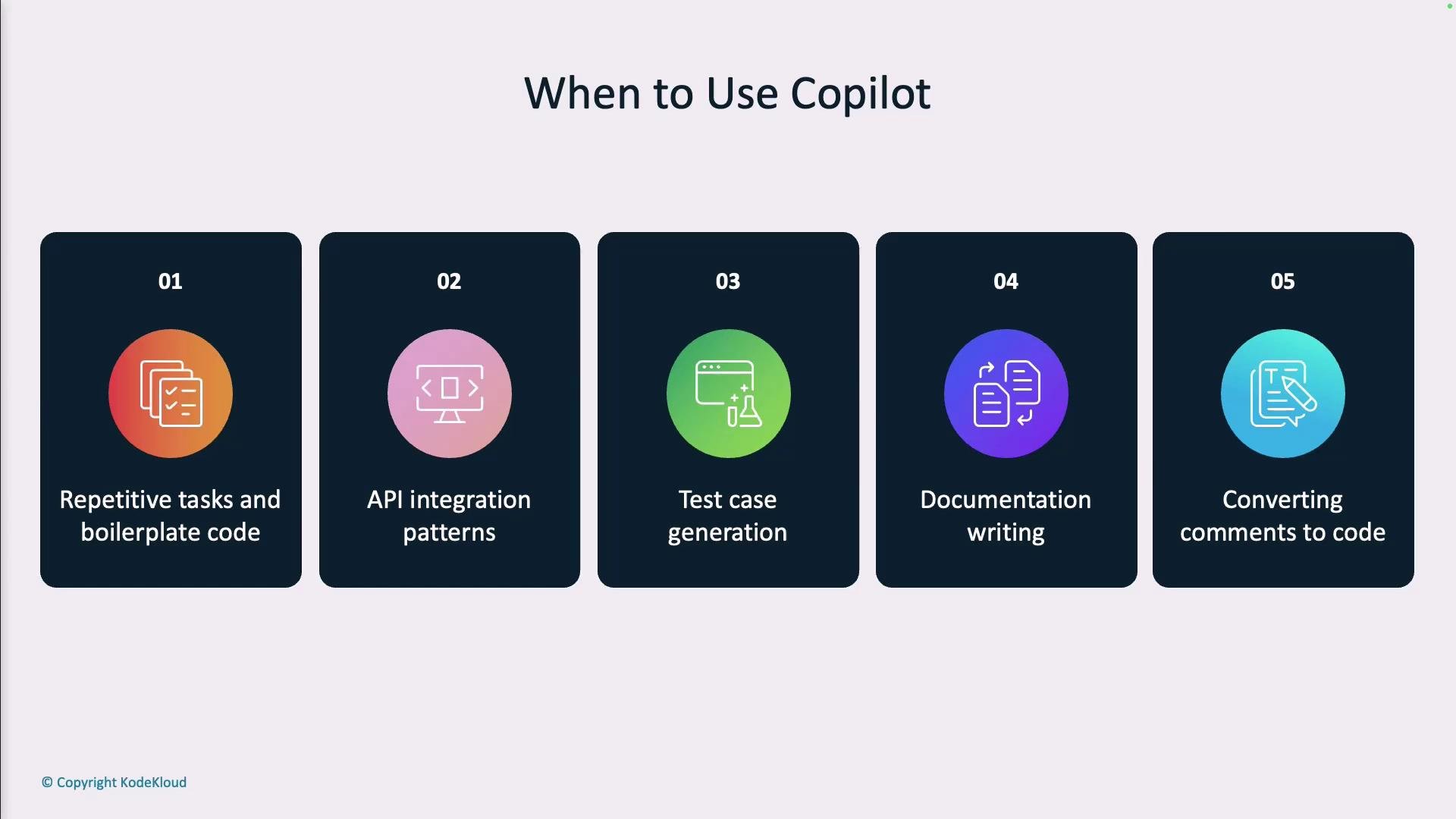
Copilot is particularly effective for tasks that are routine, pattern-based, or require fast scaffolding:
| Use Case | Why Copilot helps |
| ------------------------------- | ------------------------------------------------------- |
| Repetitive tasks & boilerplate | Generates standard code quickly |
| Common API integration patterns | Suggests idiomatic examples based on project context |
| Test generation & scaffolding | Creates unit tests and test harnesses faster |
| Documentation & README content | Produces structured docs from code/comments |
| Converting comments to code | Transforms natural-language intent into implementations |
## Practical use cases: when Copilot excels
Copilot is particularly effective for tasks that are routine, pattern-based, or require fast scaffolding:
| Use Case | Why Copilot helps |
| ------------------------------- | ------------------------------------------------------- |
| Repetitive tasks & boilerplate | Generates standard code quickly |
| Common API integration patterns | Suggests idiomatic examples based on project context |
| Test generation & scaffolding | Creates unit tests and test harnesses faster |
| Documentation & README content | Produces structured docs from code/comments |
| Converting comments to code | Transforms natural-language intent into implementations |
 ## When to be cautious — human oversight needed
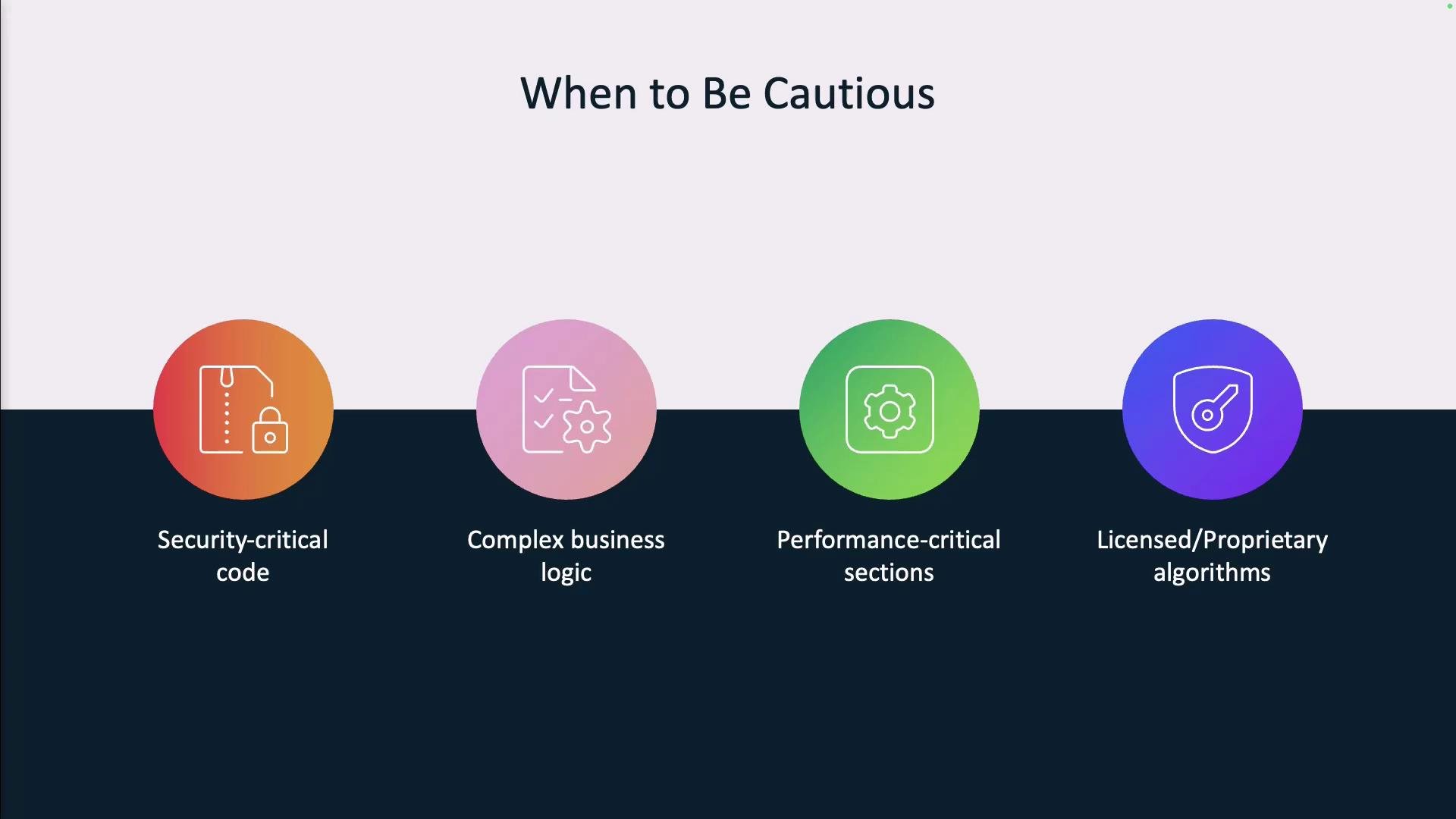
There are scenarios where AI suggestions require careful review and expert validation:
| Risk Area | Why human review is essential |
| ------------------------------- | ---------------------------------------------------------- |
| Security-critical code | Vulnerabilities and threat modeling need expert assessment |
| Complex domain-specific logic | Domain knowledge and business rules may be missed |
| Performance-critical sections | Profiling and low-level optimizations require experience |
| Licensed/proprietary algorithms | Licensing, IP, and copyright concerns must be evaluated |
## When to be cautious — human oversight needed
There are scenarios where AI suggestions require careful review and expert validation:
| Risk Area | Why human review is essential |
| ------------------------------- | ---------------------------------------------------------- |
| Security-critical code | Vulnerabilities and threat modeling need expert assessment |
| Complex domain-specific logic | Domain knowledge and business rules may be missed |
| Performance-critical sections | Profiling and low-level optimizations require experience |
| Licensed/proprietary algorithms | Licensing, IP, and copyright concerns must be evaluated |
 Always review AI-generated code for correctness, security, licensing, and performance. Copilot helps accelerate work, but does not replace expert validation.
## Best practices for adopting Copilot
* Start small: try Copilot on low-risk tasks such as boilerplate, tests, and docs.
* Learn from suggestions: use prompts and edits as a way to discover APIs and idioms.
* Establish team norms: share examples and review AI output as a team to standardize usage.
* Iterate and measure: adjust how you use Copilot over time and measure outcomes (e.g., time saved, defect rates).
* Keep responsibility clear: humans remain accountable for architecture, security, and legal compliance.
Treat Copilot as a force multiplier: it speeds routine work and surfaces possibilities, while humans retain responsibility for design, security, and correctness.
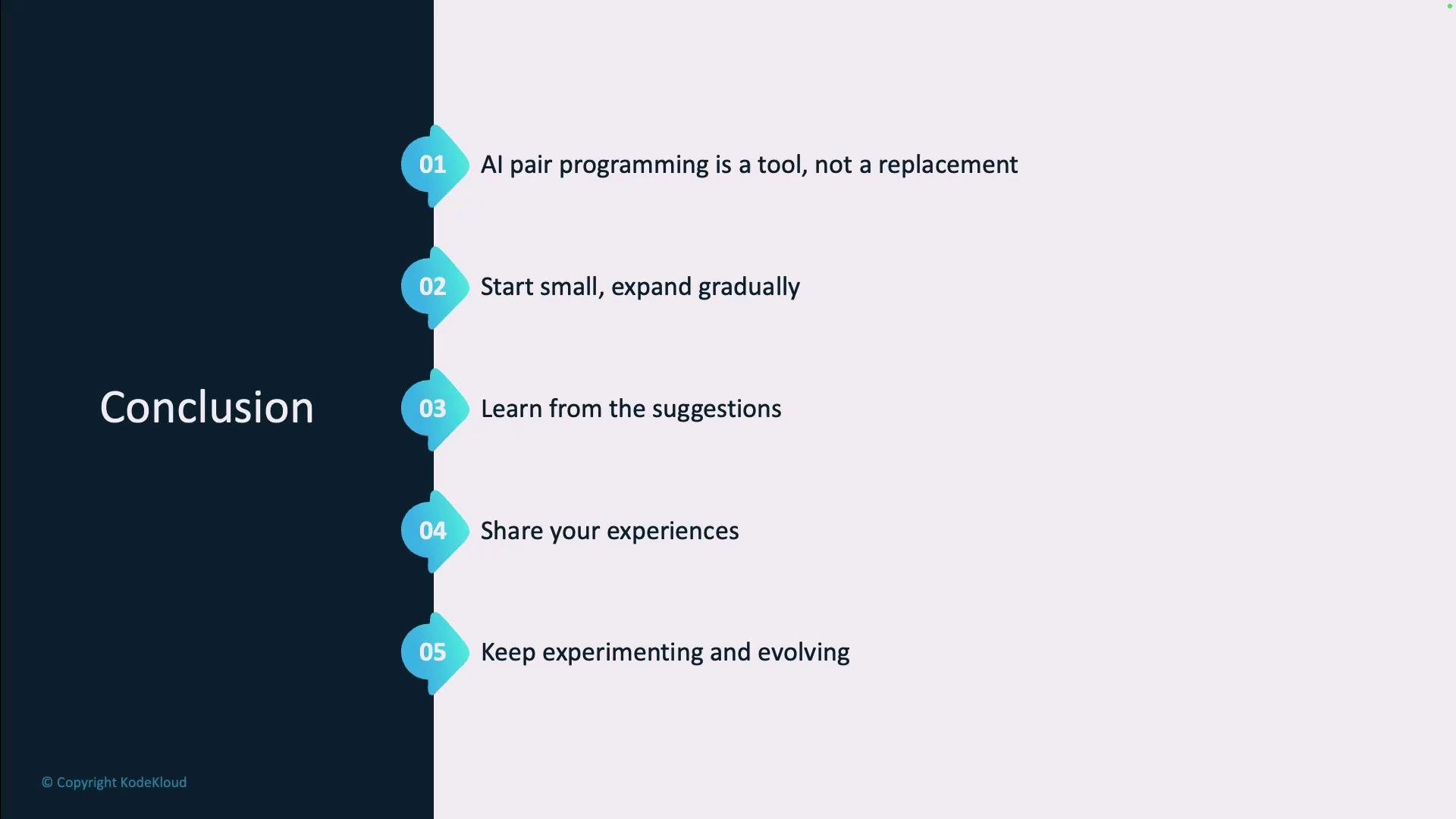
## Conclusion — AI + Human collaboration
GitHub Copilot is a powerful assistant that complements developer expertise. When used thoughtfully, AI pair programming:
* Accelerates routine work and scaffolding
* Keeps learning and discovery inside the editor
* Improves consistency and speed of prototyping
But it is not a replacement for human judgment on architecture, security, performance, or licensing. Adopt Copilot incrementally, validate outputs, and combine AI assistance with code review and expert oversight to get the best results.
Always review AI-generated code for correctness, security, licensing, and performance. Copilot helps accelerate work, but does not replace expert validation.
## Best practices for adopting Copilot
* Start small: try Copilot on low-risk tasks such as boilerplate, tests, and docs.
* Learn from suggestions: use prompts and edits as a way to discover APIs and idioms.
* Establish team norms: share examples and review AI output as a team to standardize usage.
* Iterate and measure: adjust how you use Copilot over time and measure outcomes (e.g., time saved, defect rates).
* Keep responsibility clear: humans remain accountable for architecture, security, and legal compliance.
Treat Copilot as a force multiplier: it speeds routine work and surfaces possibilities, while humans retain responsibility for design, security, and correctness.
## Conclusion — AI + Human collaboration
GitHub Copilot is a powerful assistant that complements developer expertise. When used thoughtfully, AI pair programming:
* Accelerates routine work and scaffolding
* Keeps learning and discovery inside the editor
* Improves consistency and speed of prototyping
But it is not a replacement for human judgment on architecture, security, performance, or licensing. Adopt Copilot incrementally, validate outputs, and combine AI assistance with code review and expert oversight to get the best results.
 ## Links and references
* [GitHub Copilot](https://github.com/features/copilot) — product page and documentation
* [Stack Overflow](https://stackoverflow.com) — community Q\&A and examples
Further reading:
* [GitHub Copilot docs](https://docs.github.com/en/copilot)
* [Responsible AI guidelines](https://www.microsoft.com/en-us/ai/responsible-ai)
## Links and references
* [GitHub Copilot](https://github.com/features/copilot) — product page and documentation
* [Stack Overflow](https://stackoverflow.com) — community Q\&A and examples
Further reading:
* [GitHub Copilot docs](https://docs.github.com/en/copilot)
* [Responsible AI guidelines](https://www.microsoft.com/en-us/ai/responsible-ai)