> ## Documentation Index
> Fetch the complete documentation index at: https://notes.kodekloud.com/llms.txt
> Use this file to discover all available pages before exploring further.
# Comparing InnerSource and Open Source
> Explains InnerSource vs open source, comparing practices, governance, access, benefits, adoption steps, and metrics for applying open-source workflows internally within organizations.
What are the differences between open source and InnerSource?
In many traditional companies, source code is siloed inside team boundaries: only the owning team can view, modify, or accept contributions. InnerSource applies open-source practices—discoverability, contribution workflows, consistent documentation—inside an organization so any qualified employee can discover, adopt, or contribute to internal repositories.
This guide explains what InnerSource enables, its benefits, and how it differs from public open source.
## Why adopt InnerSource?
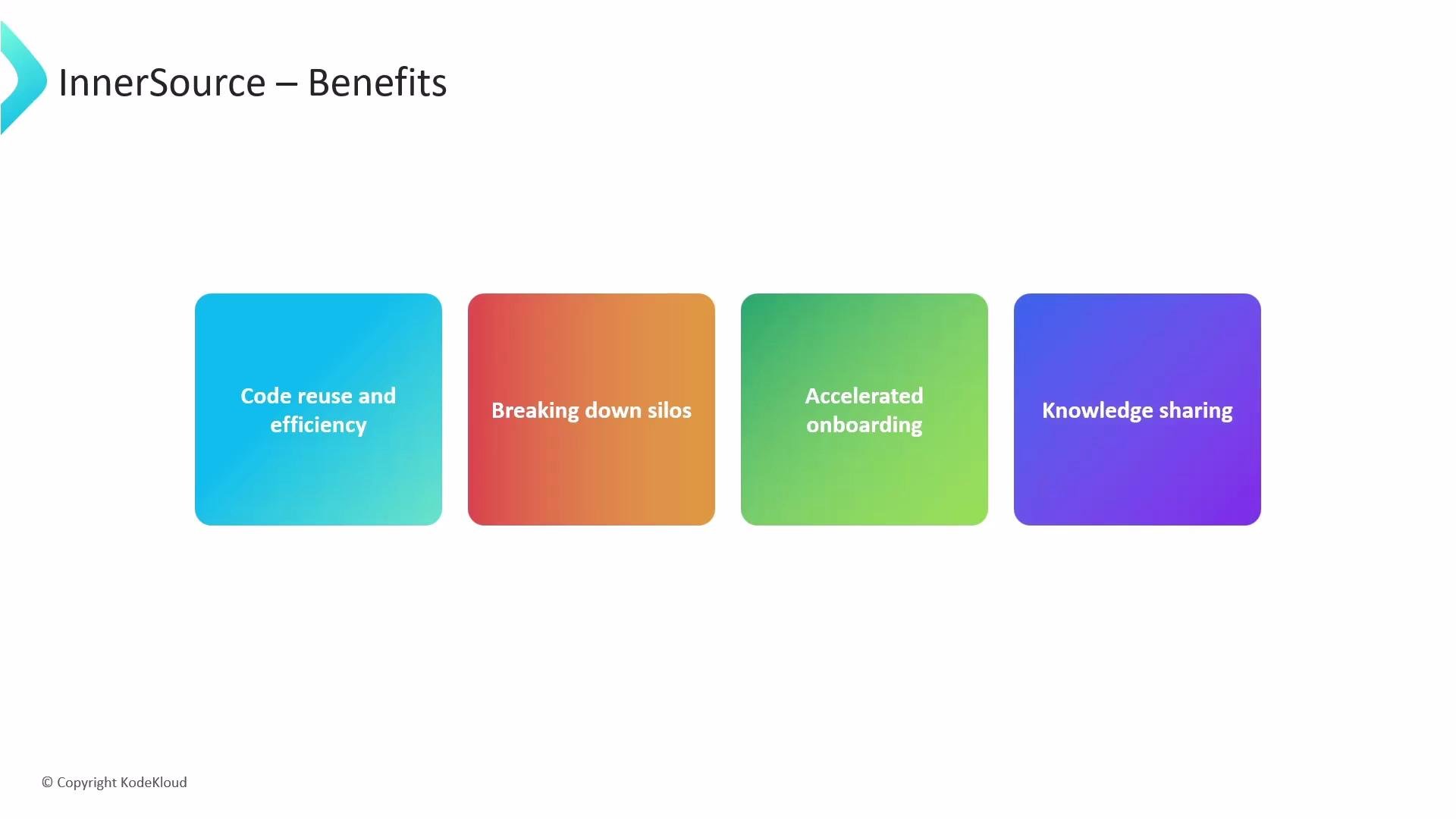
InnerSource brings proven open-source workflows into your corporate environment to increase reuse, improve quality, and speed onboarding. Key benefits include:
* Code reuse and efficiency\
One shared implementation (e.g., a single login module) reduces duplication and maintenance costs across teams. Shared components get higher-quality updates and bug fixes faster.
* Breaking down silos\
Cross-team contributions let engineers fix issues or add enhancements without waiting on the owning team’s backlog, reducing bottlenecks.
* Accelerated onboarding\
Repositories that follow open-source conventions—clear READMEs, contribution guides, API docs, and examples—make it faster for new hires to understand and contribute.
* Knowledge sharing\
Public internal discussions, PR reviews, and documented design decisions become a searchable knowledge base that helps junior and senior engineers alike.
 ## Side-by-side comparison
| Aspect | InnerSource (internal) | Open Source (public) |
| ---------------------------- | --------------------------------------------------------------------------------------- | ----------------------------------------------------------------------------------------- |
| Visibility and access | Repositories visible to employees; access controlled by company IAM | Publicly visible; anyone can view, fork, and often contribute |
| Licensing & distribution | Controlled by internal policies and contracts; rarely publicly licensed unless approved | Uses public licenses (MIT, Apache, GPL) granting explicit public rights |
| Contributors & community | Employees and approved contractors; community bounded by organization | Global contributors with diverse backgrounds and organizations |
| Governance & decision-making | Driven by internal product priorities, compliance, and SLAs | Varies (benevolent dictator, meritocracy, foundations); must manage external transparency |
| Security & compliance | Internal reviews, IP controls, and regulatory checks are easier to enforce | Requires explicit security practices and disclosure policies for a wide audience |
| Incentives & recognition | Internal recognition: performance reviews, promotions, internal reputation | Public recognition, broader career visibility, external reputation |
| Tooling & workflow | Same tools (VCS, PRs, CI/CD), applied inside corporate boundaries | Same tools applied for a public audience; governance must include external onboarding |
## Detailed differences
* Visibility and access
* InnerSource: Repos are discoverable internally and follow company access controls (IAM, SSO, RBAC).
* Open source: Public repos accept contributions from anyone subject to project contribution rules.
* Licensing and distribution
* InnerSource: Distribution handled via internal policies; public licensing is rare without legal approval.
* Open source: Projects use explicit licenses (e.g., MIT, Apache, GPL) that define public rights.
* Community and contributors
* InnerSource: Bounded by employment or contracting relationships; contributions are typically cross-functional.
* Open source: Global community participation requires onboarding, code of conduct, and sometimes formal governance.
* Governance and decision-making
* InnerSource: Priorities align with company goals, product roadmaps, and compliance mandates. Maintainers are typically internal.
* Open source: Governance models must balance transparency and community needs; decision processes are often documented publicly.
* Security and compliance
* InnerSource: Easier to enforce internal security reviews, IP protections, and regulatory compliance.
* Open source: Public projects need dedicated vulnerability disclosure and security response processes.
* Incentives and recognition
* InnerSource: Contributors earn internal credit—performance metrics, visibility within the company, career growth.
* Open source: Contributors gain public reputation, speaking opportunities, and broader industry visibility.
* Contribution workflow and tooling\
Both models benefit from the same practices: branching strategies, clear PR processes, code reviews, CI/CD, issue tracking, and comprehensive READMEs and contribution guides. InnerSource applies these within organizational boundaries.
InnerSource is not a weaker form of open source — it’s the intentional application of open-source principles (discoverability, contribution workflows, and documentation) inside an organization. This approach increases reuse, accelerates onboarding, and broadens participation while keeping internal controls intact.
## Practical steps to adopt InnerSource
* Start small: pilot InnerSource with a few non-critical libraries, shared tools, or infra projects to validate processes and measure impact.
* Define contribution rules and ownership: publish how to propose changes, who reviews them, expected SLAs, and how releases are managed.
* Improve discoverability: create a searchable component registry, tag repos, and maintain clear READMEs and API docs.
* Provide templates and automation: standardize issue templates, PR templates, CI checks, and dependency management to reduce friction.
* Train maintainers and contributors: run workshops on code review, documentation standards, and how to use internal contribution workflows.
* Measure outcomes: track reuse, contributor counts, time to resolve cross-team bugs, and onboarding time to quantify value.
## Metrics to track
| Metric | Why it matters | Example |
| --------------------------- | ------------------------------------------- | ------------------------------------------- |
| Reuse rate | Shows whether teams adopt shared components | # of projects depending on internal library |
| Contributors | Indicates cross-team participation | Count of unique contributors per quarter |
| Time-to-fix cross-team bugs | Measures reduced bottlenecks | Median time from bug report to merged PR |
| Onboarding time | How quickly new hires contribute | Time from hire to first accepted PR |
## Summary
InnerSource brings the operational benefits of open-source development—transparent workflows, discoverable code, and collaborative contribution—into the corporate environment while preserving access controls, licensing constraints, and compliance requirements. Public open source opens those same practices to the world, enabling broader collaboration and distribution. Both models succeed when projects invest in documentation, clear contribution processes, and strong maintainer practices.
Further reading and resources:
* [InnerSource Commons](https://innersourcecommons.org/)
* [Open Source Initiative (OSI)](https://opensource.org/)
* [GitHub Docs: Open Source guides](https://docs.github.com/en/get-started/quickstart/open-source)
## Side-by-side comparison
| Aspect | InnerSource (internal) | Open Source (public) |
| ---------------------------- | --------------------------------------------------------------------------------------- | ----------------------------------------------------------------------------------------- |
| Visibility and access | Repositories visible to employees; access controlled by company IAM | Publicly visible; anyone can view, fork, and often contribute |
| Licensing & distribution | Controlled by internal policies and contracts; rarely publicly licensed unless approved | Uses public licenses (MIT, Apache, GPL) granting explicit public rights |
| Contributors & community | Employees and approved contractors; community bounded by organization | Global contributors with diverse backgrounds and organizations |
| Governance & decision-making | Driven by internal product priorities, compliance, and SLAs | Varies (benevolent dictator, meritocracy, foundations); must manage external transparency |
| Security & compliance | Internal reviews, IP controls, and regulatory checks are easier to enforce | Requires explicit security practices and disclosure policies for a wide audience |
| Incentives & recognition | Internal recognition: performance reviews, promotions, internal reputation | Public recognition, broader career visibility, external reputation |
| Tooling & workflow | Same tools (VCS, PRs, CI/CD), applied inside corporate boundaries | Same tools applied for a public audience; governance must include external onboarding |
## Detailed differences
* Visibility and access
* InnerSource: Repos are discoverable internally and follow company access controls (IAM, SSO, RBAC).
* Open source: Public repos accept contributions from anyone subject to project contribution rules.
* Licensing and distribution
* InnerSource: Distribution handled via internal policies; public licensing is rare without legal approval.
* Open source: Projects use explicit licenses (e.g., MIT, Apache, GPL) that define public rights.
* Community and contributors
* InnerSource: Bounded by employment or contracting relationships; contributions are typically cross-functional.
* Open source: Global community participation requires onboarding, code of conduct, and sometimes formal governance.
* Governance and decision-making
* InnerSource: Priorities align with company goals, product roadmaps, and compliance mandates. Maintainers are typically internal.
* Open source: Governance models must balance transparency and community needs; decision processes are often documented publicly.
* Security and compliance
* InnerSource: Easier to enforce internal security reviews, IP protections, and regulatory compliance.
* Open source: Public projects need dedicated vulnerability disclosure and security response processes.
* Incentives and recognition
* InnerSource: Contributors earn internal credit—performance metrics, visibility within the company, career growth.
* Open source: Contributors gain public reputation, speaking opportunities, and broader industry visibility.
* Contribution workflow and tooling\
Both models benefit from the same practices: branching strategies, clear PR processes, code reviews, CI/CD, issue tracking, and comprehensive READMEs and contribution guides. InnerSource applies these within organizational boundaries.
InnerSource is not a weaker form of open source — it’s the intentional application of open-source principles (discoverability, contribution workflows, and documentation) inside an organization. This approach increases reuse, accelerates onboarding, and broadens participation while keeping internal controls intact.
## Practical steps to adopt InnerSource
* Start small: pilot InnerSource with a few non-critical libraries, shared tools, or infra projects to validate processes and measure impact.
* Define contribution rules and ownership: publish how to propose changes, who reviews them, expected SLAs, and how releases are managed.
* Improve discoverability: create a searchable component registry, tag repos, and maintain clear READMEs and API docs.
* Provide templates and automation: standardize issue templates, PR templates, CI checks, and dependency management to reduce friction.
* Train maintainers and contributors: run workshops on code review, documentation standards, and how to use internal contribution workflows.
* Measure outcomes: track reuse, contributor counts, time to resolve cross-team bugs, and onboarding time to quantify value.
## Metrics to track
| Metric | Why it matters | Example |
| --------------------------- | ------------------------------------------- | ------------------------------------------- |
| Reuse rate | Shows whether teams adopt shared components | # of projects depending on internal library |
| Contributors | Indicates cross-team participation | Count of unique contributors per quarter |
| Time-to-fix cross-team bugs | Measures reduced bottlenecks | Median time from bug report to merged PR |
| Onboarding time | How quickly new hires contribute | Time from hire to first accepted PR |
## Summary
InnerSource brings the operational benefits of open-source development—transparent workflows, discoverable code, and collaborative contribution—into the corporate environment while preserving access controls, licensing constraints, and compliance requirements. Public open source opens those same practices to the world, enabling broader collaboration and distribution. Both models succeed when projects invest in documentation, clear contribution processes, and strong maintainer practices.
Further reading and resources:
* [InnerSource Commons](https://innersourcecommons.org/)
* [Open Source Initiative (OSI)](https://opensource.org/)
* [GitHub Docs: Open Source guides](https://docs.github.com/en/get-started/quickstart/open-source)