> ## Documentation Index
> Fetch the complete documentation index at: https://notes.kodekloud.com/llms.txt
> Use this file to discover all available pages before exploring further.
# Understanding Open Source
> Overview of open source software, its principles, licenses, community contributions, and industry impact.
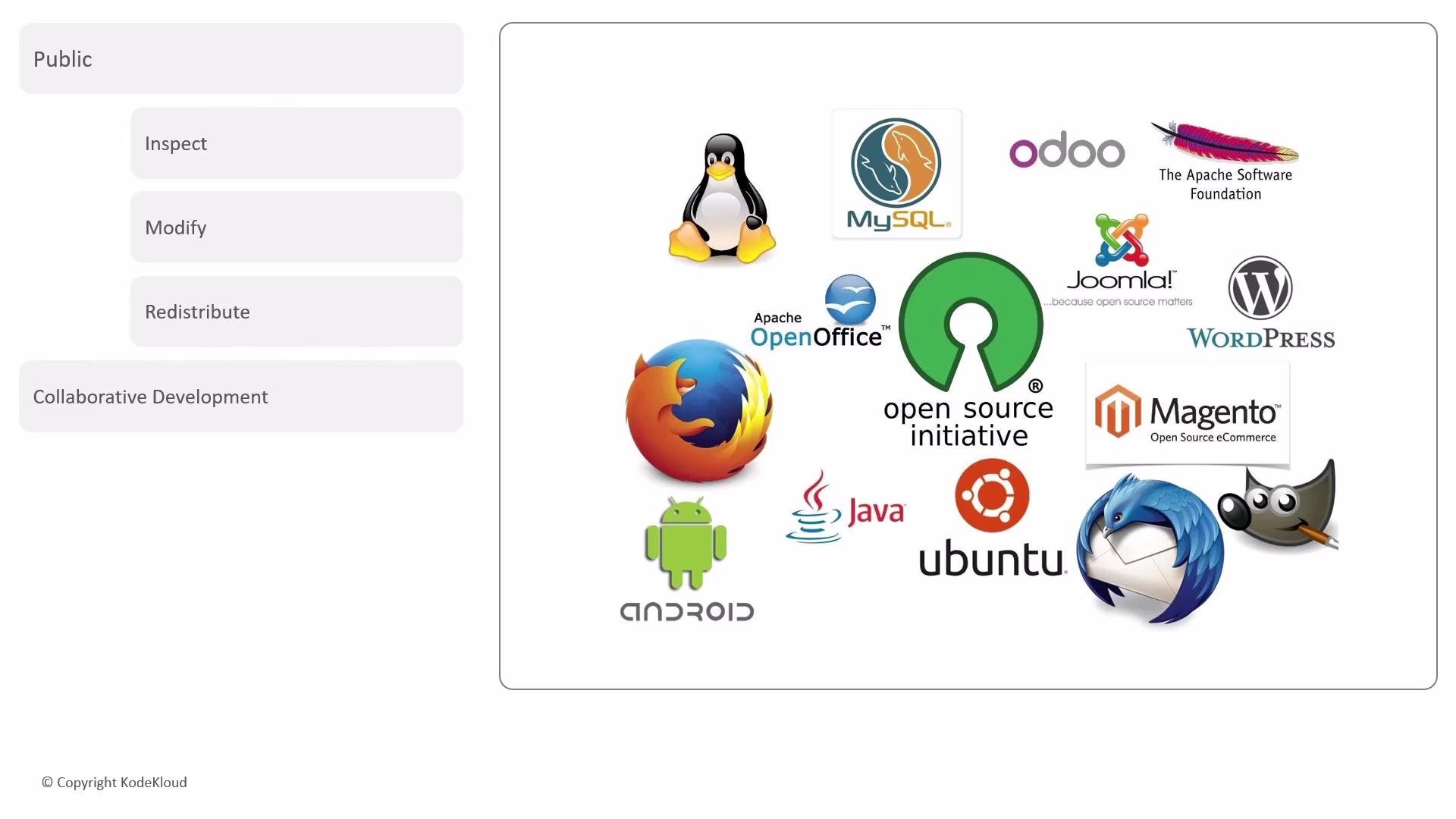
Open source describes software whose source code is intentionally published so anyone can inspect, modify, and redistribute it. This collaborative development model harnesses contributions from a global community—resulting in faster innovation, more eyes on security, and broader interoperability across tools and platforms.
 Why open source matters
* Faster iteration: Community contributions enable rapid feature development, bug fixes, and experimental ideas that might not appear in closed-source projects.
* Improved security and reliability: Publicly accessible code allows independent audits and quicker fixes when vulnerabilities are discovered.
* Vendor neutrality: Open standards and implementations reduce lock-in and increase portability between systems.
* Professional growth: Contributing is a practical way to gain experience, demonstrate expertise, and build professional reputation.
Core principles of open source
| Principle | What it means | Practical benefit |
| ------------------------- | ------------------------------------------------------------------------------------------------------------------------------------ | ---------------------------------------------------------------------------- |
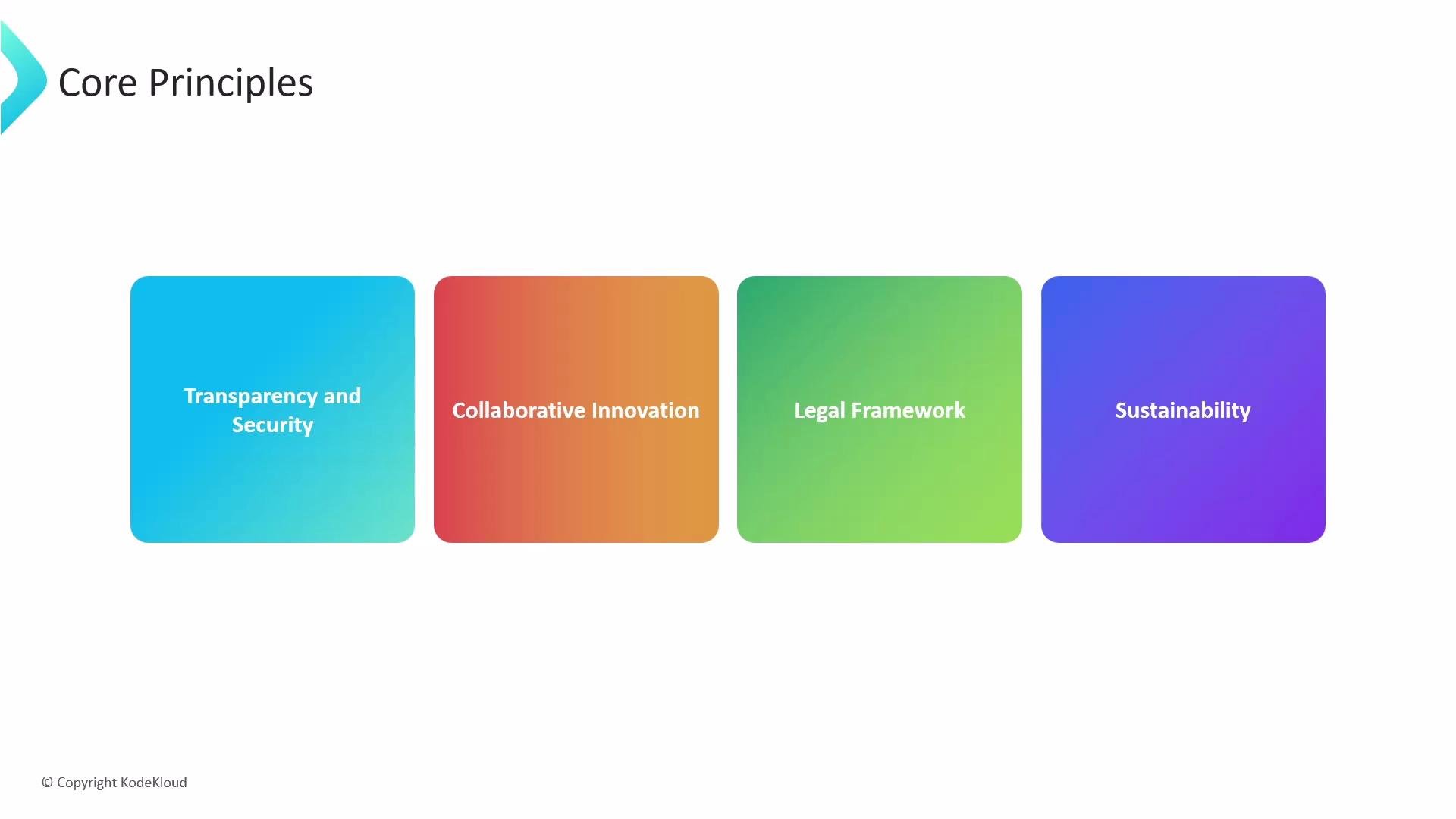
| Transparency and security | Source code is auditable by anyone, enabling community-driven reviews and vulnerability identification. | Faster detection and patching of security issues; higher trust. |
| Collaborative innovation | Development is driven by contributors from varied backgrounds rather than a single organization. | Broader creativity, diverse perspectives, and accelerated feature evolution. |
| Legal framework | Projects use explicit open source licenses (e.g., MIT, Apache, GPL) to define allowed uses, redistribution, and modification rights. | Clear rules for reuse and redistribution; license compatibility guidance. |
| Sustainability | Long-term health depends on contributors who write code, improve docs, triage issues, and mentor newcomers. | Project longevity, consistent maintenance, and community support. |
Why open source matters
* Faster iteration: Community contributions enable rapid feature development, bug fixes, and experimental ideas that might not appear in closed-source projects.
* Improved security and reliability: Publicly accessible code allows independent audits and quicker fixes when vulnerabilities are discovered.
* Vendor neutrality: Open standards and implementations reduce lock-in and increase portability between systems.
* Professional growth: Contributing is a practical way to gain experience, demonstrate expertise, and build professional reputation.
Core principles of open source
| Principle | What it means | Practical benefit |
| ------------------------- | ------------------------------------------------------------------------------------------------------------------------------------ | ---------------------------------------------------------------------------- |
| Transparency and security | Source code is auditable by anyone, enabling community-driven reviews and vulnerability identification. | Faster detection and patching of security issues; higher trust. |
| Collaborative innovation | Development is driven by contributors from varied backgrounds rather than a single organization. | Broader creativity, diverse perspectives, and accelerated feature evolution. |
| Legal framework | Projects use explicit open source licenses (e.g., MIT, Apache, GPL) to define allowed uses, redistribution, and modification rights. | Clear rules for reuse and redistribution; license compatibility guidance. |
| Sustainability | Long-term health depends on contributors who write code, improve docs, triage issues, and mentor newcomers. | Project longevity, consistent maintenance, and community support. |
 Maintaining a healthy open source project
Peer review and active community participation are essential. Contributors support a project in multiple ways:
* Code contributions and pull requests
* Documentation and tutorials
* Issue triage and testing
* Mentoring new contributors and maintaining onboarding resources
When choosing a project to contribute to, read its license and contribution guidelines. License compatibility controls how you can reuse code, and clear contribution rules speed up onboarding and increase the chances your changes will be accepted.
Common open source licenses
| License | Permissions | Common use |
| ----------------------------------------------------------------- | ------------------------------------------------------------------ | -------------------------------------------------------- |
| [MIT License](https://opensource.org/licenses/MIT) | Permissive: reuse, modify, redistribute with attribution. | Libraries, small projects, permissive commercial reuse. |
| [Apache License 2.0](https://www.apache.org/licenses/LICENSE-2.0) | Permissive with explicit patent grant and contribution terms. | Large frameworks, corporate-backed projects. |
| [GNU GPL v3](https://www.gnu.org/licenses/gpl-3.0.en.html) | Copyleft: derivative works must be distributed under same license. | Projects that emphasize downstream freedom and copyleft. |
Impact on the industry
Open source technology underpins much of the modern software stack. Examples include the [Linux](https://www.kernel.org/) kernel powering servers and mobile devices and the [Firefox](https://www.mozilla.org/firefox/) browser used for web access. For developers, evolving from a user to an active contributor is both a learning path and a way to influence critical tools used across the industry. Contributing helps:
* Improve software stability and security for everyone
* Build visibility and credibility within the community
* Shape project direction and feature priorities
Links and references
* [Kubernetes Documentation](https://kubernetes.io/docs/)
* [Docker Hub](https://hub.docker.com/)
* [Terraform Registry](https://registry.terraform.io/)
* Open source license references: [MIT](https://opensource.org/licenses/MIT), [Apache 2.0](https://www.apache.org/licenses/LICENSE-2.0), [GPL v3](https://www.gnu.org/licenses/gpl-3.0.en.html)
Maintaining a healthy open source project
Peer review and active community participation are essential. Contributors support a project in multiple ways:
* Code contributions and pull requests
* Documentation and tutorials
* Issue triage and testing
* Mentoring new contributors and maintaining onboarding resources
When choosing a project to contribute to, read its license and contribution guidelines. License compatibility controls how you can reuse code, and clear contribution rules speed up onboarding and increase the chances your changes will be accepted.
Common open source licenses
| License | Permissions | Common use |
| ----------------------------------------------------------------- | ------------------------------------------------------------------ | -------------------------------------------------------- |
| [MIT License](https://opensource.org/licenses/MIT) | Permissive: reuse, modify, redistribute with attribution. | Libraries, small projects, permissive commercial reuse. |
| [Apache License 2.0](https://www.apache.org/licenses/LICENSE-2.0) | Permissive with explicit patent grant and contribution terms. | Large frameworks, corporate-backed projects. |
| [GNU GPL v3](https://www.gnu.org/licenses/gpl-3.0.en.html) | Copyleft: derivative works must be distributed under same license. | Projects that emphasize downstream freedom and copyleft. |
Impact on the industry
Open source technology underpins much of the modern software stack. Examples include the [Linux](https://www.kernel.org/) kernel powering servers and mobile devices and the [Firefox](https://www.mozilla.org/firefox/) browser used for web access. For developers, evolving from a user to an active contributor is both a learning path and a way to influence critical tools used across the industry. Contributing helps:
* Improve software stability and security for everyone
* Build visibility and credibility within the community
* Shape project direction and feature priorities
Links and references
* [Kubernetes Documentation](https://kubernetes.io/docs/)
* [Docker Hub](https://hub.docker.com/)
* [Terraform Registry](https://registry.terraform.io/)
* Open source license references: [MIT](https://opensource.org/licenses/MIT), [Apache 2.0](https://www.apache.org/licenses/LICENSE-2.0), [GPL v3](https://www.gnu.org/licenses/gpl-3.0.en.html)