> ## Documentation Index
> Fetch the complete documentation index at: https://notes.kodekloud.com/llms.txt
> Use this file to discover all available pages before exploring further.
# Comparing Git and GitHub
> Explains the difference between Git as a local version control system and GitHub as a cloud platform for collaboration, code review, automation, and security.
What is the difference between Git and GitHub?
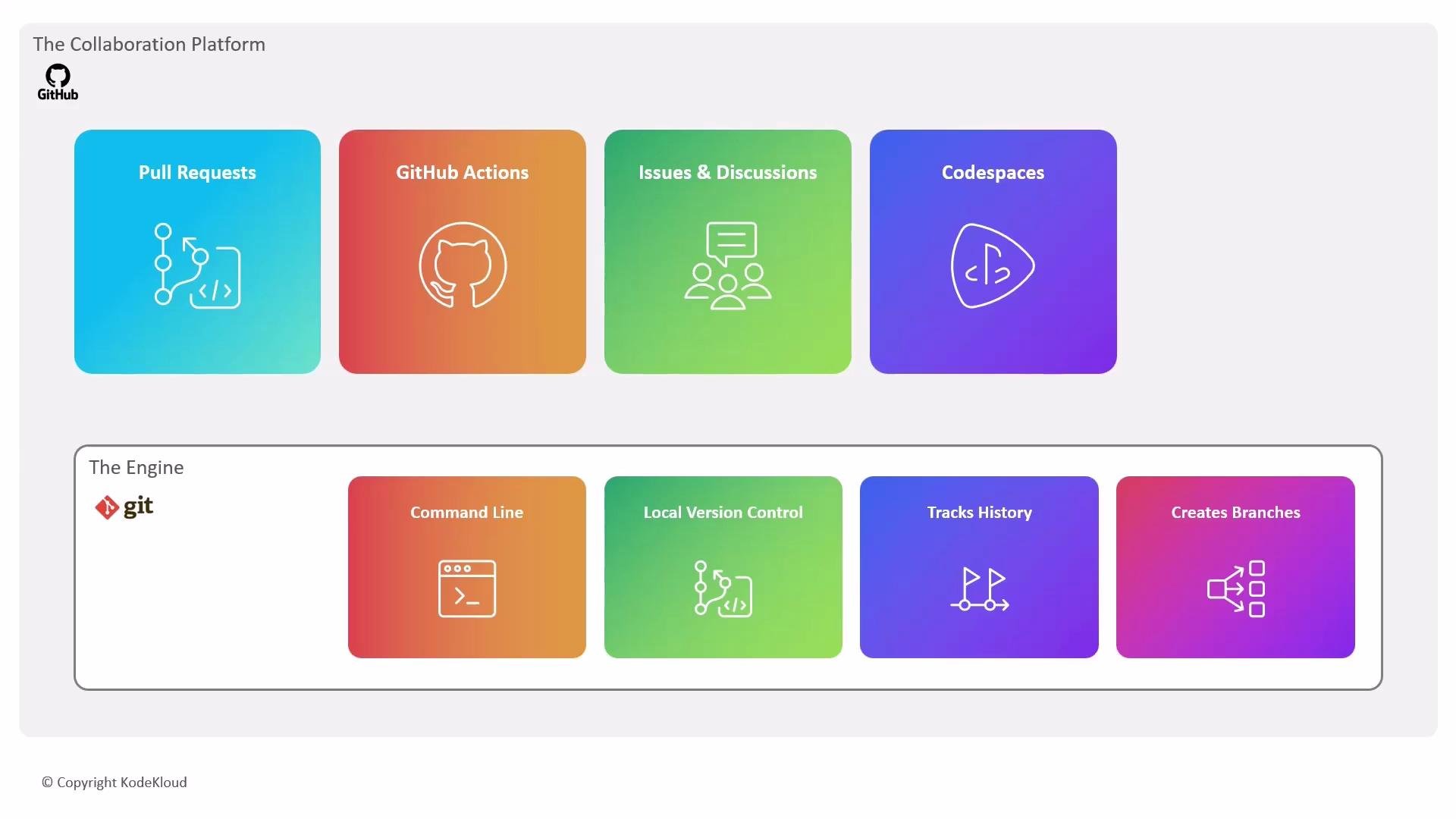
Many people use these terms interchangeably, but they serve distinct roles in software development. A helpful analogy: Git is the engine that manages changes; GitHub is the collaborative garage where teams share, review, and automate work.
Git is a distributed version control system you install locally. It records every change to files, enables branching and merging, and lets you work offline. You do the heavy lifting on your machine and push changes to a remote host when ready.
GitHub is a cloud-based platform built on Git. It hosts repositories remotely and adds collaboration, code review, project planning, automation, and security features that go beyond Git alone.
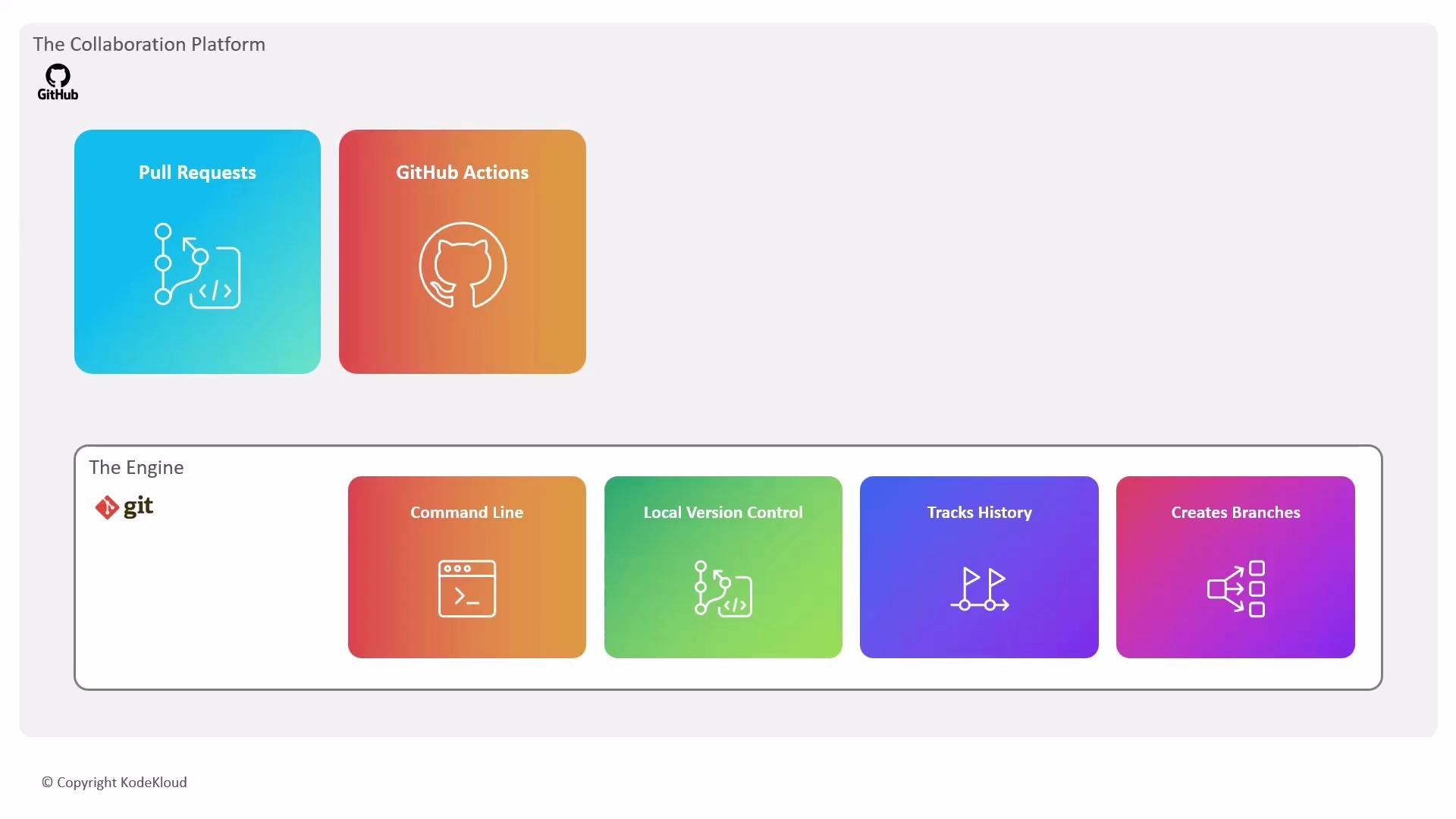 What Git provides
* Local version control with a complete history of changes
* Branch creation and merging workflows to develop features independently
* Command-line tools and local workflows that work offline
Common Git commands
```bash theme={null}
# Initialize a repository
git init
# Stage and commit changes
git add .
git commit -m "Describe changes"
# Create and switch to a branch
git checkout -b feature-branch
# Push to a remote repository
git push origin feature-branch
```
What GitHub provides
* A web interface for browsing and managing repositories
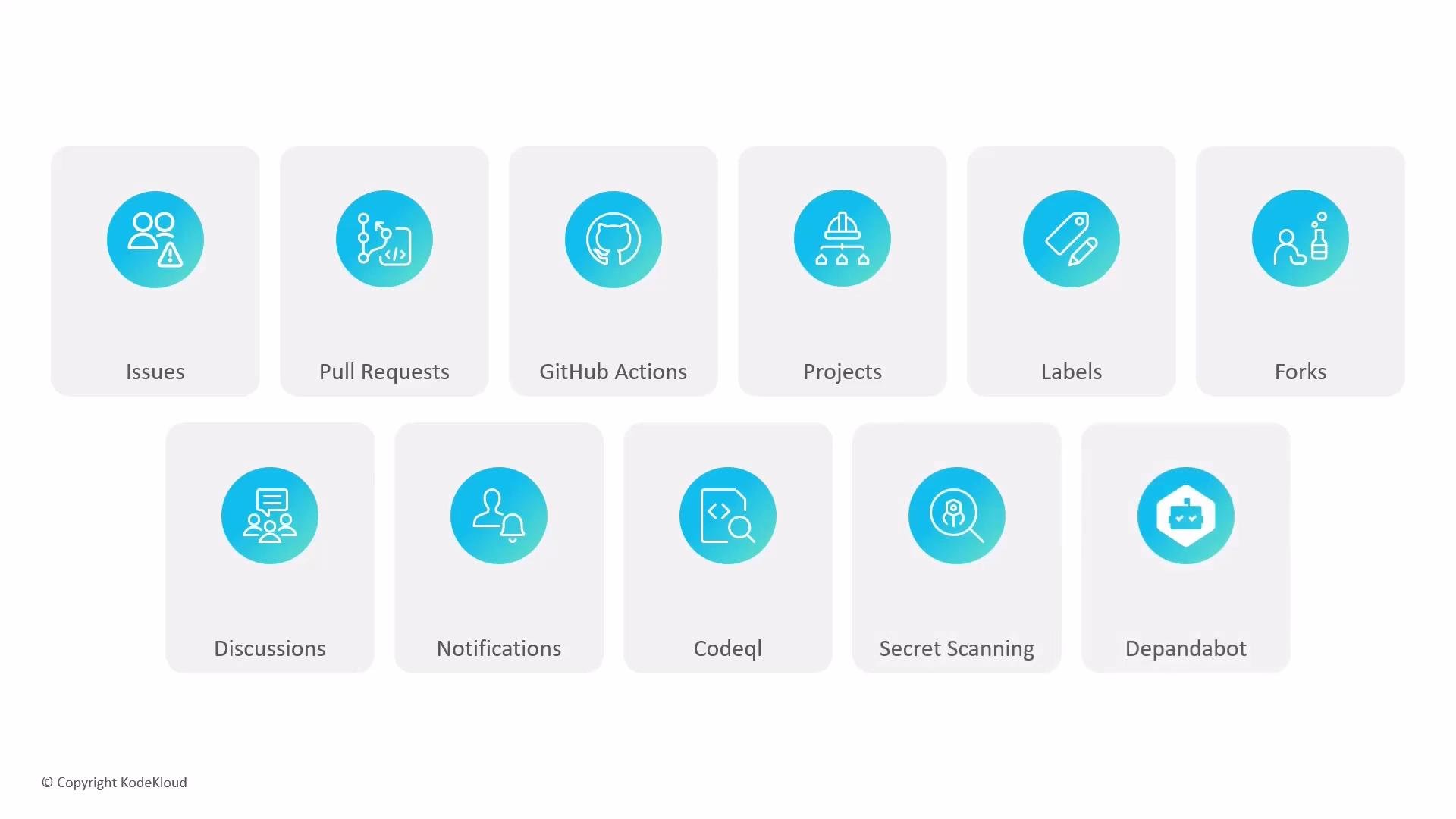
* Collaboration via [pull requests](https://docs.github.com/en/pull-requests) for code review and discussion before merging
* [Issue tracking](https://docs.github.com/en/issues) and threaded discussions for planning and communication
* Project management tools such as [project boards](https://docs.github.com/en/issues/planning-and-tracking-with-projects/using-projects/about-projects) and [labels](https://docs.github.com/en/issues/using-labels-and-milestones-to-track-work)
* Automation and CI/CD with [GitHub Actions](https://docs.github.com/en/actions)
What Git provides
* Local version control with a complete history of changes
* Branch creation and merging workflows to develop features independently
* Command-line tools and local workflows that work offline
Common Git commands
```bash theme={null}
# Initialize a repository
git init
# Stage and commit changes
git add .
git commit -m "Describe changes"
# Create and switch to a branch
git checkout -b feature-branch
# Push to a remote repository
git push origin feature-branch
```
What GitHub provides
* A web interface for browsing and managing repositories
* Collaboration via [pull requests](https://docs.github.com/en/pull-requests) for code review and discussion before merging
* [Issue tracking](https://docs.github.com/en/issues) and threaded discussions for planning and communication
* Project management tools such as [project boards](https://docs.github.com/en/issues/planning-and-tracking-with-projects/using-projects/about-projects) and [labels](https://docs.github.com/en/issues/using-labels-and-milestones-to-track-work)
* Automation and CI/CD with [GitHub Actions](https://docs.github.com/en/actions)
 Quick comparison
| Aspect | Git (local) | GitHub (remote platform) |
| --------------------- | --------------------------------------------------- | ------------------------------------------------------------------------- |
| Primary purpose | Distributed version control, history, branching | Remote hosting, collaboration, automation, project management |
| Typical commands | `git init`, `git commit`, `git branch`, `git merge` | Web UI, pull requests, Actions, Issues |
| Offline support | Full workflow available locally | Requires internet for remote features and collaboration |
| Collaboration | Manual (push/pull, email, patches) | Built-in: forks, pull requests, reviews, discussions |
| CI / Automation | External tools or custom scripts | Built-in with [GitHub Actions](https://docs.github.com/en/actions) |
| Security & governance | Local policies and tooling | Enterprise features: code scanning, secret scanning, Dependabot, and more |
GitHub also supports open collaboration workflows: you can fork repositories to experiment independently and then submit pull requests to propose changes back to the original project.
Beyond basic collaboration, GitHub Enterprise extends productivity and security for organizations. It integrates features such as [Copilot](https://github.com/features/copilot), [Copilot Chat](https://docs.github.com/en/copilot/getting-started-with-github-copilot-chat), and Copilot Agents ([https://github.blog/2024-03-05-introducing-github-copilot-agents/](https://github.blog/2024-03-05-introducing-github-copilot-agents/)) to assist developers, and provides built-in security tooling like [CodeQL](https://docs.github.com/en/code-security/code-scanning/using-codeql-code-scanning), [secret scanning](https://docs.github.com/en/code-security/secret-scanning), [Dependabot](https://docs.github.com/en/code-security/supply-chain-security/keeping-your-dependencies-updated-automatically), and a consolidated [Security Overview](https://docs.github.com/en/organizations/keeping-your-organization-secure/about-security-overview) to surface risks earlier in the development lifecycle.
Git manages the history and structure of your code locally. GitHub layers collaboration, code review, automation, and security on top of Git so teams can build, test, and deliver software together.
Quick comparison
| Aspect | Git (local) | GitHub (remote platform) |
| --------------------- | --------------------------------------------------- | ------------------------------------------------------------------------- |
| Primary purpose | Distributed version control, history, branching | Remote hosting, collaboration, automation, project management |
| Typical commands | `git init`, `git commit`, `git branch`, `git merge` | Web UI, pull requests, Actions, Issues |
| Offline support | Full workflow available locally | Requires internet for remote features and collaboration |
| Collaboration | Manual (push/pull, email, patches) | Built-in: forks, pull requests, reviews, discussions |
| CI / Automation | External tools or custom scripts | Built-in with [GitHub Actions](https://docs.github.com/en/actions) |
| Security & governance | Local policies and tooling | Enterprise features: code scanning, secret scanning, Dependabot, and more |
GitHub also supports open collaboration workflows: you can fork repositories to experiment independently and then submit pull requests to propose changes back to the original project.
Beyond basic collaboration, GitHub Enterprise extends productivity and security for organizations. It integrates features such as [Copilot](https://github.com/features/copilot), [Copilot Chat](https://docs.github.com/en/copilot/getting-started-with-github-copilot-chat), and Copilot Agents ([https://github.blog/2024-03-05-introducing-github-copilot-agents/](https://github.blog/2024-03-05-introducing-github-copilot-agents/)) to assist developers, and provides built-in security tooling like [CodeQL](https://docs.github.com/en/code-security/code-scanning/using-codeql-code-scanning), [secret scanning](https://docs.github.com/en/code-security/secret-scanning), [Dependabot](https://docs.github.com/en/code-security/supply-chain-security/keeping-your-dependencies-updated-automatically), and a consolidated [Security Overview](https://docs.github.com/en/organizations/keeping-your-organization-secure/about-security-overview) to surface risks earlier in the development lifecycle.
Git manages the history and structure of your code locally. GitHub layers collaboration, code review, automation, and security on top of Git so teams can build, test, and deliver software together.
 In short: use Git as your local version control engine and GitHub as the platform for sharing, reviewing, automating, and securing your projects. For further reading and official guides, see the Git documentation and the GitHub Docs.