> ## Documentation Index
> Fetch the complete documentation index at: https://notes.kodekloud.com/llms.txt
> Use this file to discover all available pages before exploring further.
# GitLab CICD Architecture SaaS
> This guide explores GitLab CI/CD pipelines, comparing SaaS and self-managed environments, focusing on deployment options, core components, and automated workflows.
In this guide, we’ll dive into how GitLab CI/CD pipelines leverage Runners and Executors in both SaaS and self-managed environments. You’ll learn deployment options, core components, and the end-to-end workflow powering your automated builds and deployments.
## GitLab Server Overview
GitLab Server is an open-source DevOps platform that centralizes the entire software development lifecycle:
* **Git repository management** with fine-grained access controls
* **Issue tracking** and project planning
* **Built-in CI/CD pipelines** for automated testing and deployment
* **Container & package registries** for Docker, Helm, npm, and more
* **Security & compliance** scanning, auditing, and reporting
GitLab is available as:
* **GitLab SaaS** (hosted by GitLab.com)
* **GitLab Self-Managed** (on your infrastructure)
Both share the same core features but differ in control, customization, and operational responsibilities.
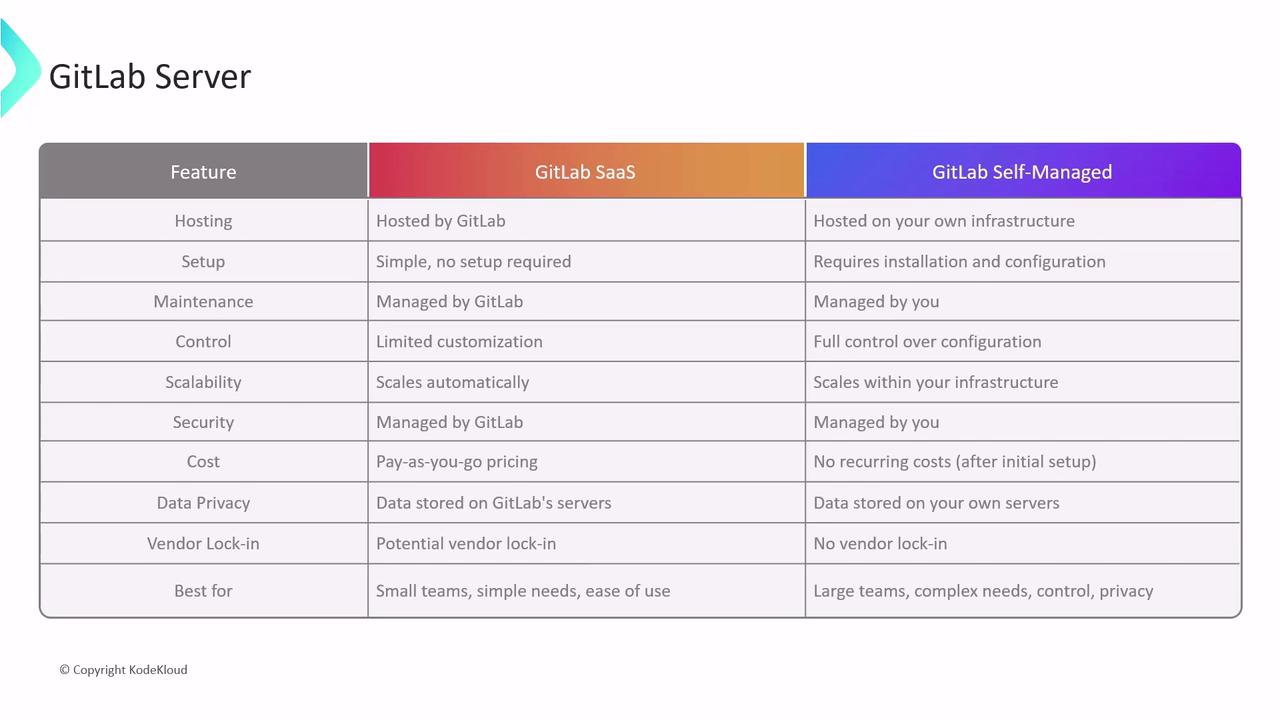
## SaaS vs Self-Managed: A Side-by-Side Comparison
Choosing the right deployment model is critical for scaling, security, and cost management:
### GitLab SaaS
**Key Benefits**
* **Zero infrastructure overhead**: No servers to install or maintain.
* **Quick setup**: Start CI/CD in minutes, even without DevOps expertise.
* **Elastic scalability**: Automatic scaling and pay-as-you-go pricing.
* **High availability**: SLA-backed uptime and redundancy managed by GitLab.com.
* **Automatic updates**: Always on the latest version with security patches.
* **Built-in security**: Vulnerability scanning, dependency checks, and DAST/SAST as a service.
**Considerations**
* Limited platform customization and plugin support.
* Data residency and privacy depend on GitLab.com’s infrastructure.
* Potential cost growth for large teams or high-load pipelines.
GitLab SaaS is ideal for small to medium teams that prefer minimal operational overhead. Check [GitLab.com Pricing](https://about.gitlab.com/pricing/) for details.
### GitLab Self-Managed
**Key Benefits**
* **Full control & customization**: Configure runners, storage, and plugins as needed.
* **Complete data ownership**: Host code, metadata, and artifacts on your hardware.
* **No vendor lock-in**: Freedom to migrate between clouds or on-premises.
* **Cost efficiency at scale**: More predictable costs for large enterprises.
**Considerations**
* Requires in-house expertise for installation, upgrades, and security.
* Infrastructure must be provisioned and scaled by your team.
* You are responsible for patching, backup, and disaster recovery.
Self-managed GitLab transfers all security and maintenance responsibilities to your team. Ensure you have proper patch management and monitoring in place.
***
## GitLab CI/CD Workflow Architecture
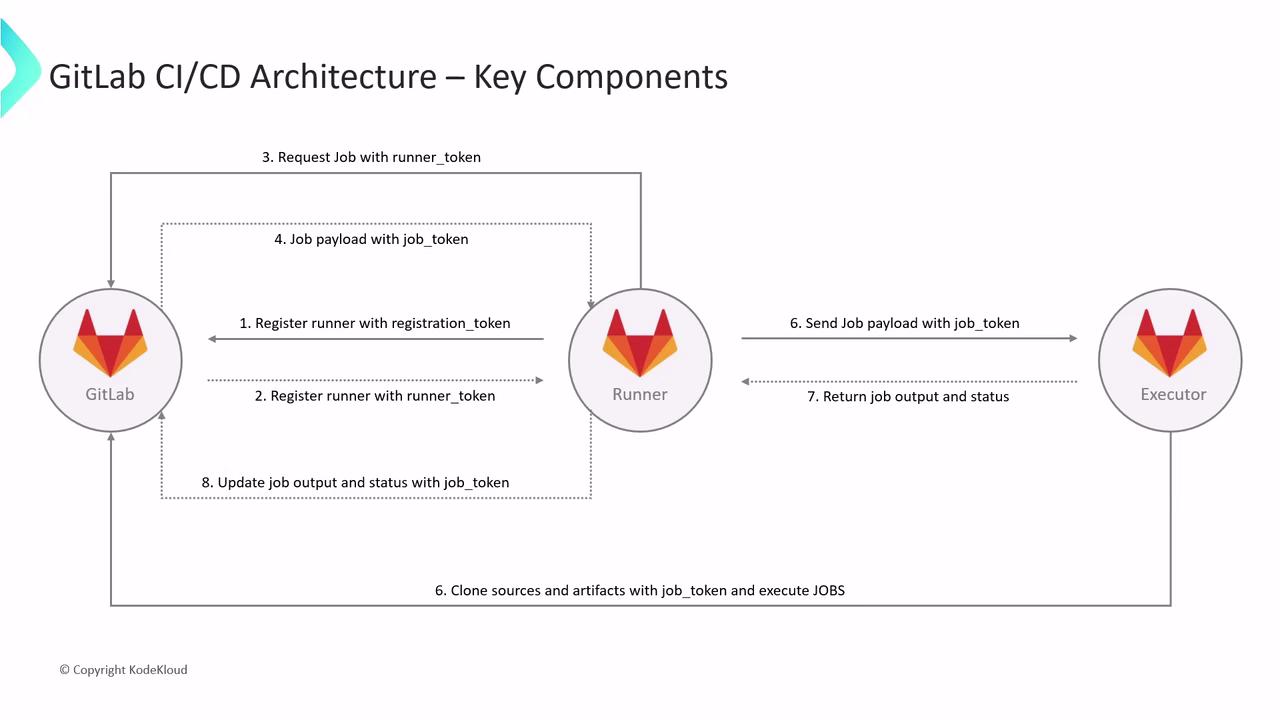
The following diagram shows how the GitLab Server, Runner, and Executor collaborate to process a CI/CD job:
### Workflow Phases
#### 1. Registration Phase
1. Runner sends a POST to `/runners/register` with the **registration token**.
2. GitLab Server validates and returns a **runner token**.
3. Runner stores this token for all future interactions.
#### 2. Job Request Phase
1. Registered Runner polls `/jobs/request`, authenticated with its **runner token**.
2. Server responds with a **job payload** containing a **job token** for that execution.
#### 3. Job Execution Phase
1. Runner passes the payload to the **Executor**.
2. Executor uses the **job token** to:
* Clone the repository
* Download dependencies and artifacts
* Execute the CI/CD script in an isolated environment (Docker, VM, shell)
3. Isolation prevents cross-job interference and secures the runner host.
#### 4. Job Reporting Phase
1. Executor gathers logs, artifacts, and exit status.
2. It POSTs back to `/jobs/:id/trace` using the **job token**.
3. GitLab Server records results and updates the pipeline UI.
### Token Exchange Summary
| Phase | Tokens Exchanged | Purpose |
| ------------ | ------------------------ | ---------------------------------------- |
| Registration | registration → runner | Authenticate Runner to GitLab Server |
| Job Request | runner token → job token | Assign and authorize a specific job |
| Execution | job token | Secure access to repo, artifacts, cache |
| Reporting | job token | Send status updates and upload artifacts |
***
By understanding these components—Server, Runner, Executor—and their interactions, you can design scalable, secure CI/CD pipelines on either GitLab SaaS or Self-Managed. Optimize runner tagging, parallelism, and caching to accelerate builds and reduce costs.
## Links and References
* [GitLab Runner Documentation](https://docs.gitlab.com/runner/)
* [Installing GitLab Self-Managed](https://docs.gitlab.com/ee/install/)
* [GitLab CI/CD Pipelines](https://docs.gitlab.com/ee/ci/pipelines/)
* [GitLab Security Features](https://docs.gitlab.com/ee/user/application_security/)