> ## Documentation Index
> Fetch the complete documentation index at: https://notes.kodekloud.com/llms.txt
> Use this file to discover all available pages before exploring further.
# Types of Runners
> This guide explores GitLab Runners, detailing Shared and Self-Managed options for executing CI/CD jobs based on organizational needs.
Building on pipeline definitions and execution concepts, GitLab CI/CD consists of three core components:
1. **GitLab Server**
2. **Runner**
3. **Executor**
In this guide, we’ll dive into **Runners**—the agents that pick up and execute your CI/CD jobs. You can choose between **Shared Runners** hosted by GitLab or **Self-Managed Runners** on your own infrastructure.
## Runner Options at a Glance
| Aspect | Shared Runners | Self-Managed Runners |
| ------------------- | -------------------------------------- | ------------------------------------------------ |
| Hosting | Hosted by GitLab | On your own servers or cloud instances |
| Setup & Maintenance | Fully managed by GitLab | Requires in-house installation and upkeep |
| Configuration | Predefined, limited customization | Fully configurable environment |
| Scalability | Auto-scaled to meet demand | Manual scaling and provisioning |
| Security Boundary | Shared across multiple projects | Isolated per project or group |
| Cost | Included in GitLab subscription tiers | Infrastructure, licensing, and maintenance costs |
| Ideal Use Case | General-purpose workloads, small teams | Strict compliance, custom tooling, high control |
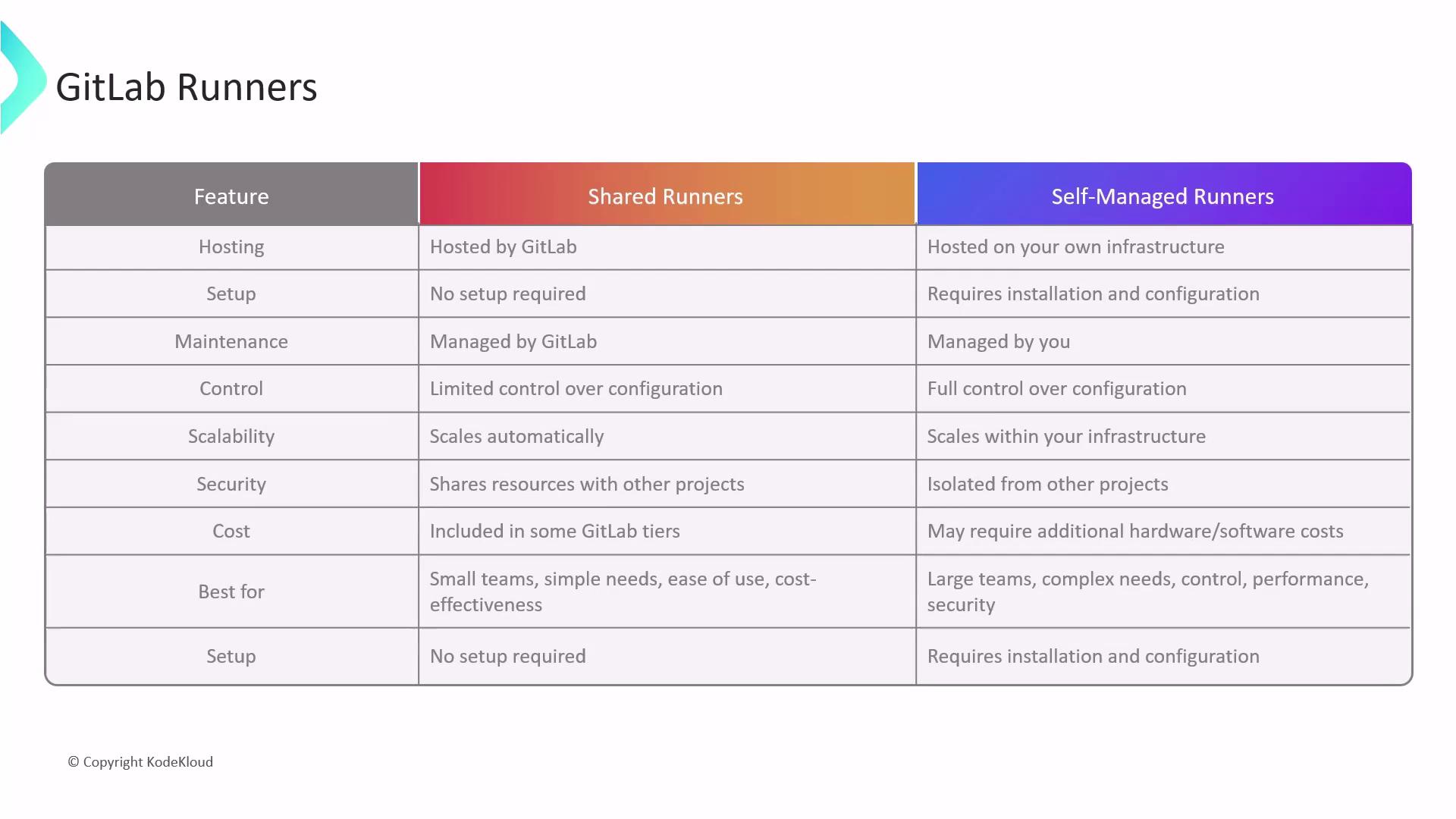
Choosing between Shared and Self-Managed Runners depends on your organization’s size, security requirements, and operational preferences.
***
## Shared Runners
Shared Runners are provided as a service by GitLab. They serve jobs from any project in a GitLab SaaS instance on a first-come, first-served basis.
### Pros
* **Zero setup**: Ready to use out of the box.
* **Cost-effective**: Included in most GitLab subscription tiers.
* **Auto-scaled**: Capacity adjusts automatically to meet job demand.
### Cons
* **Limited customization**: Cannot install additional software or change low-level settings.
* **Resource contention**: Performance may vary under heavy load.
* **Shared security boundary**: All projects share the same runner environment.
Shared Runners are ideal for small teams or open-source projects where ease of use outweighs the need for deep customization.
***
## Self-Managed Runners
Self-Managed Runners run on your own infrastructure—whether on-premises or in the cloud—giving you total control over configuration, security, and performance.
### Pros
* **Full control**: Install custom software, tune performance, and manage updates.
* **Dedicated resources**: Reduce job wait times and ensure consistent build performance.
* **Isolated environment**: Minimize cross-project interference and meet strict compliance requirements.
### Cons
* **Operational overhead**: Requires expertise to set up, monitor, and maintain.
* **Manual scaling**: You must provision or decommission machines as demand fluctuates.
* **Additional costs**: Includes hardware, licensing, and ongoing maintenance expenses.
Ensure you implement proper security measures (firewalls, secrets management, network policies) when exposing self-managed runners to public or untrusted networks.
***
## Links and References
* [GitLab Runner Documentation](https://docs.gitlab.com/runner/)
* [GitLab CI/CD Overview](https://docs.gitlab.com/ee/ci/)
* [Best Practices for GitLab CI/CD](https://docs.gitlab.com/ee/ci/best_practices/)