> ## Documentation Index
> Fetch the complete documentation index at: https://notes.kodekloud.com/llms.txt
> Use this file to discover all available pages before exploring further.
# Defer Statement
> This article explores the defer statement in Go, which postpones function execution until the surrounding function returns.
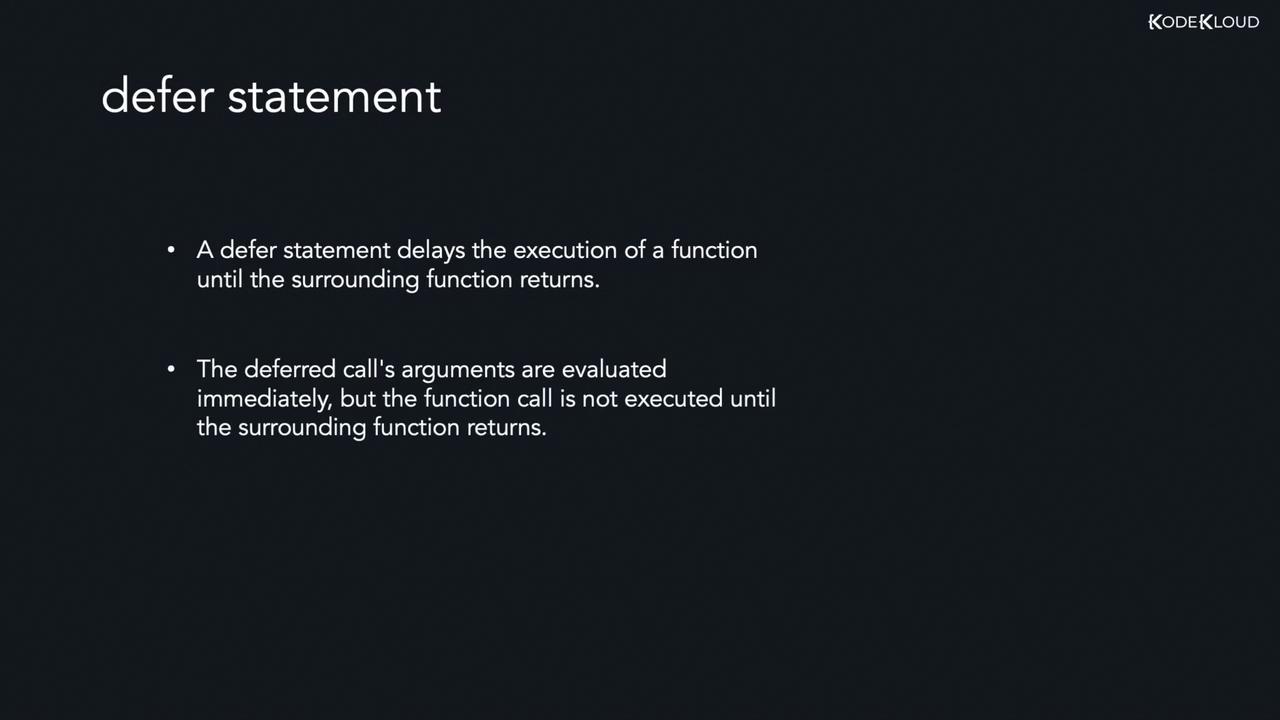
In this lesson, we'll explore the defer statement in Go, a powerful feature that postpones a function’s execution until the surrounding function returns. While the arguments for a deferred function call are evaluated immediately, the function itself executes later. This behavior ensures that certain operations, such as resource cleanup, occur right before a function exits.
## How the Defer Statement Works
Consider the example below with three functions: `printName`, `printRollNo`, and `printAddress`.
* The `printName` function outputs a provided string.
* The `printRollNo` function prints an integer.
* The `printAddress` function prints a string representing an address.
Within the `main` function, the program flow is as follows:
1. The `printName` function is immediately called to print the name "Joe".
2. The `defer` keyword schedules the `printRollNo` function to execute after `main` finishes its other statements.
3. The `printAddress` function is called to print the address "street-32".
4. Once `main` is ready to return, the deferred `printRollNo(23)` call is executed.
Even though the argument for `printRollNo(23)` is evaluated immediately, the deferred function call itself is executed only after the `main` function completes.
## Example Code
Below is the complete Go code that demonstrates the usage of the defer statement:
```go theme={null}
package main
import "fmt"
// printName prints the provided name.
func printName(str string) {
fmt.Println(str)
}
// printRollNo prints the student's roll number.
func printRollNo(rno int) {
fmt.Println(rno)
}
// printAddress prints the provided address.
func printAddress(addr string) {
fmt.Println(addr)
}
func main() {
printName("Joe")
defer printRollNo(23)
printAddress("street-32")
}
```
## Running the Program
To execute the program, use the following command in your terminal:
```bash theme={null}
go run main.go
```
The output will be:
```bash theme={null}
Joe
street-32
23
```
### Output Breakdown
1. `printName("Joe")` is executed immediately, displaying `Joe`.
2. The `defer printRollNo(23)` statement schedules `printRollNo` to run after completion of the `main` function.
3. `printAddress("street-32")` executes next, printing `street-32`.
4. When `main` is about to return, the deferred call to `printRollNo(23)` is finally executed, printing `23`.
## Additional Resources
For further details on Go's control flow and function execution, consider visiting these resources:
* [Go Official Documentation](https://golang.org/doc/)
* [Understanding Defer in Go](https://blog.golang.org/defer-panic-and-recover)
That concludes our discussion of the defer statement. Happy coding and enjoy exploring Go's powerful features with your own hands-on exercises!