> ## Documentation Index
> Fetch the complete documentation index at: https://notes.kodekloud.com/llms.txt
> Use this file to discover all available pages before exploring further.
# High Order Functions
> This article explores high-order functions that accept or return functions, enhancing code modularity, readability, and maintainability through efficient composition.
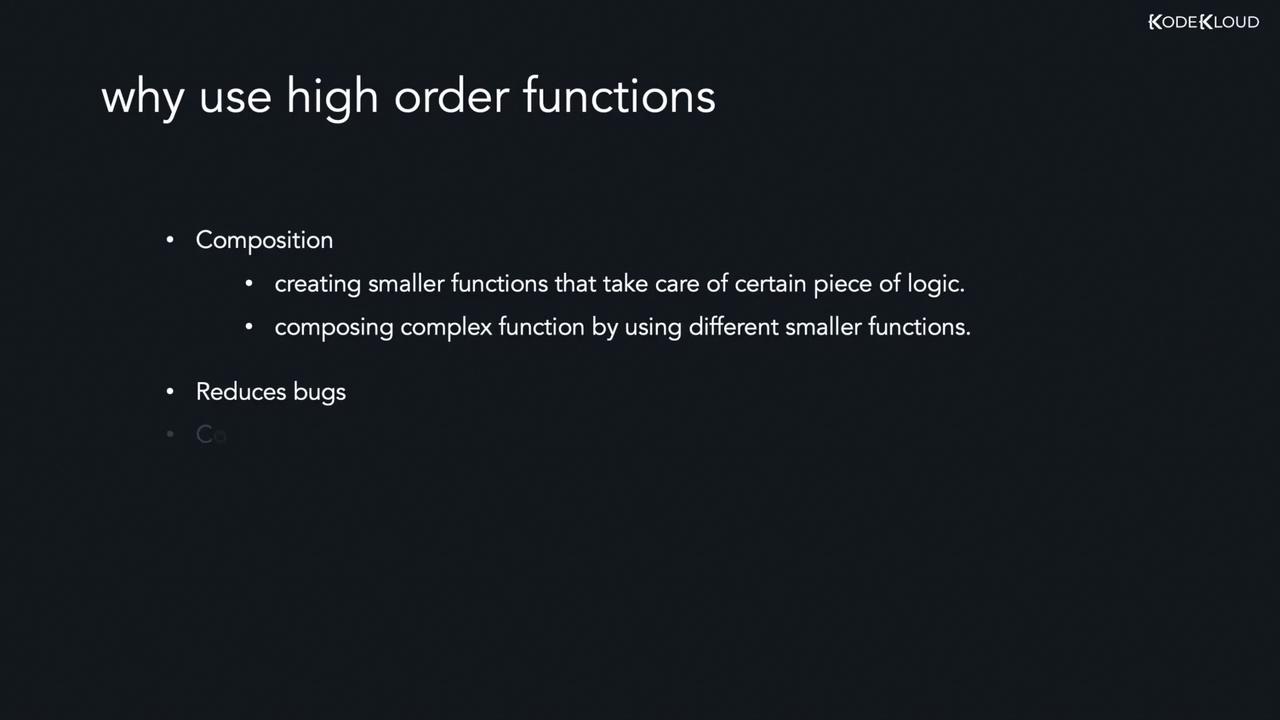
In this lesson, we explore high-order functions—functions that either accept another function as an argument or return a function as output. High-order functions enable modular composition, allowing you to build complex operations from small, focused functions. This approach not only minimizes bugs but also enhances code readability and maintainability.
Mastering high-order functions empowers you to write more efficient and maintainable code. For example, consider calculating various properties of a circle. Given a circle's radius, users might want to compute its area, perimeter, or diameter by choosing the corresponding query (1, 2, or 3).
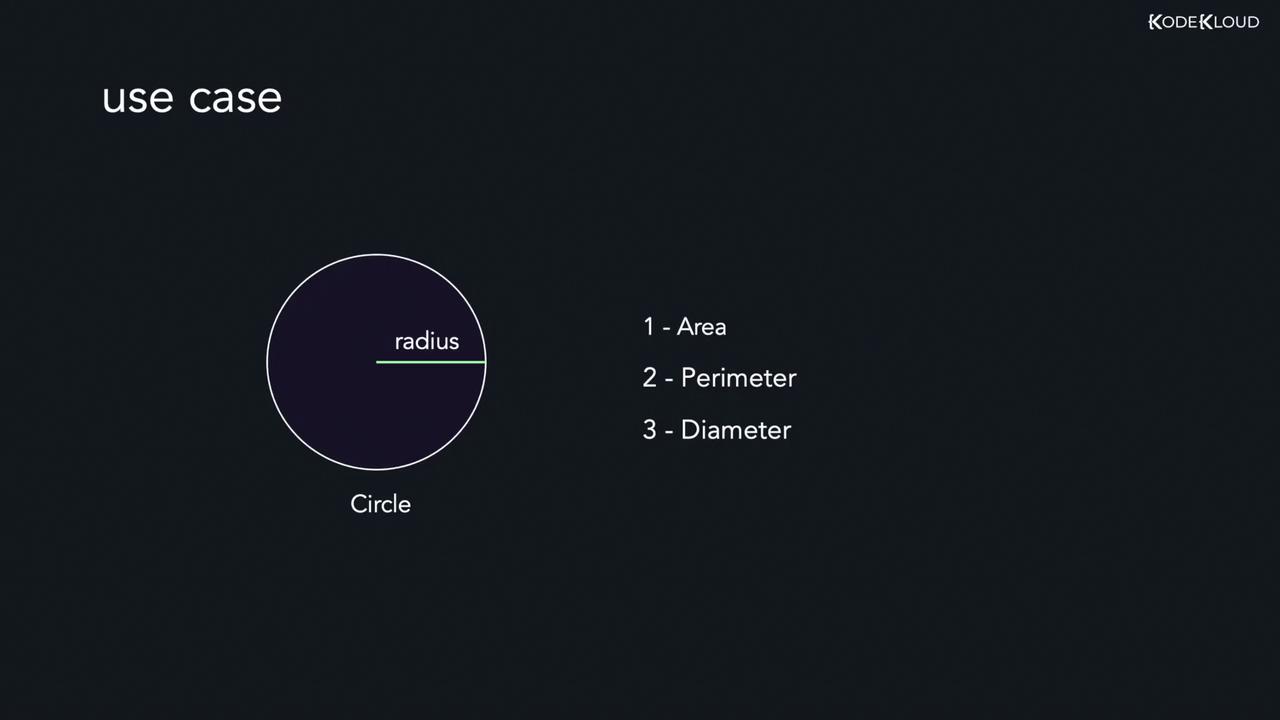
High-order functions allow you to abstract recurring operations, making your code scalable as you incorporate additional properties or shapes.
## Basic Circle Property Functions
Begin by defining basic functions to calculate the area, perimeter, and diameter of a circle. Each function receives the circle's radius as a float64 and returns a float64 value.
```go theme={null}
package main
import "fmt"
func calcArea(r float64) float64 {
return 3.14 * r * r
}
func calcPerimeter(r float64) float64 {
return 2 * 3.14 * r
}
func calcDiameter(r float64) float64 {
return 2 * r
}
```
## Handling User Input with Conditional Logic
A common approach is to use conditional statements to decide which calculation to perform based on user input. The following code demonstrates this method:
```go theme={null}
func main() {
var query int
var radius float64
fmt.Print("Enter the radius of the circle: ")
fmt.Scanf("%f", &radius)
fmt.Printf("Enter \n 1 - area \n 2 - perimeter \n 3 - diameter: ")
fmt.Scanf("%d", &query)
if query == 1 {
fmt.Println("Result: ", calcArea(radius))
} else if query == 2 {
fmt.Println("Result: ", calcPerimeter(radius))
} else if query == 3 {
fmt.Println("Result: ", calcDiameter(radius))
} else {
fmt.Println("Invalid query")
}
}
```
When running this program, the console interaction might look like:
```Go theme={null}
>>> go run main.go
Enter the radius of the circle: 9.1
Enter
1 - area
2 - perimeter
3 - diameter: 1
Result: 260.0234
Thank you!
```
While this solution works, it can quickly become cumbersome as you add more shape properties. Leveraging high-order functions simplifies the code and enhances scalability.
## Simplifying with High-Order Functions
The following sections demonstrate how to refactor the code using high-order functions. We introduce two helper functions: one to display the result and another to map the query number to the appropriate calculation function.
### Defining the printResult Function
The printResult function accepts the radius and a calculation function as parameters. It executes the calculation, stores the result, and displays it.
```go theme={null}
func printResult(radius float64, calcFunction func(r float64) float64) {
result := calcFunction(radius)
fmt.Println("Result: ", result)
fmt.Println("Thank you!")
}
```
### Defining the getFunction Function
The getFunction function maps a user's query (an integer) to the corresponding calculation function using a predefined map.
```go theme={null}
func getFunction(query int) func(r float64) float64 {
queryToFunc := map[int]func(r float64) float64{
1: calcArea,
2: calcPerimeter,
3: calcDiameter,
}
return queryToFunc[query]
}
```
### Refactored Main Function Using High-Order Functions
By integrating these high-order functions, the main function becomes succinct. It reads user input, selects the appropriate calculation function via getFunction, and passes it to printResult.
```go theme={null}
func main() {
var query int
var radius float64
fmt.Print("Enter the radius of the circle: ")
fmt.Scanf("%f", &radius)
fmt.Printf("Enter \n 1 - area \n 2 - perimeter \n 3 - diameter: ")
fmt.Scanf("%d", &query)
printResult(radius, getFunction(query))
}
```
Upon running the refactored program, you may observe the following console interaction:
```Go theme={null}
>>> go run main.go
Enter the radius of the circle: 7
Enter
1 - area
2 - perimeter
3 - diameter: 3
Result: 14
Thank you!
```
High-order functions reduce code redundancy while clarifying the logical separation between input handling and processing logic—making it easier to extend and maintain your application.
By adopting high-order functions, you enhance code clarity, modularity, and scalability. Try integrating these concepts into your projects to unlock more robust and maintainable code designs.