> ## Documentation Index
> Fetch the complete documentation index at: https://notes.kodekloud.com/llms.txt
> Use this file to discover all available pages before exploring further.
# Batch vs Streaming Ingestion Patterns
> Comparison of batch versus streaming data ingestion patterns, covering latency, volume, complexity, cost, use cases, and guidance for choosing or combining approaches.
Welcome. This lesson compares the two primary data ingestion patterns used in modern data engineering: batch processing and streaming (real-time) processing. We examine them across latency, data volume, complexity, cost, and common use cases so you can select the right approach for your workload.
At a high level:
* Batch processing collects and processes data in periodic, large chunks.
* Streaming processing ingests and processes data continuously in small increments, close to real time.
Comparison summary
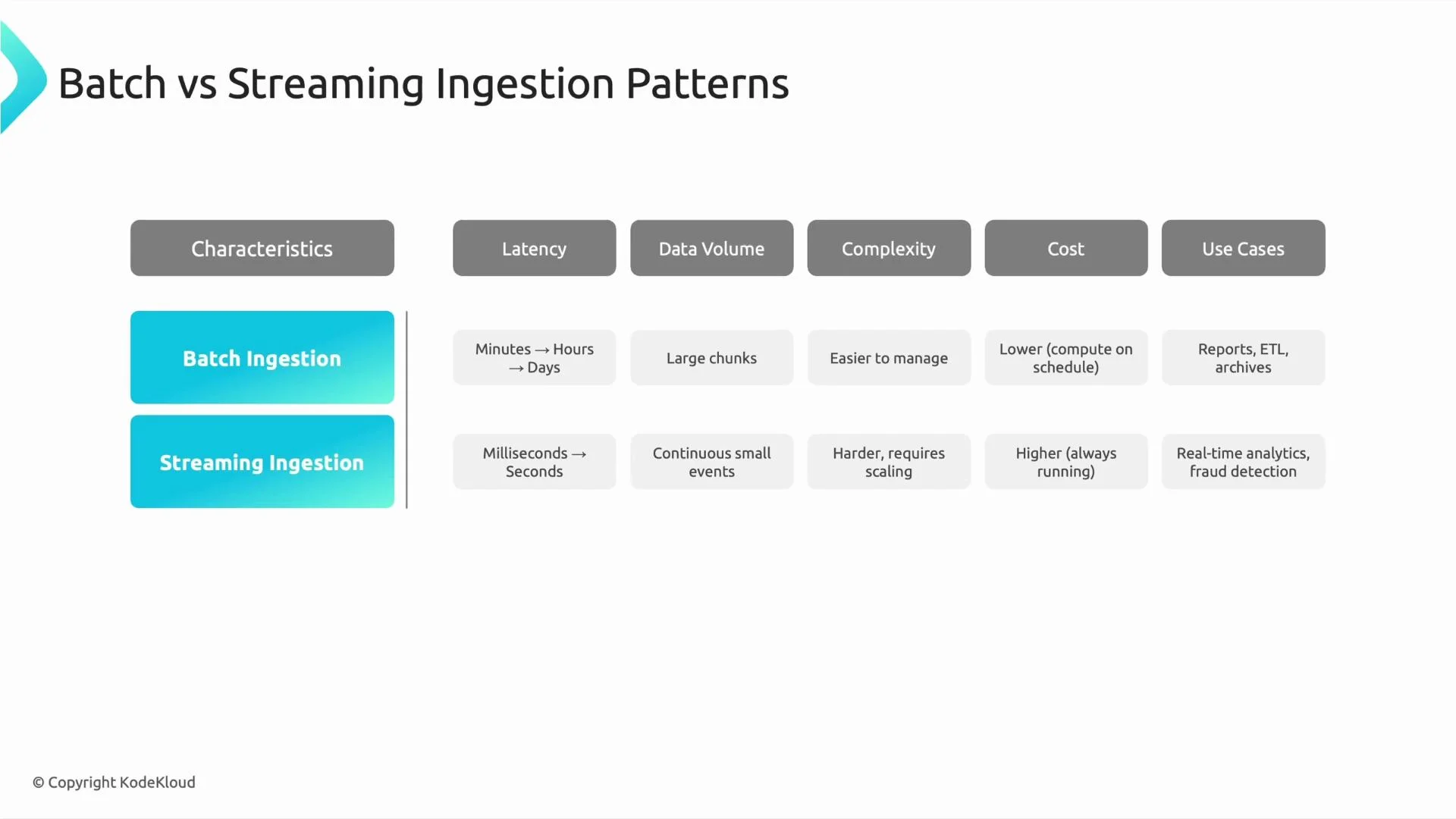
| Dimension | Batch ingestion | Streaming ingestion |
| ----------------- | ----------------------------------------------------------------- | ----------------------------------------------------------------------------------- |
| Latency | `minutes` → `hours` → `days` — data accumulates before processing | `milliseconds` → `seconds` — continuous, near real-time processing |
| Data volume | Large, periodic chunks (daily/weekly/monthly) | Continuous flows of small events (clicks, telemetry, sensor readings) |
| Complexity | Lower operational complexity; easier to retry and backfill | Higher complexity: stateful processing, ordering guarantees, exactly-once semantics |
| Cost model | Often lower: resources run only when jobs execute | Often higher: services run continuously or must scale rapidly for bursts |
| Typical use cases | Nightly reports, bulk ETL, archive processing | Real-time analytics, fraud detection, live monitoring |
 Key characteristics (expanded)
* Latency
* Batch: Acceptable when results can wait until the next scheduled run (e.g., daily aggregates). Processing time is dominated by I/O and large-volume transformations.
* Streaming: Required for low-latency needs where decisions must be made immediately (monitoring, live dashboards, alerts).
* Data volume and throughput
* Batch: Efficient for high-throughput bulk operations (e.g., monthly billing exports or archival ingestion).
* Streaming: Optimized for steady event rates or bursty small messages; scales horizontally for high-throughput event streams.
* Complexity and correctness
* Batch: Easier to reason about — deterministic runs, straightforward retries, and simple recovery patterns.
* Streaming: Requires handling out-of-order events, duplicates, windowing, and long-running state. Checkpointing and state management are essential.
* Cost and resource utilization
* Batch: Lower compute cost when jobs run on schedule and resources are de-provisioned otherwise.
* Streaming: Continuous resource allocation and autoscaling needs can increase cost; evaluate trade-offs against latency requirements.
Examples and typical use cases
* Batch examples:
* Summarize website traffic daily to generate aggregated reports.
* Monthly billing and invoicing runs.
* Bulk ETL jobs and cold data archival.
* Streaming examples:
* Process clickstream events to power real-time personalization.
* Monitor live stock prices for trading systems.
* Real-time fraud detection and alerting on payment events.
Decision checklist: When to choose which
* Choose batch if:
* Results are tolerant of minutes/hours/days of delay.
* You need simpler operational models and easier reprocessing.
* Workloads are periodic and process large volumes at once.
* Choose streaming if:
* You need sub-second to second latency for decisions or user experiences.
* You require continuous processing of events and immediate alerting.
* You must support real-time analytics, monitoring, or fraud detection.
* Consider hybrid when:
* You want immediate insights via streaming and reliable, complete historical processing via batch (e.g., stream-first analytics + nightly reconciliation).
Recommended architecture patterns
* Tightly coupled streaming: Producers push directly to processing and storage for minimal end-to-end latency.
* Loosely coupled streaming: Use durable message brokers (e.g., Pub/Sub, Kafka) to decouple producers and consumers for resilience and replayability.
* Lambda / Hybrid: Combine a streaming layer for real-time needs and a batch layer to compute comprehensive, recomputed views for correctness.
Many production architectures combine batch and streaming: stream for immediate insights and batch to reprocess or reconcile historical data for correctness and completeness.
Streaming systems are powerful but add operational overhead: expect to manage state, ensure fault tolerance, and handle out-of-order or duplicate events. Plan for monitoring, checkpointing, and replay strategies.
Further reading and references
* Google Cloud Pub/Sub: [https://cloud.google.com/pubsub](https://cloud.google.com/pubsub)
* Apache Kafka: [https://kafka.apache.org/](https://kafka.apache.org/)
* Apache Beam (unified batch & streaming model): [https://beam.apache.org/](https://beam.apache.org/)
* Google Cloud Dataflow (Apache Beam runner): [https://cloud.google.com/dataflow](https://cloud.google.com/dataflow)
* Change Data Capture (CDC) patterns (Debezium): [https://debezium.io/](https://debezium.io/)
Next steps
* Explore how streaming ingestion platforms are implemented on GCP, focusing on Pub/Sub, Dataflow, and how to design tightly coupled vs loosely coupled topologies for scalability and reliability.
* Prototype a small streaming pipeline and a batch job for the same dataset to compare operational trade-offs (latency, cost, accuracy).
* Review monitoring and alerting strategies for streaming (latency SLOs, processing lag, checkpoint health).
Key characteristics (expanded)
* Latency
* Batch: Acceptable when results can wait until the next scheduled run (e.g., daily aggregates). Processing time is dominated by I/O and large-volume transformations.
* Streaming: Required for low-latency needs where decisions must be made immediately (monitoring, live dashboards, alerts).
* Data volume and throughput
* Batch: Efficient for high-throughput bulk operations (e.g., monthly billing exports or archival ingestion).
* Streaming: Optimized for steady event rates or bursty small messages; scales horizontally for high-throughput event streams.
* Complexity and correctness
* Batch: Easier to reason about — deterministic runs, straightforward retries, and simple recovery patterns.
* Streaming: Requires handling out-of-order events, duplicates, windowing, and long-running state. Checkpointing and state management are essential.
* Cost and resource utilization
* Batch: Lower compute cost when jobs run on schedule and resources are de-provisioned otherwise.
* Streaming: Continuous resource allocation and autoscaling needs can increase cost; evaluate trade-offs against latency requirements.
Examples and typical use cases
* Batch examples:
* Summarize website traffic daily to generate aggregated reports.
* Monthly billing and invoicing runs.
* Bulk ETL jobs and cold data archival.
* Streaming examples:
* Process clickstream events to power real-time personalization.
* Monitor live stock prices for trading systems.
* Real-time fraud detection and alerting on payment events.
Decision checklist: When to choose which
* Choose batch if:
* Results are tolerant of minutes/hours/days of delay.
* You need simpler operational models and easier reprocessing.
* Workloads are periodic and process large volumes at once.
* Choose streaming if:
* You need sub-second to second latency for decisions or user experiences.
* You require continuous processing of events and immediate alerting.
* You must support real-time analytics, monitoring, or fraud detection.
* Consider hybrid when:
* You want immediate insights via streaming and reliable, complete historical processing via batch (e.g., stream-first analytics + nightly reconciliation).
Recommended architecture patterns
* Tightly coupled streaming: Producers push directly to processing and storage for minimal end-to-end latency.
* Loosely coupled streaming: Use durable message brokers (e.g., Pub/Sub, Kafka) to decouple producers and consumers for resilience and replayability.
* Lambda / Hybrid: Combine a streaming layer for real-time needs and a batch layer to compute comprehensive, recomputed views for correctness.
Many production architectures combine batch and streaming: stream for immediate insights and batch to reprocess or reconcile historical data for correctness and completeness.
Streaming systems are powerful but add operational overhead: expect to manage state, ensure fault tolerance, and handle out-of-order or duplicate events. Plan for monitoring, checkpointing, and replay strategies.
Further reading and references
* Google Cloud Pub/Sub: [https://cloud.google.com/pubsub](https://cloud.google.com/pubsub)
* Apache Kafka: [https://kafka.apache.org/](https://kafka.apache.org/)
* Apache Beam (unified batch & streaming model): [https://beam.apache.org/](https://beam.apache.org/)
* Google Cloud Dataflow (Apache Beam runner): [https://cloud.google.com/dataflow](https://cloud.google.com/dataflow)
* Change Data Capture (CDC) patterns (Debezium): [https://debezium.io/](https://debezium.io/)
Next steps
* Explore how streaming ingestion platforms are implemented on GCP, focusing on Pub/Sub, Dataflow, and how to design tightly coupled vs loosely coupled topologies for scalability and reliability.
* Prototype a small streaming pipeline and a batch job for the same dataset to compare operational trade-offs (latency, cost, accuracy).
* Review monitoring and alerting strategies for streaming (latency SLOs, processing lag, checkpoint health).