> ## Documentation Index
> Fetch the complete documentation index at: https://notes.kodekloud.com/llms.txt
> Use this file to discover all available pages before exploring further.
# Quick Summary on Data Catalog Dataplex
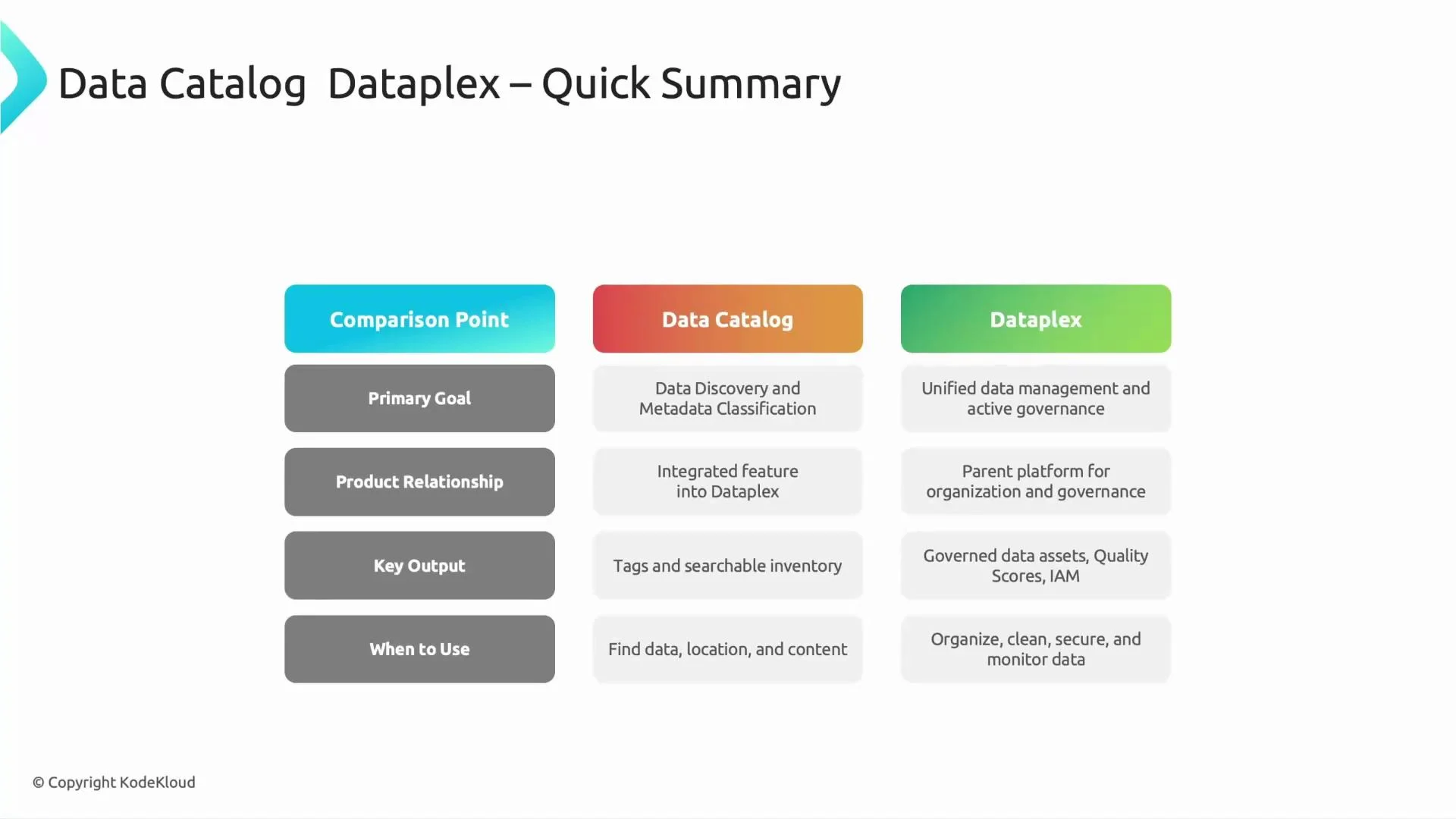
> Comparison of Google Cloud Data Catalog and Dataplex, contrasting metadata discovery and tagging with unified data governance, monitoring, and enforcement across cloud data platforms
Welcome back. This article wraps up a concise comparison of Google Cloud’s Data Catalog and Dataplex—two complementary products for metadata management and data governance. We focus on each product’s primary goal, relationships, key outputs, and practical guidance for when to use each. Short exam-style questions at the end reinforce the differences.
Overview
* Scope: Compare primary goals, outcomes, and appropriate use cases for Data Catalog and Dataplex.
* Goal: Help you choose the right tool for metadata discovery, tagging, governance, monitoring, and policy enforcement across Google Cloud data platforms (BigQuery, Cloud Storage, streaming sources).
* Audience: Data engineers, data stewards, security/ compliance teams, and cloud architects designing governed data platforms.
Primary goals (at a glance)
* Data Catalog — metadata discovery and classification
* Purpose: Provide a searchable metadata inventory and flexible tagging system so users can discover datasets, tables, columns, and other assets across Google Cloud.
* Core capabilities: Asset discovery, schema inspection, custom tags, policy tags (PII/sensitivity), and search across projects.
* Use case example: An analyst or ML engineer locating the latest BigQuery table or identifying the column that contains email addresses.
* Dataplex — unified data management and active governance
* Purpose: Organize data into lakes, zones, and domains; apply governance policies; monitor data quality and lineage; and automate operational controls across distributed storage and compute.
* Core capabilities: Zone/domain organization, policy enforcement (IAM, data access), automatic discovery (via Data Catalog), data quality checks, lineage, and lifecycle automation.
* Use case example: Enforcing consistent IAM settings and quality checks across Cloud Storage and BigQuery before datasets are available for analytics.
Product relationship
* Dataplex is a higher-level governance and operational platform that leverages Data Catalog for metadata inventory, tagging, and discovery.
Data Catalog provides the searchable metadata inventory and tagging system; Dataplex uses that capability as part of its broader governance and policy enforcement workflows.
Side-by-side feature comparison
| Area | Data Catalog | Dataplex |
| ---------------------- | ----------------------------------------------------: | -------------------------------------------------------------------- |
| Primary focus | Metadata discovery, search, schema and tag management | Data organization, governance, monitoring, and automated enforcement |
| Metadata & tags | `Yes` — custom tags & policy tags for PII/sensitivity | `Uses Data Catalog` metadata and tags to enforce policies |
| Policy enforcement | `No` (metadata only) | `Yes` — IAM consistency, lifecycle rules, quality checks |
| Data quality & lineage | `Limited` (via tags/annotations) | `Full` — quality checks, scoring, lineage tracking |
| Typical targets | BigQuery, Cloud Storage, Pub/Sub metadata | BigQuery, Cloud Storage, streaming sources, hybrid lakes |
| Best when you need | Fast discovery and asset-level tagging | End-to-end governance, monitoring, and enforcement at scale |
Key outputs and deliverables
* Data Catalog
* Searchable metadata catalog of datasets, tables, columns, and other assets.
* Custom tags and policy tags that describe ownership, sensitivity, and business context.
* Faster discovery for analysts and ML engineers (reduce time-to-insight).
* Dataplex
* Governed domains with consistent IAM, lifecycle, and quality controls.
* Observability: data quality scores, automated checks, and lineage for trust signals.
* Automated enforcement workflows so data is production-ready and compliant.
When to choose each (practical guidance)
* Choose Data Catalog when you need to:
* Quickly locate datasets or specific columns across projects.
* Discover dataset owners, schemas, and descriptions.
* Tag columns that contain PII and index business metadata for search.
* Example: A new ML engineer must find and inspect the training dataset and its tagged PII columns.
* Choose Dataplex when you need to:
* Govern and monitor datasets across many zones, storage types, or domains.
* Enforce access controls, lifecycle rules, and automated data quality checks.
* Provide centralized observability (lineage, quality scores) and operational enforcement.
* Example: Ensuring each dataset in Cloud Storage adheres to IAM policies and quality thresholds before downstream consumption.
Short exam-style questions
* Q: You need to ensure every dataset in Cloud Storage has the correct access permissions and data quality checks before analytic teams use it. Which platform enforces that automatically?\
A: Dataplex.
* Q: You want to tag a BigQuery column containing PII (e.g., email addresses). Where do these tags live?\
A: Tags are stored in Data Catalog (and are accessible when Dataplex uses them for governance).
* Q: How does an organization prove that data in a dashboard is accurate and trustworthy?\
A: Dataplex provides governance signals — data quality scores, lineage, and policy enforcement — to demonstrate trustworthiness.
Summary (one‑liner)
* Data Catalog helps you find and describe data; Dataplex helps you organize, secure, and actively govern it.
 That concludes this section on data management and governance. For a broader perspective on how these services fit into end-to-end solutions, see the GCP Data Engineering Architecture and Landscape resources below.
Links and references
* Google Cloud Data Catalog: [https://cloud.google.com/data-catalog](https://cloud.google.com/data-catalog)
* Google Cloud Dataplex: [https://cloud.google.com/dataplex](https://cloud.google.com/dataplex)
* Google Cloud documentation (general): [https://cloud.google.com/docs](https://cloud.google.com/docs)
That concludes this section on data management and governance. For a broader perspective on how these services fit into end-to-end solutions, see the GCP Data Engineering Architecture and Landscape resources below.
Links and references
* Google Cloud Data Catalog: [https://cloud.google.com/data-catalog](https://cloud.google.com/data-catalog)
* Google Cloud Dataplex: [https://cloud.google.com/dataplex](https://cloud.google.com/dataplex)
* Google Cloud documentation (general): [https://cloud.google.com/docs](https://cloud.google.com/docs)