> ## Documentation Index
> Fetch the complete documentation index at: https://notes.kodekloud.com/llms.txt
> Use this file to discover all available pages before exploring further.
# Quick Summary Data Orchestration Options
> Comparison of Google Cloud orchestration services—Composer, Functions, and Workflows—with use cases, triggers, best fits, examples, and a decision checklist for data pipeline and API orchestration choices.
Welcome back.
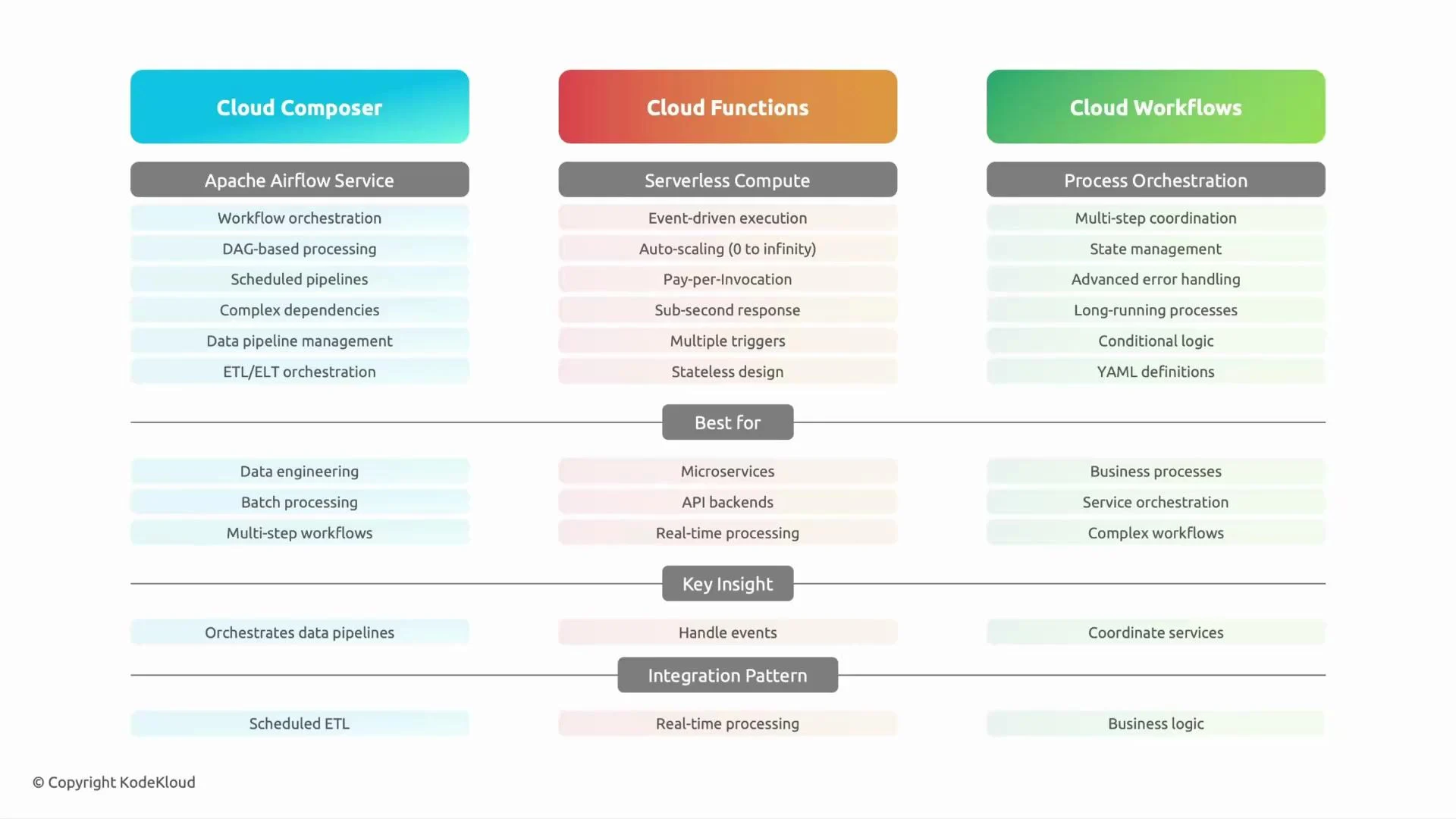
This short refresher compares the main Google Cloud orchestration services—Cloud Composer, Cloud Functions, and Cloud Workflows—so you can quickly decide which to use for specific data engineering scenarios. Use this guide to match service capabilities to common patterns (scheduled ETL, event-driven processing, or API/service orchestration) and to prepare for exam-style questions.
## At a glance comparison
| Service | Primary purpose | Best fit | Example |
| --------------- | ---------------------------------------------------------------- | ---------------------------------------------------------------------------------------- | -------------------------------------------------------------------------------------------- |
| Cloud Composer | Managed Apache Airflow for DAG-based workflows | Scheduled, data-first pipelines with complex dependencies and long-running batch jobs | Ingest daily sales into BigQuery, run multi-step transformations, and refresh dashboards |
| Cloud Functions | Serverless, event-driven functions | Small, stateless tasks triggered by events (Cloud Storage, Pub/Sub, HTTP) | Resize images after upload to Cloud Storage or trigger notifications on DB changes |
| Cloud Workflows | Orchestrate API calls and service interactions with control flow | API-driven business processes requiring conditionals, loops, retries, and error handling | Order processing that calls payment, inventory, and notification APIs with conditional logic |
## Cloud Composer
Cloud Composer is a managed [Apache Airflow](https://airflow.apache.org/) service on Google Cloud. Use Composer when your workloads require explicit task ordering, complex dependencies, and schedule-based execution. Composer is optimized for data pipelines where orchestration logic (DAGs) and retry/alerting semantics are important.
* Best fit: Scheduled, data-first pipelines with complex dependencies and long-running tasks.
* Common integrations: `BigQuery`, `Cloud Storage`, `Cloud Dataflow`, `Dataproc`.
* Example: A retail ETL pipeline that ingests nightly sales files, applies multiple transformation steps, and updates reporting tables.
* Exam tip: If a question emphasizes a cron-like schedule plus complex task dependencies (DAGs), pick Cloud Composer.
## Cloud Functions
Cloud Functions provides event-driven serverless compute for short-lived, single-purpose functions. It automatically scales and is ideal for reactive automation and lightweight processing tied to events.
* Best fit: Small, event-driven automation or lightweight processing triggered by events.
* Common triggers: `Cloud Storage` uploads, `Pub/Sub` messages, HTTP webhooks.
* Example: Automatically generate thumbnails when images are uploaded to a `Cloud Storage` bucket.
* Note: Cloud Functions are not intended to orchestrate entire long-running workflows by themselves; use them as modular building blocks invoked from an orchestration layer.
## Cloud Workflows
Cloud Workflows sequences and coordinates API calls across services with native control flow constructs (conditionals, loops, retries, and error handling). It is purpose-built for coordinating microservices and implementing business logic that spans multiple APIs.
* Best fit: Orchestration of microservices and API-driven business processes.
* Common use cases: Multi-step transactional workflows that call external APIs or different GCP services.
* Example: An order-processing workflow that calls a payment API, then an inventory API, and finally a notification API with conditional branching and retry logic.
* Exam tip: Choose Cloud Workflows when you need to coordinate disparate service APIs with logic and error-handling built into the orchestration.
Quick distinction to remember: Cloud Composer handles Airflow-style, DAGed data pipelines; Cloud Functions handles small, event-driven tasks; Cloud Workflows handles API/service orchestration and business processes.
## Ingestion and trigger patterns
* Cloud Composer: Scheduled and batch workflows (cron-like scheduling, DAG-driven orchestration).
* Cloud Functions: Real-time, event-driven triggers (push-based from `Cloud Storage`, `Pub/Sub`, or HTTP).
* Cloud Workflows: API-driven orchestration and service coordination (pulling/pushing across services with control flow and retries).
Decision checklist:
* Is the problem a data pipeline with strict ordering and scheduling? → Cloud Composer.
* Is it a small, stateless reaction to an event (file upload, message, webhook)? → Cloud Functions.
* Is it a multi-API business flow that needs conditionals and retries? → Cloud Workflows.
 Other related services to consider for specific processing or compute needs:
* Cloud Dataflow — stream and batch data processing (Apache Beam).
* Dataproc — managed Spark and Hadoop clusters for big data processing.
* BigQuery — serverless data warehouse for analytics and ad-hoc queries.
## Links and references
* [Apache Airflow](https://airflow.apache.org/)
* [Cloud Composer documentation](https://cloud.google.com/composer/docs)
* [Cloud Functions documentation](https://cloud.google.com/functions/docs)
* [Cloud Workflows documentation](https://cloud.google.com/workflows/docs)
* [Cloud Dataflow](https://cloud.google.com/dataflow/docs)
* [Dataproc](https://cloud.google.com/dataproc/docs)
That is it for this lesson.
Other related services to consider for specific processing or compute needs:
* Cloud Dataflow — stream and batch data processing (Apache Beam).
* Dataproc — managed Spark and Hadoop clusters for big data processing.
* BigQuery — serverless data warehouse for analytics and ad-hoc queries.
## Links and references
* [Apache Airflow](https://airflow.apache.org/)
* [Cloud Composer documentation](https://cloud.google.com/composer/docs)
* [Cloud Functions documentation](https://cloud.google.com/functions/docs)
* [Cloud Workflows documentation](https://cloud.google.com/workflows/docs)
* [Cloud Dataflow](https://cloud.google.com/dataflow/docs)
* [Dataproc](https://cloud.google.com/dataproc/docs)
That is it for this lesson.