> ## Documentation Index
> Fetch the complete documentation index at: https://notes.kodekloud.com/llms.txt
> Use this file to discover all available pages before exploring further.
# Architecture Time Series Analysis
> A GCP architecture guide for ingesting, processing, storing, and analyzing time series data using Pub/Sub, Cloud Storage, Dataflow, Bigtable, and BigQuery
Hello and welcome.
This article walks through a time-series analysis architecture on Google Cloud Platform, explaining why each service is chosen and how the pieces fit together. As you read, keep asking: does this design match the use case, scale, latency, and operational constraints?
## Use case and ingestion
* Use case: internal time-series analysis (monitoring, IoT, metrics, financial ticks, etc.).
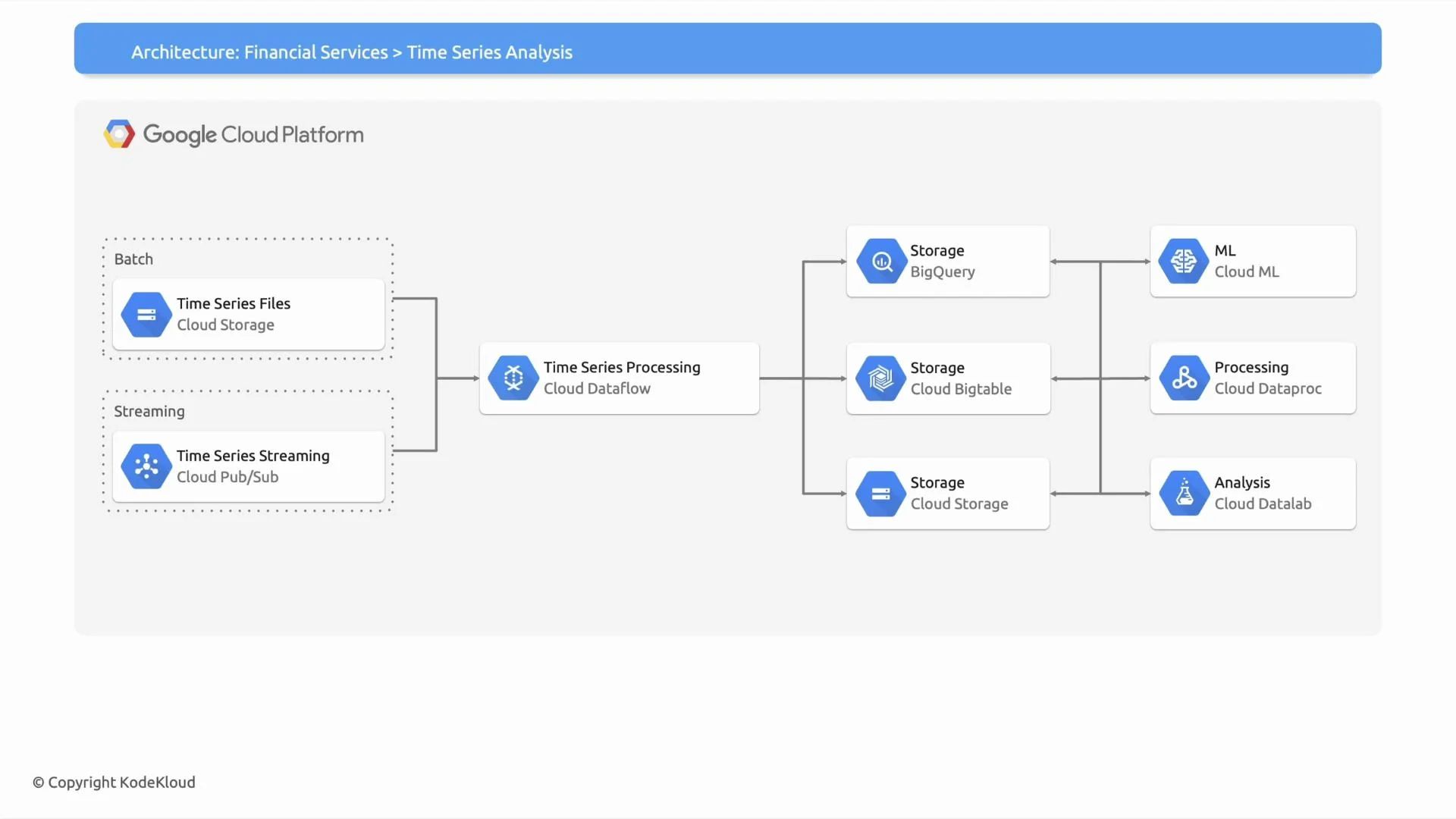
* Ingestion patterns: both streaming (near real-time) and batch (file-based) data arrive into the system.
For streaming ingestion, Cloud Pub/Sub is a natural fit: it offers durable, distributed messaging with low latency and at-least-once delivery semantics. For file-based batch ingestion, Cloud Storage is typically the initial landing zone for raw time-series files (CSV, Parquet, JSONL).
Recommended reading:
* [Cloud Pub/Sub](https://cloud.google.com/pubsub/docs/overview)
* [Cloud Storage](https://cloud.google.com/storage/docs/overview)
## Storage choice: Cloud Storage vs Cloud Bigtable
Choosing between Cloud Storage and Cloud Bigtable depends on access patterns, latency requirements, and operational goals.
| Characteristic | Cloud Storage | Cloud Bigtable |
| -------------- | ----------------------------------------------------------: | --------------------------------------------------------------------------: |
| Best for | Cost-effective archival and batch file workflows | High-throughput, low-latency row lookups and point reads/writes |
| Access pattern | File-level and bulk processing | Time-series row or windowed queries with well-designed row keys |
| Latency | Seconds (batch-oriented) | Sub-millisecond to low milliseconds |
| Integration | Easy with Dataflow, Dataproc, Data Catalog | Excellent for OLTP-like time-series workloads and real-time lookups |
| When to choose | Start here when ingesting files and running batch pipelines | Move here when you require low-latency, high QPS access to time-series rows |
Start with Cloud Storage for raw/batch files to reduce cost and complexity. Adopt Cloud Bigtable when your workload demands low-latency point reads/writes, sustained high throughput, and you can design efficient row keys for time-window access patterns.
If you choose Cloud Bigtable, plan your row-key carefully. Poor row-key design can lead to hotspotting and degraded performance for time-series workloads.
## Processing layer
This architecture uses Cloud Dataflow (Apache Beam) for unified stream and batch processing. Dataflow is a serverless, managed service providing autoscaling, windowing, session handling, and built-in connectors to Pub/Sub, Cloud Storage, BigQuery, and Bigtable.
When to consider alternatives:
* Use Dataproc (Spark) if you have existing Spark jobs or need specific Spark libraries, notebooks, or custom cluster management.
* Prefer Dataflow when you want a unified programming model for streaming and batch with minimal operational overhead.
Reference:
* [Cloud Dataflow](https://cloud.google.com/dataflow/docs/overview)
* [Apache Beam programming model](https://beam.apache.org/documentation/)
## Outputs and downstream analysis
Processed outputs typically flow to one or more destinations depending on query patterns and downstream consumers:
* Cloud Storage — store raw, windowed, or aggregated files; archive snapshots and large batch outputs.
* Cloud Bigtable — store time-series rows for sub-millisecond lookups and high-throughput point queries.
* BigQuery — store denormalized or aggregated tables for interactive, ad-hoc analytics and reporting.
These stores then feed ML and analytics tools:
* Vertex AI / Cloud AI for model training and serving.
* Dataproc (Spark) for specialized heavy analytics or legacy Spark workloads.
* Notebooks and notebook services for experimentation and exploratory analysis.
Useful links:
* [BigQuery](https://cloud.google.com/bigquery/docs)
* [Vertex AI](https://cloud.google.com/vertex-ai)
* [Dataproc](https://cloud.google.com/dataproc/docs)
 ## How to think about service selection
When evaluating components ask:
* Which service minimizes operational burden while meeting functional needs?
* Which service will provide the required features at scale and over time?
* Do we need serverless autoscaling and unified semantics (Dataflow), or specific Spark features (Dataproc)?
* Are low-latency point reads required (Bigtable) or are batch/analytical queries more important (BigQuery/Cloud Storage)?
Quick decision checklist:
1. Start: Ingest files to Cloud Storage, streams to Pub/Sub, process with Dataflow.
2. If you need interactive analytics and SQL, push aggregates to BigQuery.
3. If you need low-latency, high-throughput row access, move processed time-series rows to Bigtable.
4. For specialized Spark work or migration, use Dataproc.
Further reading and certification resources:
* [Google Cloud Professional Data Engineer certification course](https://learn.kodekloud.com/user/courses/google-cloud-professional-data-engineer-certification)
* [Google Cloud product docs](https://cloud.google.com/docs)
That is it for this article.
## How to think about service selection
When evaluating components ask:
* Which service minimizes operational burden while meeting functional needs?
* Which service will provide the required features at scale and over time?
* Do we need serverless autoscaling and unified semantics (Dataflow), or specific Spark features (Dataproc)?
* Are low-latency point reads required (Bigtable) or are batch/analytical queries more important (BigQuery/Cloud Storage)?
Quick decision checklist:
1. Start: Ingest files to Cloud Storage, streams to Pub/Sub, process with Dataflow.
2. If you need interactive analytics and SQL, push aggregates to BigQuery.
3. If you need low-latency, high-throughput row access, move processed time-series rows to Bigtable.
4. For specialized Spark work or migration, use Dataproc.
Further reading and certification resources:
* [Google Cloud Professional Data Engineer certification course](https://learn.kodekloud.com/user/courses/google-cloud-professional-data-engineer-certification)
* [Google Cloud product docs](https://cloud.google.com/docs)
That is it for this article.