> ## Documentation Index
> Fetch the complete documentation index at: https://notes.kodekloud.com/llms.txt
> Use this file to discover all available pages before exploring further.
# Cloud VPC Connecting to other networks
> Overview of Google Cloud VPC connectivity options for on-prem, VPC-to-VPC, interconnect, and multi-cloud scenarios comparing VPN, Dedicated and Partner Interconnect and peering
Welcome back. This lesson explains how a Google Cloud VPC can connect to other networks — on-premises data centers, other Google Cloud projects, or external clouds such as AWS. We cover the common connection options, how they work, trade-offs, and guidance for choosing the right solution for performance, cost, and security.
Private Service Connect (overview)
* Private Service Connect enables private consumption of Google services inside your VPC. Networks often need to communicate privately between environments; this article focuses on the main networking primitives and when to use each.
## On-premises to Google Cloud: VPN and Interconnect
Scenario: Your organization runs workloads on-premises and in Google Cloud. You need secure, private IP connectivity between your on-prem network and a Google VPC.
Common approaches:
* Cloud VPN (site-to-site IPsec)
* Creates encrypted tunnels over the public Internet.
* Use HA VPN for higher availability and automatic redundancy across Google edge locations.
* Best when cost and quick setup matter or for low/medium bandwidth requirements.
* Cloud Interconnect
* Provides private, dedicated connectivity into Google’s network.
* Traffic enters Google’s global backbone and does not traverse the public Internet.
* Ideal for very high throughput, lower latency, predictable performance, or strict compliance requirements.
Key distinction:
* Interconnect = private connectivity into Google’s backbone (no traversal of the public Internet).
* VPN = encrypted traversal of the public Internet (IPsec), but still provides private connectivity between on-prem and cloud resources.
## VPC-to-VPC: VPC Network Peering
If you need private connectivity between multiple VPCs across projects or regions, VPC Network Peering is a common choice.
* VPC Peering connects two VPCs directly over Google’s internal network.
* Traffic remains on Google’s backbone and is not exposed to the public Internet.
* Peering is one-to-one and non-transitive — you cannot route from VPC A to VPC C via VPC B.
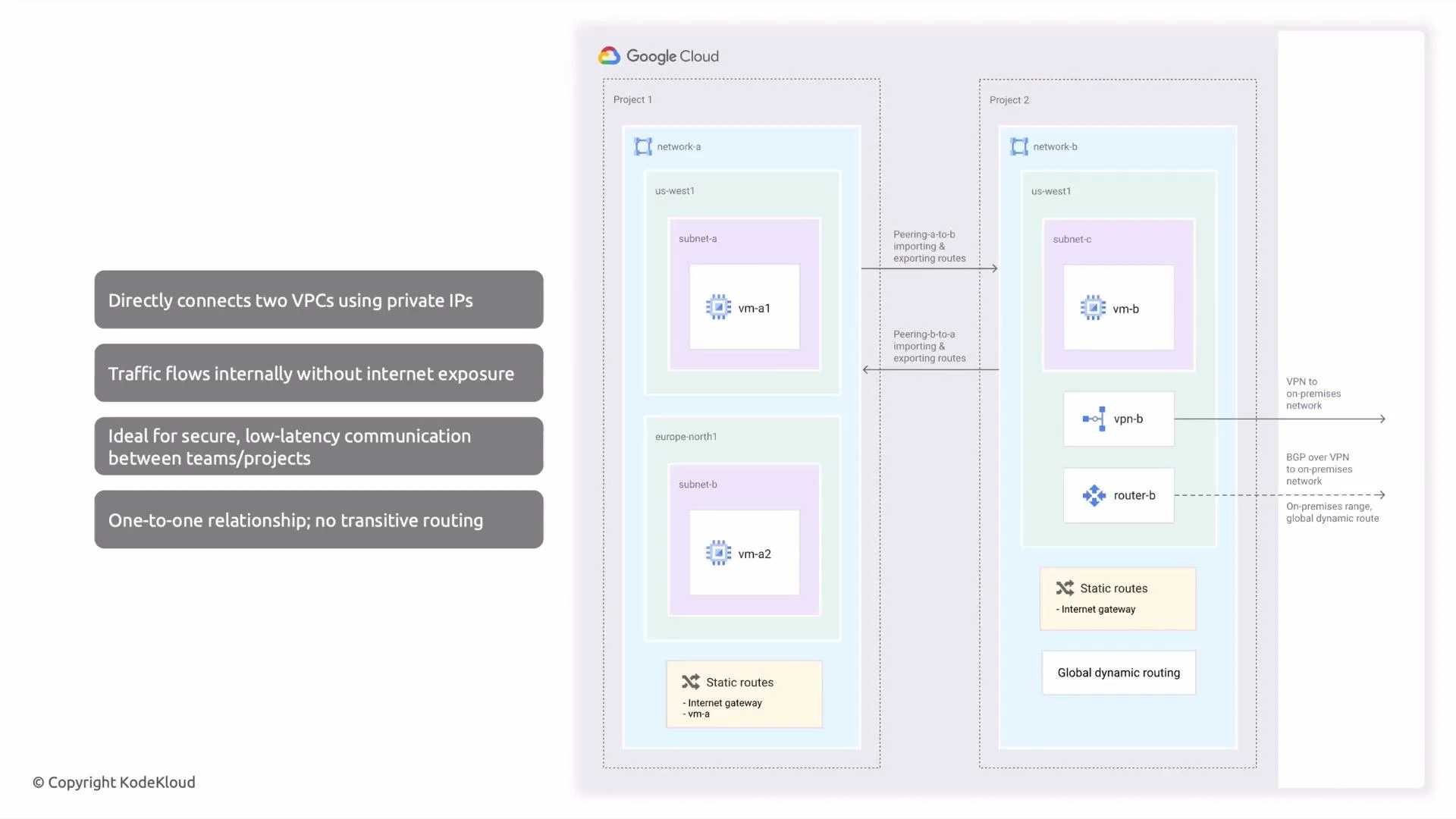 Use VPC peering for low-latency, private communication between two VPCs when simple, direct connectivity is sufficient. For hub-and-spoke or centralized routing, consider Shared VPC, Cloud VPN with a hub, or network virtual appliances.
## Interconnect options: Dedicated vs Partner
For high-bandwidth or low-latency requirements, Cloud Interconnect is preferable to VPN. Choose between Dedicated Interconnect and Partner Interconnect depending on location, bandwidth requirements, and operational preferences.
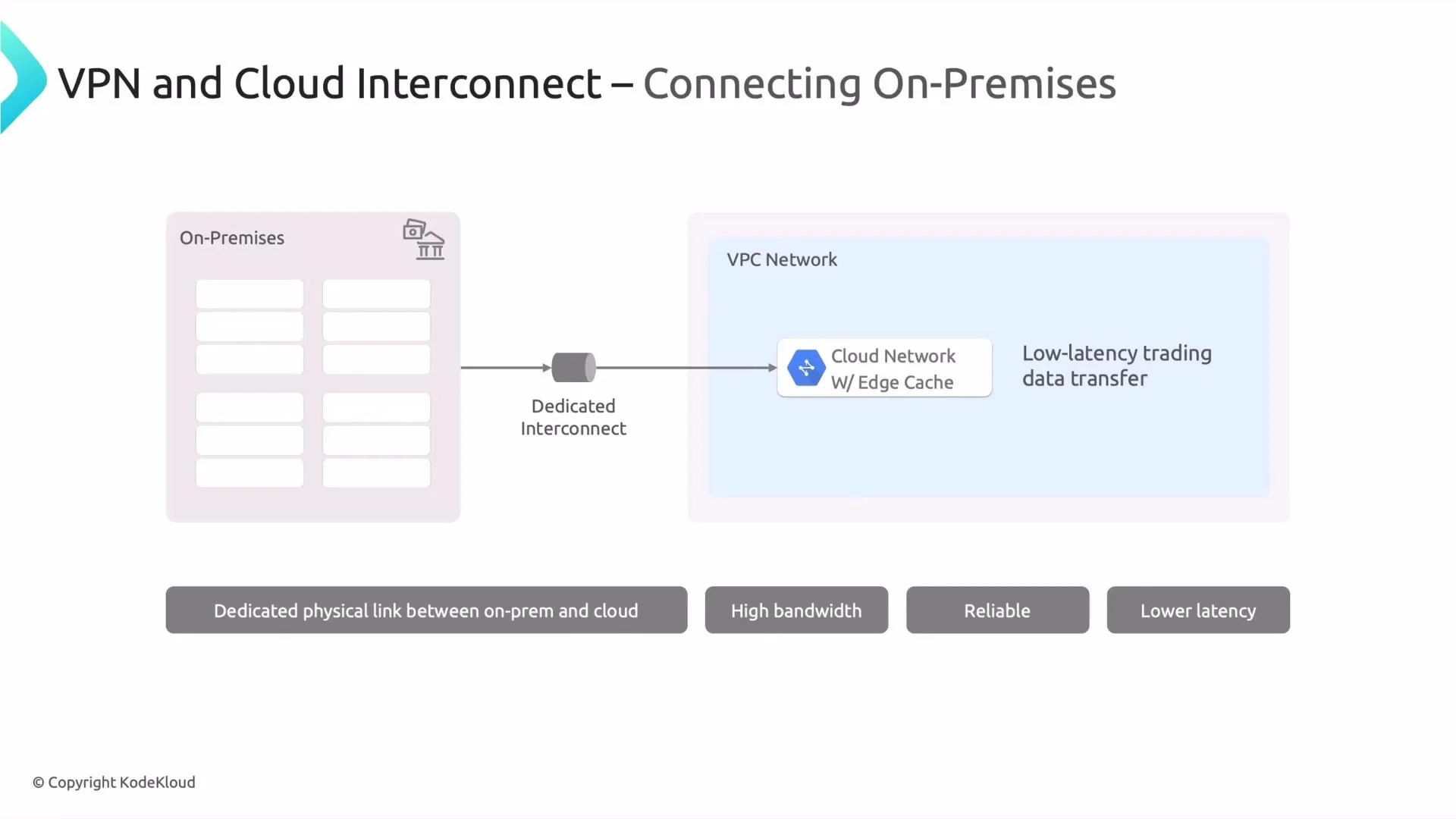
* Dedicated Interconnect
* A physically direct connection from your on-prem network to Google’s network at an interconnect location (colocation facility).
* Provides very high bandwidth, low latency, and predictable performance because traffic enters Google’s backbone immediately.
* Common for organizations that transfer large volumes of data frequently or require strict data-control guarantees.
Use VPC peering for low-latency, private communication between two VPCs when simple, direct connectivity is sufficient. For hub-and-spoke or centralized routing, consider Shared VPC, Cloud VPN with a hub, or network virtual appliances.
## Interconnect options: Dedicated vs Partner
For high-bandwidth or low-latency requirements, Cloud Interconnect is preferable to VPN. Choose between Dedicated Interconnect and Partner Interconnect depending on location, bandwidth requirements, and operational preferences.
* Dedicated Interconnect
* A physically direct connection from your on-prem network to Google’s network at an interconnect location (colocation facility).
* Provides very high bandwidth, low latency, and predictable performance because traffic enters Google’s backbone immediately.
* Common for organizations that transfer large volumes of data frequently or require strict data-control guarantees.
 * Partner Interconnect
* Use when Google lacks a direct presence at your data center location.
* A supported service provider (telecom or colocation partner) delivers connectivity to Google at an interconnect location.
* Provides Layer 3 connectivity into your VPC with multiple bandwidth options and greater geographic flexibility.
## Multi-cloud and hybrid connectivity
* Multi-cloud setups (for example, connecting Google Cloud to AWS) are common. Typical approaches include:
* VPN tunnels between clouds for encrypted IP connectivity.
* Provider-based dedicated connectivity or partner services that link cloud backbones.
* Hybrid designs that combine Interconnect, VPN, and peering depending on latency and throughput needs.
Choose the method based on:
* Latency and bandwidth requirements
* Cost and operational overhead
* Regulatory, compliance, or data residency constraints
## Comparison table: connectivity options
| Connection type | Use case | Pros | Cons |
| ---------------------- | ------------------------------------------------------: | ---------------------------------------------------------------------------- | --------------------------------------------------------------------------------- |
| Cloud VPN / HA VPN | Site-to-site encrypted tunnels over the Internet | Quick to set up; encrypted; `HA VPN` offers regional redundancy | Performance depends on Internet; not ideal for very high bandwidth |
| Dedicated Interconnect | High-throughput on-prem to Google backbone | Very high bandwidth, low latency, predictable performance | Requires colocation and physical setup; higher cost |
| Partner Interconnect | Where Google has no direct presence | Flexible locations; multiple bandwidth tiers; easier onboarding via provider | Slightly higher latency than Dedicated; dependent on provider |
| VPC Network Peering | Private VPC-to-VPC connectivity across projects/regions | Low-latency, private traffic on Google backbone | One-to-one, non-transitive; not suitable for hub-and-spoke without other controls |
## Quick exam-style question
Which connection option provides the highest bandwidth and lowest latency to your on-prem environment?
* Answer: Dedicated Interconnect.
Remember: VPC peering is non-transitive and does not allow route propagation through intermediate peers. For architectures that require centralized connectivity or transitive routing, consider alternatives such as Shared VPC, Cloud VPN in a hub-and-spoke topology, or a third-party network virtual appliance.
## Summary
Google Cloud offers multiple secure ways to connect networks:
* Cloud VPN: encrypted site-to-site tunnels over the Internet (`HA VPN` for higher availability).
* Cloud Interconnect: dedicated private connectivity (`Dedicated Interconnect` and `Partner Interconnect`) for high performance.
* VPC Network Peering: private, low-latency connectivity between VPCs (one-to-one, non-transitive).
Select the option that best balances performance, cost, and security for your workload.
## Links and references
* [Google Cloud VPN documentation](https://cloud.google.com/network-connectivity/docs/vpn)
* [Cloud Interconnect documentation](https://cloud.google.com/network-connectivity/docs/interconnect)
* [VPC Network Peering documentation](https://cloud.google.com/vpc/docs/vpc-peering)
* [AWS (Amazon Web Services)](https://aws.amazon.com)
* Partner Interconnect
* Use when Google lacks a direct presence at your data center location.
* A supported service provider (telecom or colocation partner) delivers connectivity to Google at an interconnect location.
* Provides Layer 3 connectivity into your VPC with multiple bandwidth options and greater geographic flexibility.
## Multi-cloud and hybrid connectivity
* Multi-cloud setups (for example, connecting Google Cloud to AWS) are common. Typical approaches include:
* VPN tunnels between clouds for encrypted IP connectivity.
* Provider-based dedicated connectivity or partner services that link cloud backbones.
* Hybrid designs that combine Interconnect, VPN, and peering depending on latency and throughput needs.
Choose the method based on:
* Latency and bandwidth requirements
* Cost and operational overhead
* Regulatory, compliance, or data residency constraints
## Comparison table: connectivity options
| Connection type | Use case | Pros | Cons |
| ---------------------- | ------------------------------------------------------: | ---------------------------------------------------------------------------- | --------------------------------------------------------------------------------- |
| Cloud VPN / HA VPN | Site-to-site encrypted tunnels over the Internet | Quick to set up; encrypted; `HA VPN` offers regional redundancy | Performance depends on Internet; not ideal for very high bandwidth |
| Dedicated Interconnect | High-throughput on-prem to Google backbone | Very high bandwidth, low latency, predictable performance | Requires colocation and physical setup; higher cost |
| Partner Interconnect | Where Google has no direct presence | Flexible locations; multiple bandwidth tiers; easier onboarding via provider | Slightly higher latency than Dedicated; dependent on provider |
| VPC Network Peering | Private VPC-to-VPC connectivity across projects/regions | Low-latency, private traffic on Google backbone | One-to-one, non-transitive; not suitable for hub-and-spoke without other controls |
## Quick exam-style question
Which connection option provides the highest bandwidth and lowest latency to your on-prem environment?
* Answer: Dedicated Interconnect.
Remember: VPC peering is non-transitive and does not allow route propagation through intermediate peers. For architectures that require centralized connectivity or transitive routing, consider alternatives such as Shared VPC, Cloud VPN in a hub-and-spoke topology, or a third-party network virtual appliance.
## Summary
Google Cloud offers multiple secure ways to connect networks:
* Cloud VPN: encrypted site-to-site tunnels over the Internet (`HA VPN` for higher availability).
* Cloud Interconnect: dedicated private connectivity (`Dedicated Interconnect` and `Partner Interconnect`) for high performance.
* VPC Network Peering: private, low-latency connectivity between VPCs (one-to-one, non-transitive).
Select the option that best balances performance, cost, and security for your workload.
## Links and references
* [Google Cloud VPN documentation](https://cloud.google.com/network-connectivity/docs/vpn)
* [Cloud Interconnect documentation](https://cloud.google.com/network-connectivity/docs/interconnect)
* [VPC Network Peering documentation](https://cloud.google.com/vpc/docs/vpc-peering)
* [AWS (Amazon Web Services)](https://aws.amazon.com)