> ## Documentation Index
> Fetch the complete documentation index at: https://notes.kodekloud.com/llms.txt
> Use this file to discover all available pages before exploring further.
# Comparing Terraform to Other Tools
> Explains Terraform versus cloud-native and config management tools, highlighting differences, use cases, and when to combine provisioning with in-VM configuration
This guide clears up common confusions about Terraform and how it compares to other tools in the infrastructure and configuration-management ecosystem. Understanding these differences helps you choose the right tool(s) for provisioning, management, and in-VM configuration—especially in single-cloud vs multi-cloud environments.
## IaC tools vs configuration-management tools (diagram overview)
On the left side of the diagram are tools that share Terraform’s core goal: provisioning and managing cloud infrastructure.
* CloudFormation and Bicep are cloud-native, declarative IaC systems tightly integrated with a single cloud provider (AWS and Azure respectively). They give deep provider-specific features and often get new provider functionality sooner.
* Pulumi is cloud-agnostic like Terraform but exposes general-purpose programming languages (TypeScript, Python, Go, etc.) to define infrastructure, which can appeal to developer-centric teams.
* Terraform is cloud-agnostic and focuses on declarative HCL to provide a consistent experience across many providers, making it a common choice for multi-cloud strategies.
Many organizations adopting multi-cloud prefer a cloud-agnostic IaC layer (Terraform or Pulumi) so teams don’t need to learn and maintain distinct native IaC solutions for each cloud.
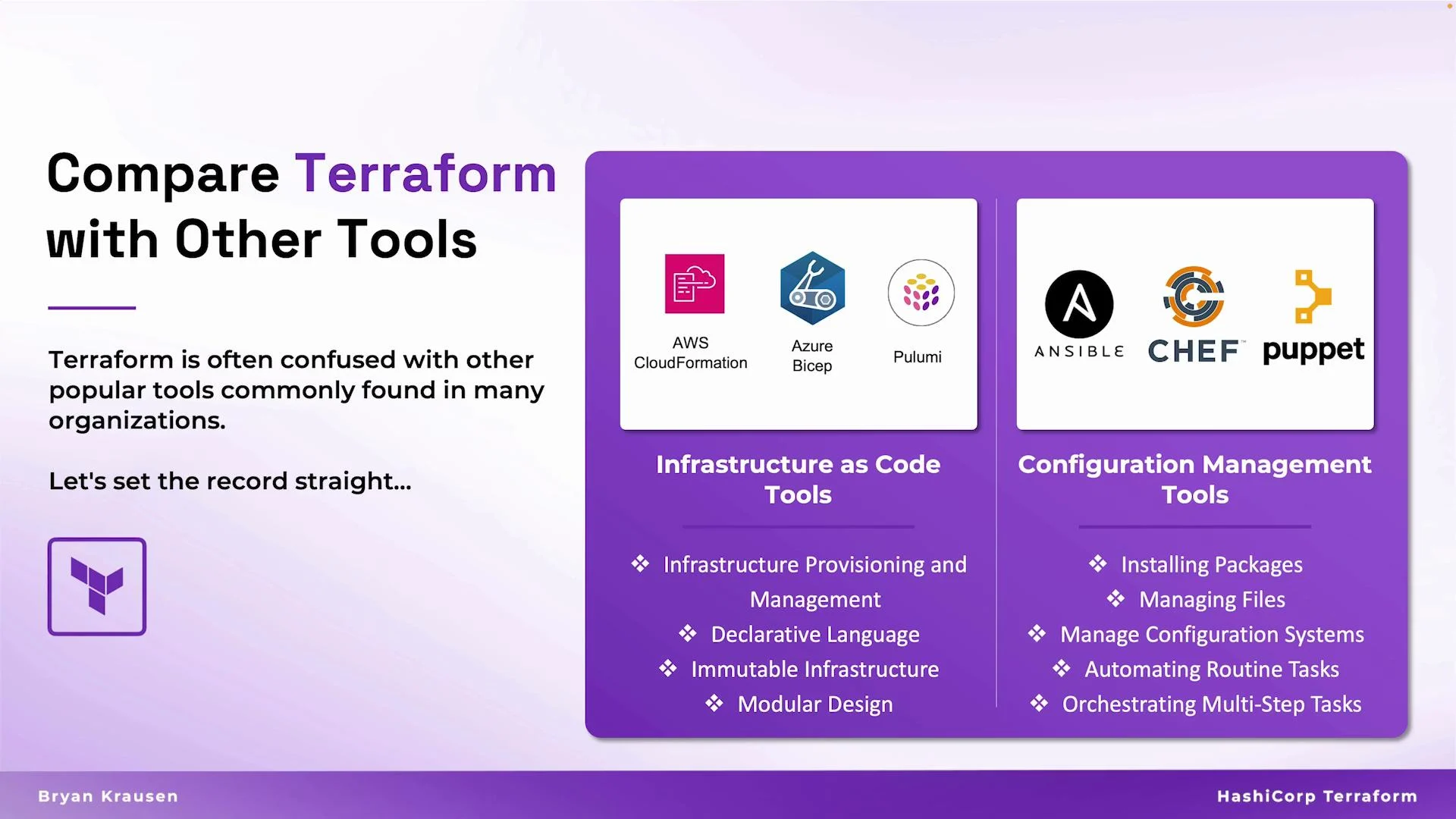 On the right side of the diagram are tools that solve a different set of problems—usually complementary to Terraform.
* Ansible, Chef, Puppet, and SaltStack are configuration management systems focused on in-VM tasks: installing packages, templating and distributing configuration files, managing OS services, and enforcing runtime desired state.
* These tools typically run inside provisioned instances (or via agentless connections) and are best suited for application configuration, ongoing drift correction, and orchestration of software deployment.
## Typical pattern: combine provisioning with configuration
A common and recommended separation of concerns is:
* Provision infrastructure resources with Terraform (or another IaC tool): VMs, networking, load balancers, managed databases, and cloud-managed services.
* Configure software and runtime behavior inside those instances with configuration-management tools or boot-time mechanisms (Ansible, Chef, Puppet, SaltStack, `cloud-init`, baked images, or container orchestration).
This division keeps lifecycle management distinct from in-guest configuration and lets each tool do what it does best.
## Quick comparison table
| Category | Examples | Primary use | Strengths |
| --------------------------------------- | -------------------------------------------------------------------------------------------------------------------------------------------------------------------------------------------: | ----------------------------------------------------------------------------- | ------------------------------------------------------------- |
| Infrastructure as Code (cloud-specific) | [CloudFormation](https://learn.kodekloud.com/user/courses/aws-cloud-formation), Azure Bicep | Declarative provisioning within a single cloud | Deep provider integration, fast access to provider features |
| Infrastructure as Code (cloud-agnostic) | Terraform, [Pulumi](https://learn.kodekloud.com/user/courses/pulumi-essentials) | Multi-cloud provisioning and resource management | Portability across providers, consistent workflows |
| Configuration management | [Ansible](https://learn.kodekloud.com/user/courses/learn-ansible-basics-beginners-course), [Chef](https://www.chef.io/), [Puppet](https://puppet.com/), [SaltStack](https://saltproject.io/) | Package installs, config files, service management, runtime state enforcement | In-VM orchestration, drift remediation, rich templating |
| Bootstrapping / cloud-init | `cloud-init` | Instance initialization and first-boot tasks | Lightweight, runs at VM boot, commonly used for initial setup |
Terraform is primarily for infrastructure provisioning. CloudFormation and Bicep are cloud-specific with deep provider integration. Configuration-management tools (Ansible, Chef, Puppet, SaltStack) handle in-VM software and runtime configuration. Pulumi is another cloud-agnostic IaC option that uses general-purpose programming languages and offers a different developer experience.
## How to choose
* Use cloud-native IaC (CloudFormation/Bicep) when you need the deepest, earliest access to provider-specific features and you operate mainly within one cloud.
* Use Terraform or Pulumi when you require consistent multi-cloud workflows and a provider-agnostic model.
* Use configuration management tools (or `cloud-init`) where you need agent-based/agentless in-VM configuration, application deployment, or ongoing state enforcement.
* In many environments, a combined approach yields the best balance: Terraform (or Pulumi) to provision cloud resources and a configuration system to install and manage software inside instances.
## Links and references
* [AWS CloudFormation](https://learn.kodekloud.com/user/courses/aws-cloud-formation)
* [Pulumi Essentials](https://learn.kodekloud.com/user/courses/pulumi-essentials)
* [Learn Ansible Basics - Beginners Course](https://learn.kodekloud.com/user/courses/learn-ansible-basics-beginners-course)
* [Chef](https://www.chef.io/)
* [Puppet](https://puppet.com/)
* [SaltStack](https://saltproject.io/)
* `cloud-init` — [https://cloud-init.io/](https://cloud-init.io/)
On the right side of the diagram are tools that solve a different set of problems—usually complementary to Terraform.
* Ansible, Chef, Puppet, and SaltStack are configuration management systems focused on in-VM tasks: installing packages, templating and distributing configuration files, managing OS services, and enforcing runtime desired state.
* These tools typically run inside provisioned instances (or via agentless connections) and are best suited for application configuration, ongoing drift correction, and orchestration of software deployment.
## Typical pattern: combine provisioning with configuration
A common and recommended separation of concerns is:
* Provision infrastructure resources with Terraform (or another IaC tool): VMs, networking, load balancers, managed databases, and cloud-managed services.
* Configure software and runtime behavior inside those instances with configuration-management tools or boot-time mechanisms (Ansible, Chef, Puppet, SaltStack, `cloud-init`, baked images, or container orchestration).
This division keeps lifecycle management distinct from in-guest configuration and lets each tool do what it does best.
## Quick comparison table
| Category | Examples | Primary use | Strengths |
| --------------------------------------- | -------------------------------------------------------------------------------------------------------------------------------------------------------------------------------------------: | ----------------------------------------------------------------------------- | ------------------------------------------------------------- |
| Infrastructure as Code (cloud-specific) | [CloudFormation](https://learn.kodekloud.com/user/courses/aws-cloud-formation), Azure Bicep | Declarative provisioning within a single cloud | Deep provider integration, fast access to provider features |
| Infrastructure as Code (cloud-agnostic) | Terraform, [Pulumi](https://learn.kodekloud.com/user/courses/pulumi-essentials) | Multi-cloud provisioning and resource management | Portability across providers, consistent workflows |
| Configuration management | [Ansible](https://learn.kodekloud.com/user/courses/learn-ansible-basics-beginners-course), [Chef](https://www.chef.io/), [Puppet](https://puppet.com/), [SaltStack](https://saltproject.io/) | Package installs, config files, service management, runtime state enforcement | In-VM orchestration, drift remediation, rich templating |
| Bootstrapping / cloud-init | `cloud-init` | Instance initialization and first-boot tasks | Lightweight, runs at VM boot, commonly used for initial setup |
Terraform is primarily for infrastructure provisioning. CloudFormation and Bicep are cloud-specific with deep provider integration. Configuration-management tools (Ansible, Chef, Puppet, SaltStack) handle in-VM software and runtime configuration. Pulumi is another cloud-agnostic IaC option that uses general-purpose programming languages and offers a different developer experience.
## How to choose
* Use cloud-native IaC (CloudFormation/Bicep) when you need the deepest, earliest access to provider-specific features and you operate mainly within one cloud.
* Use Terraform or Pulumi when you require consistent multi-cloud workflows and a provider-agnostic model.
* Use configuration management tools (or `cloud-init`) where you need agent-based/agentless in-VM configuration, application deployment, or ongoing state enforcement.
* In many environments, a combined approach yields the best balance: Terraform (or Pulumi) to provision cloud resources and a configuration system to install and manage software inside instances.
## Links and references
* [AWS CloudFormation](https://learn.kodekloud.com/user/courses/aws-cloud-formation)
* [Pulumi Essentials](https://learn.kodekloud.com/user/courses/pulumi-essentials)
* [Learn Ansible Basics - Beginners Course](https://learn.kodekloud.com/user/courses/learn-ansible-basics-beginners-course)
* [Chef](https://www.chef.io/)
* [Puppet](https://puppet.com/)
* [SaltStack](https://saltproject.io/)
* `cloud-init` — [https://cloud-init.io/](https://cloud-init.io/)