> ## Documentation Index
> Fetch the complete documentation index at: https://notes.kodekloud.com/llms.txt
> Use this file to discover all available pages before exploring further.
# Benefits and Use Cases of Seal Wrapping
> This article discusses seal wrapping in HashiCorp Vault, highlighting its benefits for double encryption and FIPS 140-2 compliance in high-security environments.
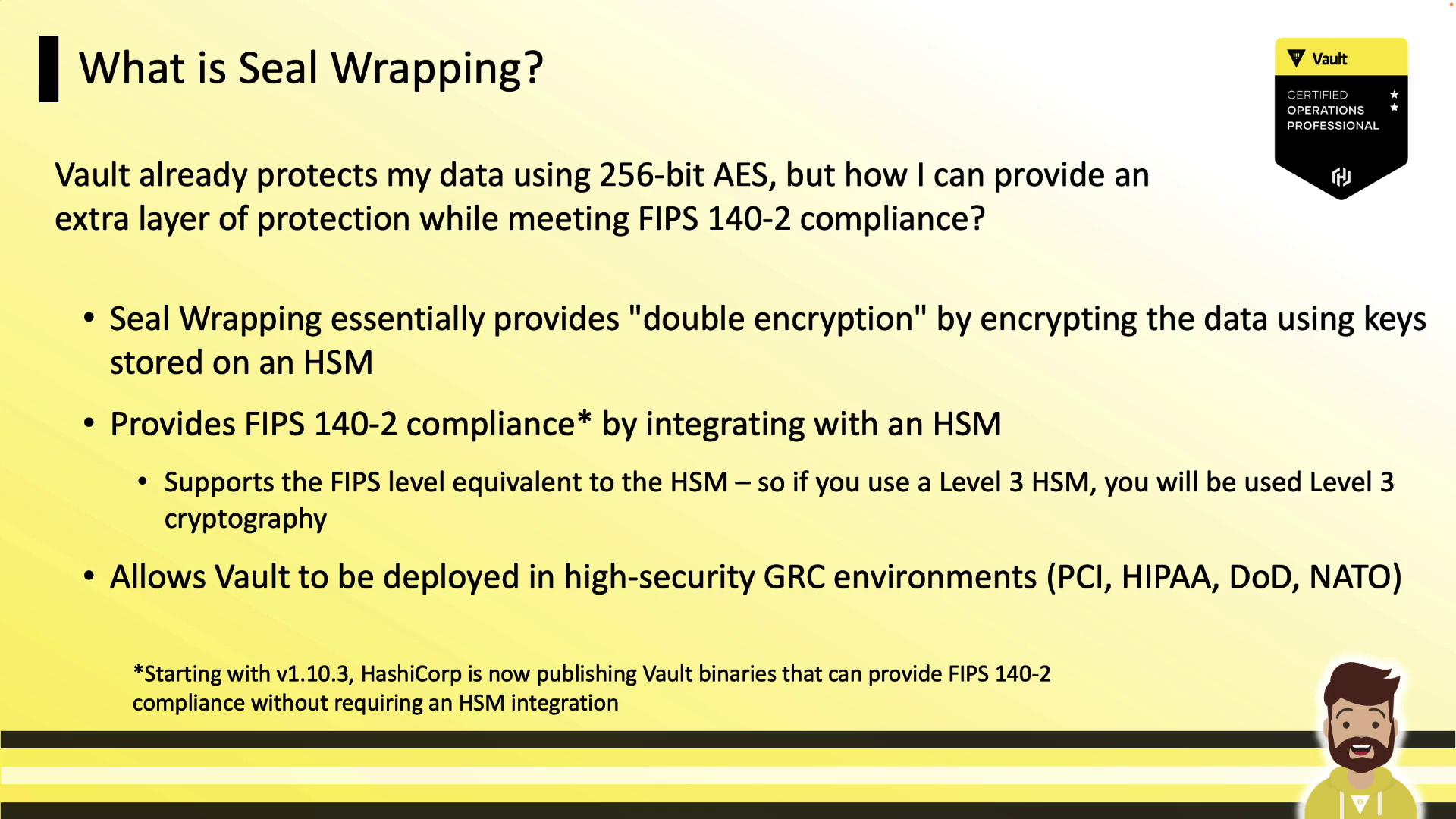
HashiCorp Vault encrypts data at rest with AES-256, but seal wrapping adds a second layer of encryption using an HSM for FIPS 140-2 compliance. This “double encryption” ensures data is encrypted first by Vault’s master key, then again by the HSM’s key.
As of Vault 1.10.3, HashiCorp publishes FIPS-certified binaries suffixed with `-fips` that do not require an HSM.
## What Is Seal Wrapping?
Seal wrapping encrypts Vault’s ciphertext a second time with HSM-managed keys, enabling Vault in high-security environments (PCI, HIPAA, DoD, NATO).
By combining:
* AES-256 encryption by Vault’s master key
* Secondary HSM encryption
Vault achieves FIPS 140-2 Level 3 compliance when paired with a Level 3 HSM.
### Default Seal-Wrapped Data
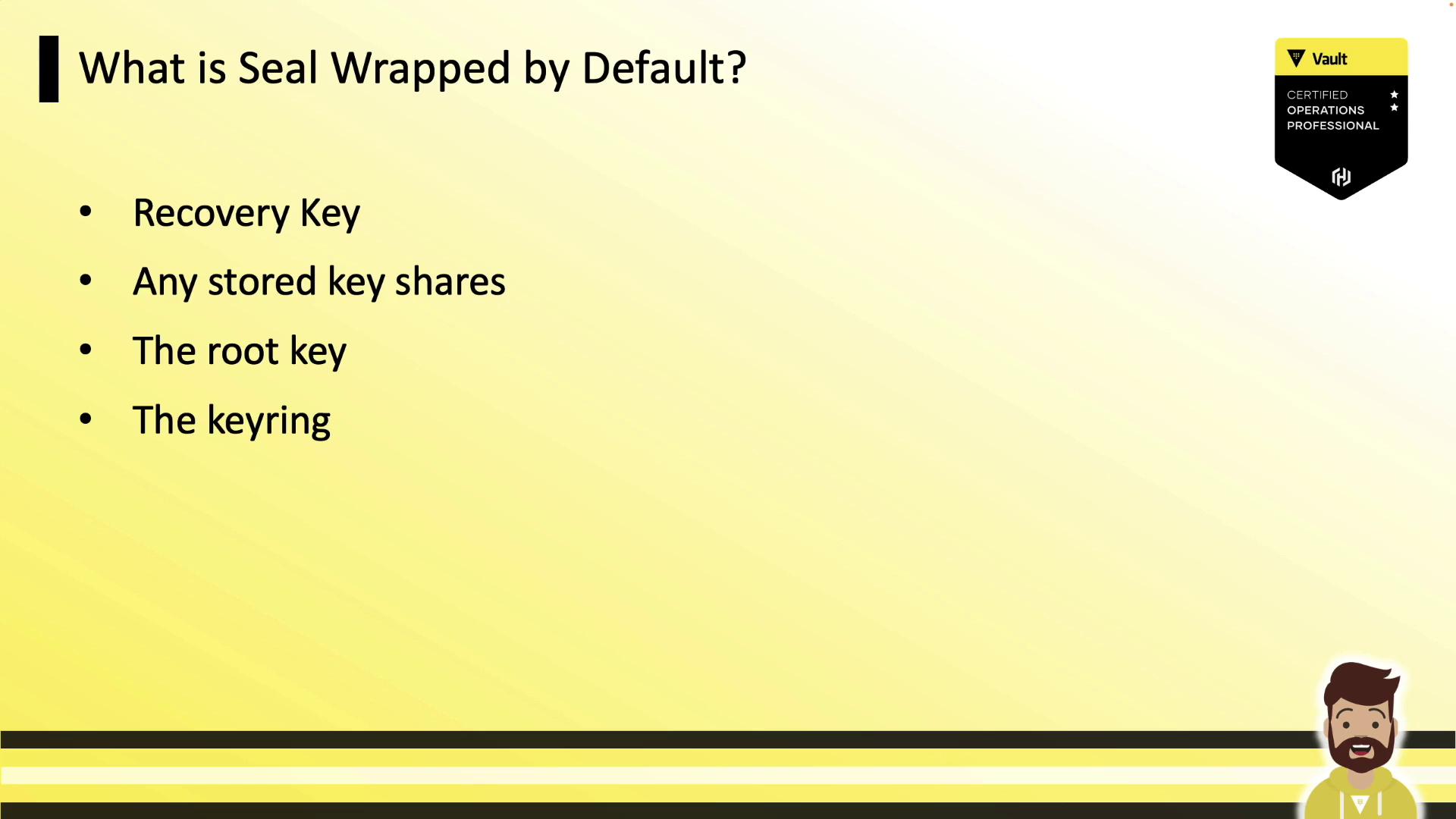
Vault seal-wraps the most sensitive assets by default:
| Resource | Description |
| ------------- | ------------------------------ |
| Recovery Key | Master recovery key shares |
| Stored Shares | All encrypted key shares |
| Root Key | Primary root token key |
| Keyring | Internal cryptographic keyring |
## Configuring Seal Wrapping
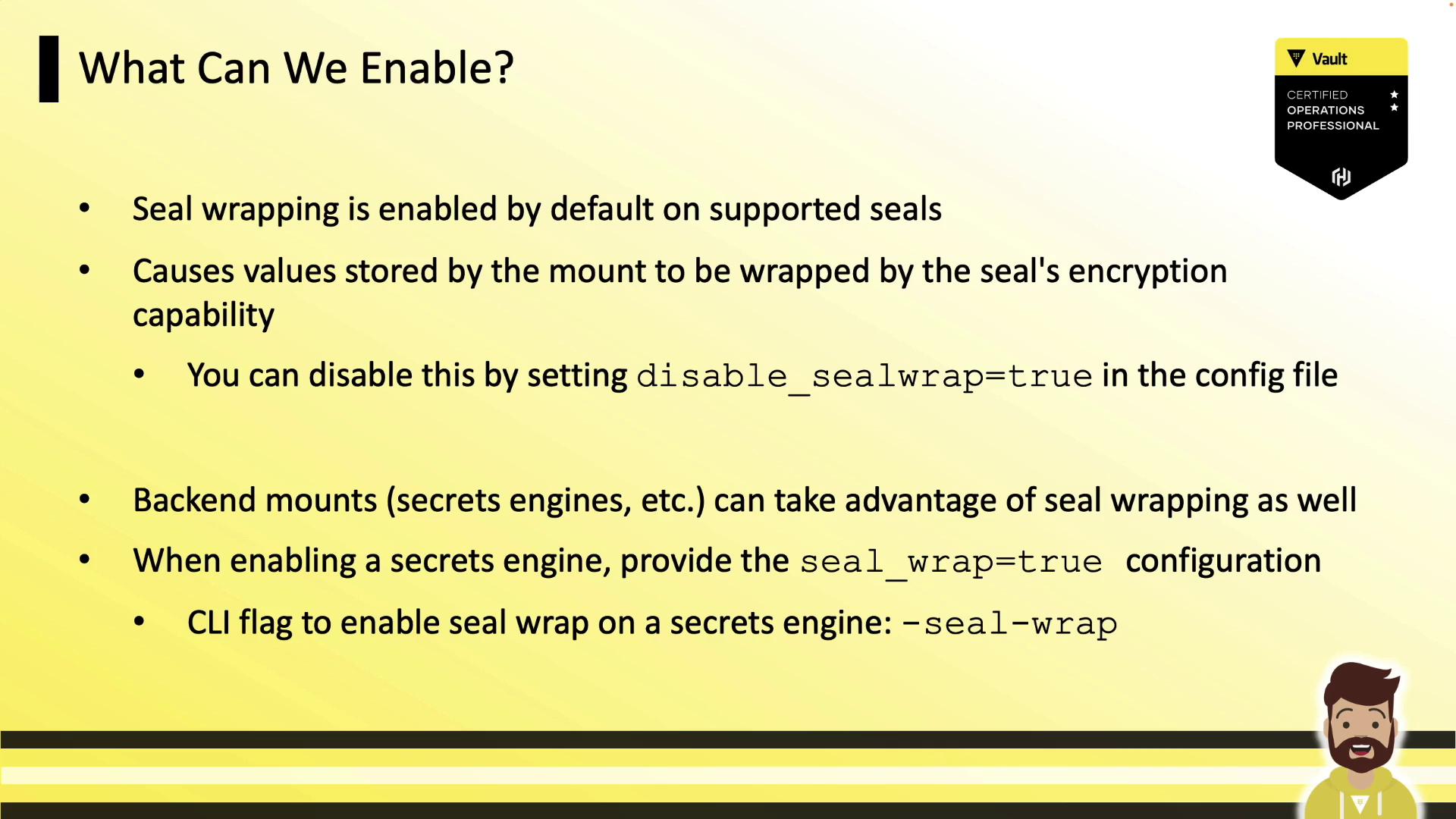
Seal wrapping is on by default for supported HSM seals. To disable it (trading security for a slight performance boost):
```hcl theme={null}
# vault.hcl
disable_sealwrap = true
```
Disabling seal wrapping reduces your security posture. Only disable if HSM double-encryption is not required.
## Enabling Seal Wrapping on a Secrets Engine
When mounting a secrets engine, enable HSM seal wrapping with `-seal-wrap` (CLI) or `seal_wrap = true` (HCL):
```shell theme={null}
# Enable KV secrets engine with HSM seal wrapping
vault secrets enable -seal-wrap kv
```
```shell theme={null}
# Verify enabled secrets engines
vault secrets list -detailed
```
| Path | Plugin | Seal Wrap |
| ---------- | --------- | --------- |
| cubbyhole/ | cubbyhole | false |
| identity/ | identity | false |
| kv/ | kv | true |
## Conclusion
Seal wrapping is key for high-security Vault deployments requiring FIPS 140-2 Level 3 compliance with an HSM or when using HashiCorp’s FIPS-certified binaries. It ensures that Vault’s most critical secrets remain protected under dual encryption.
## References
* [Vault Documentation](https://www.vaultproject.io/docs)
* [FIPS 140-2 Overview](https://csrc.nist.gov/projects/cryptographic-module-validation-program/fips-140)