> ## Documentation Index
> Fetch the complete documentation index at: https://notes.kodekloud.com/llms.txt
> Use this file to discover all available pages before exploring further.
# Keyspaces
> Overview of Amazon Keyspaces, AWS’s managed, Cassandra‑compatible serverless database offering CQL compatibility, scalable capacity modes, multi‑region replication, security, and managed operational features.
In this lesson we cover Amazon Keyspaces — AWS’s managed, Cassandra-compatible database service for high-throughput, low-latency workloads.
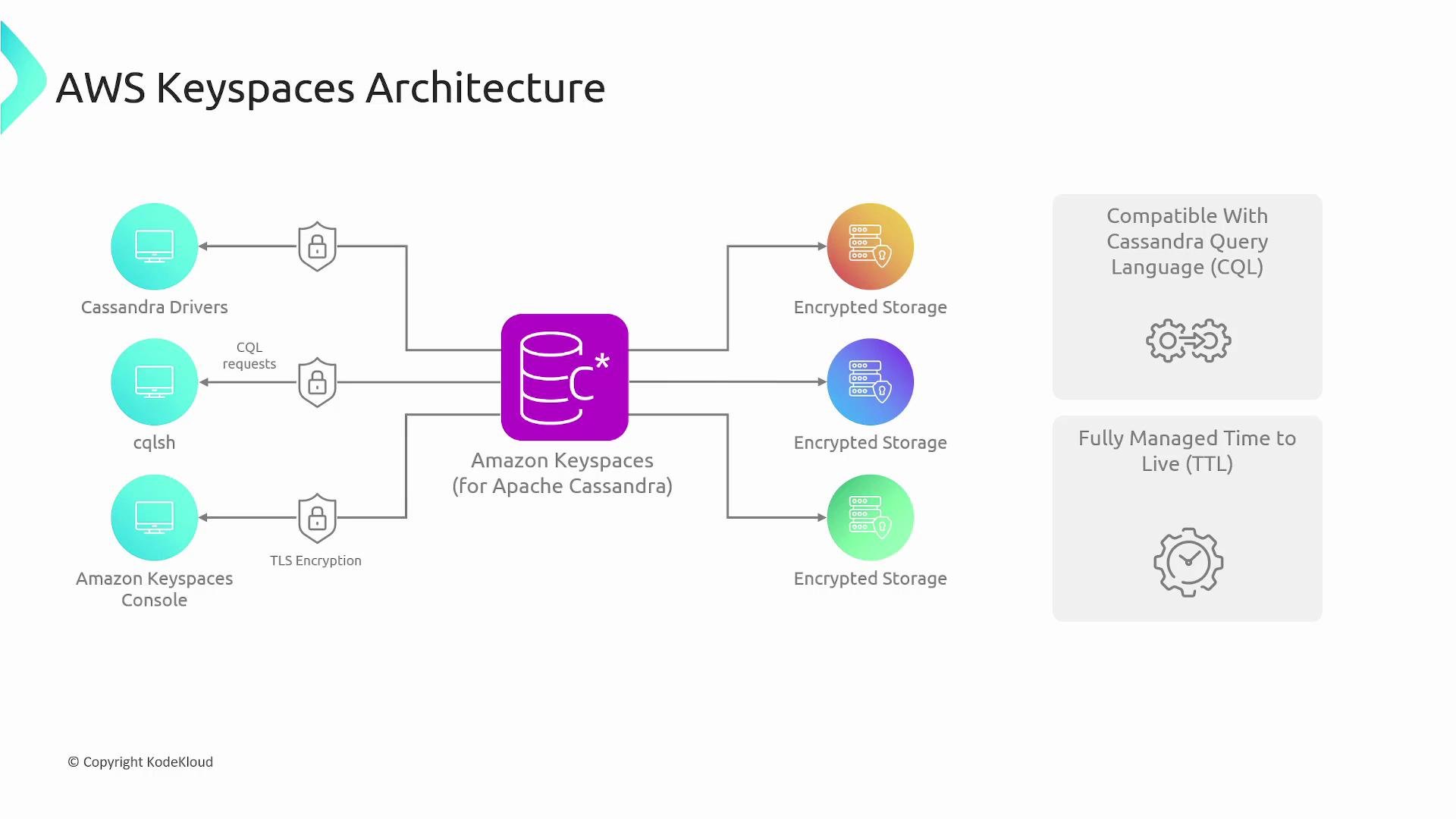
Amazon Keyspaces (for Apache Cassandra) delivers a serverless Cassandra experience: AWS manages the underlying infrastructure, automatically scales capacity, and provides built-in security, availability, and monitoring. Applications use Cassandra Query Language (CQL) and standard Cassandra drivers to interact with Keyspaces, minimizing migration or tooling changes.
Key highlights:
* Fully managed, Cassandra-compatible service using familiar CQL and Cassandra drivers.
* Serverless scaling with on-demand billing or provisioned throughput (with auto scaling).
* High availability across Availability Zones, encryption at rest, IAM integration, and VPC endpoints.
* Built-in TTL (time-to-live) for automatic expiration of data and managed backups.
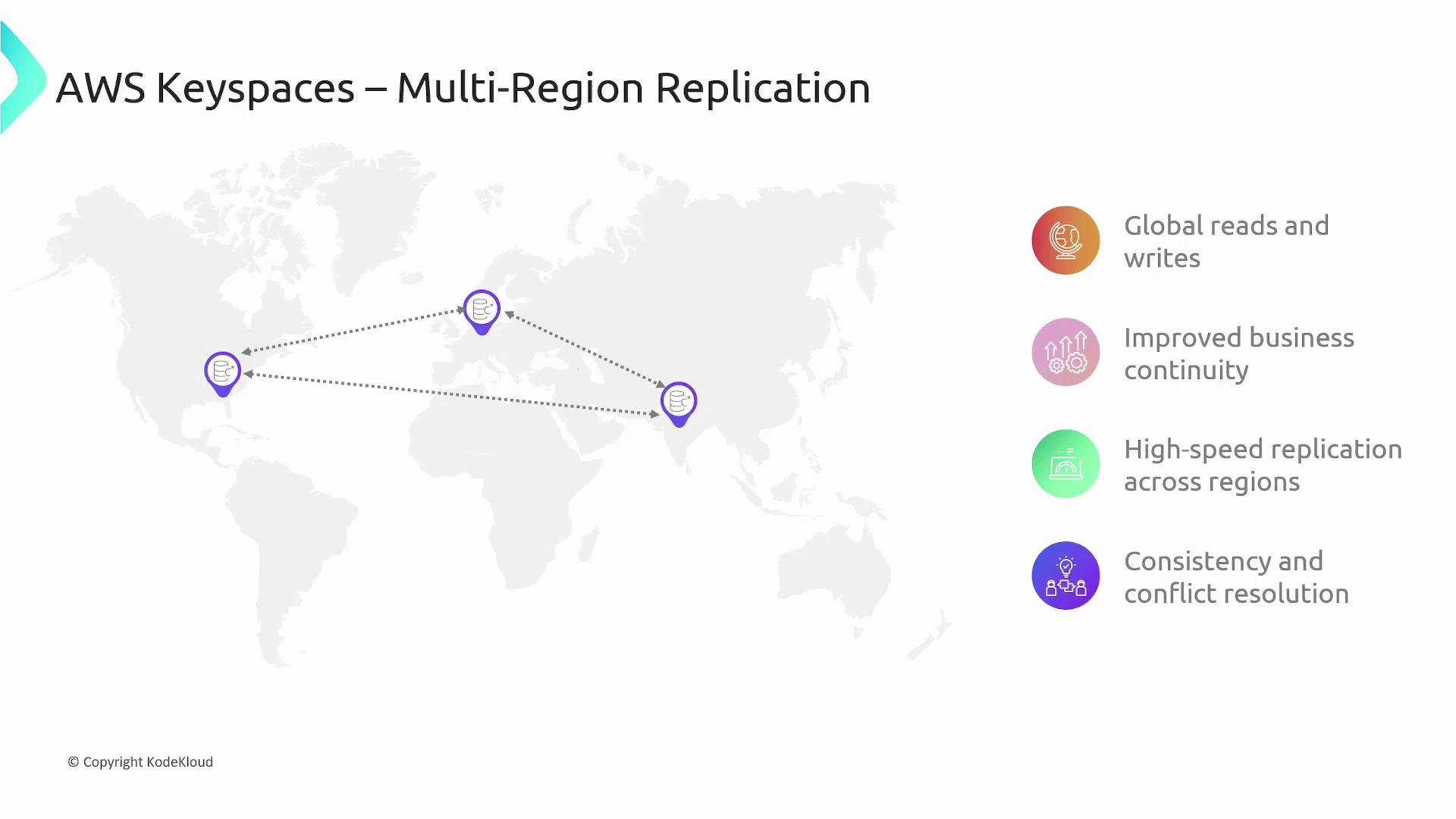
* Support for multi-region (active-active) deployments with storage-based asynchronous replication.
 What is Amazon Keyspaces
Amazon Keyspaces is designed to remove the operational burden of running Apache Cassandra clusters: provisioning, patching, node management, and scaling. Because Keyspaces is compatible with CQL and Cassandra drivers, you can often reuse existing application code with minimal changes.
How applications use Keyspaces
* Use CQL and standard Cassandra drivers (Java, Python, Node.js, etc.) to read and write data.
* Keyspaces encrypts data at rest and in transit, integrates with AWS IAM for auth, and supports VPC endpoints for private connectivity.
* TTL (time-to-live) is fully managed by Keyspaces — you don’t provision capacity separately for TTL operations.
Quick CQL examples
Create a keyspace (CQL):
```sql theme={null}
CREATE KEYSPACE IF NOT EXISTS demo_keyspace
WITH REPLICATION = {'class': 'SingleRegionStrategy'};
```
Create a table and use it:
```sql theme={null}
CREATE TABLE IF NOT EXISTS demo_keyspace.devices (
device_id uuid,
ts timestamp,
temperature double,
PRIMARY KEY (device_id, ts)
) WITH CLUSTERING ORDER BY (ts DESC);
INSERT INTO demo_keyspace.devices (device_id, ts, temperature)
VALUES (uuid(), toTimestamp(now()), 72.5);
SELECT * FROM demo_keyspace.devices WHERE device_id = 123e4567-e89b-12d3-a456-426655440000;
```
Capacity modes
Keyspaces supports two throughput capacity modes. Choose the mode that matches your workload characteristics:
| Mode | How it works | Best for |
| -------------------- | ------------------------------------------------------------------------------------------------------ | -------------------------------------------------------------------------- |
| On-demand capacity | You pay per read/write request. Keyspaces instantly scales to adapt to unpredictable or spiky traffic. | Applications with irregular, bursty, or unpredictable traffic. |
| Provisioned capacity | You specify read/write capacity units; enable auto scaling to adjust capacity as load changes. | Stable, predictable workloads where cost can be optimized by provisioning. |
Choose on‑demand for unpredictable or bursty workloads and provisioned capacity (with auto scaling) for predictable workloads where cost optimization matters.
You can switch a table’s capacity mode (on‑demand ↔ provisioned) at most once per day. Plan capacity changes accordingly.
Multi-region Keyspaces
Keyspaces supports multi-region (global) tables implemented as replica tables — one replica per region — that share a single logical schema. Writes in any region are propagated to other regions using storage-based asynchronous replication. Typical replication lag is low (often under one second), and replication occurs in storage so it has minimal effect on query performance.
Benefits of multi-region Keyspaces:
* Active‑active global reads and writes with low latency for local users.
* Improved business continuity: if a region fails, traffic can be routed to another active region.
* Built-in conflict resolution for write conflicts across regions.
What is Amazon Keyspaces
Amazon Keyspaces is designed to remove the operational burden of running Apache Cassandra clusters: provisioning, patching, node management, and scaling. Because Keyspaces is compatible with CQL and Cassandra drivers, you can often reuse existing application code with minimal changes.
How applications use Keyspaces
* Use CQL and standard Cassandra drivers (Java, Python, Node.js, etc.) to read and write data.
* Keyspaces encrypts data at rest and in transit, integrates with AWS IAM for auth, and supports VPC endpoints for private connectivity.
* TTL (time-to-live) is fully managed by Keyspaces — you don’t provision capacity separately for TTL operations.
Quick CQL examples
Create a keyspace (CQL):
```sql theme={null}
CREATE KEYSPACE IF NOT EXISTS demo_keyspace
WITH REPLICATION = {'class': 'SingleRegionStrategy'};
```
Create a table and use it:
```sql theme={null}
CREATE TABLE IF NOT EXISTS demo_keyspace.devices (
device_id uuid,
ts timestamp,
temperature double,
PRIMARY KEY (device_id, ts)
) WITH CLUSTERING ORDER BY (ts DESC);
INSERT INTO demo_keyspace.devices (device_id, ts, temperature)
VALUES (uuid(), toTimestamp(now()), 72.5);
SELECT * FROM demo_keyspace.devices WHERE device_id = 123e4567-e89b-12d3-a456-426655440000;
```
Capacity modes
Keyspaces supports two throughput capacity modes. Choose the mode that matches your workload characteristics:
| Mode | How it works | Best for |
| -------------------- | ------------------------------------------------------------------------------------------------------ | -------------------------------------------------------------------------- |
| On-demand capacity | You pay per read/write request. Keyspaces instantly scales to adapt to unpredictable or spiky traffic. | Applications with irregular, bursty, or unpredictable traffic. |
| Provisioned capacity | You specify read/write capacity units; enable auto scaling to adjust capacity as load changes. | Stable, predictable workloads where cost can be optimized by provisioning. |
Choose on‑demand for unpredictable or bursty workloads and provisioned capacity (with auto scaling) for predictable workloads where cost optimization matters.
You can switch a table’s capacity mode (on‑demand ↔ provisioned) at most once per day. Plan capacity changes accordingly.
Multi-region Keyspaces
Keyspaces supports multi-region (global) tables implemented as replica tables — one replica per region — that share a single logical schema. Writes in any region are propagated to other regions using storage-based asynchronous replication. Typical replication lag is low (often under one second), and replication occurs in storage so it has minimal effect on query performance.
Benefits of multi-region Keyspaces:
* Active‑active global reads and writes with low latency for local users.
* Improved business continuity: if a region fails, traffic can be routed to another active region.
* Built-in conflict resolution for write conflicts across regions.
 When to use Keyspaces
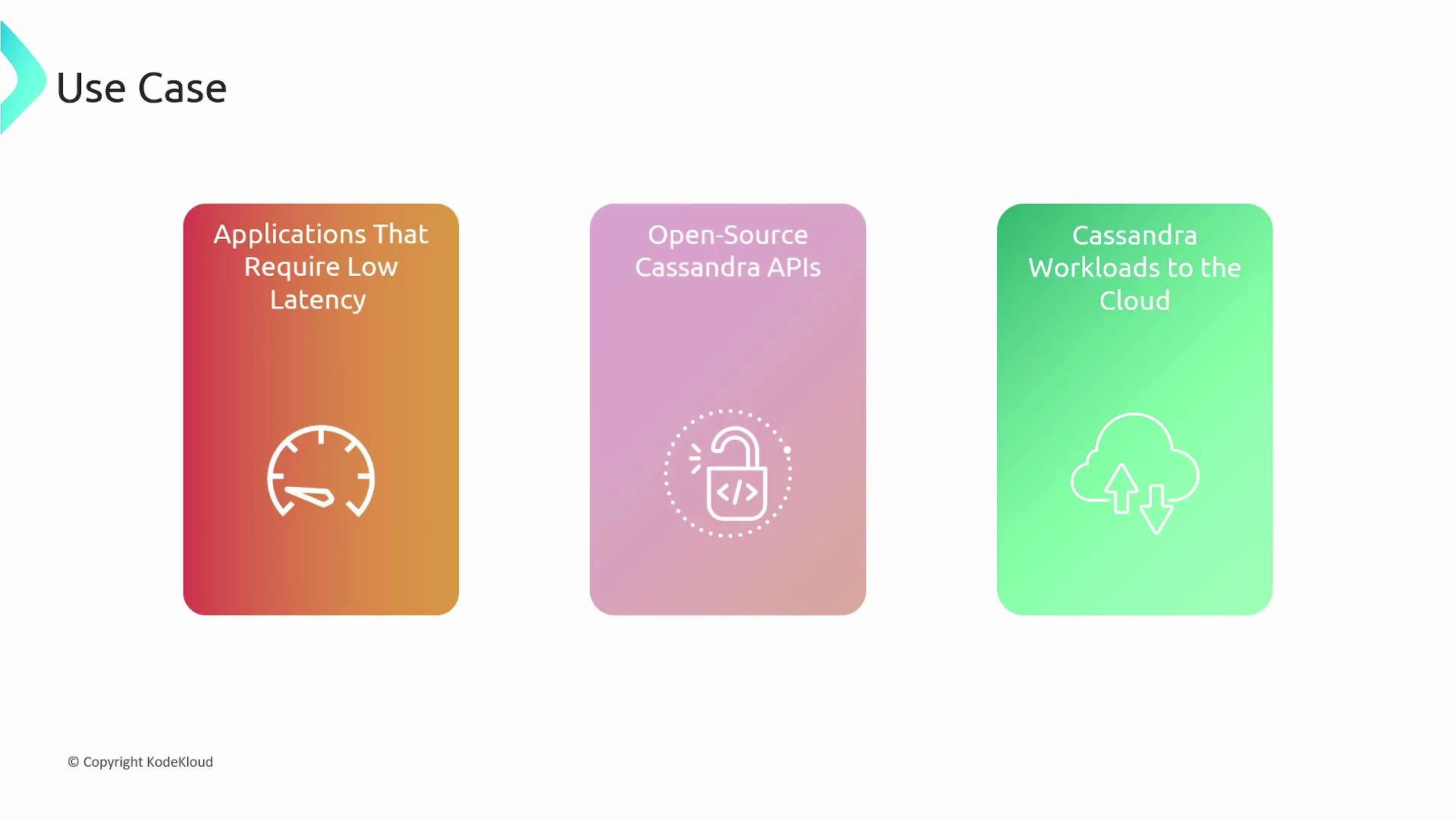
Keyspaces is a strong fit when you need Cassandra compatibility without operational overhead. Typical use cases include:
* High-volume telemetry and time-series ingestion (industrial IoT).
* Real-time trading and market monitoring systems.
* Fleet management, routing, or any system that needs low-latency reads and high write throughput.
Key advantages:
* No Cassandra cluster management (provisioning, patching, repair).
* Seamless use of existing CQL-based tools and drivers.
* Built-in security and monitoring integrations.
When to use Keyspaces
Keyspaces is a strong fit when you need Cassandra compatibility without operational overhead. Typical use cases include:
* High-volume telemetry and time-series ingestion (industrial IoT).
* Real-time trading and market monitoring systems.
* Fleet management, routing, or any system that needs low-latency reads and high write throughput.
Key advantages:
* No Cassandra cluster management (provisioning, patching, repair).
* Seamless use of existing CQL-based tools and drivers.
* Built-in security and monitoring integrations.
 Key features (quick reference)
| Feature | Description |
| -------------------------- | ---------------------------------------------------------------------------- |
| CQL & driver compatibility | Use existing Cassandra drivers and CQL tools (cqlsh, DataStax drivers). |
| Serverless scaling | On-demand mode scales automatically; provisioned mode supports auto scaling. |
| Multi-AZ HA | Data is replicated across Availability Zones for availability. |
| Multi-region replication | Active-active global tables with storage-based replication. |
| Security & compliance | Encryption at rest/in transit, IAM integration, and VPC endpoints. |
| Managed TTL & backups | Automatic TTL handling and AWS-managed backups/retention. |
Summary
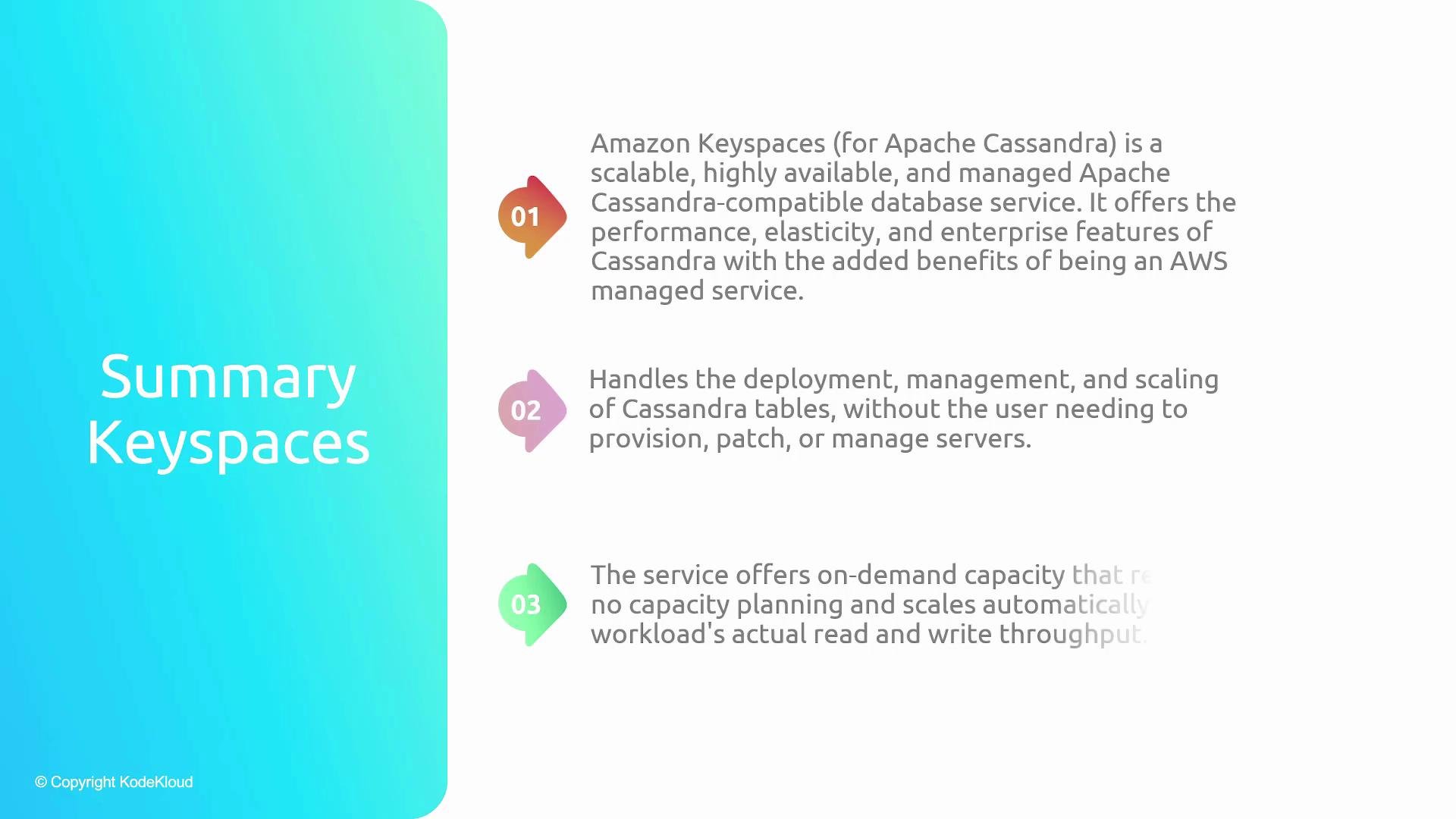
Amazon Keyspaces is a fully managed, Cassandra-compatible, serverless database service that reduces operational complexity while preserving the familiar CQL interface. Choose on-demand capacity for unpredictable traffic and provisioned capacity (with auto scaling) for steady, predictable workloads. Multi-region active-active tables provide global reads and writes with low latency and built-in conflict resolution, while the service handles security, replication, TTL, and monitoring for you.
Key features (quick reference)
| Feature | Description |
| -------------------------- | ---------------------------------------------------------------------------- |
| CQL & driver compatibility | Use existing Cassandra drivers and CQL tools (cqlsh, DataStax drivers). |
| Serverless scaling | On-demand mode scales automatically; provisioned mode supports auto scaling. |
| Multi-AZ HA | Data is replicated across Availability Zones for availability. |
| Multi-region replication | Active-active global tables with storage-based replication. |
| Security & compliance | Encryption at rest/in transit, IAM integration, and VPC endpoints. |
| Managed TTL & backups | Automatic TTL handling and AWS-managed backups/retention. |
Summary
Amazon Keyspaces is a fully managed, Cassandra-compatible, serverless database service that reduces operational complexity while preserving the familiar CQL interface. Choose on-demand capacity for unpredictable traffic and provisioned capacity (with auto scaling) for steady, predictable workloads. Multi-region active-active tables provide global reads and writes with low latency and built-in conflict resolution, while the service handles security, replication, TTL, and monitoring for you.
 Further reading and references
* Amazon Keyspaces (for Apache Cassandra) — [https://aws.amazon.com/keyspaces/](https://aws.amazon.com/keyspaces/)
* Cassandra Query Language (CQL) — [https://cassandra.apache.org/doc/latest/cql/](https://cassandra.apache.org/doc/latest/cql/)
* Cassandra drivers — [https://cassandra.apache.org/doc/latest/drivers/](https://cassandra.apache.org/doc/latest/drivers/)
Further reading and references
* Amazon Keyspaces (for Apache Cassandra) — [https://aws.amazon.com/keyspaces/](https://aws.amazon.com/keyspaces/)
* Cassandra Query Language (CQL) — [https://cassandra.apache.org/doc/latest/cql/](https://cassandra.apache.org/doc/latest/cql/)
* Cassandra drivers — [https://cassandra.apache.org/doc/latest/drivers/](https://cassandra.apache.org/doc/latest/drivers/)