

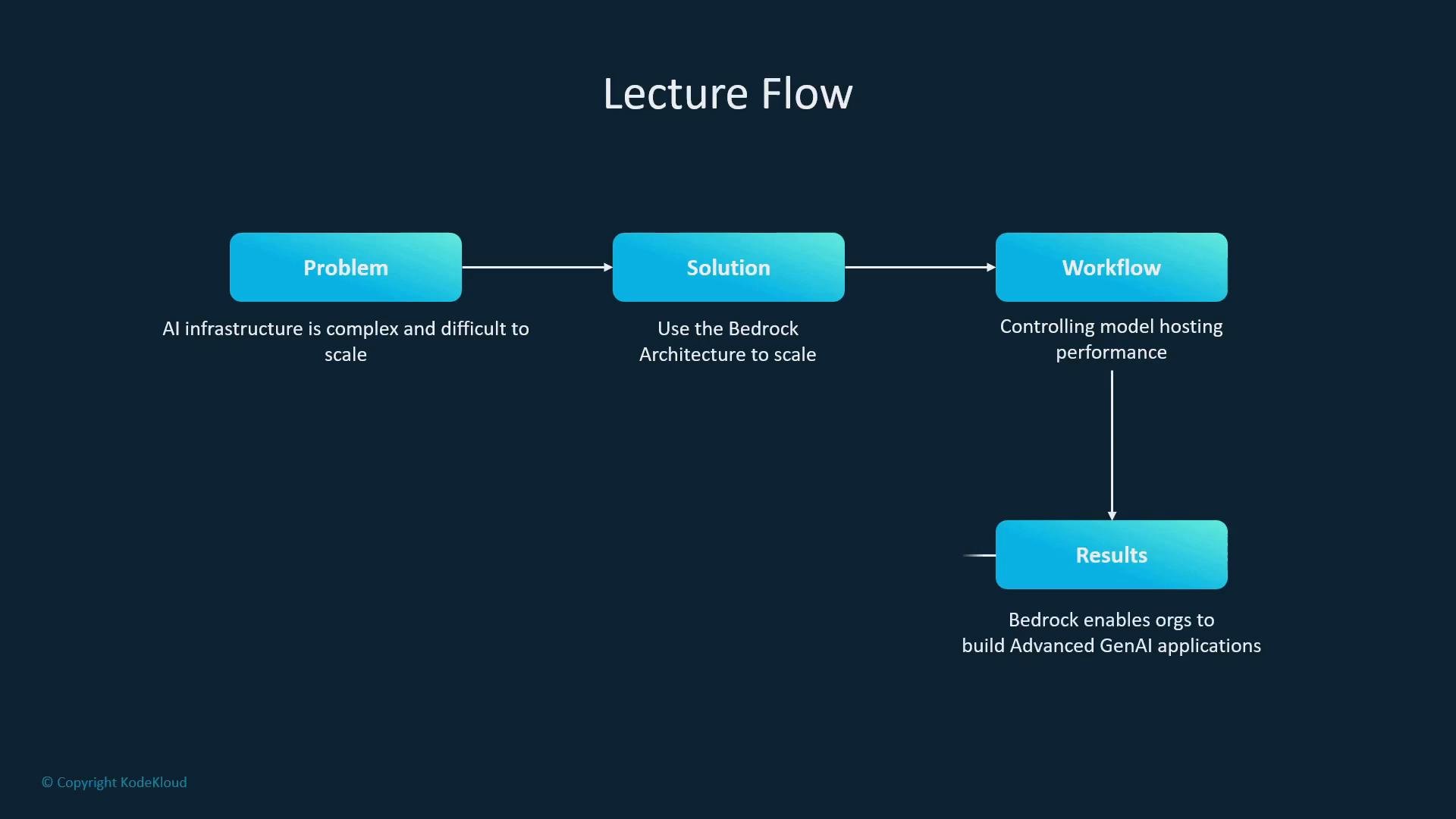
- Define the real-world challenges of running and scaling generative AI models in production.
- Describe the Bedrock solution and the typical request flow for invoking a foundation model.
- Clarify what Bedrock manages vs. what you must implement.
- Summarize key operational responsibilities and next steps for deeper study.
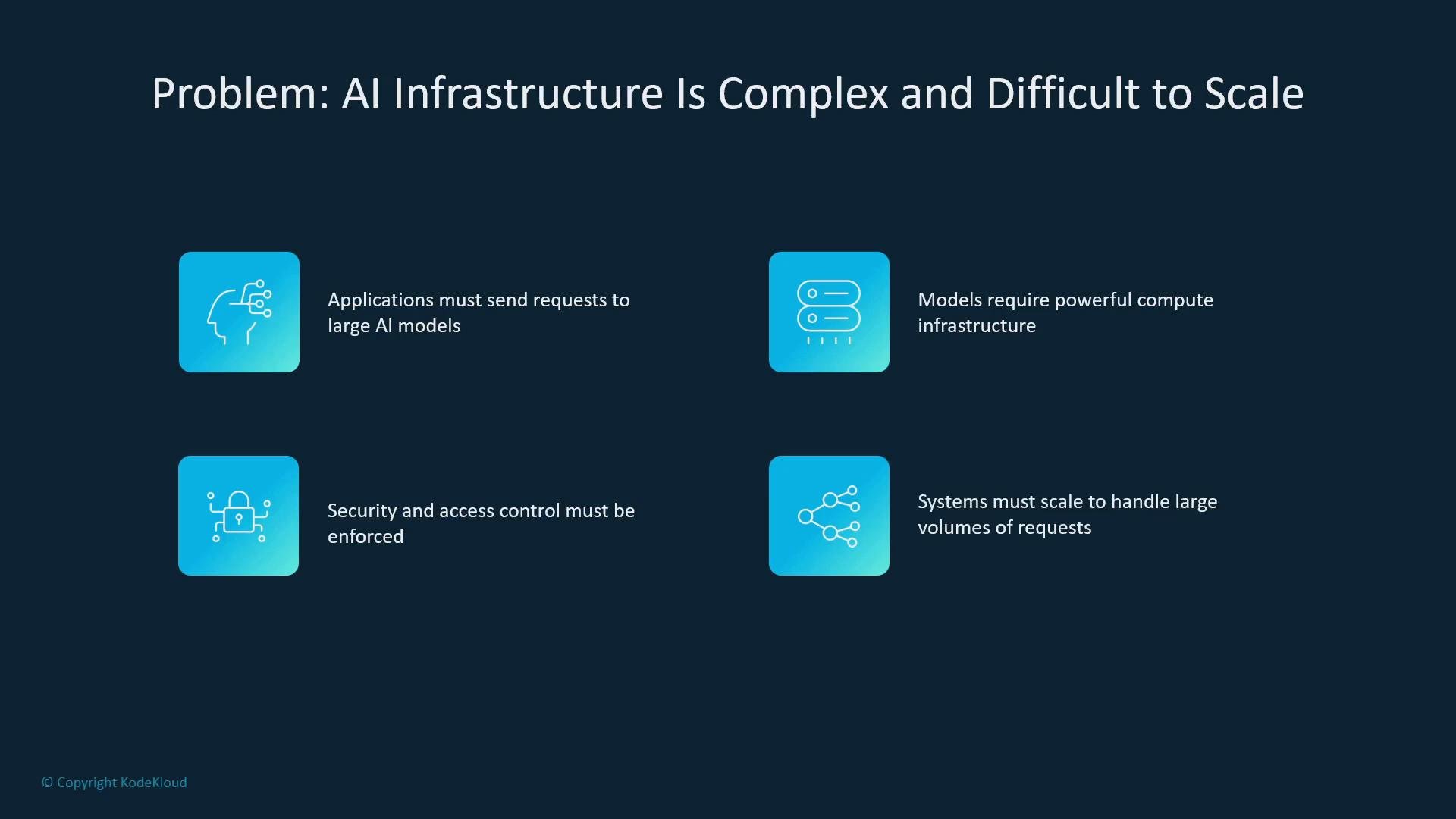
- Security and access control: Ensure only authorized clients can call models.
- Scalability: Handle spikes in concurrent users without sacrificing latency.
- Observability: Monitor latency, request success/error rates, and model output issues (e.g., truncation).
- Safety and content control: Prevent disallowed content and enforce compliance policies.
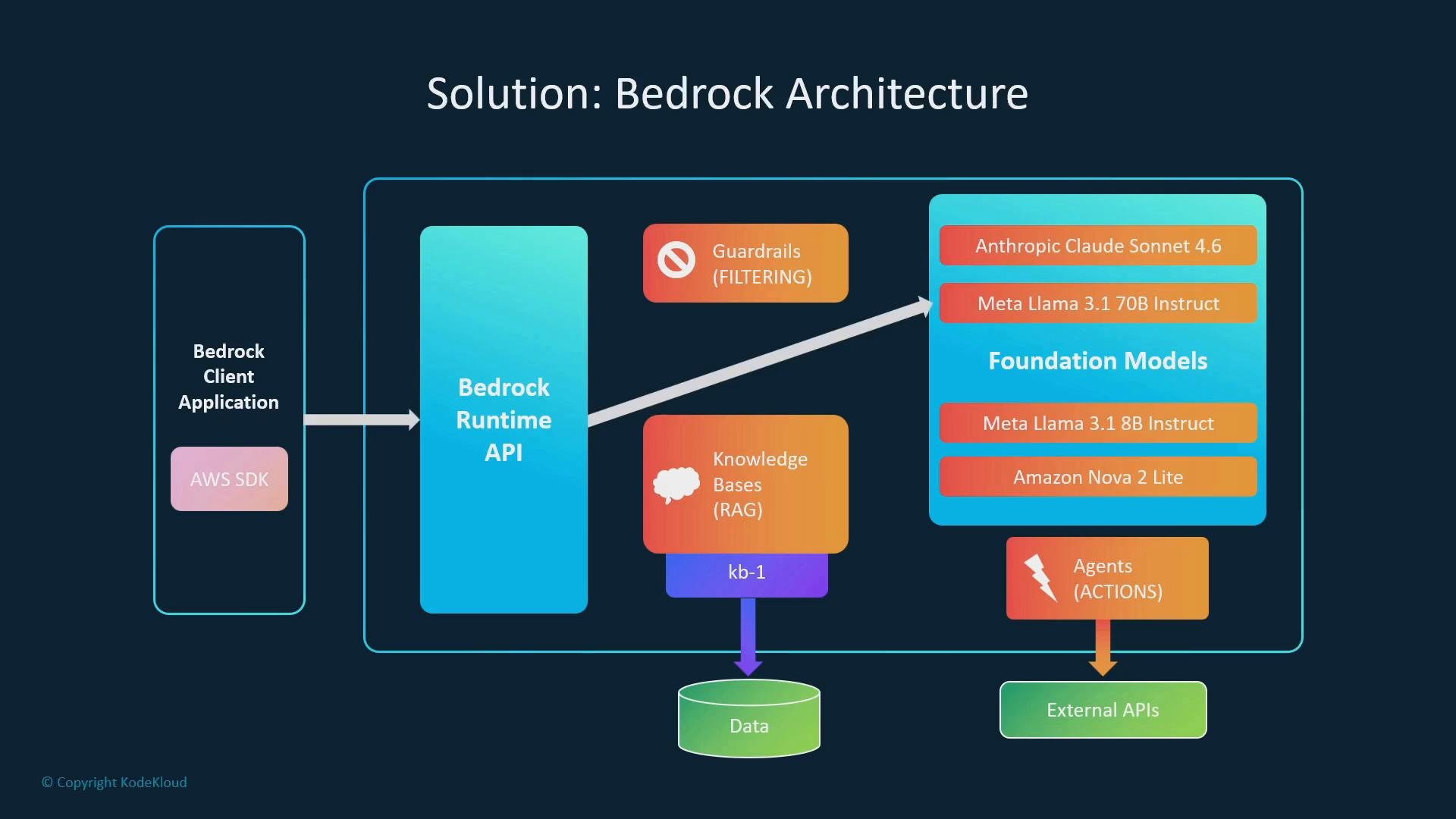
- Model hosting and lifecycle management (no VM provisioning).
- Regional availability and scaling infrastructure.
- Integration points with AWS services (IAM, CloudWatch, Lambda).
- Initialize an AWS SDK client in your application (for example, the AWS SDK for Python).
- Call the Bedrock Runtime invocation method and specify the target model and the prompt.
- Bedrock routes the request to the hosted foundation model in the chosen AWS Region and returns the model output.
Use the AWS SDK for your preferred language for authentication, retries, and regional configuration. The example above is illustrative — check the latest AWS SDK docs for exact client and method names.
- Guardrails: Configurable runtime checks to block or transform requests and responses to meet safety and compliance requirements.
- Knowledge bases and RAG (retrieval-augmented generation): Run semantic search against your private data and include retrieved snippets in the model prompt to reduce hallucinations and improve factuality.
- Agents: Allow models to call external tools or services (APIs, databases, or AWS Lambda functions) to retrieve live data or perform actions during a session.
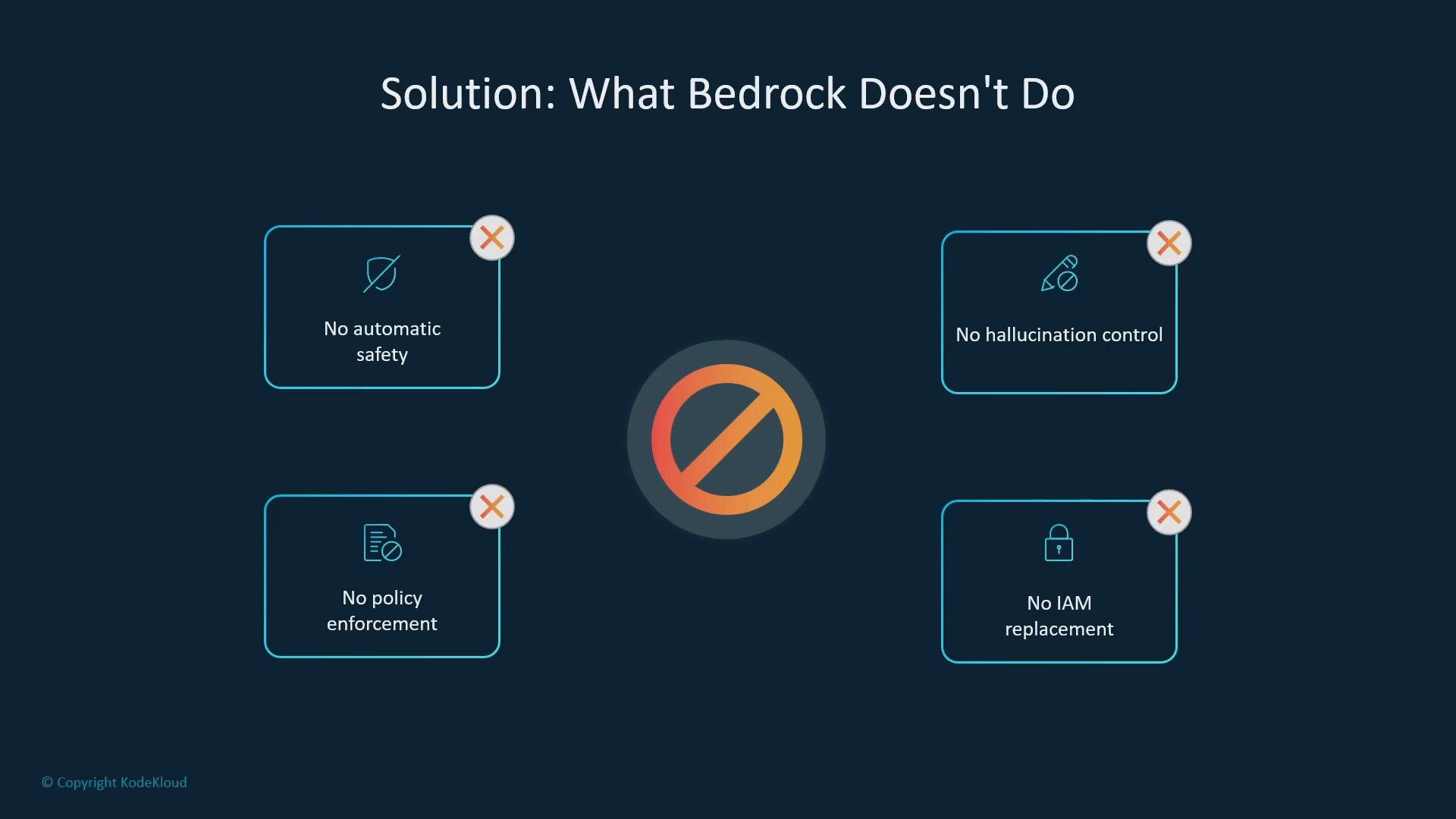
- Perform automatic content safety filtering or sanitization.
- Detect or correct model hallucinations.
- Replace custom policy needs beyond AWS IAM.
- Implement application-specific monitoring or alerting logic beyond standard metrics.
Best practices and operational notes
- Access control: Apply the principle of least privilege using
IAMroles and policies. Limit which principals and services can call specific models. - Logging: Decide what to log (prompts, responses, metadata) based on your privacy and compliance requirements.
- Observability: Capture latency, throughput, error rates, and model-specific signals. Integrate with CloudWatch and set up alerts for anomalies.
- Safety: Use Guardrails or build pre/post filters to enforce corporate policies (profanity filters, PII redaction, blocked topics).
- Agents and tooling: When enabling agents, secure the tools they invoke (API keys, VPC access, Lambda permissions) and audit those calls.
Models can generate incorrect or disallowed content. Treat model outputs as probabilistic — design verification, fallbacks, or human review into critical workflows.
- Run a semantic search against a Bedrock Knowledge Base to retrieve relevant documents/snippets.
- Include the retrieved context in the prompt sent to the foundation model.
- Optionally log the retrieval and the model response for traceability and auditing.
IAM, CloudWatch, and Lambda. Optional features like Guardrails, Knowledge Bases (RAG), and Agents help you build safer, more grounded, and more capable GenAI applications. However, Bedrock does not automatically enforce safety, prevent hallucinations, or replace IAM-based access control — those responsibilities remain with your team.
Recommended follow-ups
- Explore Guardrails configurations to implement runtime safety policies.
- Build a sample RAG flow using Bedrock Knowledge Bases to reduce hallucinations.
- Design IAM policies and CloudWatch dashboards for production readiness.