> ## Documentation Index
> Fetch the complete documentation index at: https://notes.kodekloud.com/llms.txt
> Use this file to discover all available pages before exploring further.
# Defining the Agentic Future in DevOps
> This article examines the integration of AI agents in DevOps workflows, enhancing automation, reliability, and collaboration within Kubernetes environments.
Artificial intelligence (AI) is evolving from a passive helper to an active collaborator in DevOps workflows. By embedding autonomous, self-learning agents within Kubernetes clusters, cloud environments, and CI/CD pipelines, organizations can accelerate deployments, improve system reliability, and tailor infrastructure at scale. This article examines how different AI agent architectures integrate with Kubernetes engineering and redefines the roles and processes in modern DevOps.
## Types of AI Agents
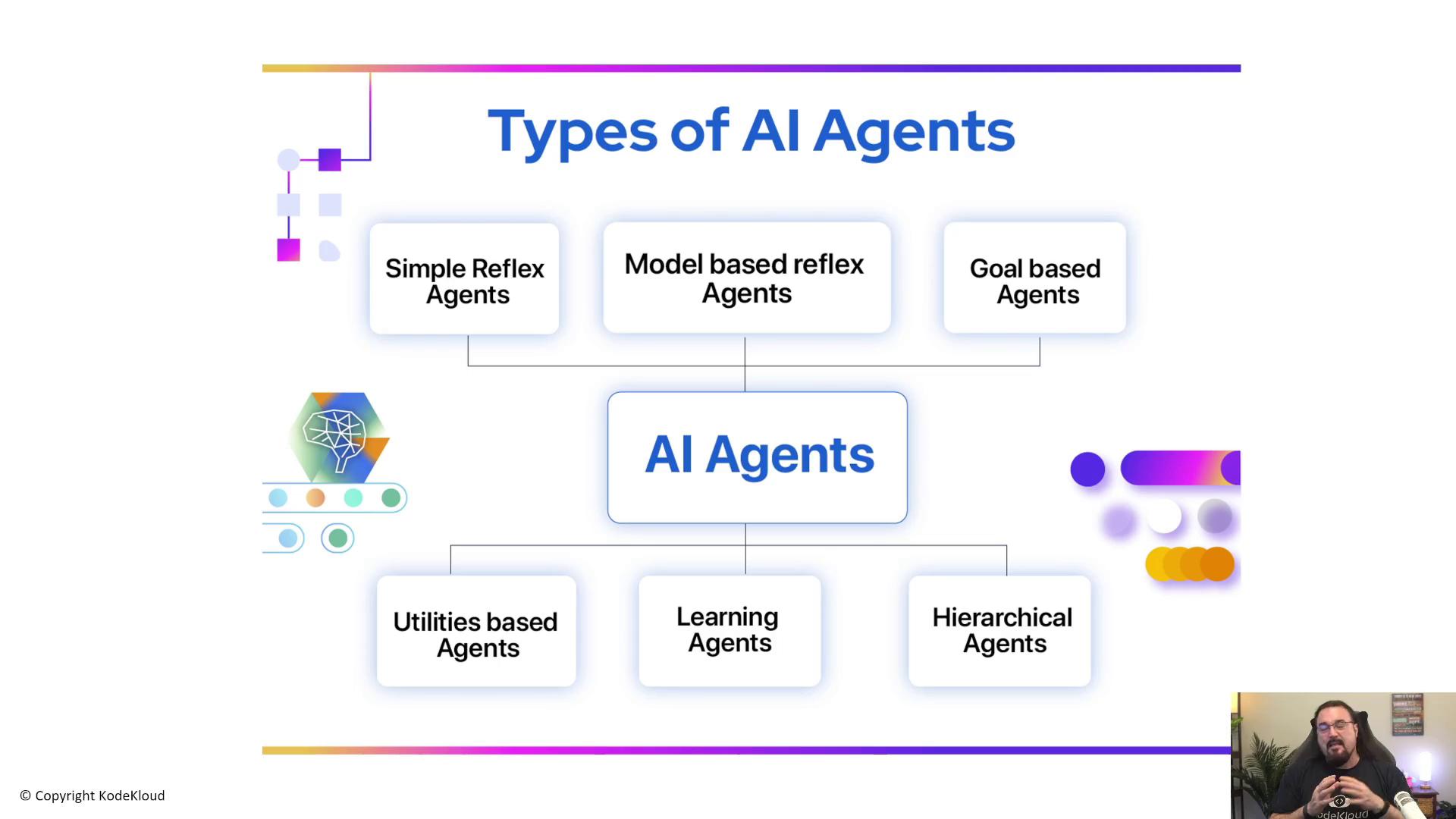
Below is an overview of the main AI agent categories and their Kubernetes applications:
| Agent Type | Key Characteristic | Kubernetes Use Case |
| ------------------ | ------------------------------------------ | --------------------------------------------------------- |
| Simple Reflex | Rule-based actions based on current inputs | Auto-restart failed pods or trigger alerts |
| Model-Based Reflex | Maintains internal state model | Enhanced liveness probes with context-aware decisions |
| Goal-Based | Plans steps to meet defined objectives | Autoscale replicas to hit CPU/memory/latency targets |
| Utility-Based | Optimizes for maximum overall utility | Balances pod placement for cost, latency, and throughput |
| Learning | Adapts from feedback and experience | Detects anomalies by learning performance baselines |
| Hierarchical | Coordinates multi-layer decision-making | Orchestrates infra provisioning, network, and deployments |
### 1. Simple Reflex Agents
Simple reflex agents execute predefined rules triggered by environmental inputs. In Kubernetes, these agents can automatically restart a pod that fails or notify engineers when thresholds are breached. They require no historical context or learning capability.
### 2. Model-Based Reflex Agents
Model-based agents keep an internal representation of cluster state. They can differentiate between transient slowdowns and genuine failures—acting as intelligent liveness probes that understand typical startup patterns.
### 3. Goal-Based Agents
Goal-based agents plan a sequence of actions to achieve specific objectives. For example, a Kubernetes goal-based agent can adjust pod counts or node affinity to meet performance targets, such as low latency or resource utilization limits.
### 4. Utility-Based Agents
Utility-based agents evaluate possible outcomes to maximize a utility function. In DevOps, they optimize pod scheduling by weighing resource usage, inter-service latency, and cloud costs to deliver efficient and cost-effective cluster configurations.
### 5. Learning Agents
Learning agents continuously refine their behavior based on feedback. A Kubernetes learning agent might analyze logs and metrics over time, detecting anomalies and alerting you only when deviations from learned baselines occur.
### 6. Hierarchical Agents
Hierarchical agents manage decisions across multiple layers—from low-level container health checks to high-level infrastructure provisioning. They coordinate tasks like networking, storage, and application deployment to ensure cohesive system operation.
***
## Key Features of Agentic DevOps
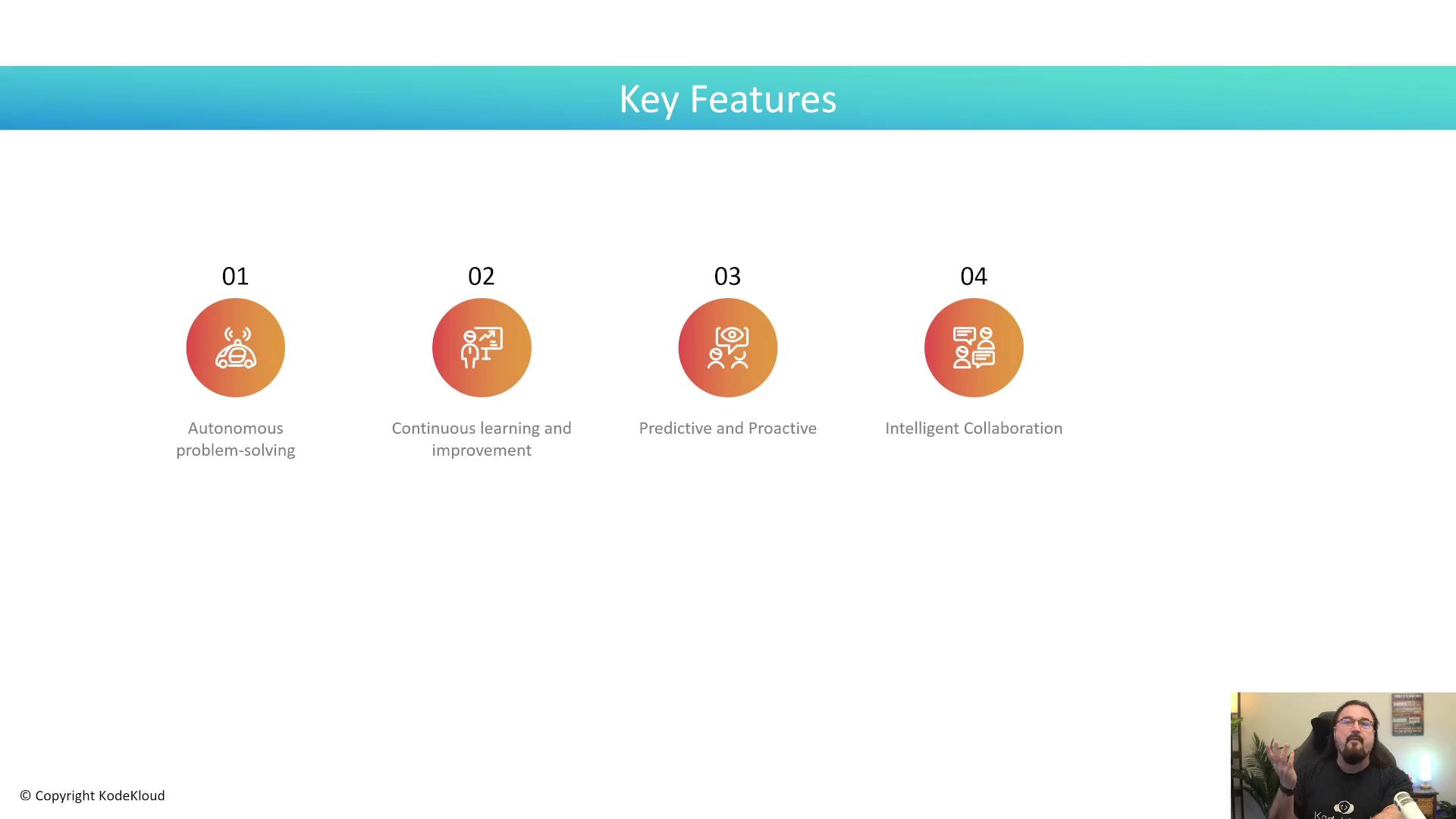
1. **Autonomous Problem-Solving**\
AI agents identify and resolve issues—root cause analysis, remediation, and escalation—without manual intervention.
2. **Continuous Learning & Improvement**\
Agents build and update a knowledge base from system telemetry and user feedback, sharpening best practices over time.
3. **Predictive & Proactive**\
By analyzing logs and metrics in real time, agents forecast failures and remediate before outages occur.
4. **Intelligent Collaboration**\
Agents can generate insights, propose experiments, or request policy updates through chat interfaces, maintaining an interactive dialogue with engineers.
5. **Cross-System Optimization**\
Viewing the CI/CD pipeline as an interconnected ecosystem, agents optimize repository workflows, build jobs, artifact storage, test suites, and multi-environment rollouts simultaneously.
To achieve optimal results, configure agents with clear policies, performance budgets, and rollback strategies.
***
## Impact on DevOps Roles and Processes
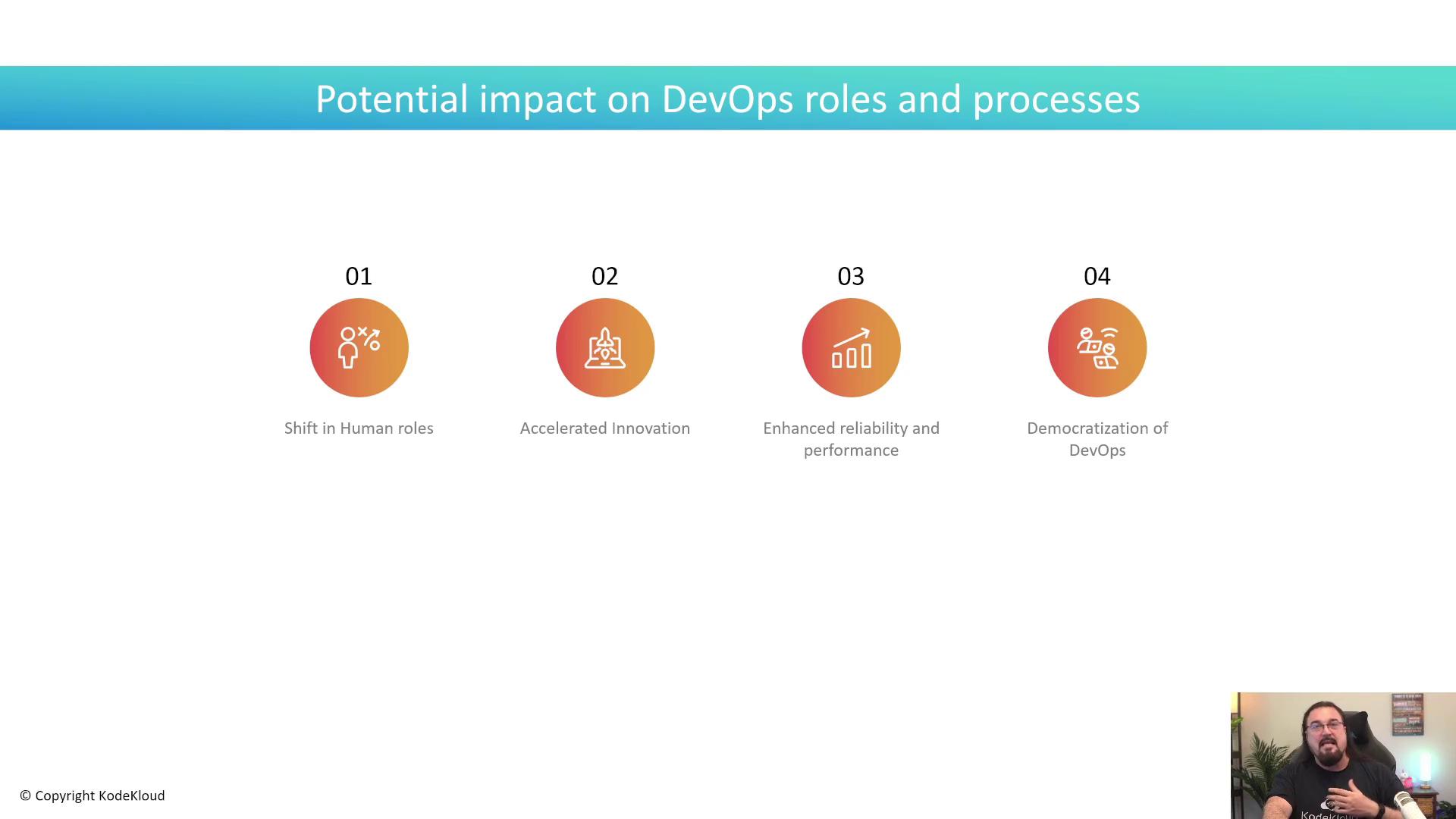
1. **Evolving Human Roles**\
Engineers shift from routine operational tasks to defining guardrails, policies, and training AI agents to handle complex edge cases.
2. **Accelerated Innovation**\
With automation handling repetitive tasks, teams can focus on high-value features and rapid iteration of applications and infrastructure.
3. **Enhanced Reliability & Performance**\
Continuous, data-driven optimizations reduce manual errors, improving uptime, scalability, and cost efficiency.
4. **Democratization of DevOps**\
Sophisticated agents lower the barrier to entry—empowering newcomers to manage large-scale environments while experts tackle strategic initiatives.
AI agents should operate under human oversight with clear approval workflows to prevent unintended system changes.
***
## Links and References
* [Kubernetes Basics](https://kubernetes.io/docs/concepts/overview/what-is-kubernetes/)
* [CI/CD Concepts](https://en.wikipedia.org/wiki/CI/CD)
* [Terraform Registry](https://registry.terraform.io/)
* [Docker Hub](https://hub.docker.com/)
As AI agents evolve from simple reflex systems to hierarchical orchestrators, the DevOps landscape will become increasingly autonomous, predictive, and collaborative—reshaping how teams architect, deploy, and manage robust cloud-native environments.