> ## Documentation Index
> Fetch the complete documentation index at: https://notes.kodekloud.com/llms.txt
> Use this file to discover all available pages before exploring further.
# Integrating Multimodal Inputs in Generative AI
> This article explains how generative AI models integrate multiple data types to create richer, context-aware outputs through various techniques and applications.
In this lesson, you’ll learn how generative AI models process and synthesize multiple data types—text, images, charts, audio, and video—to deliver richer, context-aware outputs. We’ll cover:
* Defining multimodal inputs
* Core integration techniques
* Key applications and examples
* Challenges and best practices
* Future directions
***
## 1. Overview of a Multimodal AI Model
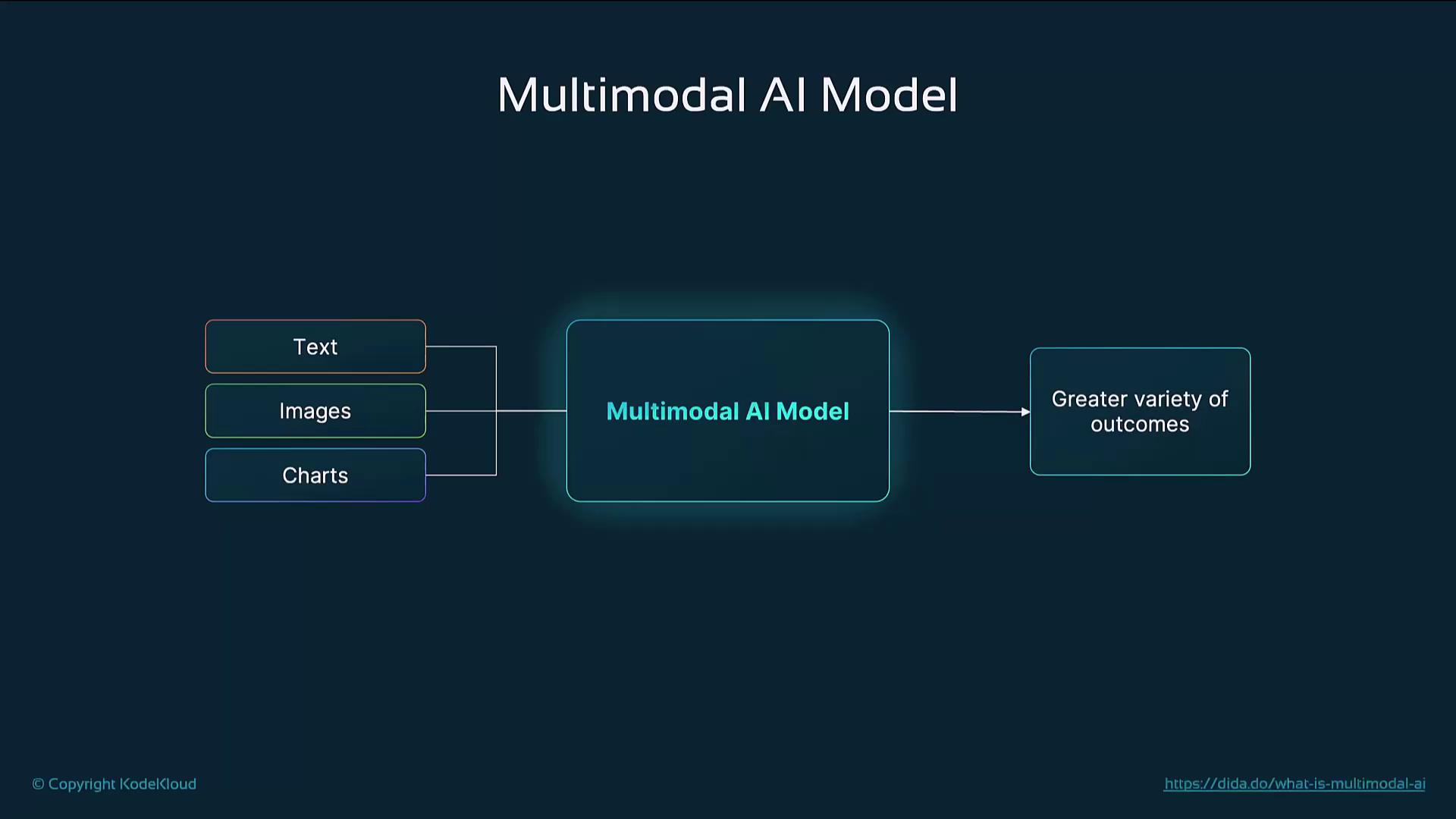
The diagram below shows how a multimodal AI model ingests text, images, and charts, then fuses them into a unified representation to power diverse outcomes—answers to complex questions, mixed-media content, and detailed insights.
***
## 2. What Are Multimodal Inputs?
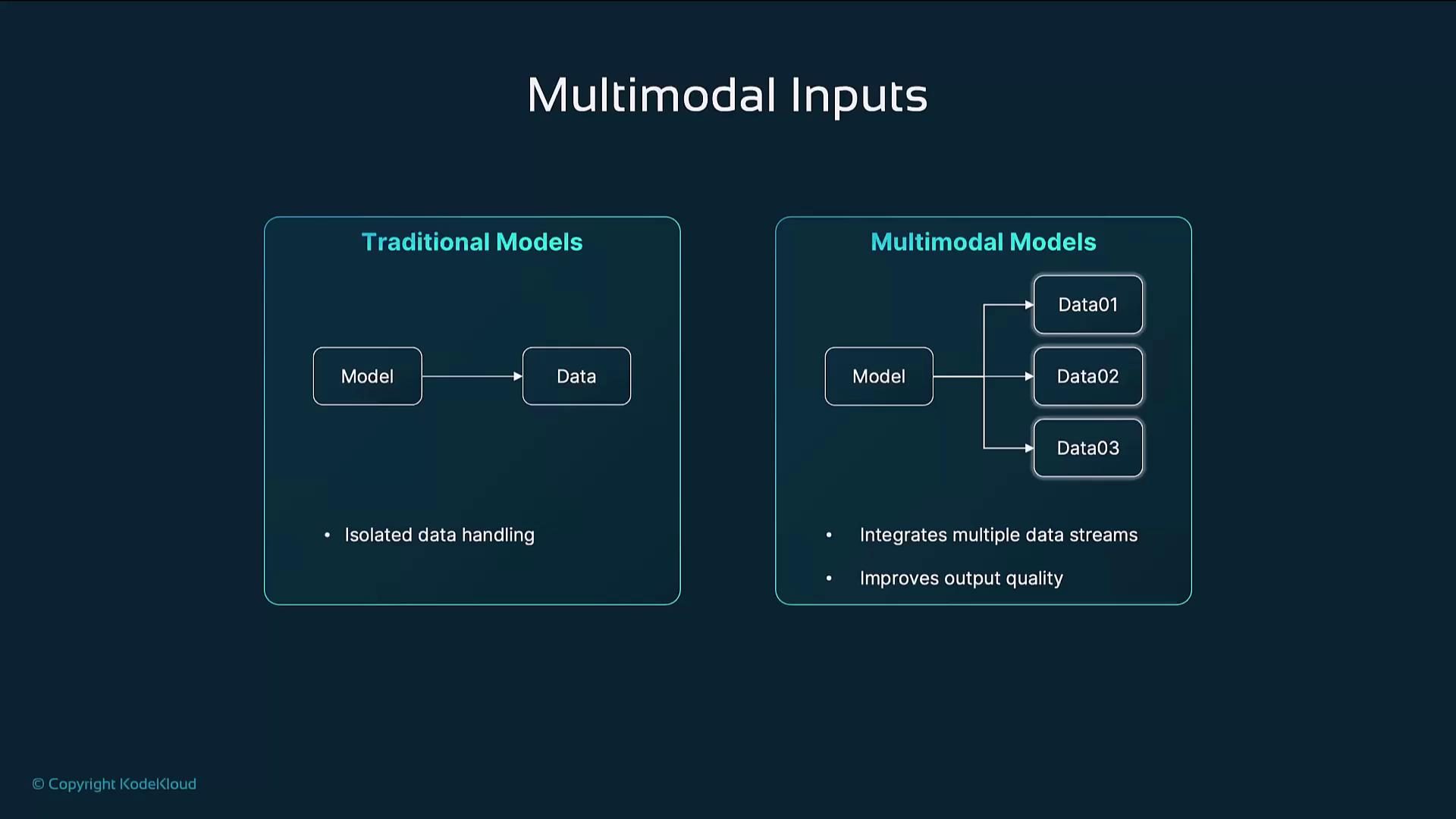
Multimodal inputs combine distinct data streams—text, images, audio, and video—into a single AI pipeline. Unlike single‐modality models that learn from one data type at a time, multimodal models leverage cross-modal relationships to generate more meaningful, context‐rich outputs.
For example, given an image of a dog and the prompt “a dog playing fetch,” a multimodal model can produce:
* A vivid narrative describing the scene
* An enhanced or stylized version of the image
* A brief animation simulating the dog’s play
Below is a visual comparison of single‐modality versus multimodal architectures:
***
## 3. Techniques for Integrating Multimodal Inputs
### 3.1 Shared Embedding Space
Map each modality into a common vector space so that semantic features align across data types. For instance, CLIP encodes text descriptions and images into the same embedding space, enabling tasks like text-to-image retrieval or zero-shot classification.
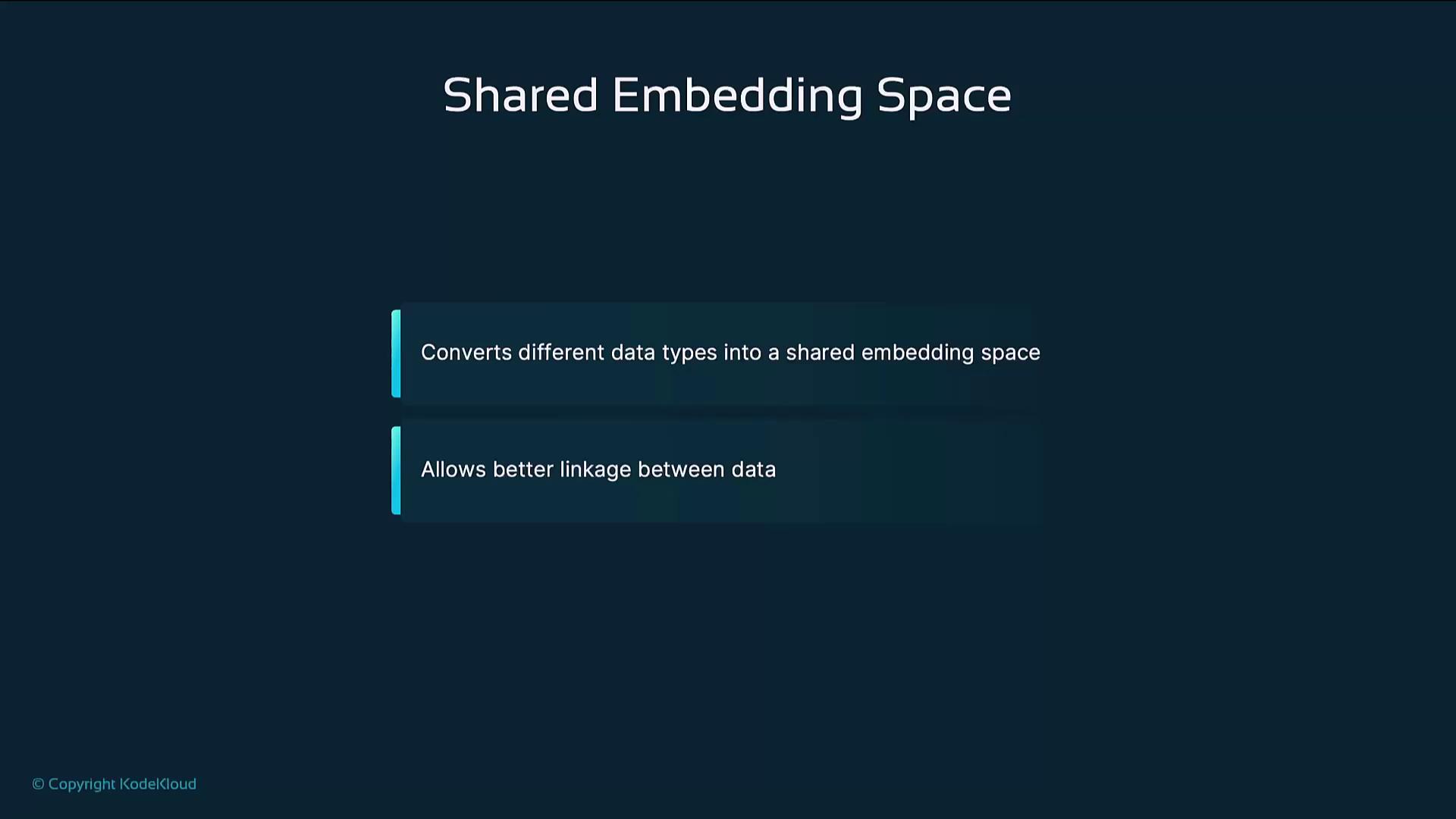
A well-designed shared embedding space ensures that similar concepts—across words and pixels—occupy nearby positions, improving retrieval and generation tasks.
### 3.2 Cross-Attention Mechanisms
Cross-attention layers let the model highlight relevant segments in one modality while processing another. In image captioning, the text generator “attends” to critical image regions. DALL·E uses cross-attention to align prompts like “a two-story house shaped like a shoe” with the correct visual features during synthesis.
### 3.3 Multimodal Transformers
Extend transformer architectures by assigning separate encoders for each modality, then fuse their outputs into a joint representation. Models like VisualGPT or Flamingo ingest text alongside images to generate captions, stories, or even novel visuals.

***
## 4. Applications of Multimodal Generative AI
| Application | Description | Example Model |
| ------------------------------- | ------------------------------------------------------------------------------------------------ | ----------------- |
| Text-to-Image Generation | Converts textual prompts into high-quality images by linking semantic embeddings with pixels. | DALL·E |
| Video Generation | Produces animated sequences from a static image plus text, adding motion and narrative context. | vid2vid variants |
| Visual Question Answering (VQA) | Answers user queries by interpreting images or videos in tandem with natural language questions. | VQA systems |
| Multimodal Virtual Assistance | Combines voice commands and visual inputs (e.g., photos) to perform context-aware tasks. | Smart home agents |
***
## 5. Challenges and Considerations
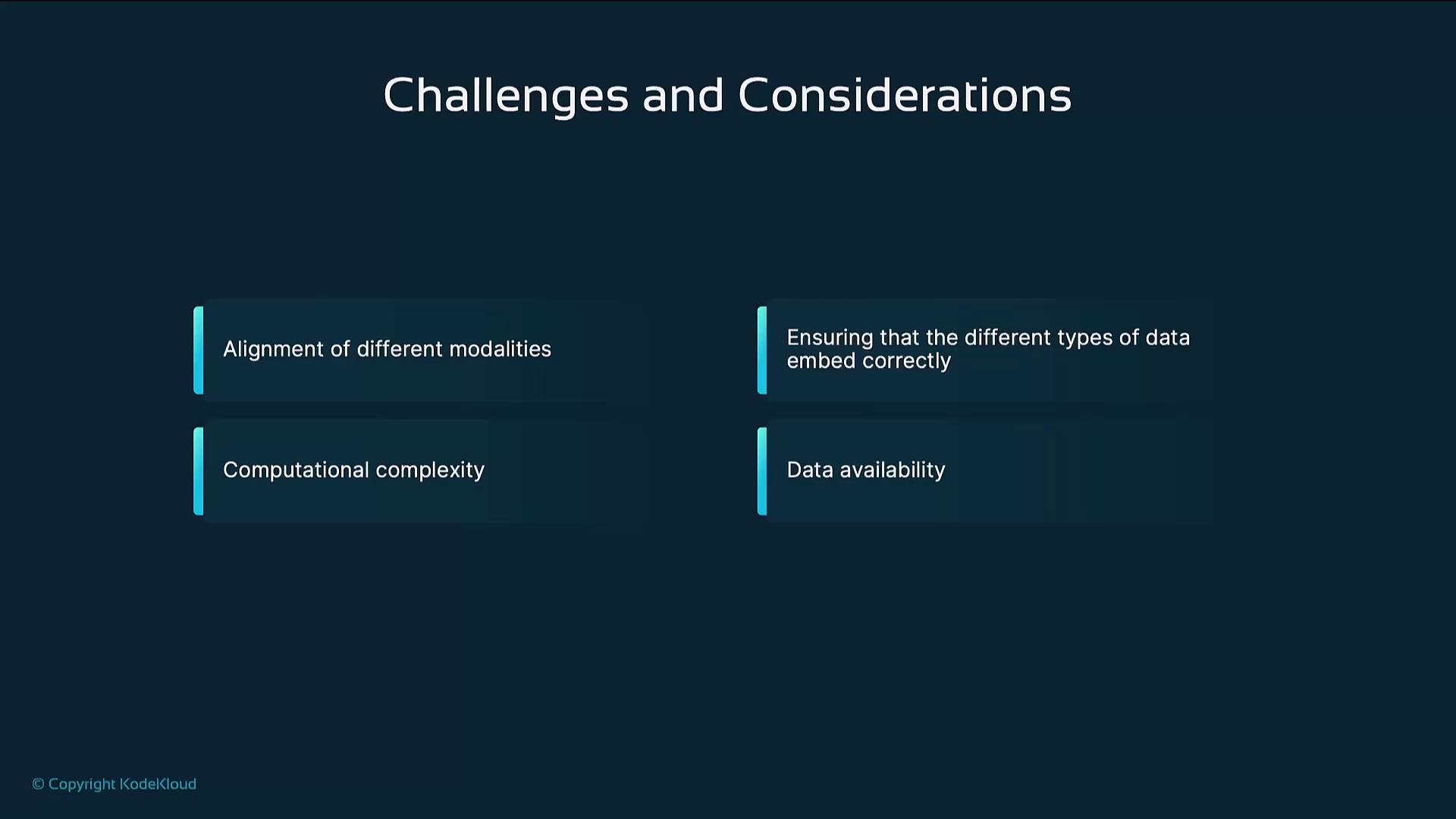
Multimodal integration comes with its own set of hurdles:
* **Alignment of Modalities**\
Synchronizing embeddings across text, images, audio, and video can be complex.
* **Computational Complexity**\
Training and inference on multiple data streams require substantial GPU/TPU resources.
* **Data Availability**\
Building large, well-curated multimodal datasets is time-intensive and expensive.
Insufficient alignment or low-quality data in any modality can degrade overall performance. Ensure balanced, high-fidelity datasets before training.
***
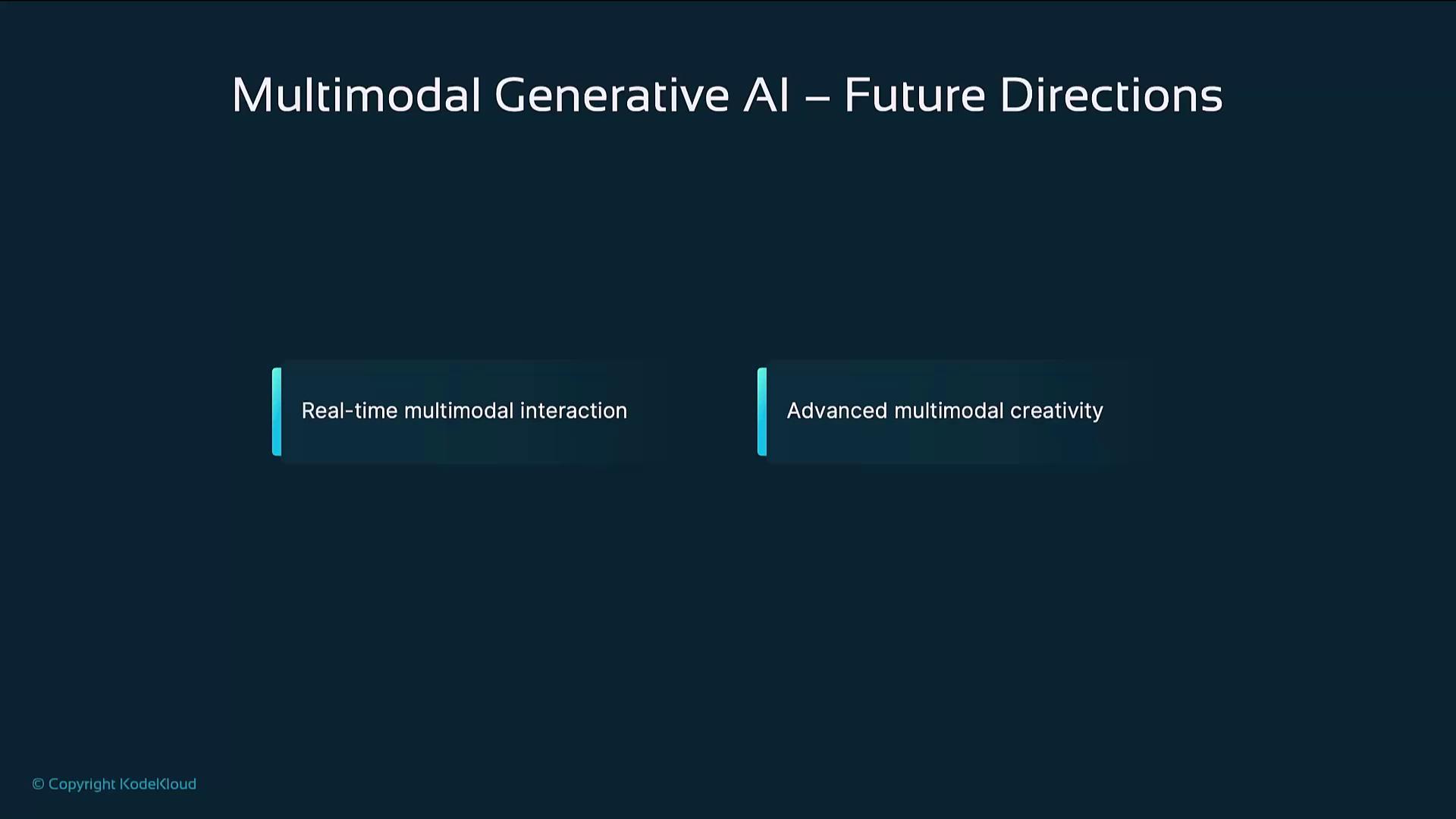
## 6. Future Directions
Research is driving toward more immersive and responsive multimodal experiences:
* **Real-Time Multimodal Interaction**\
Instantaneous responses to combined voice, gesture, and visual cues—ideal for gaming and AR/VR.
* **Advanced Multimodal Creativity**\
Generating fully cohesive artworks that blend text, images, audio, and video into unified narratives.
***
## References
* [OpenAI CLIP](https://openai.com/research/clip)
* [DALL·E](https://openai.com/research/dall-e)
* [vid2vid: High-Resolution Video-to-Video Translation](https://arxiv.org/abs/1808.06601)
* [Flamingo: a Visual Language Model](https://deepmind.com/blog/article/flamingo)