> ## Documentation Index
> Fetch the complete documentation index at: https://notes.kodekloud.com/llms.txt
> Use this file to discover all available pages before exploring further.
# Cons and Limitations of KAgent
> Overview of KAgent limitations, operational requirements, and technical trade-offs for hosting AI agents on Kubernetes, with guidance on suitability and deployment considerations
KAgent is a powerful, Kubernetes-native framework for hosting AI agents, but it is still early in its lifecycle. Below is a concise, structured summary of known constraints, operational trade-offs, and technical considerations to help you assess whether KAgent fits your environment and workloads.
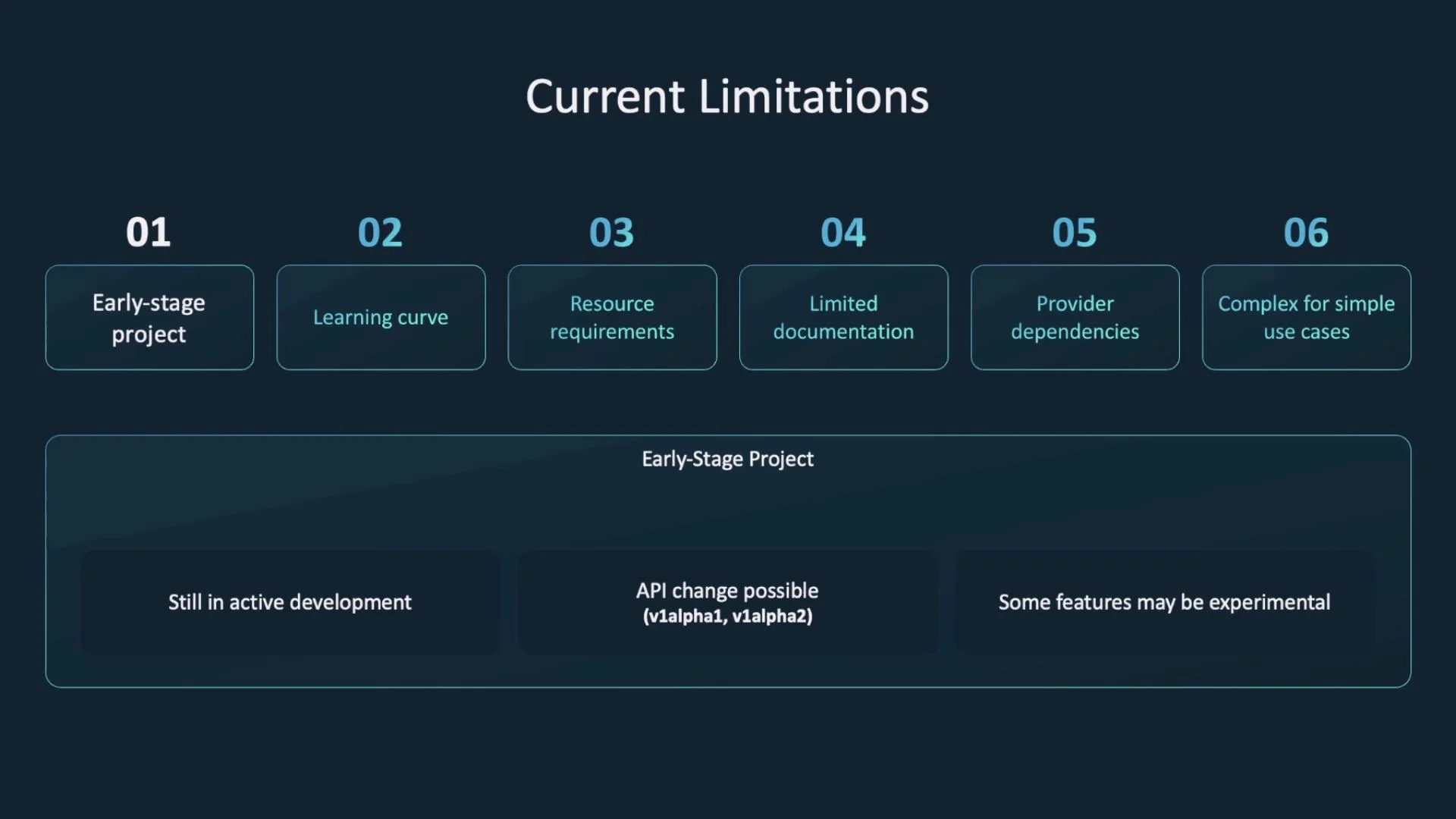
It’s important to note that KAgent is under active development; APIs and features may change between releases. Some capabilities are experimental and might be modified or removed as the project evolves.
 ## Summary of current limitations
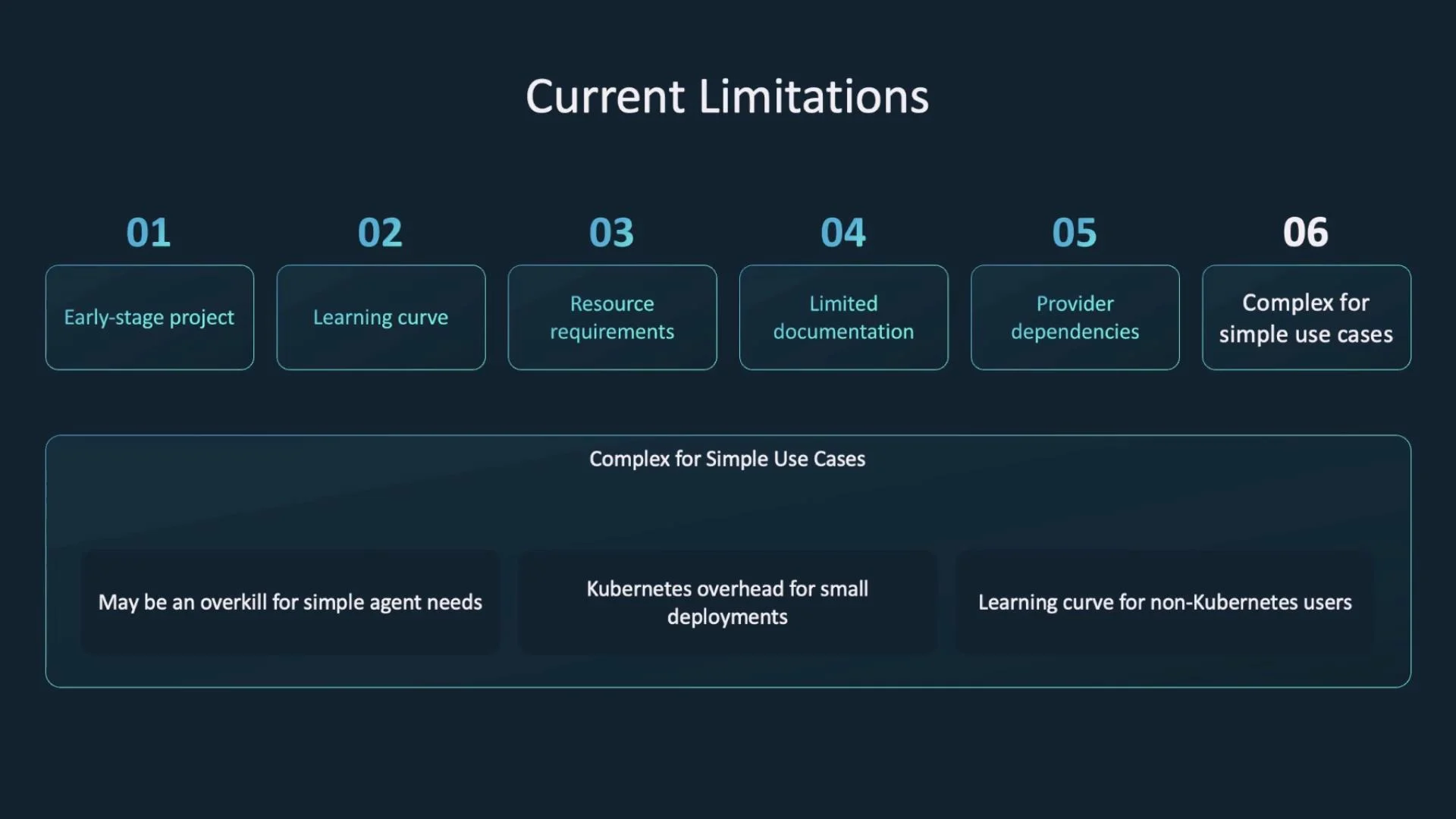
* Early-stage project: Active development and API churn are possible.
* Learning curve: Requires Kubernetes expertise (CRDs, controllers, RBAC).
* Resource requirements: Needs a Kubernetes cluster and controller components.
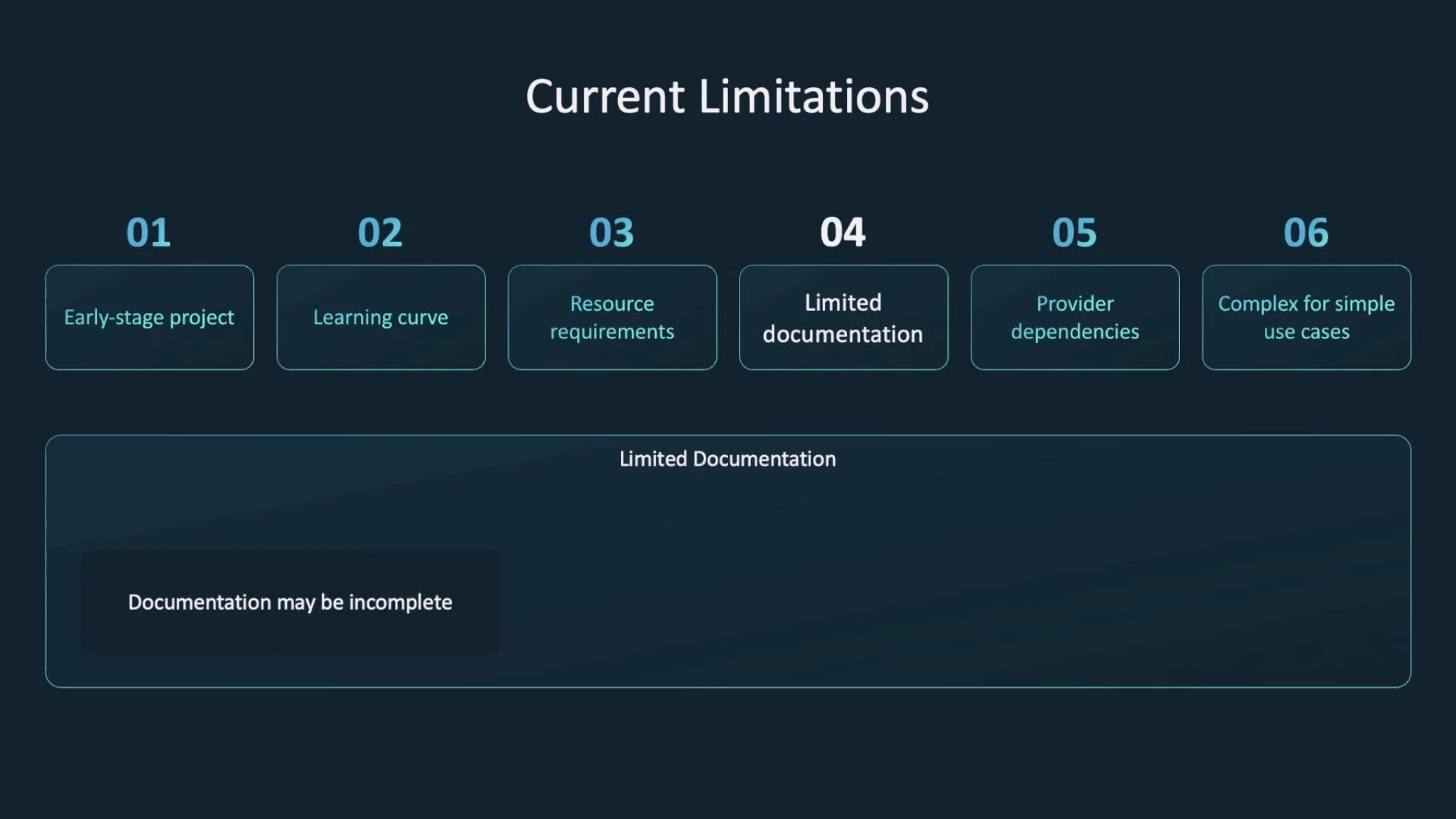
* Documentation: Community-driven, with gaps or outdated examples.
* Provider dependencies: Requires LLM provider API keys and cost management.
* Complexity for simple use cases: Overhead may be high for single-agent needs.
## Learning curve
KAgent is Kubernetes-native and relies on Kubernetes primitives such as CRDs, controllers, and standard tooling patterns. Operating KAgent reliably therefore requires good familiarity with Kubernetes concepts, cluster operations, RBAC, and network policies. Understanding agent design patterns and relevant agent protocols (for example, MCP and other agent standards) will reduce friction when building and integrating agent systems.
## Summary of current limitations
* Early-stage project: Active development and API churn are possible.
* Learning curve: Requires Kubernetes expertise (CRDs, controllers, RBAC).
* Resource requirements: Needs a Kubernetes cluster and controller components.
* Documentation: Community-driven, with gaps or outdated examples.
* Provider dependencies: Requires LLM provider API keys and cost management.
* Complexity for simple use cases: Overhead may be high for single-agent needs.
## Learning curve
KAgent is Kubernetes-native and relies on Kubernetes primitives such as CRDs, controllers, and standard tooling patterns. Operating KAgent reliably therefore requires good familiarity with Kubernetes concepts, cluster operations, RBAC, and network policies. Understanding agent design patterns and relevant agent protocols (for example, MCP and other agent standards) will reduce friction when building and integrating agent systems.
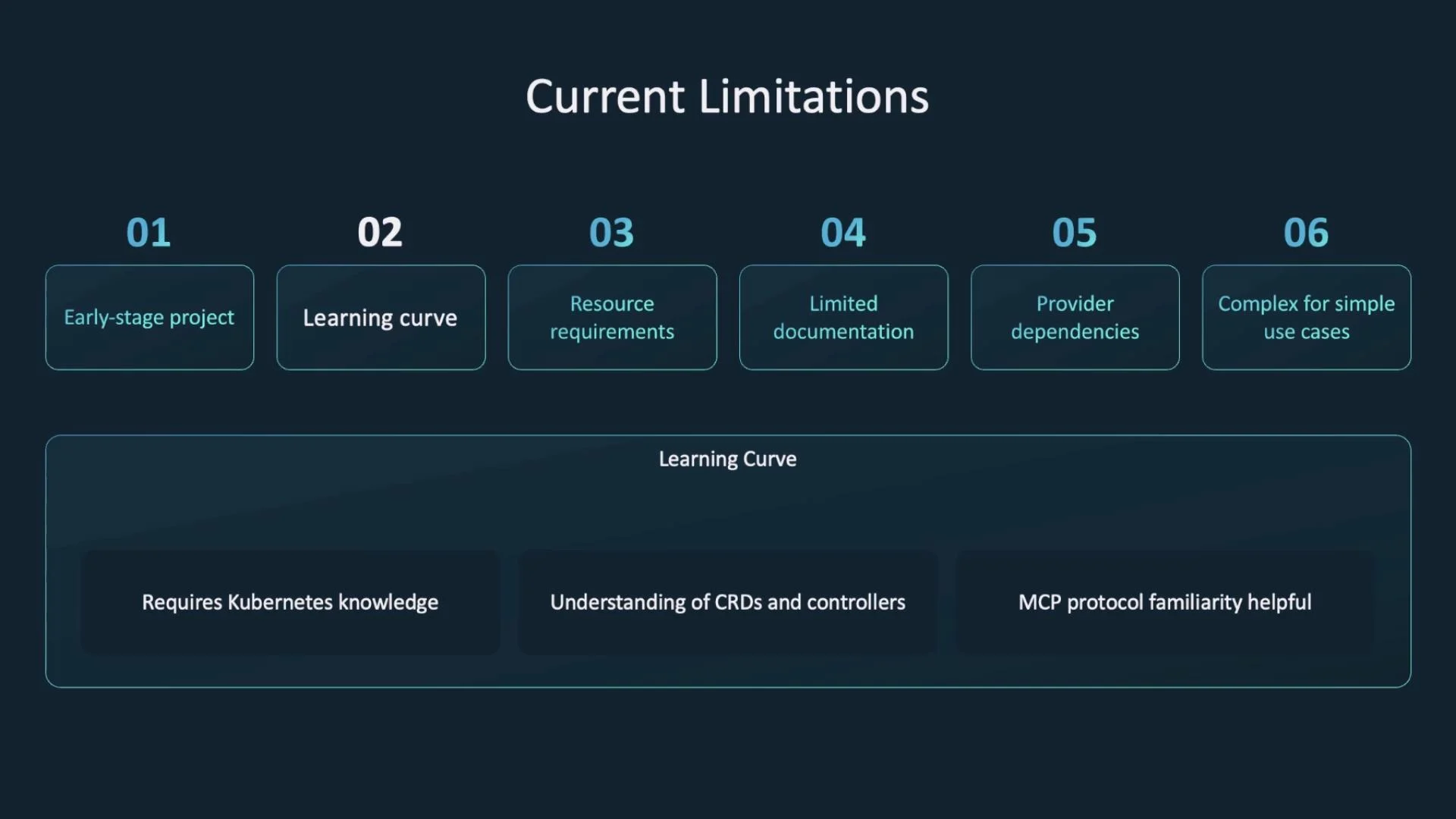 Kubernetes expertise (CRDs, controllers, RBAC, networking) and familiarity with MCP will reduce operational friction. If you lack Kubernetes experience, expect a steeper ramp-up.
## Resource requirements and documentation
KAgent leverages Kubernetes for scheduling, scaling, and lifecycle management. If you do not already operate a cluster, expect additional operational overhead: provisioning, monitoring, backups, upgrades, and running the KAgent controller and supporting components. This adds baseline resource and maintenance costs compared to a standalone single-process agent.
Documentation is community-driven and continues to improve. You may encounter examples that need updates or limited reference material compared with more mature tooling. Plan for validation and testing when following community examples.
Kubernetes expertise (CRDs, controllers, RBAC, networking) and familiarity with MCP will reduce operational friction. If you lack Kubernetes experience, expect a steeper ramp-up.
## Resource requirements and documentation
KAgent leverages Kubernetes for scheduling, scaling, and lifecycle management. If you do not already operate a cluster, expect additional operational overhead: provisioning, monitoring, backups, upgrades, and running the KAgent controller and supporting components. This adds baseline resource and maintenance costs compared to a standalone single-process agent.
Documentation is community-driven and continues to improve. You may encounter examples that need updates or limited reference material compared with more mature tooling. Plan for validation and testing when following community examples.
 ## Provider dependencies
KAgent requires credentials for supported large language model (LLM) providers to make API calls. Operators must manage API keys, monitor usage, control rate limits, and implement cost controls.
## Provider dependencies
KAgent requires credentials for supported large language model (LLM) providers to make API calls. Operators must manage API keys, monitor usage, control rate limits, and implement cost controls.
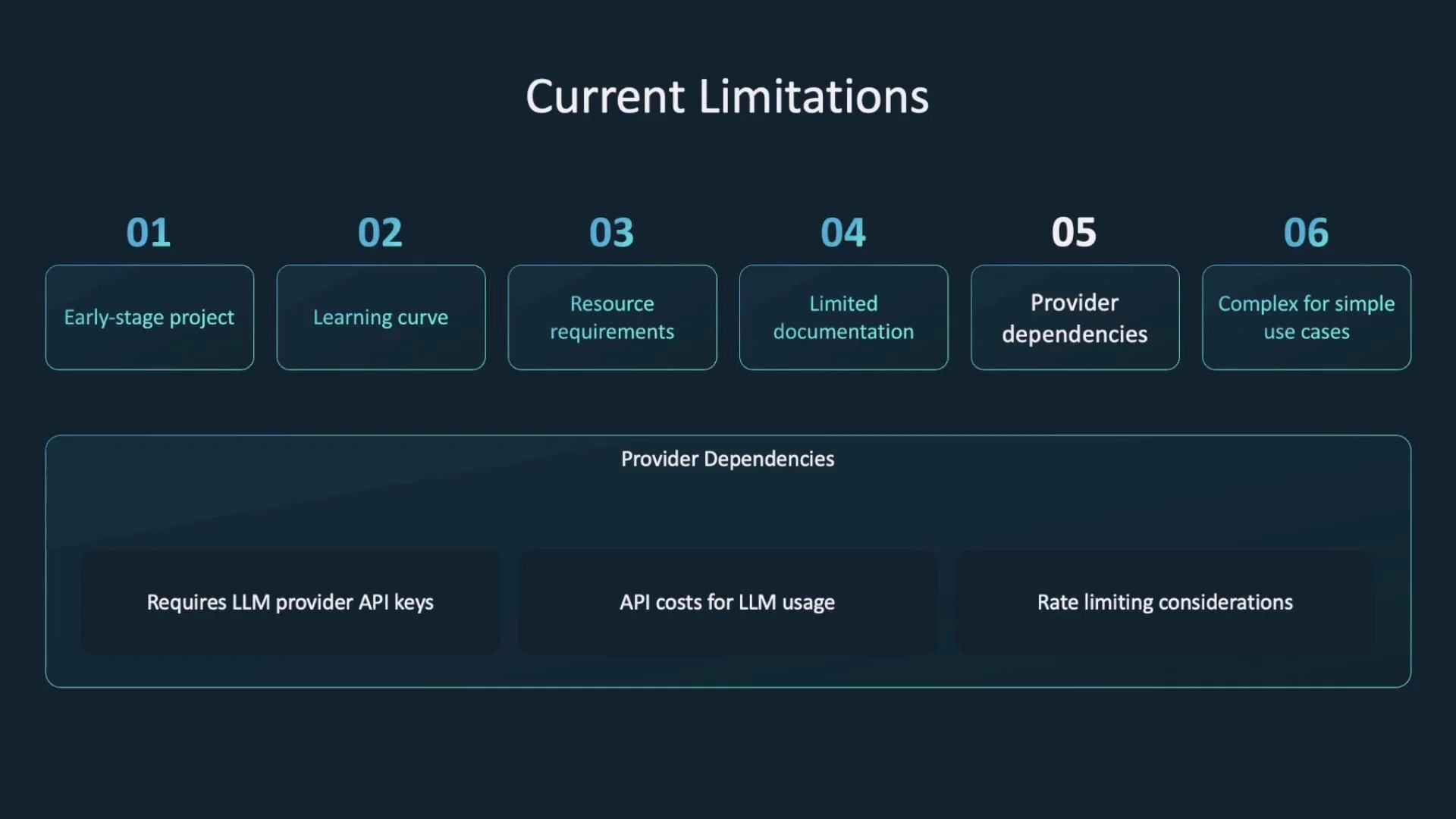 Ensure strict secrets and cost controls. Misconfigured or leaked API keys and unmonitored usage can lead to high costs or security incidents.
## Complexity for simple use cases
For teams that require a single, simple agent or have limited Kubernetes experience, KAgent may introduce more operational overhead than benefit. You will need Kubernetes infrastructure, Helm releases (or similar), CI/CD automation, and observability tooling to manage production deployments. Evaluate whether KAgent’s advantages—scalability, multi-agent orchestration, and built-in observability—justify the investment for your use case.
Ensure strict secrets and cost controls. Misconfigured or leaked API keys and unmonitored usage can lead to high costs or security incidents.
## Complexity for simple use cases
For teams that require a single, simple agent or have limited Kubernetes experience, KAgent may introduce more operational overhead than benefit. You will need Kubernetes infrastructure, Helm releases (or similar), CI/CD automation, and observability tooling to manage production deployments. Evaluate whether KAgent’s advantages—scalability, multi-agent orchestration, and built-in observability—justify the investment for your use case.
 ## Technical considerations
### API stability
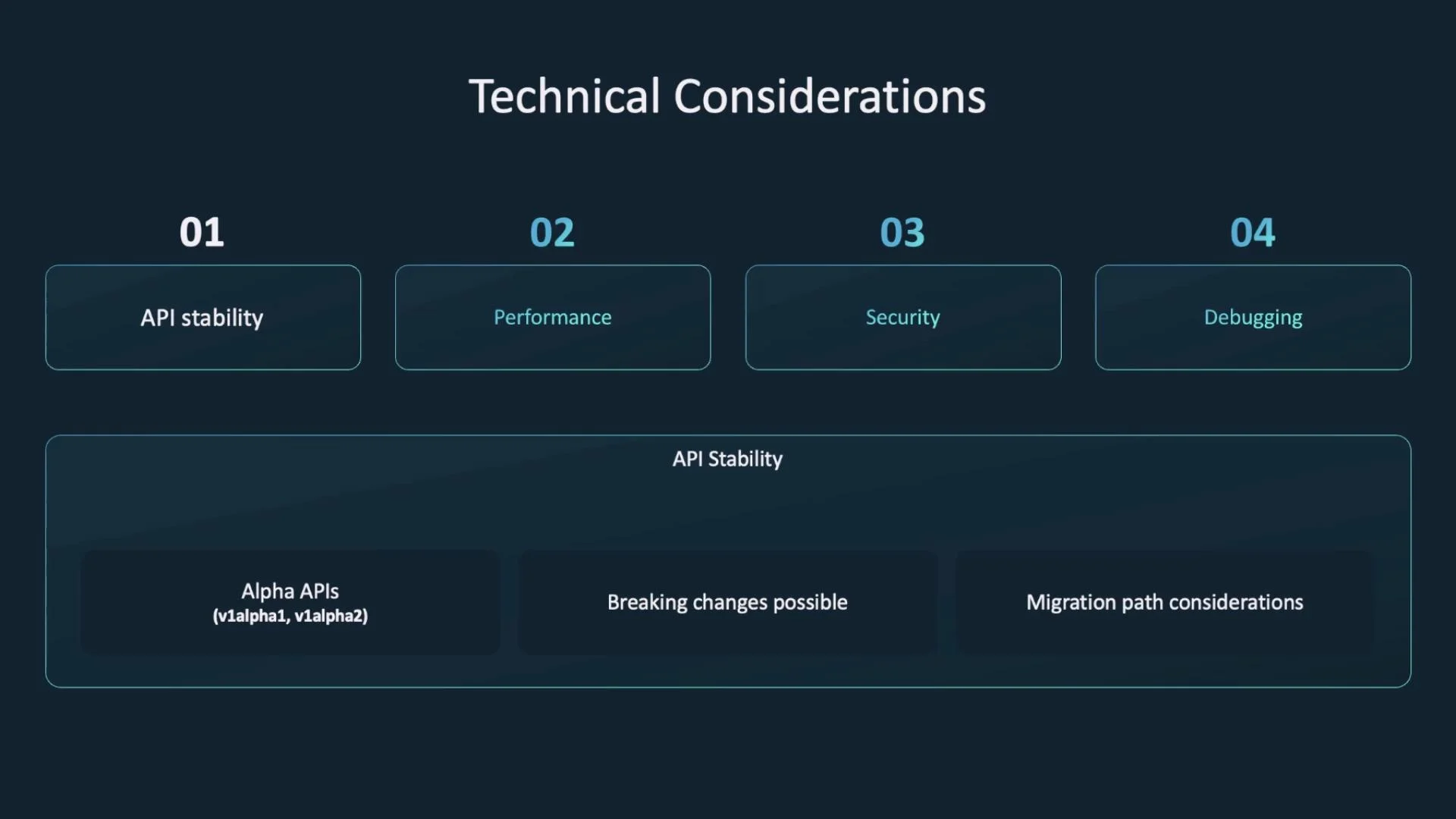
KAgent’s APIs are evolving. Alpha or experimental APIs can be subject to breaking changes, requiring migration work for agents or integrations. While the project is stabilizing with each release, plan for release testing and version upgrade paths in your deployment strategy.
## Technical considerations
### API stability
KAgent’s APIs are evolving. Alpha or experimental APIs can be subject to breaking changes, requiring migration work for agents or integrations. While the project is stabilizing with each release, plan for release testing and version upgrade paths in your deployment strategy.
 ### Performance
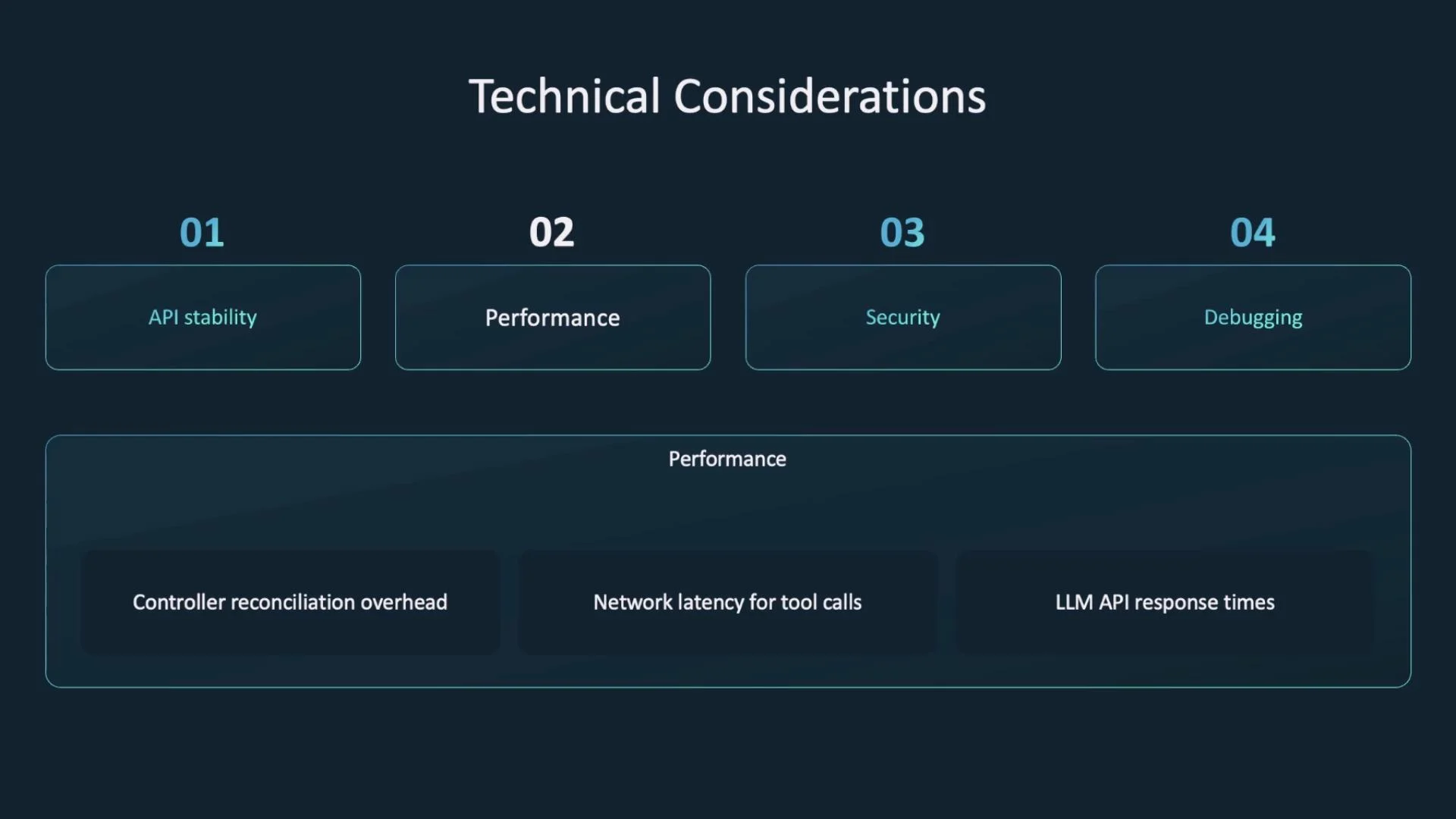
KAgent uses a reconciliation-style controller loop to manage agents and their interactions. Controller orchestration adds some overhead and can introduce latency in tool invocation and inter-agent communication. External factors such as LLM API response times and network latency also affect end-to-end performance. Production deployments should include performance testing, tuning, and capacity planning.
### Performance
KAgent uses a reconciliation-style controller loop to manage agents and their interactions. Controller orchestration adds some overhead and can introduce latency in tool invocation and inter-agent communication. External factors such as LLM API response times and network latency also affect end-to-end performance. Production deployments should include performance testing, tuning, and capacity planning.
 ### Security and debugging
KAgent does not replace core operator responsibilities such as secrets lifecycle management, RBAC policies, or network segmentation. You must:
* Enforce least-privilege RBAC for controllers and agents.
* Store API keys in a secure secret store (e.g., Kubernetes Secrets with an external KMS).
* Apply network policies and protocol-level restrictions for tool integrations.
For observability and debugging, distributed tracing (for example, OpenTelemetry) is recommended to trace flows across controllers, agents, and provider calls. Instrumentation and tracing for multi-component systems can be complex and will require design and tooling investment.
## When to use — and when not to use
| Use case | Recommended? | Notes |
| ---------------------------------------------------------- | -----------: | -------------------------------------------------------------------------- |
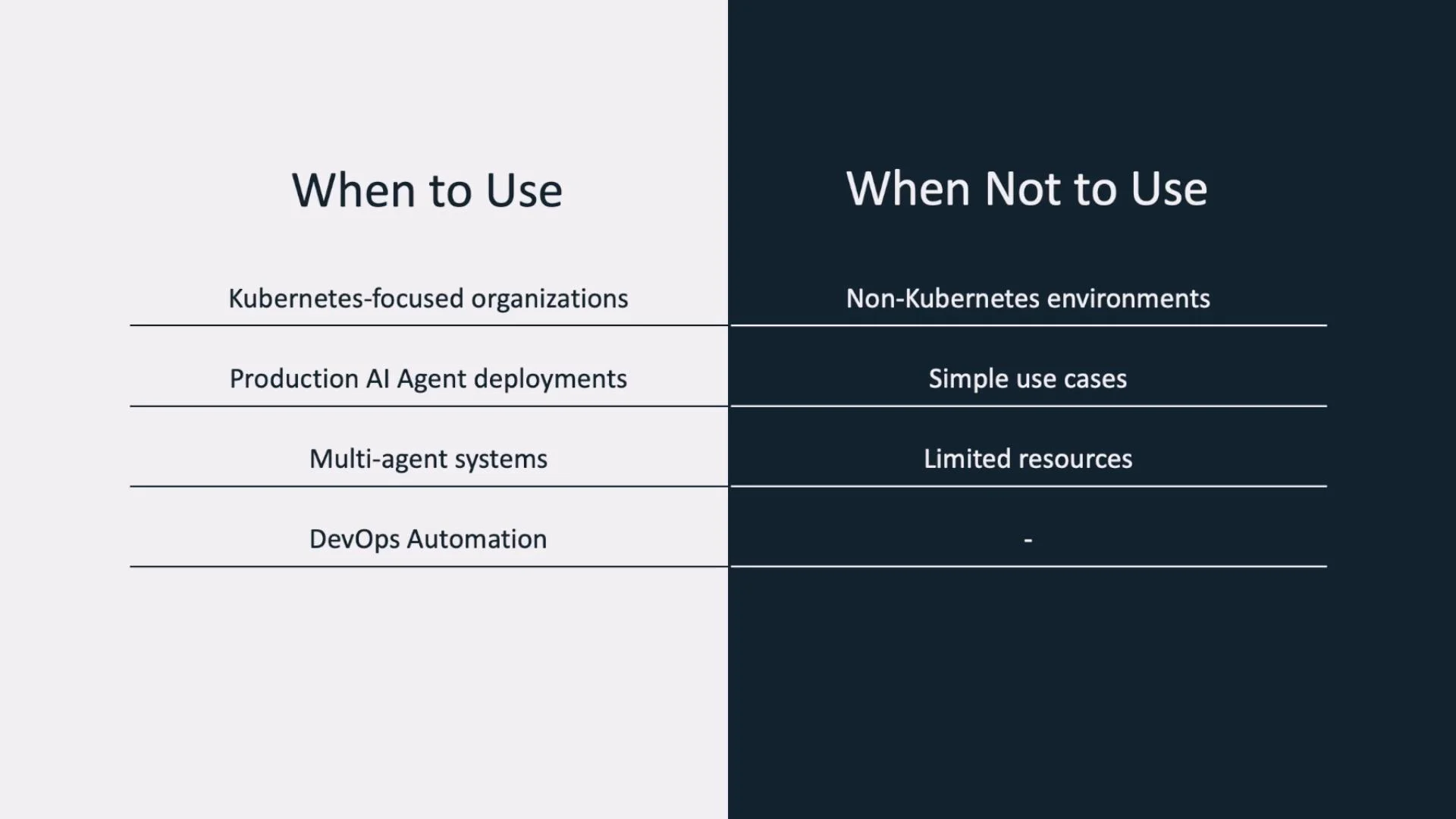
| Kubernetes-focused organizations | Yes | Best fit when teams already run and operate Kubernetes workloads. |
| Production-grade AI agent deployments | Yes | Supports multi-agent orchestration, scalability, and observability. |
| Multi-agent systems (A2A communication) | Yes | Native support for agent-to-agent interactions and standardized protocols. |
| Teams ready to adopt DevOps automation (CI/CD, Helm) | Yes | Requires pipelines for reproducible deployments and upgrades. |
| Non-Kubernetes or legacy on-prem without cluster resources | No | Lacks the infrastructure KAgent depends on. |
| Very simple, single-agent projects | No | Operational overhead may outweigh benefits. |
| Teams without capacity for secrets, RBAC, or cost controls | No | High operational risk without proper governance. |
### Security and debugging
KAgent does not replace core operator responsibilities such as secrets lifecycle management, RBAC policies, or network segmentation. You must:
* Enforce least-privilege RBAC for controllers and agents.
* Store API keys in a secure secret store (e.g., Kubernetes Secrets with an external KMS).
* Apply network policies and protocol-level restrictions for tool integrations.
For observability and debugging, distributed tracing (for example, OpenTelemetry) is recommended to trace flows across controllers, agents, and provider calls. Instrumentation and tracing for multi-component systems can be complex and will require design and tooling investment.
## When to use — and when not to use
| Use case | Recommended? | Notes |
| ---------------------------------------------------------- | -----------: | -------------------------------------------------------------------------- |
| Kubernetes-focused organizations | Yes | Best fit when teams already run and operate Kubernetes workloads. |
| Production-grade AI agent deployments | Yes | Supports multi-agent orchestration, scalability, and observability. |
| Multi-agent systems (A2A communication) | Yes | Native support for agent-to-agent interactions and standardized protocols. |
| Teams ready to adopt DevOps automation (CI/CD, Helm) | Yes | Requires pipelines for reproducible deployments and upgrades. |
| Non-Kubernetes or legacy on-prem without cluster resources | No | Lacks the infrastructure KAgent depends on. |
| Very simple, single-agent projects | No | Operational overhead may outweigh benefits. |
| Teams without capacity for secrets, RBAC, or cost controls | No | High operational risk without proper governance. |
 ## Feature comparison: KAgent vs traditional AI frameworks
| Feature | KAgent (Kubernetes-native) | Traditional frameworks |
| ------------------------- | --------------------------------------------------------: | --------------------------------------------------------- |
| Deployment model | Runs on Kubernetes using CRDs and controllers | Often single-process apps or managed services |
| Agent declaration | YAML-first, declarative agent & tool manifests | Frequently code-first, embedded in app logic |
| Provider integration | Built-in multi-provider support and pluggable adapters | Many frameworks embed provider logic in code |
| Tooling and protocols | Emerging agent protocols (MCP, A2A) and adapter ecosystem | Custom adapters or bespoke integration typically required |
| Observability | Integrates with OpenTelemetry and cluster-wide tools | Varies widely; may need custom instrumentation |
| Scalability | Scales with Kubernetes capacity and autoscaling | Scaling may require app-level changes or custom ops |
| Multi-agent communication | Native A2A support and patterns | Harder to implement; usually custom messaging |
| Project status | Active open-source project (rapid iteration) | Varies by project; some are more mature/stable |
kMCP and other open standards used by KAgent are key to interoperability and ecosystem growth.
## Key takeaways
## Feature comparison: KAgent vs traditional AI frameworks
| Feature | KAgent (Kubernetes-native) | Traditional frameworks |
| ------------------------- | --------------------------------------------------------: | --------------------------------------------------------- |
| Deployment model | Runs on Kubernetes using CRDs and controllers | Often single-process apps or managed services |
| Agent declaration | YAML-first, declarative agent & tool manifests | Frequently code-first, embedded in app logic |
| Provider integration | Built-in multi-provider support and pluggable adapters | Many frameworks embed provider logic in code |
| Tooling and protocols | Emerging agent protocols (MCP, A2A) and adapter ecosystem | Custom adapters or bespoke integration typically required |
| Observability | Integrates with OpenTelemetry and cluster-wide tools | Varies widely; may need custom instrumentation |
| Scalability | Scales with Kubernetes capacity and autoscaling | Scaling may require app-level changes or custom ops |
| Multi-agent communication | Native A2A support and patterns | Harder to implement; usually custom messaging |
| Project status | Active open-source project (rapid iteration) | Varies by project; some are more mature/stable |
kMCP and other open standards used by KAgent are key to interoperability and ecosystem growth.
## Key takeaways
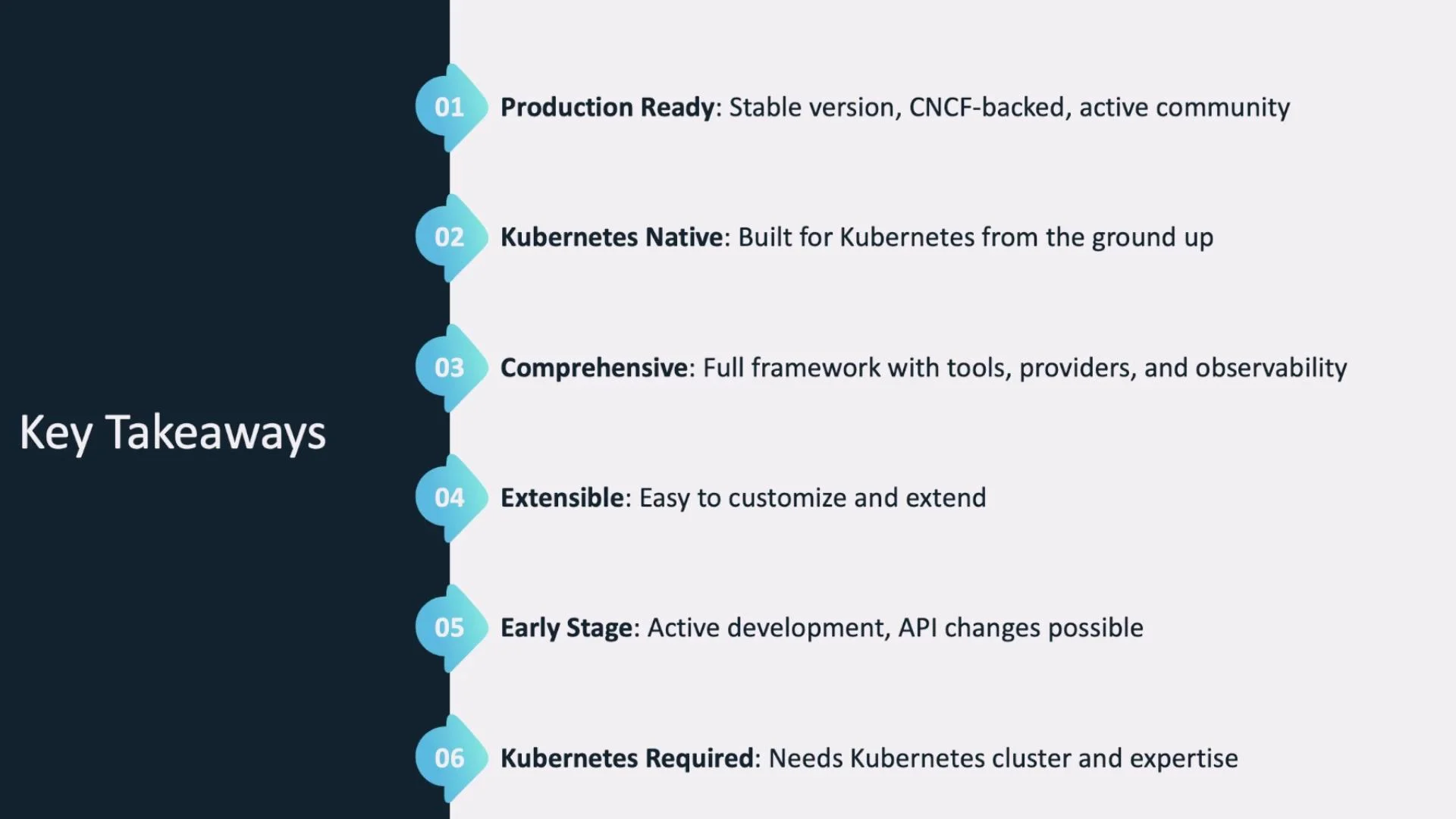 * Production-ready and Kubernetes-native: KAgent is designed for Kubernetes environments and is suitable for production when you have cluster and devops practices in place.
* Comprehensive and extensible: It supports providers, tools, and observability integrations and embraces open standards.
* Early-stage and evolving: Active development means APIs can change—plan for migrations and version testing.
* Requires Kubernetes expertise: Deploying and operating KAgent effectively requires Kubernetes, CI/CD, secrets management, and cost governance.
## Next steps
In the following lessons we will examine KAgent components—controller, CRDs, provider integrations, and observability—in depth and show practical deployment patterns, migration strategies, and production hardening tips.
Links and references
* Kubernetes concepts and best practices: [https://kubernetes.io/docs/](https://kubernetes.io/docs/)
* OpenTelemetry: [https://opentelemetry.io/](https://opentelemetry.io/)
* For community support and the latest project updates, check the KAgent project repository and its contributing guides (see the repository referenced from the project homepage).
* Production-ready and Kubernetes-native: KAgent is designed for Kubernetes environments and is suitable for production when you have cluster and devops practices in place.
* Comprehensive and extensible: It supports providers, tools, and observability integrations and embraces open standards.
* Early-stage and evolving: Active development means APIs can change—plan for migrations and version testing.
* Requires Kubernetes expertise: Deploying and operating KAgent effectively requires Kubernetes, CI/CD, secrets management, and cost governance.
## Next steps
In the following lessons we will examine KAgent components—controller, CRDs, provider integrations, and observability—in depth and show practical deployment patterns, migration strategies, and production hardening tips.
Links and references
* Kubernetes concepts and best practices: [https://kubernetes.io/docs/](https://kubernetes.io/docs/)
* OpenTelemetry: [https://opentelemetry.io/](https://opentelemetry.io/)
* For community support and the latest project updates, check the KAgent project repository and its contributing guides (see the repository referenced from the project homepage).