> ## Documentation Index
> Fetch the complete documentation index at: https://notes.kodekloud.com/llms.txt
> Use this file to discover all available pages before exploring further.
# Agent to Agent A2A Protocol
> Explains A2A, an open standard enabling secure, discoverable, interoperable agent-to-agent communication for discovery, invocation, security, streaming, and long-running multi-agent collaboration.
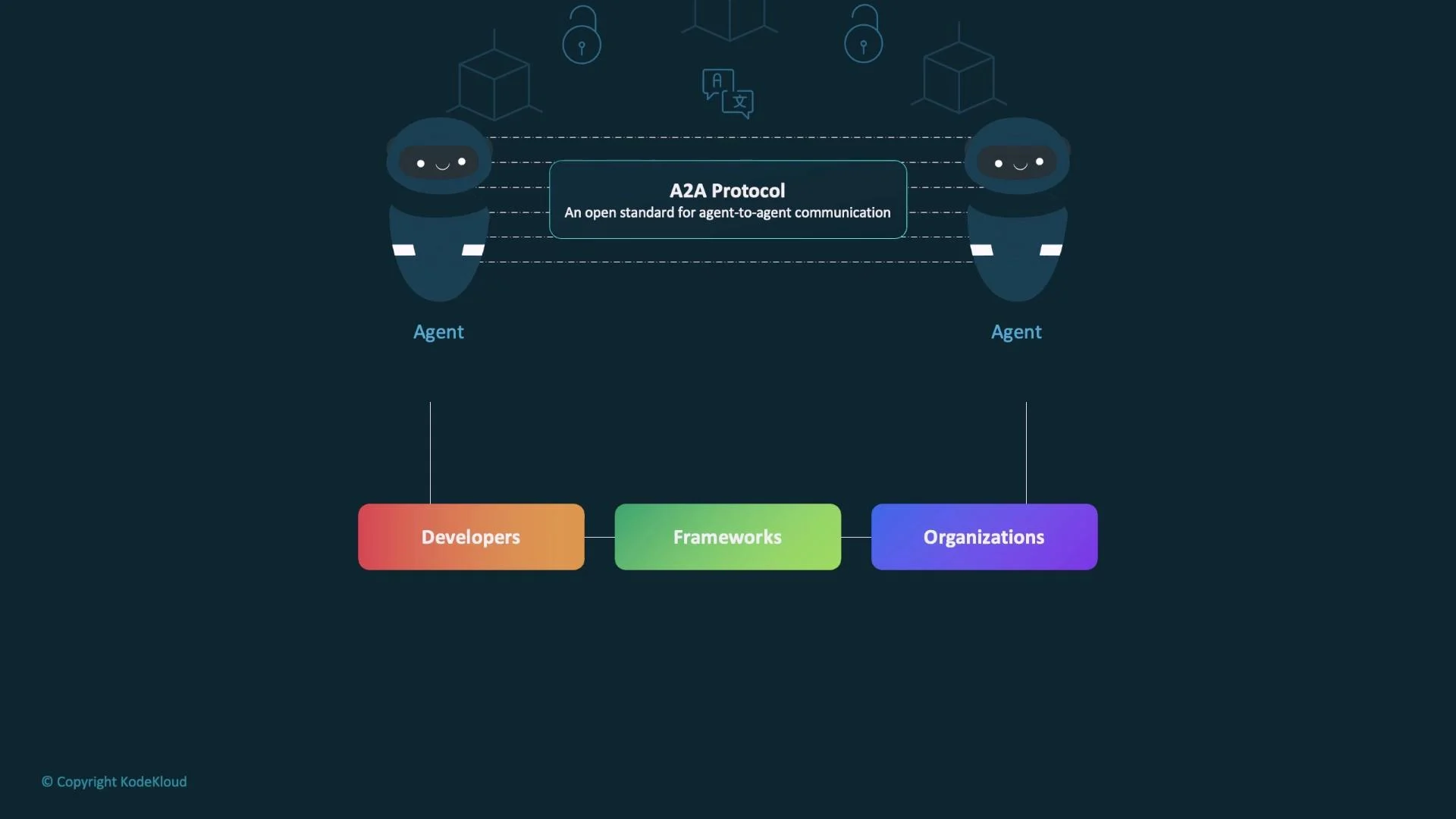
Welcome—this lesson explains the A2A protocol: an open standard for secure, discoverable, and interoperable agent-to-agent communication. You’ll learn why A2A exists, the problems it solves in multi-agent systems, and the practical benefits for building AI agents that collaborate reliably across frameworks and vendors.
A2A (Agent-to-Agent) is a protocol designed to make multi-agent collaboration predictable and secure by standardizing discovery, invocation, data exchange, and long-running interactions between agents.
 ## Why the A2A protocol exists
At its core, A2A solves the practical challenges of enabling multiple specialized agents to discover, authenticate, and interact with each other reliably. Consider a user request like “Plan an international trip.” Delivering that outcome typically requires several distinct agents (flights, hotels, currency conversion, local tours). Without a shared protocol, teams must build brittle, custom integrations for every pairwise connection. A2A provides a standard way to:
* Expose an agent’s capabilities and metadata
* Discover available agents and their interfaces
* Invoke capabilities with well-defined message formats
* Authenticate callers and enforce scoped access
* Support streaming and long-running operations
## Problems A2A addresses
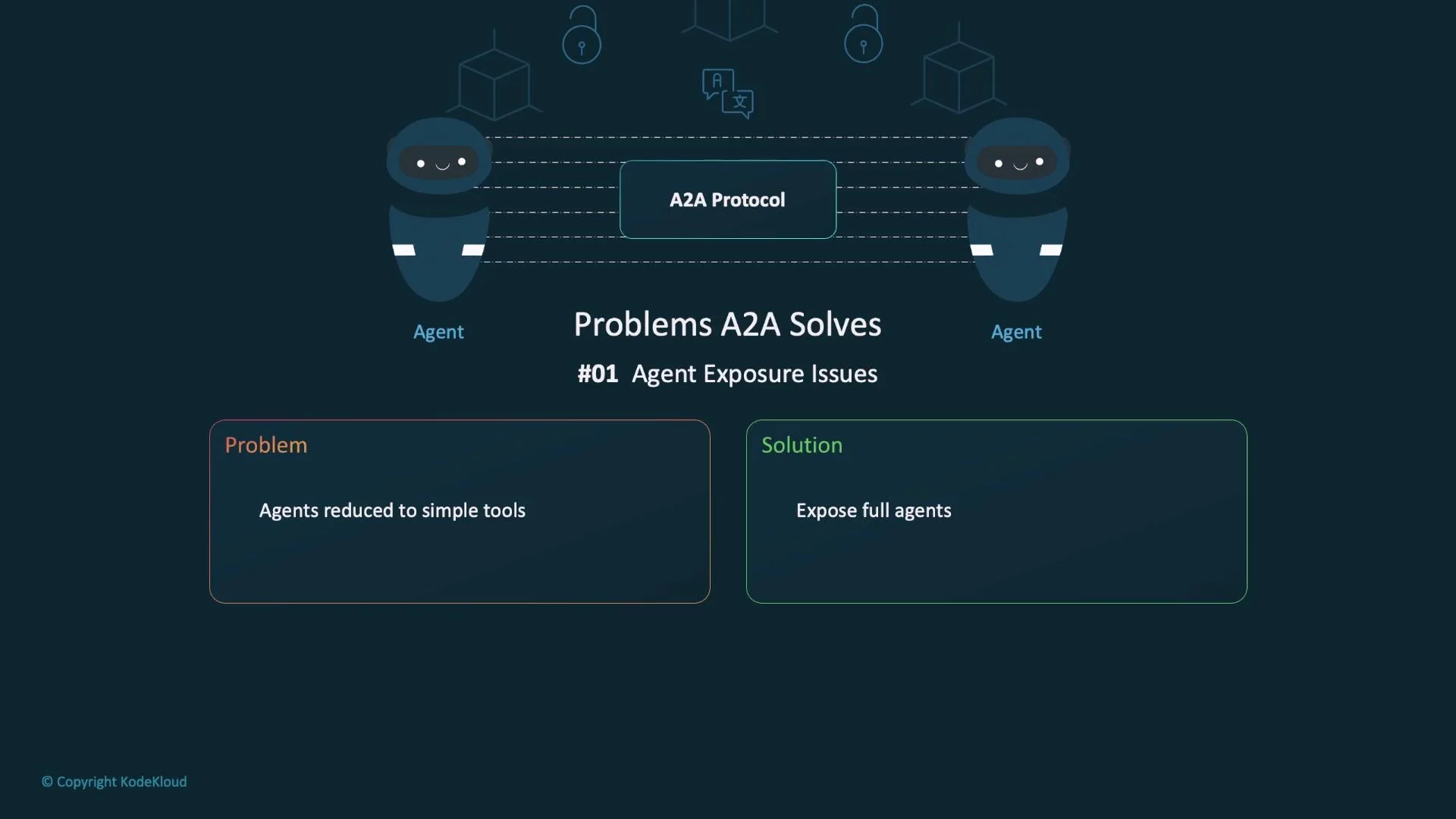
* Agent exposure: Agents are often reduced to single-purpose tools or endpoints, which limits autonomy and prevents richer interactions. A2A promotes exposing a full agent interface so other agents can invoke capabilities and exchange structured data.
## Why the A2A protocol exists
At its core, A2A solves the practical challenges of enabling multiple specialized agents to discover, authenticate, and interact with each other reliably. Consider a user request like “Plan an international trip.” Delivering that outcome typically requires several distinct agents (flights, hotels, currency conversion, local tours). Without a shared protocol, teams must build brittle, custom integrations for every pairwise connection. A2A provides a standard way to:
* Expose an agent’s capabilities and metadata
* Discover available agents and their interfaces
* Invoke capabilities with well-defined message formats
* Authenticate callers and enforce scoped access
* Support streaming and long-running operations
## Problems A2A addresses
* Agent exposure: Agents are often reduced to single-purpose tools or endpoints, which limits autonomy and prevents richer interactions. A2A promotes exposing a full agent interface so other agents can invoke capabilities and exchange structured data.
 * Custom integrations: Pairwise custom code is expensive and fragile. A2A defines a single connection model that eliminates glue code.
* Slow innovation: Teams spend time on integration plumbing instead of improving agent logic and features.
* Scalability: Bespoke integrations don’t scale as agent ecosystems grow. A standard protocol simplifies onboarding and maintenance.
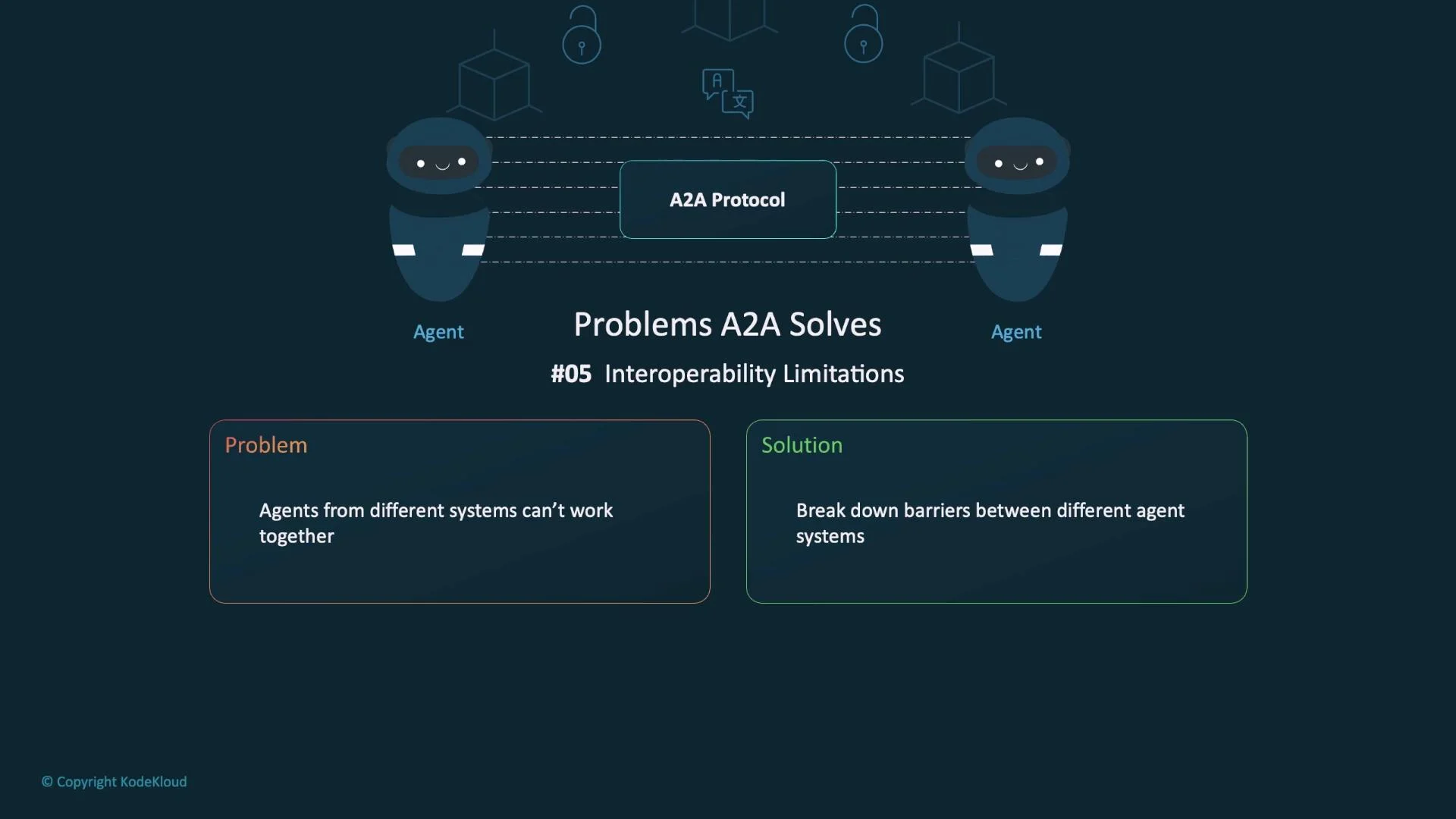
* Interoperability limitations: Agents from different vendors or frameworks can’t collaborate without a common communication method. A2A breaks these barriers.
* Custom integrations: Pairwise custom code is expensive and fragile. A2A defines a single connection model that eliminates glue code.
* Slow innovation: Teams spend time on integration plumbing instead of improving agent logic and features.
* Scalability: Bespoke integrations don’t scale as agent ecosystems grow. A standard protocol simplifies onboarding and maintenance.
* Interoperability limitations: Agents from different vendors or frameworks can’t collaborate without a common communication method. A2A breaks these barriers.
 * Security gaps: Inconsistent security practices cause risks in inter-agent calls. A2A prescribes security primitives (TLS/HTTPS, authentication, scoped disclosures) so agents can trust one another and limit exposure of sensitive data.
Security is a first-class concern in A2A. Implement TLS, mutual auth where appropriate, and fine-grained scopes to limit the data and capabilities shared between agents.
## Problems → A2A Solutions (at a glance)
| Problem | Impact | A2A solution |
| --------------------------------------- | --------------------------------------------------- | ---------------------------------------------------------- |
| Agents exposed as single-purpose tools | Limited functionality and poor reusability | Standard agent interface and richer metadata for discovery |
| Pairwise custom integrations | High maintenance and fragile connections | Single consistent connection model and message formats |
| Slow feature delivery | Teams spend time integrating rather than innovating | Protocol reduces integration overhead |
| Poor interoperability across frameworks | Agents can’t collaborate across vendors | Common discovery and invocation semantics |
| Security inconsistencies | Data leakage and unauthorized access | Standardized TLS, authentication, and scoped disclosures |
## Concrete scenario: With and Without A2A
* Without A2A: An AI assistant receiving “Plan an international trip” must either implement bespoke integrations with many services or fail to complete the task because it cannot reliably discover or invoke the right agents.
* With A2A: The assistant acts as an orchestrator. It uses the protocol to discover specialized agents, authenticate, invoke capabilities, and coordinate responses. The orchestration is reliable because discovery, messaging, and security follow a known standard.
## Core benefits of adopting A2A
* Secure collaboration: Agents communicate over encrypted channels, authenticate peers, and share only the minimal required data for a task. This minimizes risk and preserves privacy.
* Security gaps: Inconsistent security practices cause risks in inter-agent calls. A2A prescribes security primitives (TLS/HTTPS, authentication, scoped disclosures) so agents can trust one another and limit exposure of sensitive data.
Security is a first-class concern in A2A. Implement TLS, mutual auth where appropriate, and fine-grained scopes to limit the data and capabilities shared between agents.
## Problems → A2A Solutions (at a glance)
| Problem | Impact | A2A solution |
| --------------------------------------- | --------------------------------------------------- | ---------------------------------------------------------- |
| Agents exposed as single-purpose tools | Limited functionality and poor reusability | Standard agent interface and richer metadata for discovery |
| Pairwise custom integrations | High maintenance and fragile connections | Single consistent connection model and message formats |
| Slow feature delivery | Teams spend time integrating rather than innovating | Protocol reduces integration overhead |
| Poor interoperability across frameworks | Agents can’t collaborate across vendors | Common discovery and invocation semantics |
| Security inconsistencies | Data leakage and unauthorized access | Standardized TLS, authentication, and scoped disclosures |
## Concrete scenario: With and Without A2A
* Without A2A: An AI assistant receiving “Plan an international trip” must either implement bespoke integrations with many services or fail to complete the task because it cannot reliably discover or invoke the right agents.
* With A2A: The assistant acts as an orchestrator. It uses the protocol to discover specialized agents, authenticate, invoke capabilities, and coordinate responses. The orchestration is reliable because discovery, messaging, and security follow a known standard.
## Core benefits of adopting A2A
* Secure collaboration: Agents communicate over encrypted channels, authenticate peers, and share only the minimal required data for a task. This minimizes risk and preserves privacy.
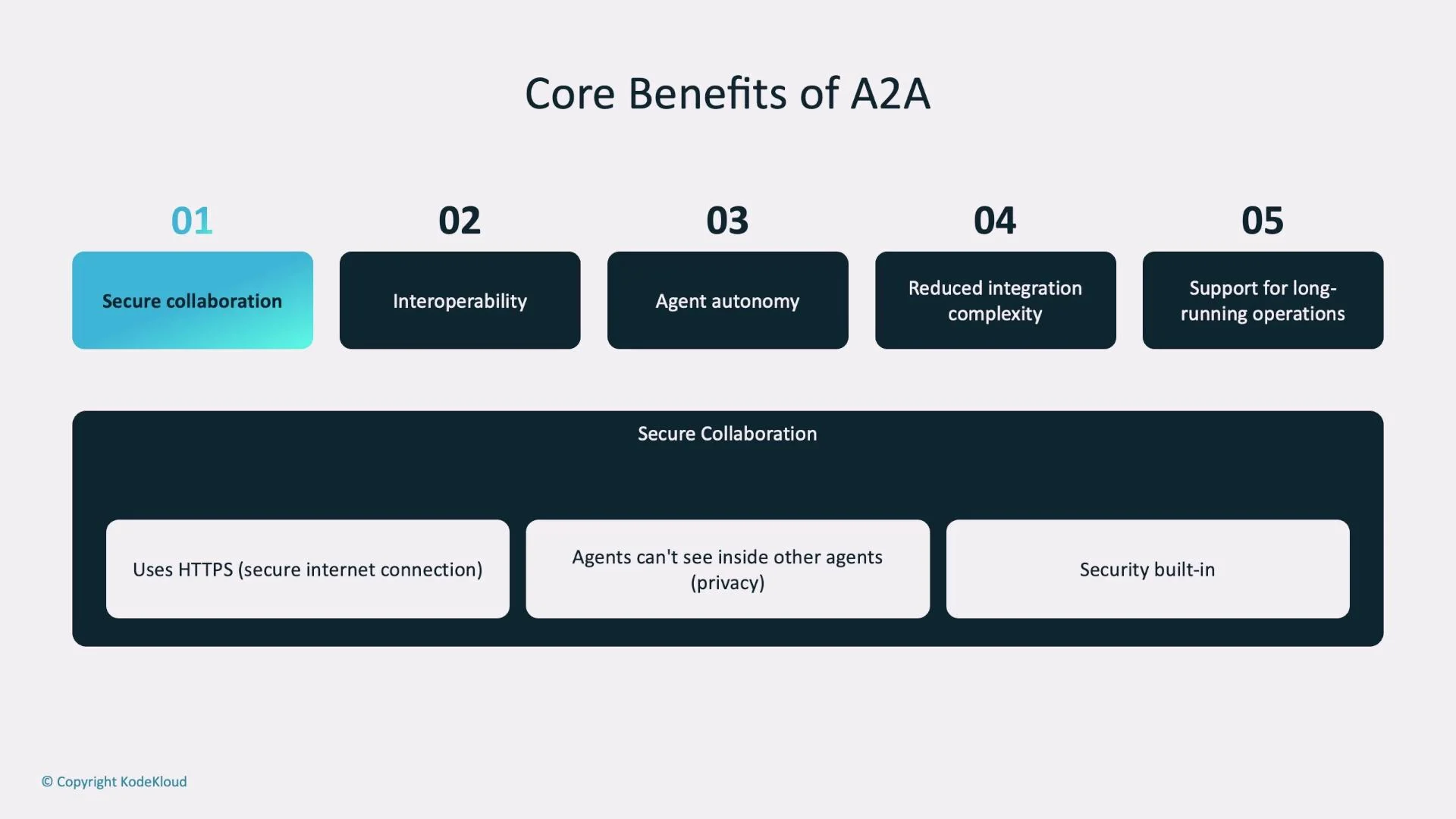 * Interoperability: Agents built with different frameworks and vendors—such as Agent Development Kit, [LangChain](https://learn.kodekloud.com/user/courses/langchain), CrewAI, and others—can interoperate using shared message formats, discovery mechanisms, and invocation semantics.
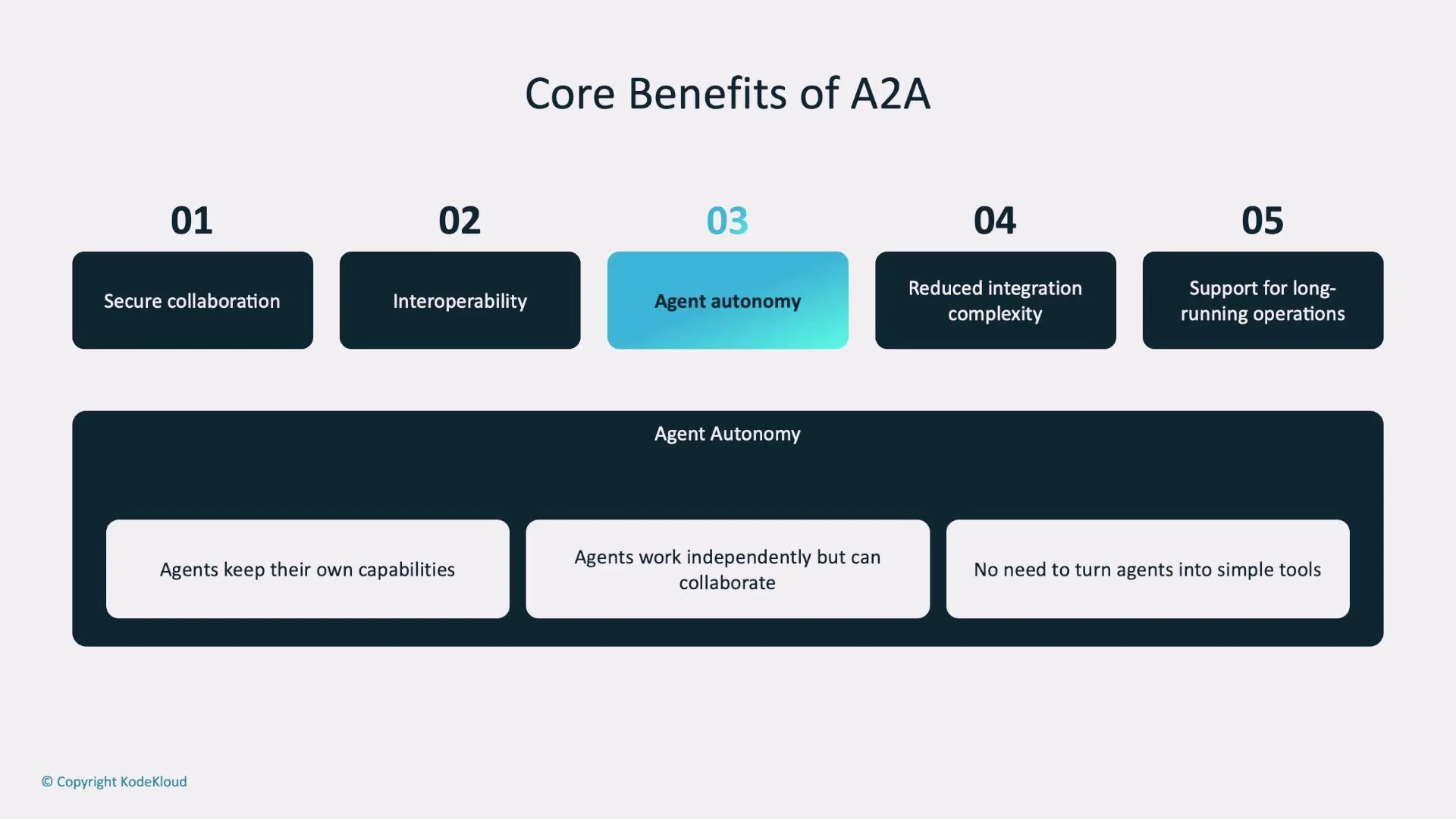
* Agent autonomy: Agents retain independent decision-making, internal tools, and capabilities. A2A prevents the anti-pattern of converting full agents into limited “tools” purely for integration convenience.
* Interoperability: Agents built with different frameworks and vendors—such as Agent Development Kit, [LangChain](https://learn.kodekloud.com/user/courses/langchain), CrewAI, and others—can interoperate using shared message formats, discovery mechanisms, and invocation semantics.
* Agent autonomy: Agents retain independent decision-making, internal tools, and capabilities. A2A prevents the anti-pattern of converting full agents into limited “tools” purely for integration convenience.
 * Reduced integration complexity: Implement one well-documented protocol instead of many bespoke connectors, lowering maintenance costs and accelerating development.
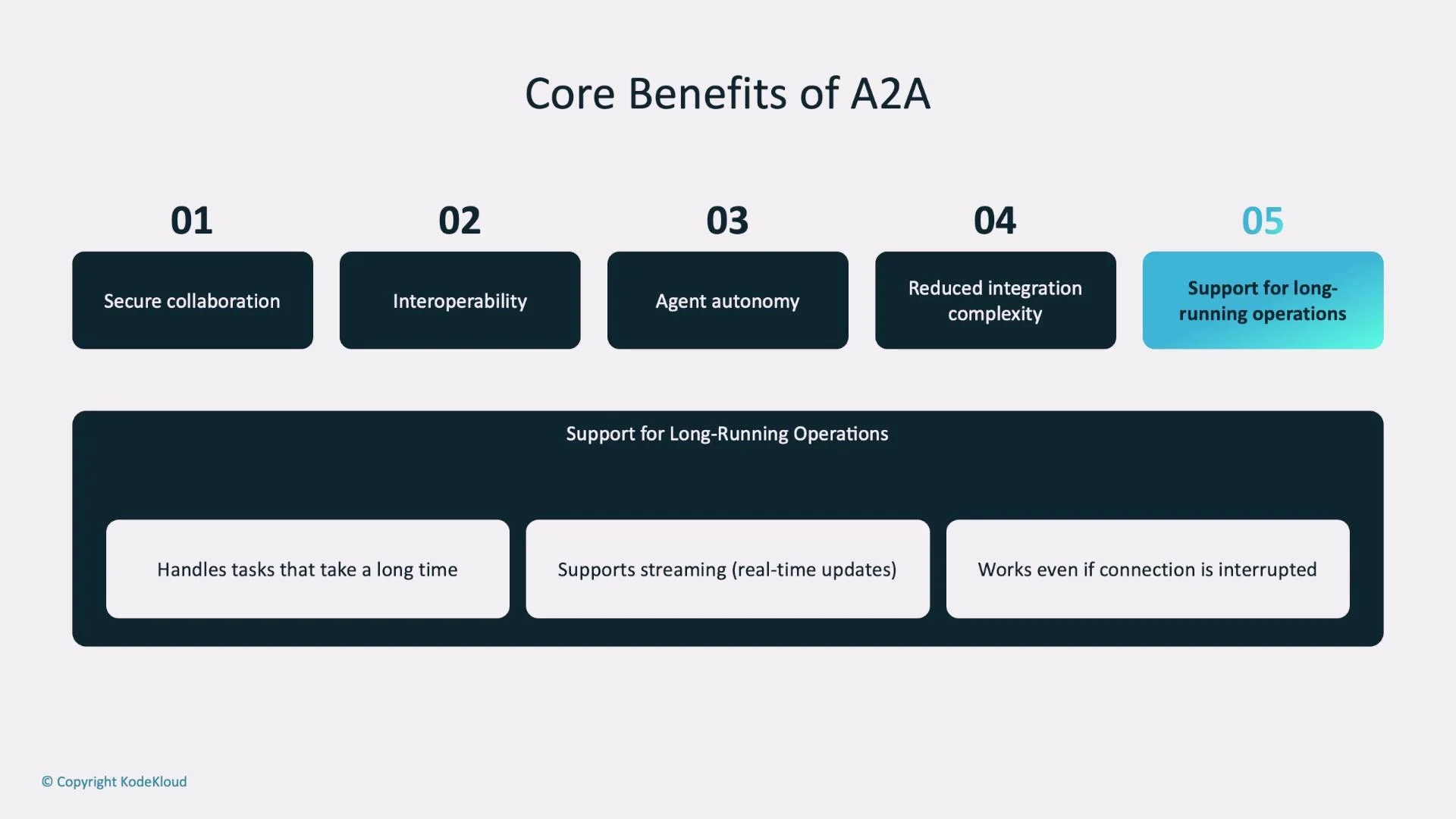
* Support for long-running operations: A2A supports streaming updates, durable operations, and resilience to intermittent connectivity so callers can receive progress updates and resume interactions when needed.
* Reduced integration complexity: Implement one well-documented protocol instead of many bespoke connectors, lowering maintenance costs and accelerating development.
* Support for long-running operations: A2A supports streaming updates, durable operations, and resilience to intermittent connectivity so callers can receive progress updates and resume interactions when needed.
 ## Summary
A2A standardizes how agents:
* Publish capabilities and metadata
* Discover and authenticate peers
* Exchange structured messages and scoped data
* Handle streaming and long-running workflows
* Securely collaborate across vendors and frameworks
Adopting A2A reduces integration overhead, increases interoperability, preserves agent autonomy, and improves security—enabling teams to build richer, more reliable multi-agent systems.
## Links and further reading
* [LangChain course reference](https://learn.kodekloud.com/user/courses/langchain)
* [Kubernetes Documentation](https://kubernetes.io/docs/) (for deploying agent runtimes and orchestration)
## Summary
A2A standardizes how agents:
* Publish capabilities and metadata
* Discover and authenticate peers
* Exchange structured messages and scoped data
* Handle streaming and long-running workflows
* Securely collaborate across vendors and frameworks
Adopting A2A reduces integration overhead, increases interoperability, preserves agent autonomy, and improves security—enabling teams to build richer, more reliable multi-agent systems.
## Links and further reading
* [LangChain course reference](https://learn.kodekloud.com/user/courses/langchain)
* [Kubernetes Documentation](https://kubernetes.io/docs/) (for deploying agent runtimes and orchestration)