> ## Documentation Index
> Fetch the complete documentation index at: https://notes.kodekloud.com/llms.txt
> Use this file to discover all available pages before exploring further.
# Kubeflow Ecosystem
> Overview of Kubeflow components and how they integrate to support the end-to-end ML lifecycle
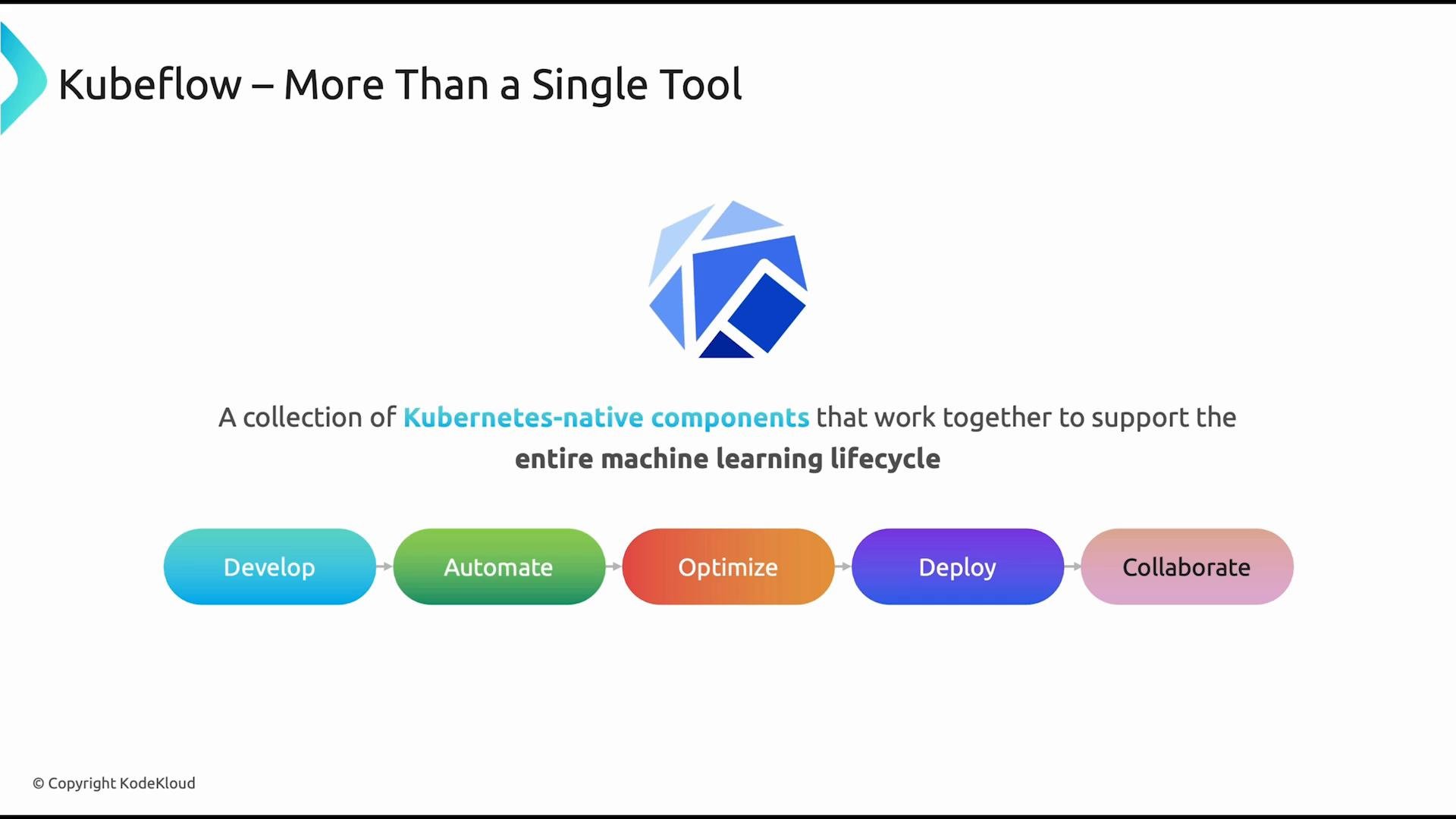
When people first hear "Kubeflow," they often think of a single application. In reality, Kubeflow is an ecosystem of Kubernetes-native components. Each component targets a specific stage of the machine learning (ML) lifecycle — and together they form an end-to-end MLOps platform for building, automating, optimizing, deploying, and operating models at scale.
 This article focuses on the Kubeflow components most commonly used in production: Notebooks, Pipelines, Katib, KServe, and Profiles. Use this as a practical overview to understand how the parts fit together across the ML lifecycle.
Each Kubeflow component solves a particular problem. Below is a concise description of the core components and how they fit together.
This article focuses on the Kubeflow components most commonly used in production: Notebooks, Pipelines, Katib, KServe, and Profiles. Use this as a practical overview to understand how the parts fit together across the ML lifecycle.
Each Kubeflow component solves a particular problem. Below is a concise description of the core components and how they fit together.
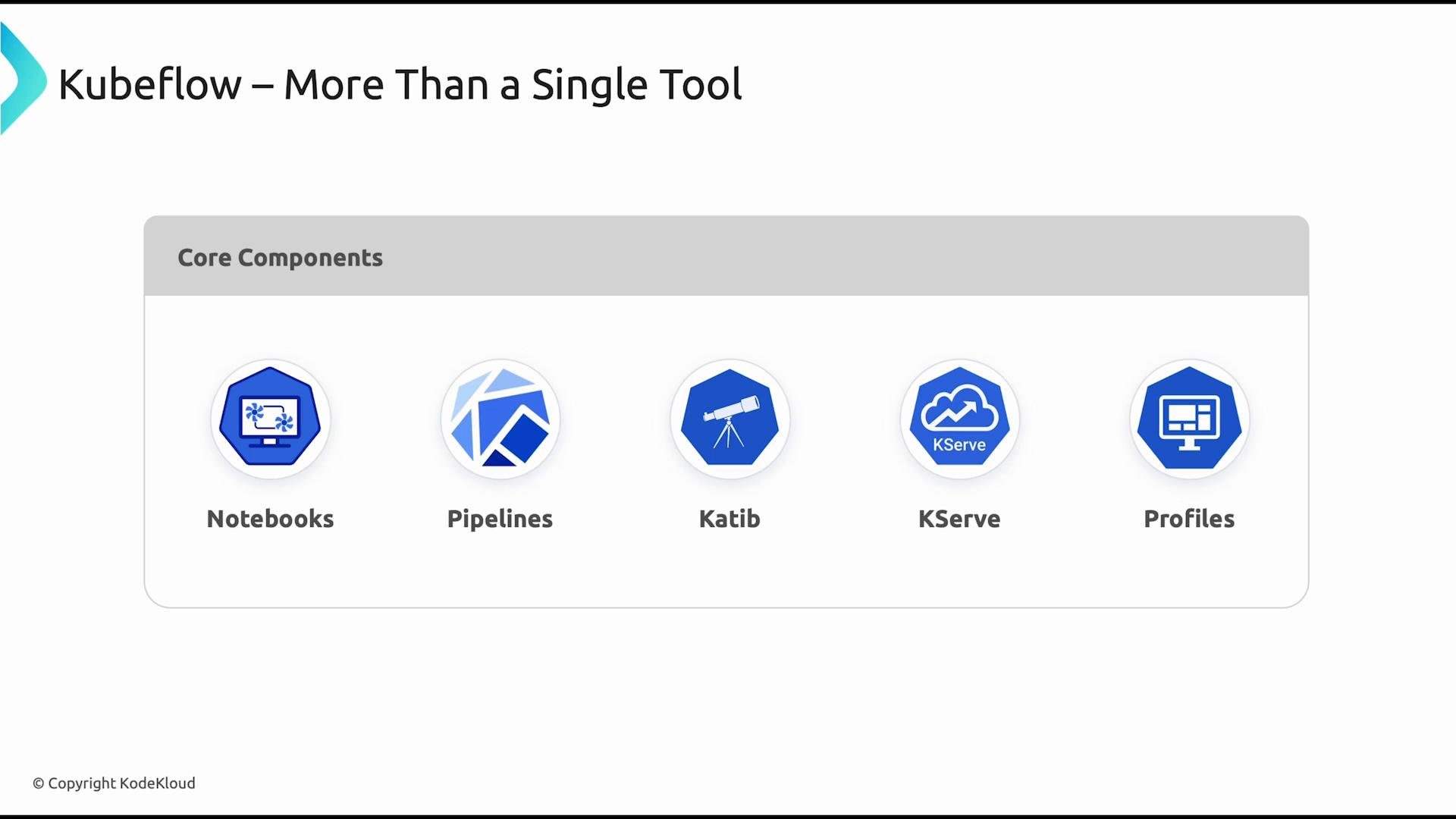 * Notebooks — Interactive development environments (commonly [Jupyter](https://jupyter.org/)) running as Kubernetes workloads. Notebooks let data scientists explore data, prototype models, and leverage cluster resources (including GPUs) instead of relying on local machines.
* Pipelines — Automation and orchestration for ML workflows. Kubeflow Pipelines builds on the [Argo Workflows](https://argoproj.github.io/argo-workflows/) engine to compose reproducible, versioned workflows from reusable components.
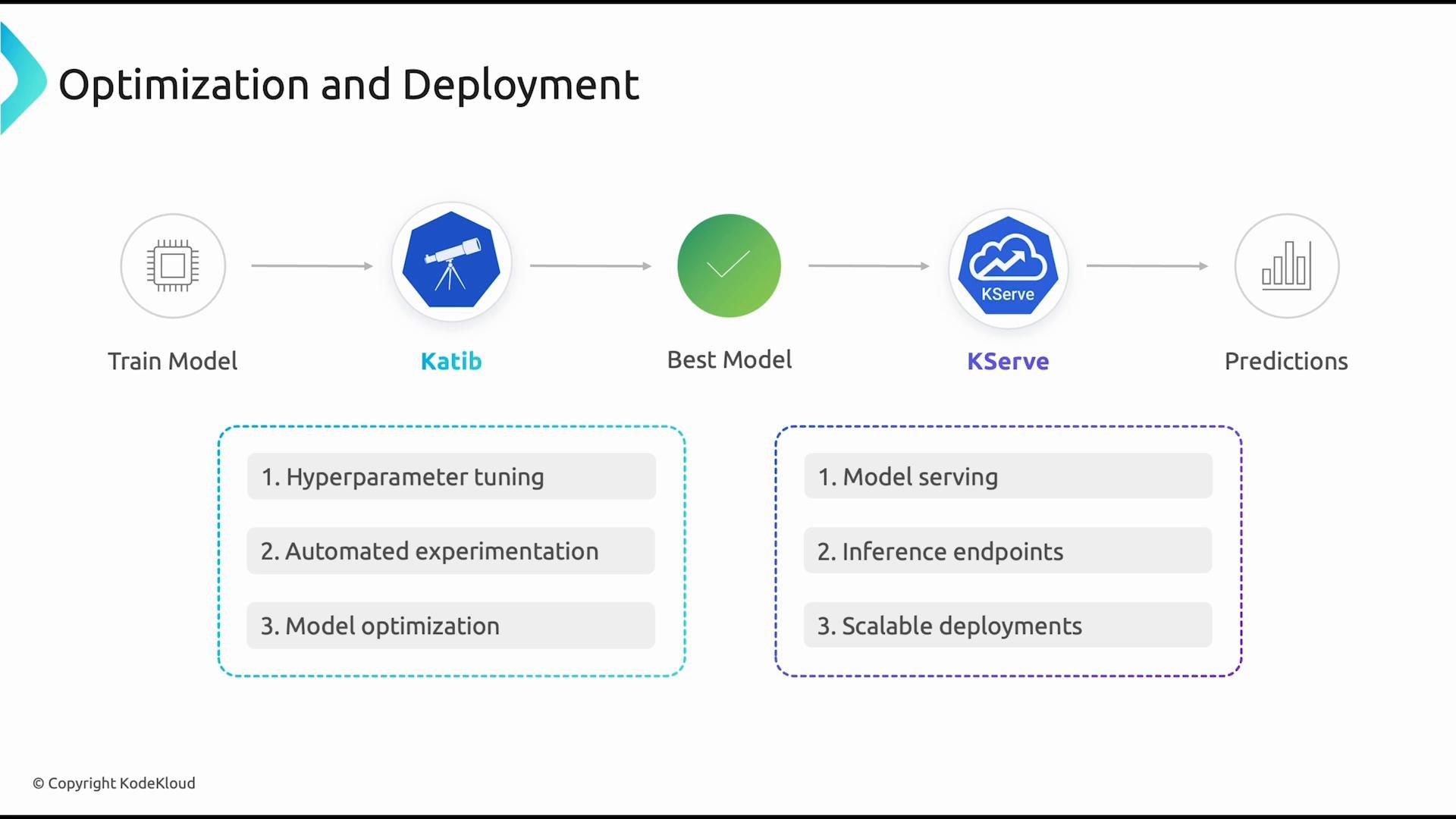
* Katib — Automated experiment management and hyperparameter tuning. Katib runs many trials using strategies such as grid search, random search, or Bayesian optimization to identify the best model configurations.
* KServe — Model serving and scalable inference. Built on serverless primitives (e.g., [Knative](https://knative.dev/)), KServe exposes trained models as endpoints for real-time or batch predictions.
* Profiles — Multi-user and multi-team support. Profiles provision isolated workspaces (typically namespaces), create role bindings, and enforce resource quotas so teams can share a cluster securely.
Summary table — core Kubeflow components:
| Component | Primary Purpose | Typical Usage / Notes |
| - | - | - |
| Notebooks | Interactive development and experimentation | Use for data exploration, prototyping, and GPU-based training from a browser-based environment |
| Pipelines | Orchestration and automation | Compose reproducible workflows; integrates with Argo Workflows for orchestration |
| Katib | Hyperparameter tuning and experimentation | Automate large-scale search (grid, random, Bayesian) across model configurations |
| KServe | Model serving and inference | Expose models as scalable endpoints using serverless autoscaling (Knative) |
| Profiles | Multi-tenant isolation and access control | Create namespaces, role bindings, and quotas for team collaboration |
The ML lifecycle often follows this sequence:
1. Develop and experiment in Notebooks.
2. Automate training and ETL with Pipelines for reproducibility and scheduling.
3. Optimize model parameters and architecture with Katib.
4. Deploy optimized models using KServe for production inference.
5. Use Profiles and cluster RBAC to manage multi-user access and resource isolation.
* Notebooks — Interactive development environments (commonly [Jupyter](https://jupyter.org/)) running as Kubernetes workloads. Notebooks let data scientists explore data, prototype models, and leverage cluster resources (including GPUs) instead of relying on local machines.
* Pipelines — Automation and orchestration for ML workflows. Kubeflow Pipelines builds on the [Argo Workflows](https://argoproj.github.io/argo-workflows/) engine to compose reproducible, versioned workflows from reusable components.
* Katib — Automated experiment management and hyperparameter tuning. Katib runs many trials using strategies such as grid search, random search, or Bayesian optimization to identify the best model configurations.
* KServe — Model serving and scalable inference. Built on serverless primitives (e.g., [Knative](https://knative.dev/)), KServe exposes trained models as endpoints for real-time or batch predictions.
* Profiles — Multi-user and multi-team support. Profiles provision isolated workspaces (typically namespaces), create role bindings, and enforce resource quotas so teams can share a cluster securely.
Summary table — core Kubeflow components:
| Component | Primary Purpose | Typical Usage / Notes |
| - | - | - |
| Notebooks | Interactive development and experimentation | Use for data exploration, prototyping, and GPU-based training from a browser-based environment |
| Pipelines | Orchestration and automation | Compose reproducible workflows; integrates with Argo Workflows for orchestration |
| Katib | Hyperparameter tuning and experimentation | Automate large-scale search (grid, random, Bayesian) across model configurations |
| KServe | Model serving and inference | Expose models as scalable endpoints using serverless autoscaling (Knative) |
| Profiles | Multi-tenant isolation and access control | Create namespaces, role bindings, and quotas for team collaboration |
The ML lifecycle often follows this sequence:
1. Develop and experiment in Notebooks.
2. Automate training and ETL with Pipelines for reproducibility and scheduling.
3. Optimize model parameters and architecture with Katib.
4. Deploy optimized models using KServe for production inference.
5. Use Profiles and cluster RBAC to manage multi-user access and resource isolation.
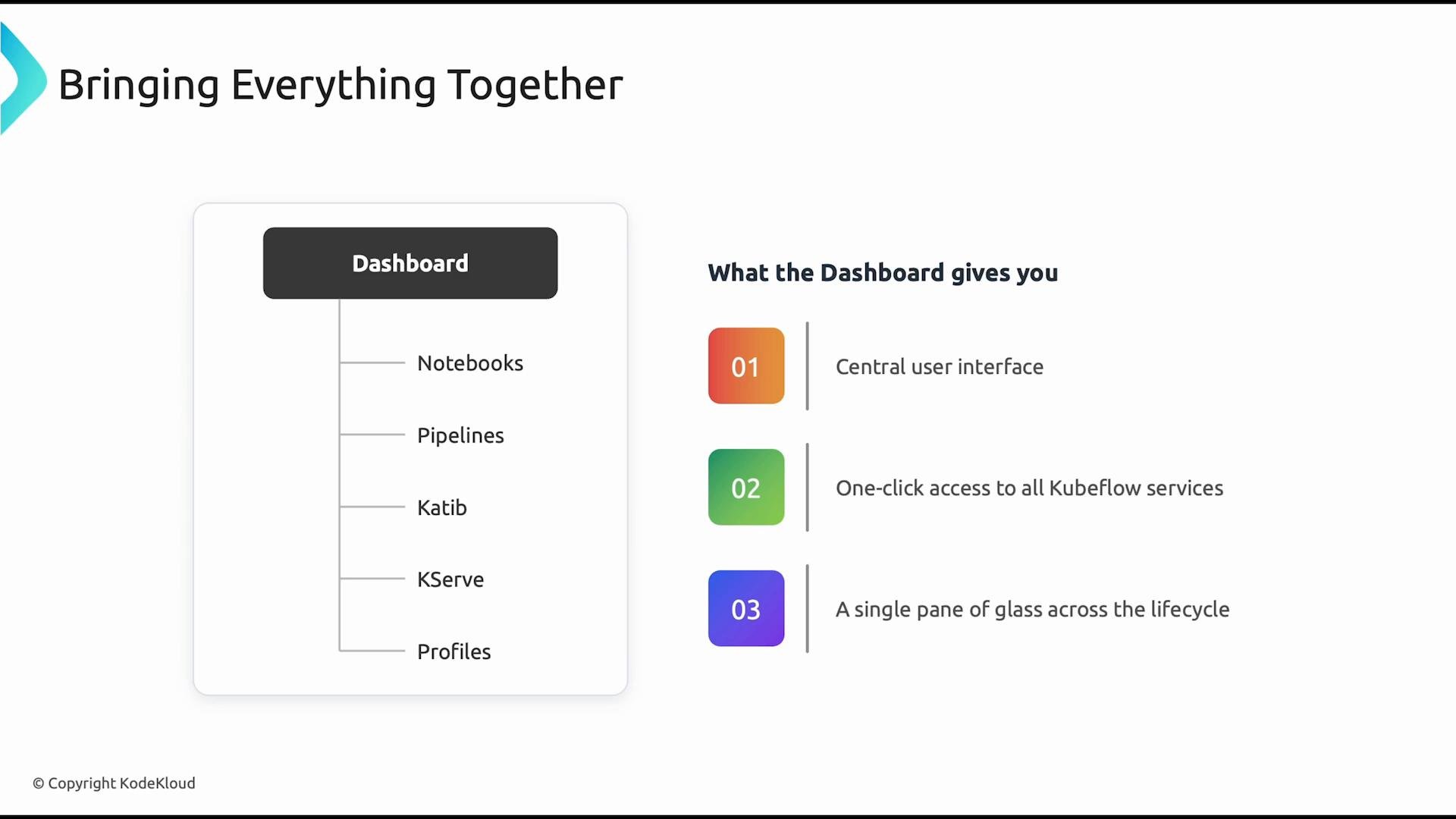
 The Kubeflow dashboard is the central user interface that brings these services together. From the dashboard you can launch notebooks, create and monitor pipelines, inspect Katib experiments, and manage KServe deployments — all in one place.
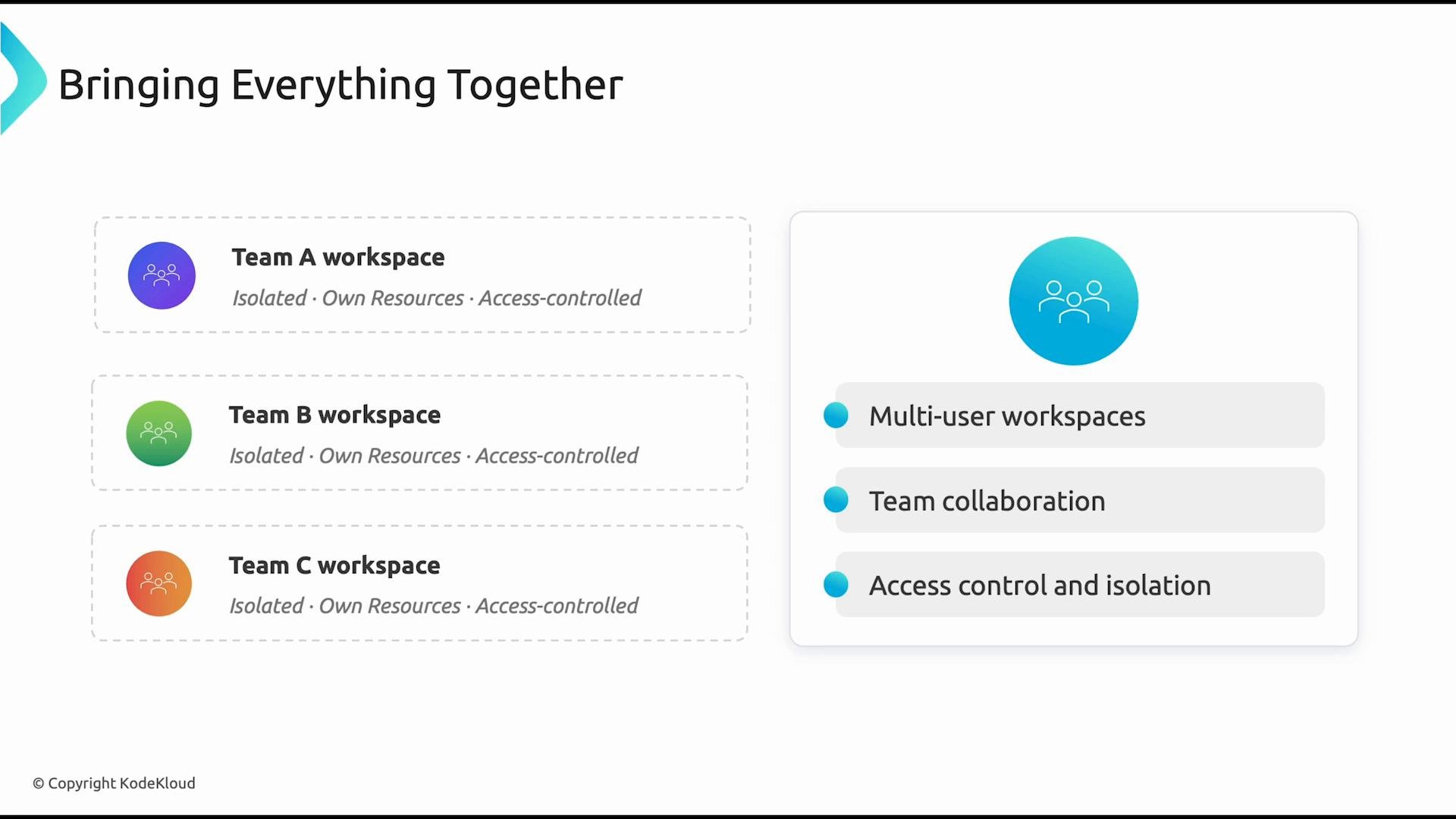
 For multi-team or enterprise environments, Profiles are essential. They provision isolated team workspaces and apply role-based access controls and resource quotas so teams can collaborate without interfering with each other’s workloads.
When running Kubeflow in a shared cluster, carefully design Profiles, namespace limits, and RBAC policies. Without proper isolation and quotas you risk noisy-neighbor problems or accidental privilege escalation.
Throughout this article you can see how Kubeflow’s Kubernetes-native components integrate to support the full machine learning lifecycle — from interactive experimentation to automated training, hyperparameter optimization, and production inference. The platform’s strength is in how these tools work together to provide a consistent, scalable MLOps foundation for teams.
For multi-team or enterprise environments, Profiles are essential. They provision isolated team workspaces and apply role-based access controls and resource quotas so teams can collaborate without interfering with each other’s workloads.
When running Kubeflow in a shared cluster, carefully design Profiles, namespace limits, and RBAC policies. Without proper isolation and quotas you risk noisy-neighbor problems or accidental privilege escalation.
Throughout this article you can see how Kubeflow’s Kubernetes-native components integrate to support the full machine learning lifecycle — from interactive experimentation to automated training, hyperparameter optimization, and production inference. The platform’s strength is in how these tools work together to provide a consistent, scalable MLOps foundation for teams.
 Links and references
* Kubeflow official docs: [https://kubeflow.org/](https://kubeflow.org/)
* Jupyter: [https://jupyter.org/](https://jupyter.org/)
* Argo Workflows: [https://argoproj.github.io/argo-workflows/](https://argoproj.github.io/argo-workflows/)
* Katib docs: [https://www.kubeflow.org/docs/components/katib/](https://www.kubeflow.org/docs/components/katib/)
* KServe docs: [https://kserve.github.io/](https://kserve.github.io/)
* Knative: [https://knative.dev/](https://knative.dev/)
This documentation is built and hosted on [Mintlify](https://mintlify.com), a developer documentation platform.
Links and references
* Kubeflow official docs: [https://kubeflow.org/](https://kubeflow.org/)
* Jupyter: [https://jupyter.org/](https://jupyter.org/)
* Argo Workflows: [https://argoproj.github.io/argo-workflows/](https://argoproj.github.io/argo-workflows/)
* Katib docs: [https://www.kubeflow.org/docs/components/katib/](https://www.kubeflow.org/docs/components/katib/)
* KServe docs: [https://kserve.github.io/](https://kserve.github.io/)
* Knative: [https://knative.dev/](https://knative.dev/)
This documentation is built and hosted on [Mintlify](https://mintlify.com), a developer documentation platform.