> ## Documentation Index
> Fetch the complete documentation index at: https://notes.kodekloud.com/llms.txt
> Use this file to discover all available pages before exploring further.
# Benefits of Kubeflow
> Overview of Kubeflow benefits including containerized reproducible pipelines, scalable Kubernetes training and serving, model registry, managed notebooks, KServe deployment, and cross environment portability
Kubeflow gives you a production-ready, Kubernetes-native platform for building and operating ML workflows. Its core strengths are modular, containerized pipelines; reproducible experiment tracking; scalable training and serving; integrated model lifecycle management; and portable deployments across clouds and on-premises clusters.
## Pipelines as containerized DAGs
With Kubeflow you author ML workflows as pipelines expressed as DAGs. Each pipeline step runs in its isolated container, so steps can fail independently, be retried, and take advantage of caching. That design makes it straightforward to automate end-to-end ML processes and to reason about failures, retries, and where to add observability.
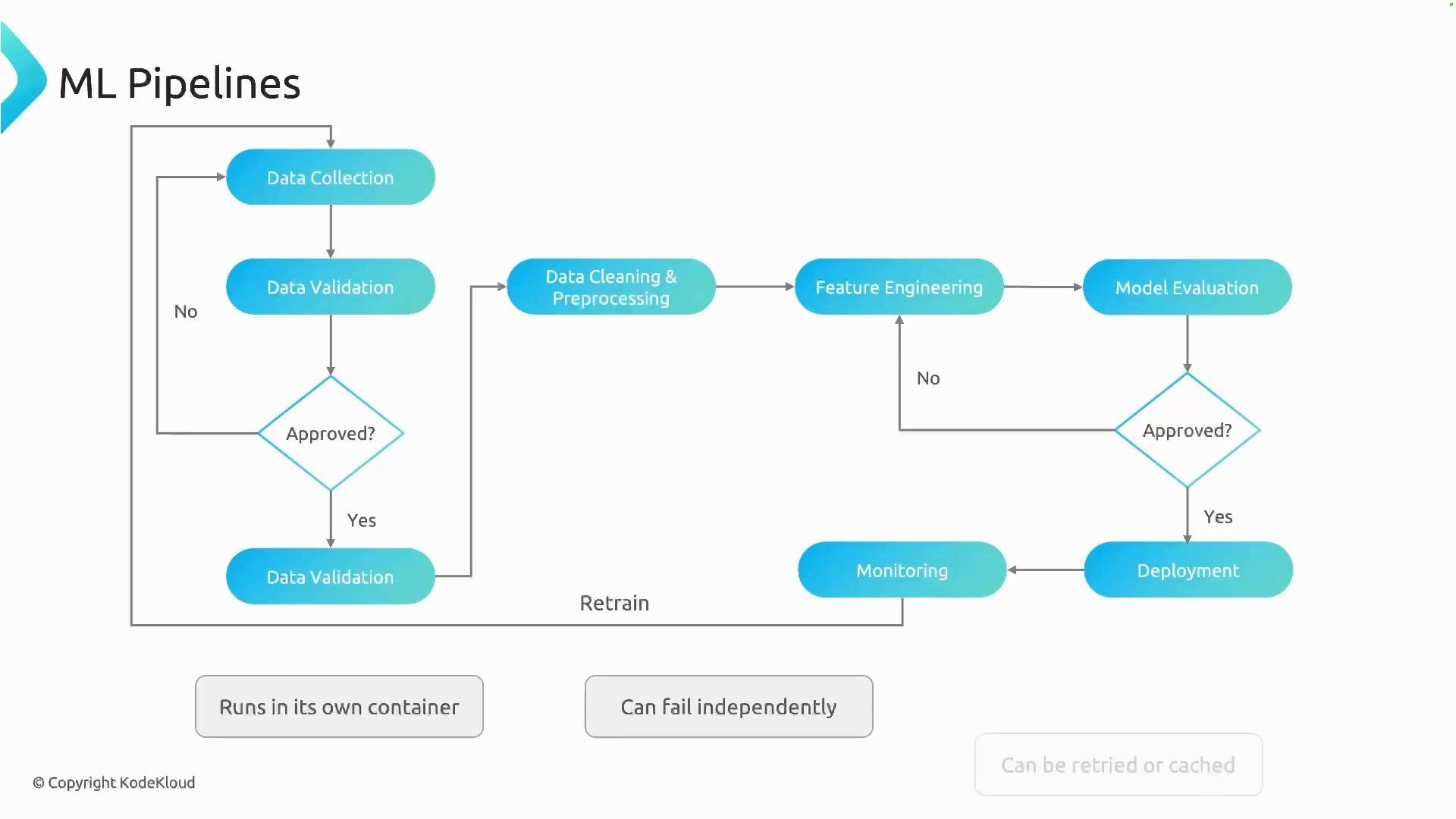 These containerized pipelines replace fragile ad-hoc scripts and chained notebooks. Instead of copying notebooks or wiring together shell scripts, you define pipeline components and their inputs/outputs declaratively so they can be scheduled, cached, retried, and executed consistently across environments.
## Reproducibility and experiment tracking
Reproducibility is a central benefit. Kubeflow captures pipeline definitions, run metadata, parameters, and environment details (for example, container images and resource requests). Because artifacts and pipeline specs can be versioned or tied to immutable artifacts, experiments can be rerun identically — making results explainable and enabling deterministic debugging so research becomes production-ready.
These containerized pipelines replace fragile ad-hoc scripts and chained notebooks. Instead of copying notebooks or wiring together shell scripts, you define pipeline components and their inputs/outputs declaratively so they can be scheduled, cached, retried, and executed consistently across environments.
## Reproducibility and experiment tracking
Reproducibility is a central benefit. Kubeflow captures pipeline definitions, run metadata, parameters, and environment details (for example, container images and resource requests). Because artifacts and pipeline specs can be versioned or tied to immutable artifacts, experiments can be rerun identically — making results explainable and enabling deterministic debugging so research becomes production-ready.
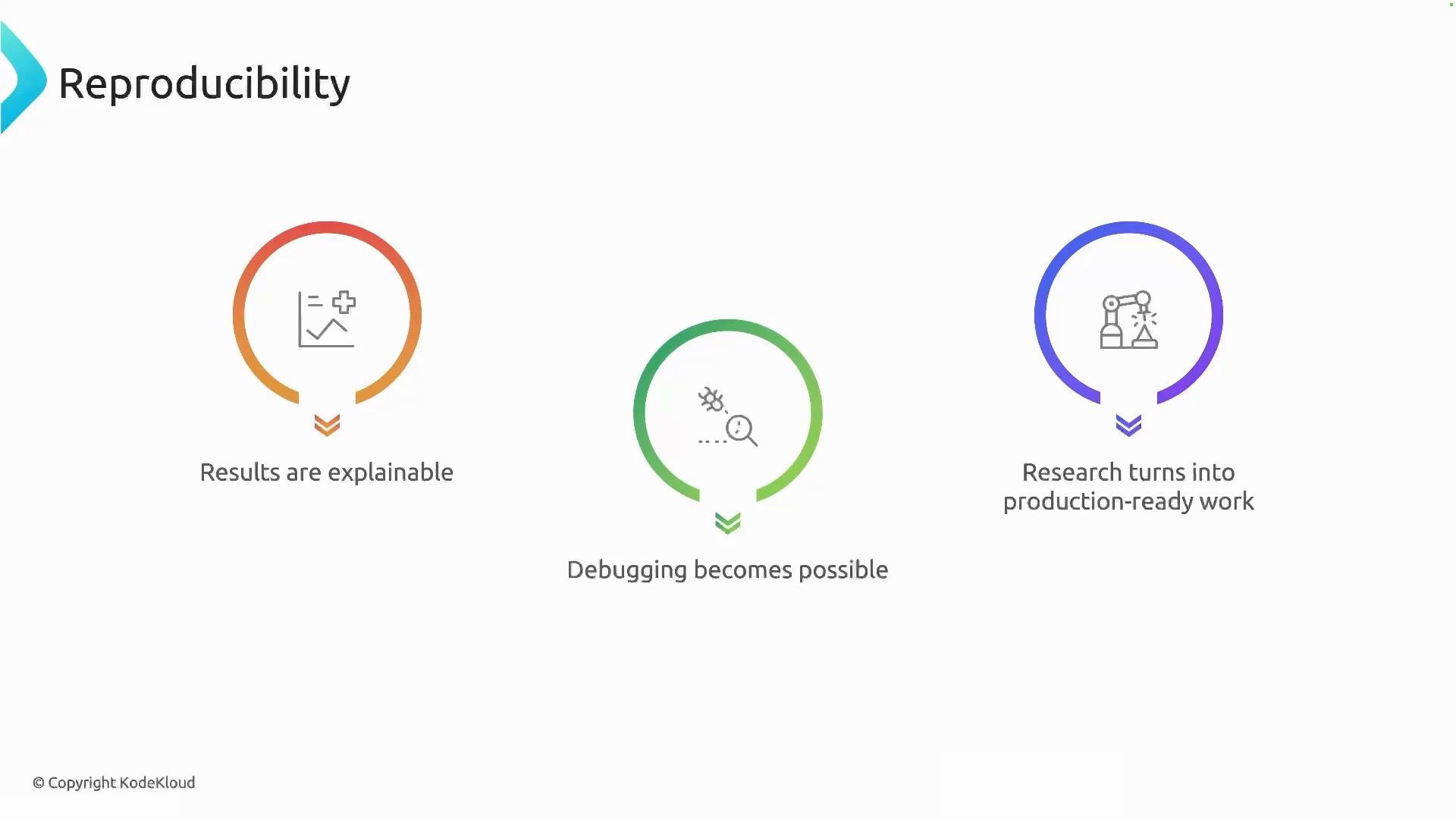 Track parameters, container image tags, and artifact locations for each run. This metadata is essential for comparing experiments, auditing results, and performing rollback to previous artifacts.
## Scalability on Kubernetes
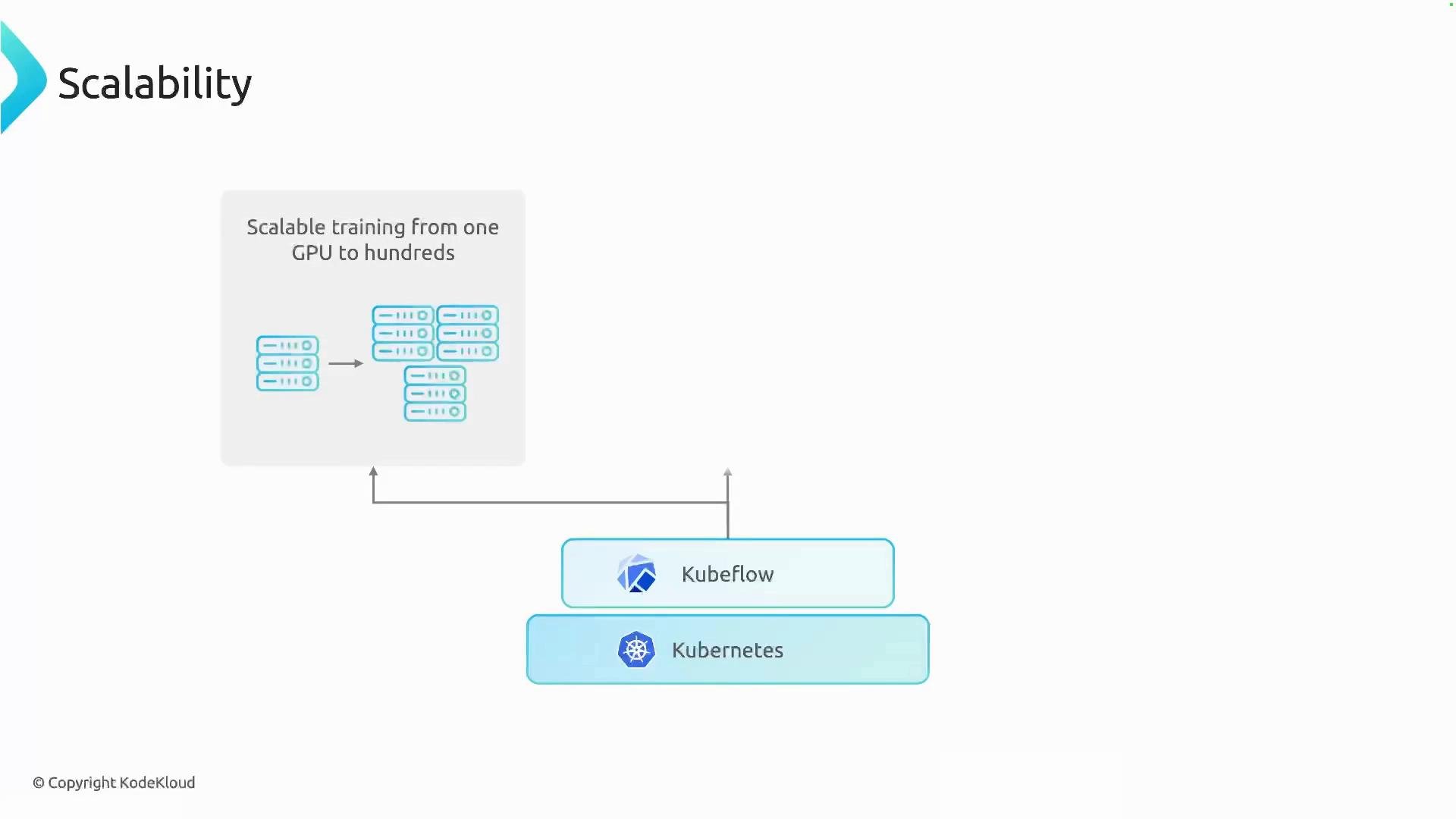
Kubeflow runs on Kubernetes, so training and inference workloads scale from a single GPU to many. Kubernetes schedules resources efficiently and supports multi-tenant isolation via namespaces and admission controls. This removes the need for manual server management, custom autoscaling code, and fragile orchestration logic.
Track parameters, container image tags, and artifact locations for each run. This metadata is essential for comparing experiments, auditing results, and performing rollback to previous artifacts.
## Scalability on Kubernetes
Kubeflow runs on Kubernetes, so training and inference workloads scale from a single GPU to many. Kubernetes schedules resources efficiently and supports multi-tenant isolation via namespaces and admission controls. This removes the need for manual server management, custom autoscaling code, and fragile orchestration logic.
 ## Model registry and metadata management
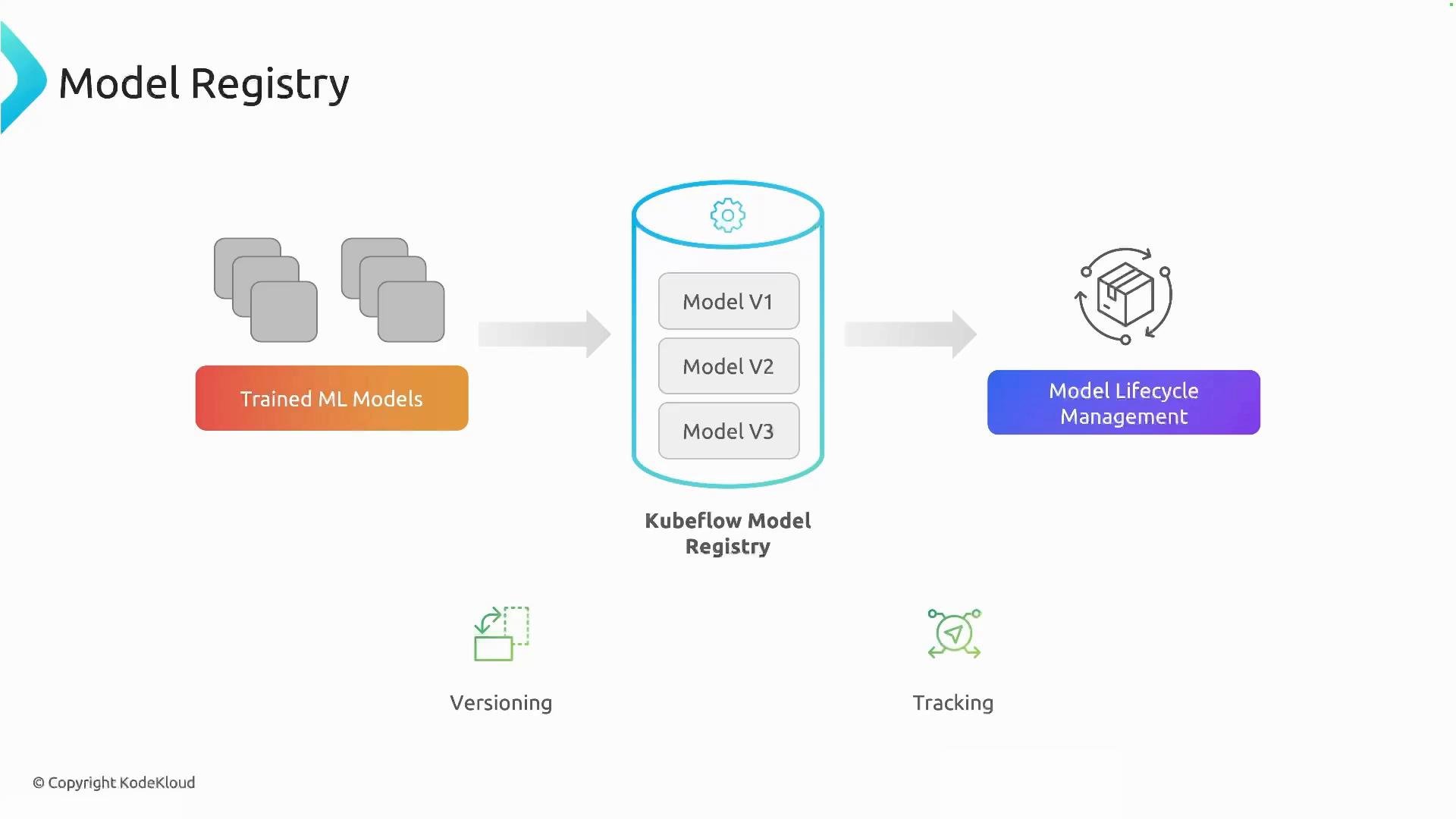
Kubeflow integrates metadata tracking and model registries so trained models are stored and managed through their lifecycle. Model versioning and metadata let teams correlate models with training data, hyperparameters, and evaluation metrics — similar to how Git tracks code, but for ML artifacts. That correlation is crucial for reproducible deployments and safe rollouts.
## Model registry and metadata management
Kubeflow integrates metadata tracking and model registries so trained models are stored and managed through their lifecycle. Model versioning and metadata let teams correlate models with training data, hyperparameters, and evaluation metrics — similar to how Git tracks code, but for ML artifacts. That correlation is crucial for reproducible deployments and safe rollouts.
 ## Notebooks and development environments
Data scientists commonly use Jupyter Notebooks for exploration. Kubeflow provides managed notebook servers with GPU access and namespace isolation so teams can run notebooks in consistent, shareable environments without interfering with other projects or resources.
## Model serving with KServe
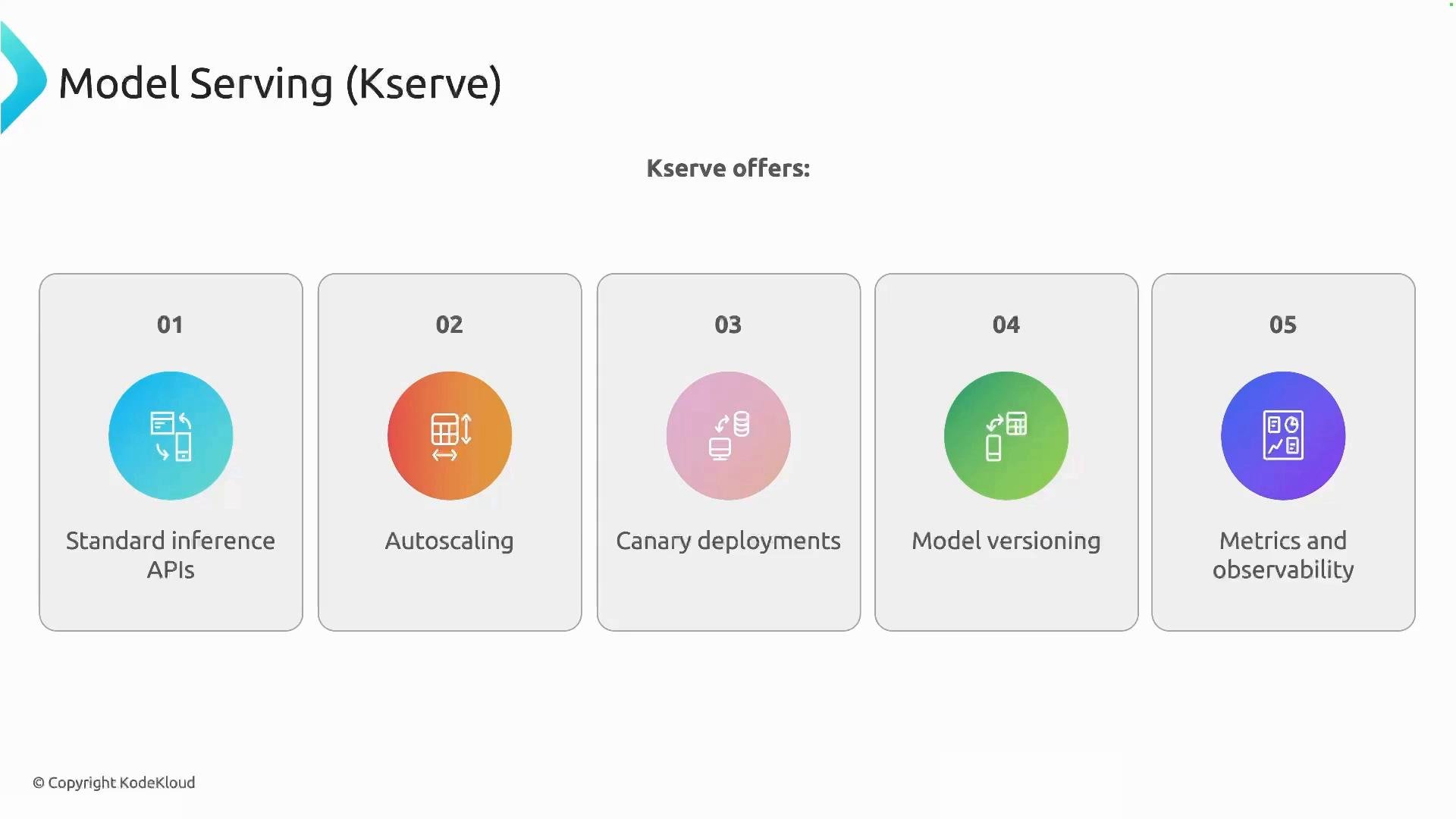
When models are ready for inference, Kubeflow supports serving via KServe. KServe simplifies model deployment and exposes standard inference APIs while providing built-in autoscaling, canary rollouts, model versioning, and observability. These features remove the need to build custom serving stacks (for example, a bespoke FastAPI + autoscaler + deployment pipeline).
* Learn more: [KServe Fundamentals: Serving ML Models on Kubernetes](https://learn.kodekloud.com/user/courses/kserve-fundamentals-serving-ml-models-on-kubernetes)
* Example lightweight REST framework often paired with custom endpoints: [FastAPI](https://fastapi.tiangolo.com)
## Notebooks and development environments
Data scientists commonly use Jupyter Notebooks for exploration. Kubeflow provides managed notebook servers with GPU access and namespace isolation so teams can run notebooks in consistent, shareable environments without interfering with other projects or resources.
## Model serving with KServe
When models are ready for inference, Kubeflow supports serving via KServe. KServe simplifies model deployment and exposes standard inference APIs while providing built-in autoscaling, canary rollouts, model versioning, and observability. These features remove the need to build custom serving stacks (for example, a bespoke FastAPI + autoscaler + deployment pipeline).
* Learn more: [KServe Fundamentals: Serving ML Models on Kubernetes](https://learn.kodekloud.com/user/courses/kserve-fundamentals-serving-ml-models-on-kubernetes)
* Example lightweight REST framework often paired with custom endpoints: [FastAPI](https://fastapi.tiangolo.com)
 ## Portability across environments
Because Kubeflow is open source and built on Kubernetes, it is portable across public clouds (AWS, GCP, Azure), on-premises clusters, and hybrid deployments. This portability lets teams standardize their ML platform independently of infrastructure vendors.
## Quick comparison: Benefits at a glance
| Benefit | What it provides | Why it matters |
| - | - | - |
| Pipelines as DAGs | Containerized, retryable steps with caching | Robust automation, easier debugging |
| Reproducibility | Run metadata, artifact versioning, environment capture | Deterministic experiments and audits |
| Scalability | Kubernetes-based autoscaling for training and serving | Efficient resource use from single GPU to cluster |
| Model registry & metadata | Versioning and lifecycle tracking of models | Traceability between data, code, and model |
| Notebooks | Managed, isolated notebook servers with GPU access | Consistent dev environments for teams |
| Serving (KServe) | Standard APIs, autoscaling, canary deployments | Faster, safer production deployments |
| Portability | Works across cloud and on-premises Kubernetes | Vendor-independent ML platform |
## Further reading and references
* [Kubernetes Basics](https://kubernetes.io/docs/concepts/overview/what-is-kubernetes/)
* [Kubeflow official documentation](https://www.kubeflow.org/)
* [KServe Fundamentals: Serving ML Models on Kubernetes](https://learn.kodekloud.com/user/courses/kserve-fundamentals-serving-ml-models-on-kubernetes)
* [FastAPI — high performance web APIs for Python](https://fastapi.tiangolo.com)
This documentation is built and hosted on [Mintlify](https://mintlify.com), a developer documentation platform.
## Portability across environments
Because Kubeflow is open source and built on Kubernetes, it is portable across public clouds (AWS, GCP, Azure), on-premises clusters, and hybrid deployments. This portability lets teams standardize their ML platform independently of infrastructure vendors.
## Quick comparison: Benefits at a glance
| Benefit | What it provides | Why it matters |
| - | - | - |
| Pipelines as DAGs | Containerized, retryable steps with caching | Robust automation, easier debugging |
| Reproducibility | Run metadata, artifact versioning, environment capture | Deterministic experiments and audits |
| Scalability | Kubernetes-based autoscaling for training and serving | Efficient resource use from single GPU to cluster |
| Model registry & metadata | Versioning and lifecycle tracking of models | Traceability between data, code, and model |
| Notebooks | Managed, isolated notebook servers with GPU access | Consistent dev environments for teams |
| Serving (KServe) | Standard APIs, autoscaling, canary deployments | Faster, safer production deployments |
| Portability | Works across cloud and on-premises Kubernetes | Vendor-independent ML platform |
## Further reading and references
* [Kubernetes Basics](https://kubernetes.io/docs/concepts/overview/what-is-kubernetes/)
* [Kubeflow official documentation](https://www.kubeflow.org/)
* [KServe Fundamentals: Serving ML Models on Kubernetes](https://learn.kodekloud.com/user/courses/kserve-fundamentals-serving-ml-models-on-kubernetes)
* [FastAPI — high performance web APIs for Python](https://fastapi.tiangolo.com)
This documentation is built and hosted on [Mintlify](https://mintlify.com), a developer documentation platform.