> ## Documentation Index
> Fetch the complete documentation index at: https://notes.kodekloud.com/llms.txt
> Use this file to discover all available pages before exploring further.
# Section Introduction
> How to productionize machine learning using Kubernetes with KServe for scalable model serving and Katib for automated hyperparameter optimization
Most machine learning work starts and often ends inside a notebook: train a model, check accuracy, maybe export a file — then consider the task done.
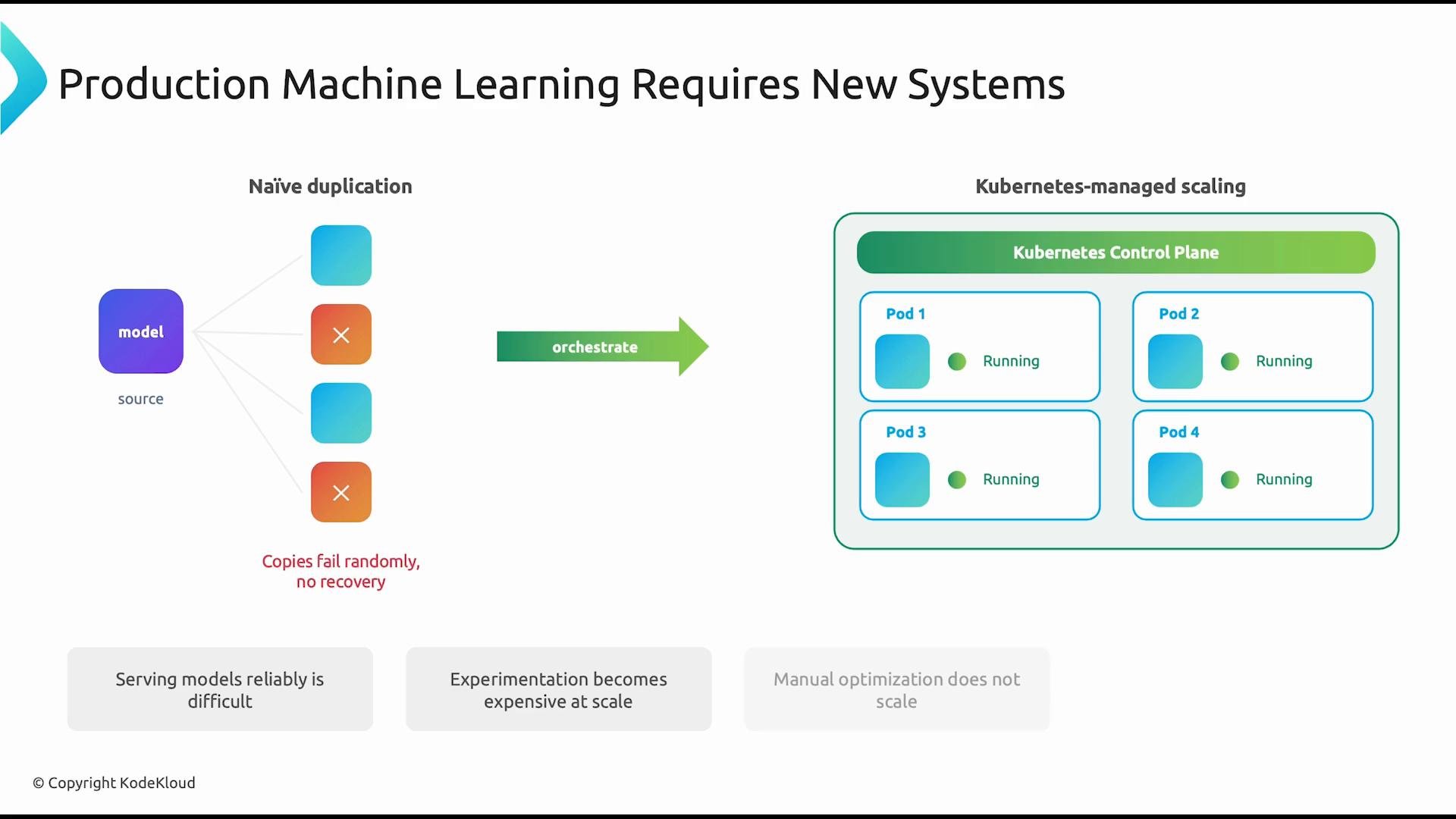
Production machine learning is different. When a model must serve predictions to applications, handle traffic, scale automatically, and continuously improve, it becomes an infrastructure problem. That shift—from a single notebook to a live, reliable service—is the focus of this section.
Operationalizing ML introduces new engineering questions:
* How do we expose models reliably through APIs?
* How do we scale inference for steady, bursty, or unpredictable traffic patterns?
* How do we monitor and continuously improve model performance in production?
* How do we automate experimentation (hyperparameter search) instead of manually tuning parameters?
Kubernetes provides the orchestration layer that addresses many of these questions. On top of Kubernetes, ML-focused systems handle model serving and autoscaling:
* KServe simplifies deploying models as scalable, production-ready inference services on Kubernetes.
* Knative provides serverless primitives for autoscaling and event-driven workloads.
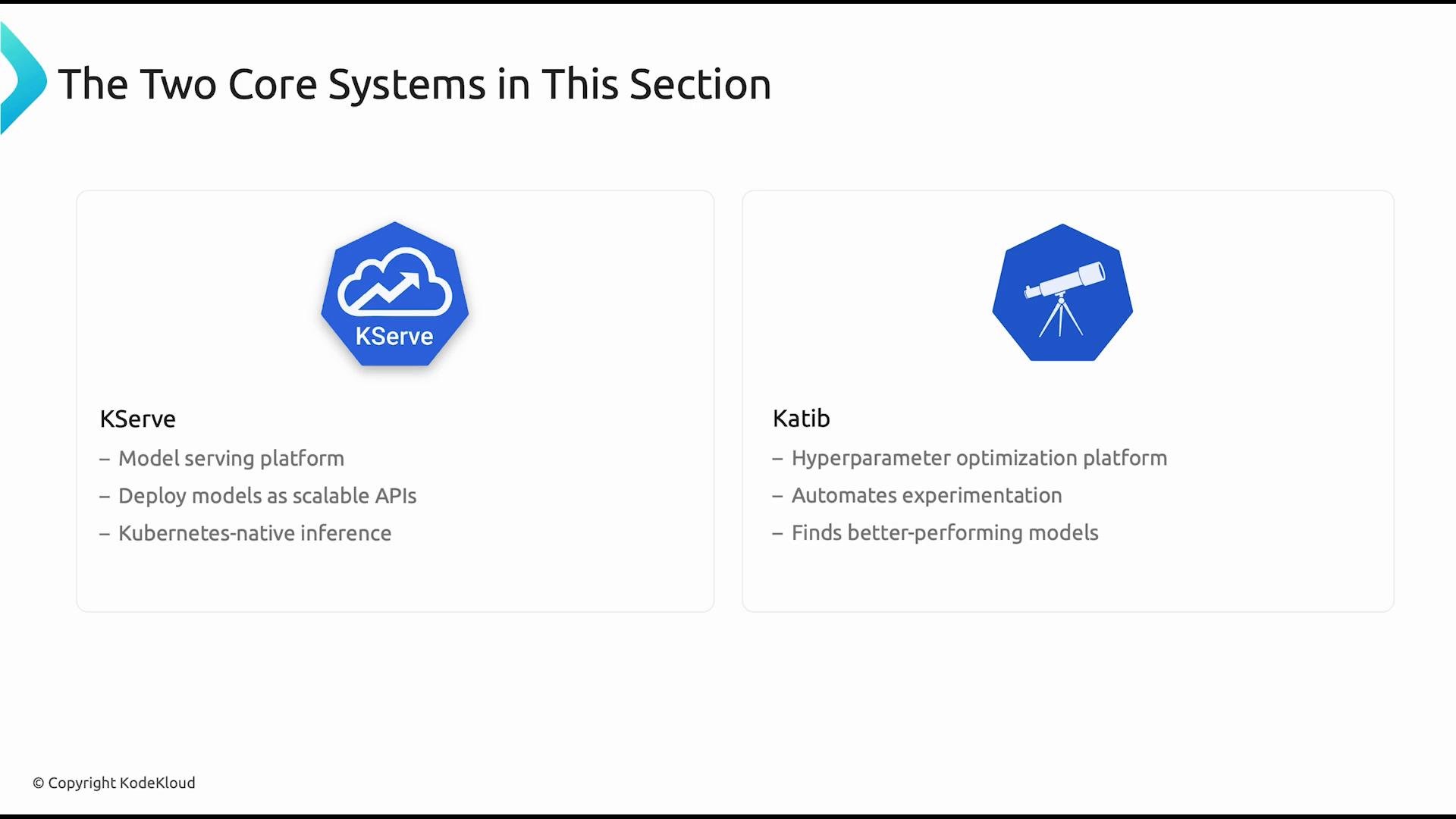
 This section concentrates on two core, complementary systems within the modern MLOps stack:
* [KServe](https://learn.kodekloud.com/user/courses/kserve-fundamentals-serving-ml-models-on-kubernetes) — a Kubernetes-native model serving platform that exposes models as scalable HTTP/gRPC inference APIs and integrates with autoscaling and Kubernetes networking.
* [Katib](https://learn.kodekloud.com/user/courses/kubeflow) — an automated hyperparameter optimization framework that runs experiments to discover better-performing model configurations.
This section concentrates on two core, complementary systems within the modern MLOps stack:
* [KServe](https://learn.kodekloud.com/user/courses/kserve-fundamentals-serving-ml-models-on-kubernetes) — a Kubernetes-native model serving platform that exposes models as scalable HTTP/gRPC inference APIs and integrates with autoscaling and Kubernetes networking.
* [Katib](https://learn.kodekloud.com/user/courses/kubeflow) — an automated hyperparameter optimization framework that runs experiments to discover better-performing model configurations.
 Together, KServe and Katib create a production-style ML workflow: automate experiments to find strong models, then serve the selected model reliably at scale.
What to expect in this section:
* A practical end-to-end example using the Iris dataset.
* Training a Random Forest model and evaluating how hyperparameters affect performance.
* Using Katib to automate hyperparameter search and run reproducible experiments.
* Deploying the optimized model with KServe and exposing it as a live inference API on Kubernetes.
Quick comparison
| Component | Primary role | Typical outcome |
| - | - | - |
| KServe | Model serving / inference | A production-ready inference endpoint (HTTP/gRPC) with autoscaling and observability |
| Katib | Hyperparameter optimization | Automated experiments that return optimal hyperparameters and improved model metrics |
Before you begin: ensure you have access to a Kubernetes cluster and a working `kubectl` context. Installing KServe and Katib requires cluster admin privileges. For guided installs and permissions, see the linked course pages above.
By the end of this section you will understand:
* Why ML in production is primarily an infrastructure problem.
* How Kubernetes enables reliable, scalable model serving.
* How Katib automates experimentation so teams can find better model configurations faster.
* How to combine these tools into repeatable, production-ready MLOps workflows.
Links and references
* [Kubernetes Basics](https://kubernetes.io/docs/concepts/overview/what-is-kubernetes/)
* [KServe course (KodeKloud)](https://learn.kodekloud.com/user/courses/kserve-fundamentals-serving-ml-models-on-kubernetes)
* [Katib / Kubeflow course (KodeKloud)](https://learn.kodekloud.com/user/courses/kubeflow)
* [Knative (serverless on Kubernetes)](https://knative.dev)
* [Fundamentals of MLOps (KodeKloud)](https://learn.kodekloud.com/user/courses/fundamentals-of-mlops)
This documentation is built and hosted on [Mintlify](https://mintlify.com), a developer documentation platform.
Together, KServe and Katib create a production-style ML workflow: automate experiments to find strong models, then serve the selected model reliably at scale.
What to expect in this section:
* A practical end-to-end example using the Iris dataset.
* Training a Random Forest model and evaluating how hyperparameters affect performance.
* Using Katib to automate hyperparameter search and run reproducible experiments.
* Deploying the optimized model with KServe and exposing it as a live inference API on Kubernetes.
Quick comparison
| Component | Primary role | Typical outcome |
| - | - | - |
| KServe | Model serving / inference | A production-ready inference endpoint (HTTP/gRPC) with autoscaling and observability |
| Katib | Hyperparameter optimization | Automated experiments that return optimal hyperparameters and improved model metrics |
Before you begin: ensure you have access to a Kubernetes cluster and a working `kubectl` context. Installing KServe and Katib requires cluster admin privileges. For guided installs and permissions, see the linked course pages above.
By the end of this section you will understand:
* Why ML in production is primarily an infrastructure problem.
* How Kubernetes enables reliable, scalable model serving.
* How Katib automates experimentation so teams can find better model configurations faster.
* How to combine these tools into repeatable, production-ready MLOps workflows.
Links and references
* [Kubernetes Basics](https://kubernetes.io/docs/concepts/overview/what-is-kubernetes/)
* [KServe course (KodeKloud)](https://learn.kodekloud.com/user/courses/kserve-fundamentals-serving-ml-models-on-kubernetes)
* [Katib / Kubeflow course (KodeKloud)](https://learn.kodekloud.com/user/courses/kubeflow)
* [Knative (serverless on Kubernetes)](https://knative.dev)
* [Fundamentals of MLOps (KodeKloud)](https://learn.kodekloud.com/user/courses/fundamentals-of-mlops)
This documentation is built and hosted on [Mintlify](https://mintlify.com), a developer documentation platform.