> ## Documentation Index
> Fetch the complete documentation index at: https://notes.kodekloud.com/llms.txt
> Use this file to discover all available pages before exploring further.
# Customizing Component Image
> How to control container images and dependencies for Kubeflow Pipelines components, tradeoffs of runtime installs, and when to build custom images
In this lesson we'll cover how to customize the container image that runs a Kubeflow Pipelines (KFP) component. Understanding the runtime environment — the container image, Python version, and installed packages — is essential to make pipelines reproducible, performant, and reliable.
KFP lets you express workflows as Python code, but each step executes remotely inside a container. That runtime is governed by Kubernetes, so we need to think in terms of containers (images) — not just local Python scripts.
Why this matters
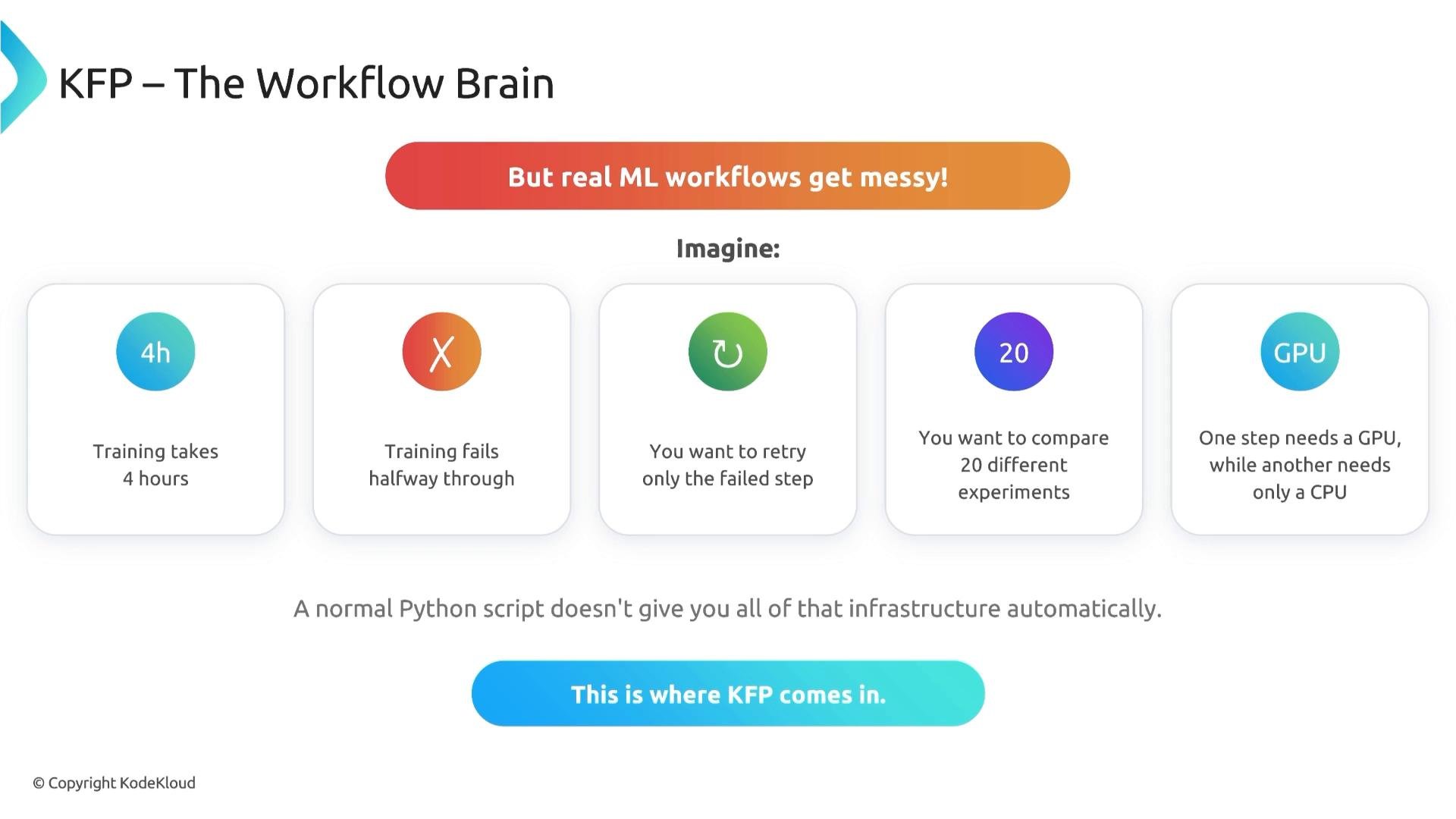
* Local scripts are convenient for prototyping but don't provide retries, resource scheduling, isolated environments, or experiment orchestration.
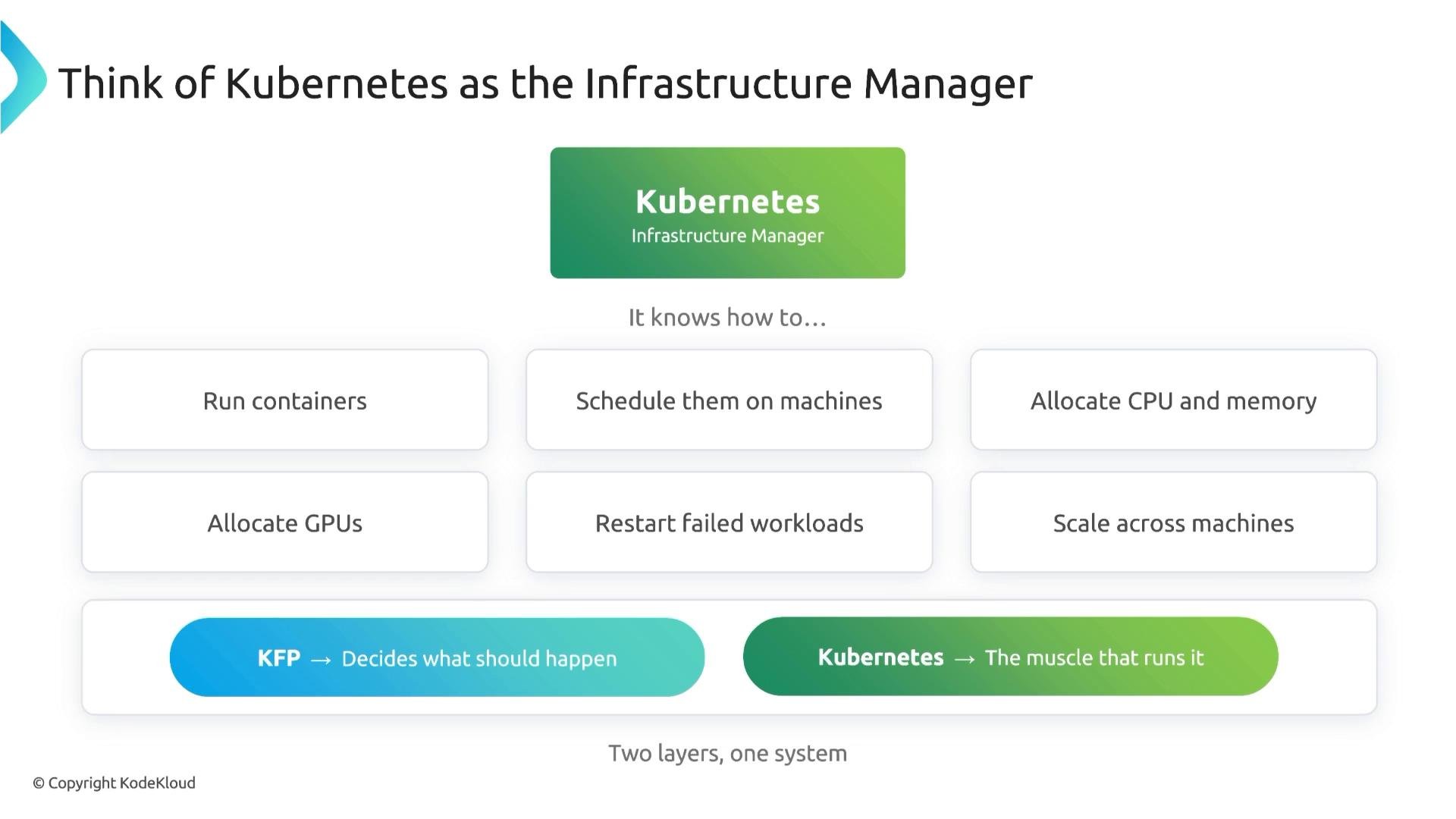
* KFP turns Python functions into managed steps and delegates execution to Kubernetes, which runs containers on cluster nodes, allocates CPU/GPU, restarts failed workloads, and handles scaling.
Think of KFP as the conductor and Kubernetes as the infrastructure manager.
 The conductor (KFP) defines what runs and when. Kubernetes runs the containers that execute each component’s code. The container image determines the execution environment — OS, Python interpreter, and preinstalled packages — so controlling that image is how you control component behavior and reproducibility.
 From function to component
* In KFP, components are the building blocks of a pipeline. You write Python functions and convert them into remote components with `@dsl.component`.
* Each component executes in its own container created by the KFP backend as Kubernetes resources (pods, jobs, etc.).
Example — simple functions converted to components:
```python theme={null}
from kfp import dsl
@dsl.component
def load_data():
print("Loading data")
@dsl.component
def train_model():
print("Training model")
@dsl.pipeline
def my_pipeline():
load_task = load_data()
train_task = train_model().after(load_task)
```
Making components self-contained
* To improve portability, put imports inside the component function so the component clearly declares its runtime dependencies.
```python theme={null}
@dsl.component
def load_data():
from sklearn.datasets import load_iris
iris = load_iris()
print(iris.data.shape)
```
Where does that code run?
* Each component runs inside a container image. Your local dev environment may differ from that image.
* The image determines the Python version and OS-level libraries available to the component.
Base images and on-start installs
* KFP’s `@dsl.component` supports a `base_image` parameter to specify the image (for example, `python:3.10-slim`).
* You can also use `packages_to_install` to pip-install dependencies at component startup.
Example — specifying a base image:
```python theme={null}
from kfp import dsl
@dsl.component(base_image="python:3.10-slim")
def check_environment():
import sys
print(sys.version)
```
Example — installing Python packages at startup:
```python theme={null}
from kfp import dsl
@dsl.component(
base_image="python:3.10-slim",
packages_to_install=[
"pandas",
"scikit-learn"
]
)
def load_data():
from sklearn.datasets import load_iris
iris = load_iris()
print(iris.data.shape)
```
Runtime installation is convenient for quick prototyping. However, it has operational trade-offs.
From function to component
* In KFP, components are the building blocks of a pipeline. You write Python functions and convert them into remote components with `@dsl.component`.
* Each component executes in its own container created by the KFP backend as Kubernetes resources (pods, jobs, etc.).
Example — simple functions converted to components:
```python theme={null}
from kfp import dsl
@dsl.component
def load_data():
print("Loading data")
@dsl.component
def train_model():
print("Training model")
@dsl.pipeline
def my_pipeline():
load_task = load_data()
train_task = train_model().after(load_task)
```
Making components self-contained
* To improve portability, put imports inside the component function so the component clearly declares its runtime dependencies.
```python theme={null}
@dsl.component
def load_data():
from sklearn.datasets import load_iris
iris = load_iris()
print(iris.data.shape)
```
Where does that code run?
* Each component runs inside a container image. Your local dev environment may differ from that image.
* The image determines the Python version and OS-level libraries available to the component.
Base images and on-start installs
* KFP’s `@dsl.component` supports a `base_image` parameter to specify the image (for example, `python:3.10-slim`).
* You can also use `packages_to_install` to pip-install dependencies at component startup.
Example — specifying a base image:
```python theme={null}
from kfp import dsl
@dsl.component(base_image="python:3.10-slim")
def check_environment():
import sys
print(sys.version)
```
Example — installing Python packages at startup:
```python theme={null}
from kfp import dsl
@dsl.component(
base_image="python:3.10-slim",
packages_to_install=[
"pandas",
"scikit-learn"
]
)
def load_data():
from sklearn.datasets import load_iris
iris = load_iris()
print(iris.data.shape)
```
Runtime installation is convenient for quick prototyping. However, it has operational trade-offs.
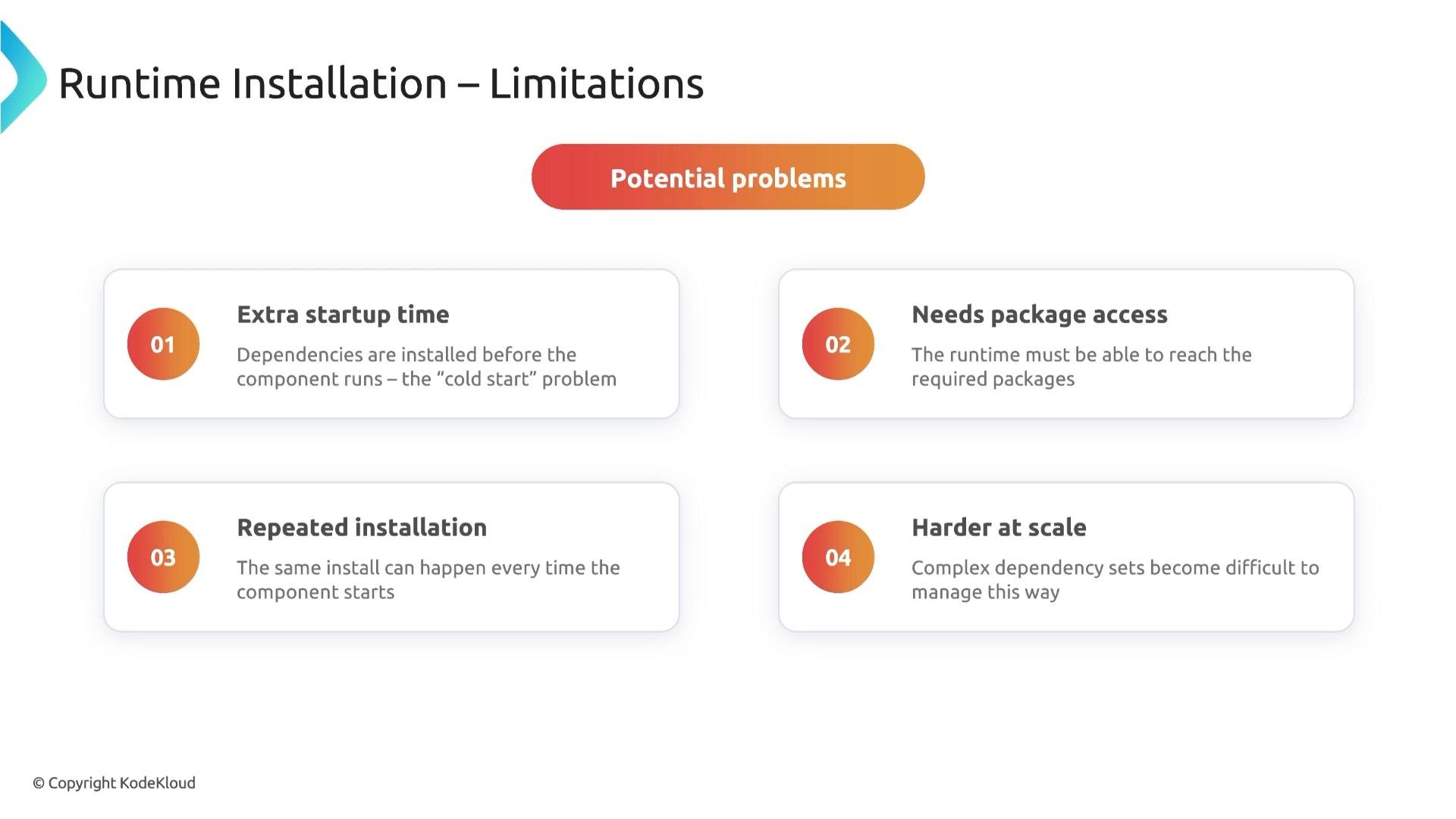 Use `base_image` and `packages_to_install` for rapid prototyping. For production or large-scale pipelines, build a custom image with your dependencies preinstalled to reduce cold-start times and improve reproducibility.
Comparing approaches
| Approach | Pros | Cons | When to use |
| - | - | - | - |
| `base_image` + `packages_to_install` | Fast to iterate; no build pipeline required | Slower startup, repeated installs, requires network access to PyPI, less reproducible | Local development, quick experiments, demos |
| Prebuilt custom image (Docker/OCI) | Faster cold-start, deterministic dependencies, better for scale | Requires Docker/CI build step and image registry | Production, large-scale runs, reproducible experiments |
Tips for building custom images
* Start from an official base (e.g., `python:3.10-slim`) and install system libs first (apt packages) before Python packages.
* Pin package versions in `requirements.txt` and build image in CI to ensure reproducibility.
* Push images to a registry accessible by your Kubernetes cluster (e.g., Docker Hub, GCR, ECR, or a private registry).
* Use multi-stage builds to reduce final image size and include only necessary runtime artifacts.
Example Dockerfile (conceptual)
```dockerfile theme={null}
FROM python:3.10-slim
# Install system dependencies first
RUN apt-get update && apt-get install -y build-essential libpq-dev --no-install-recommends \
&& rm -rf /var/lib/apt/lists/*
# Install Python dependencies
COPY requirements.txt .
RUN pip install --no-cache-dir -r requirements.txt
# Add your component code (optional)
COPY component.py /app/component.py
WORKDIR /app
ENTRYPOINT ["python", "component.py"]
```
Key takeaway
* Customizing the component image gives you control over the runtime environment. For prototypes, use `base_image` plus `packages_to_install`. For production or large-scale scenarios, build and maintain custom images to reduce startup time, ensure dependency reproducibility, and simplify operations.
Links and references
* [Kubeflow Pipelines documentation](https://www.kubeflow.org/docs/components/pipelines/)
* [Kubernetes documentation](https://kubernetes.io/docs/)
* [PyPI — Python Package Index](https://pypi.org/)
This documentation is built and hosted on [Mintlify](https://mintlify.com), a developer documentation platform.
Use `base_image` and `packages_to_install` for rapid prototyping. For production or large-scale pipelines, build a custom image with your dependencies preinstalled to reduce cold-start times and improve reproducibility.
Comparing approaches
| Approach | Pros | Cons | When to use |
| - | - | - | - |
| `base_image` + `packages_to_install` | Fast to iterate; no build pipeline required | Slower startup, repeated installs, requires network access to PyPI, less reproducible | Local development, quick experiments, demos |
| Prebuilt custom image (Docker/OCI) | Faster cold-start, deterministic dependencies, better for scale | Requires Docker/CI build step and image registry | Production, large-scale runs, reproducible experiments |
Tips for building custom images
* Start from an official base (e.g., `python:3.10-slim`) and install system libs first (apt packages) before Python packages.
* Pin package versions in `requirements.txt` and build image in CI to ensure reproducibility.
* Push images to a registry accessible by your Kubernetes cluster (e.g., Docker Hub, GCR, ECR, or a private registry).
* Use multi-stage builds to reduce final image size and include only necessary runtime artifacts.
Example Dockerfile (conceptual)
```dockerfile theme={null}
FROM python:3.10-slim
# Install system dependencies first
RUN apt-get update && apt-get install -y build-essential libpq-dev --no-install-recommends \
&& rm -rf /var/lib/apt/lists/*
# Install Python dependencies
COPY requirements.txt .
RUN pip install --no-cache-dir -r requirements.txt
# Add your component code (optional)
COPY component.py /app/component.py
WORKDIR /app
ENTRYPOINT ["python", "component.py"]
```
Key takeaway
* Customizing the component image gives you control over the runtime environment. For prototypes, use `base_image` plus `packages_to_install`. For production or large-scale scenarios, build and maintain custom images to reduce startup time, ensure dependency reproducibility, and simplify operations.
Links and references
* [Kubeflow Pipelines documentation](https://www.kubeflow.org/docs/components/pipelines/)
* [Kubernetes documentation](https://kubernetes.io/docs/)
* [PyPI — Python Package Index](https://pypi.org/)
This documentation is built and hosted on [Mintlify](https://mintlify.com), a developer documentation platform.