> ## Documentation Index
> Fetch the complete documentation index at: https://notes.kodekloud.com/llms.txt
> Use this file to discover all available pages before exploring further.
# Summary Closure and Limitation of HPA VPA
> Comparison and guidance on Kubernetes Horizontal Pod Autoscaler and Vertical Pod Autoscaler, differences, limitations, interactions, and practical recommendations for choosing and combining them
This article summarizes the key differences, strengths, and limitations of the Horizontal Pod Autoscaler (HPA) and the Vertical Pod Autoscaler (VPA). Use this guidance to choose the right autoscaling strategy for your workloads and to understand practical caveats when combining autoscalers.
Overview — HPA vs VPA (high-level)
* HPA scales the number of pod replicas (horizontal scaling). It adds or removes instances of the same pod spec to meet traffic demand.
* VPA adjusts pod CPU and memory requests (and optionally limits) (vertical scaling). It provides recommendations or directly changes resource requests, which may cause pod restarts to apply new values.
HPA usually fits stateless services that scale by adding replicas. VPA is better for stateful, resource-constrained, or single-replica workloads where per-pod resource increases are required.
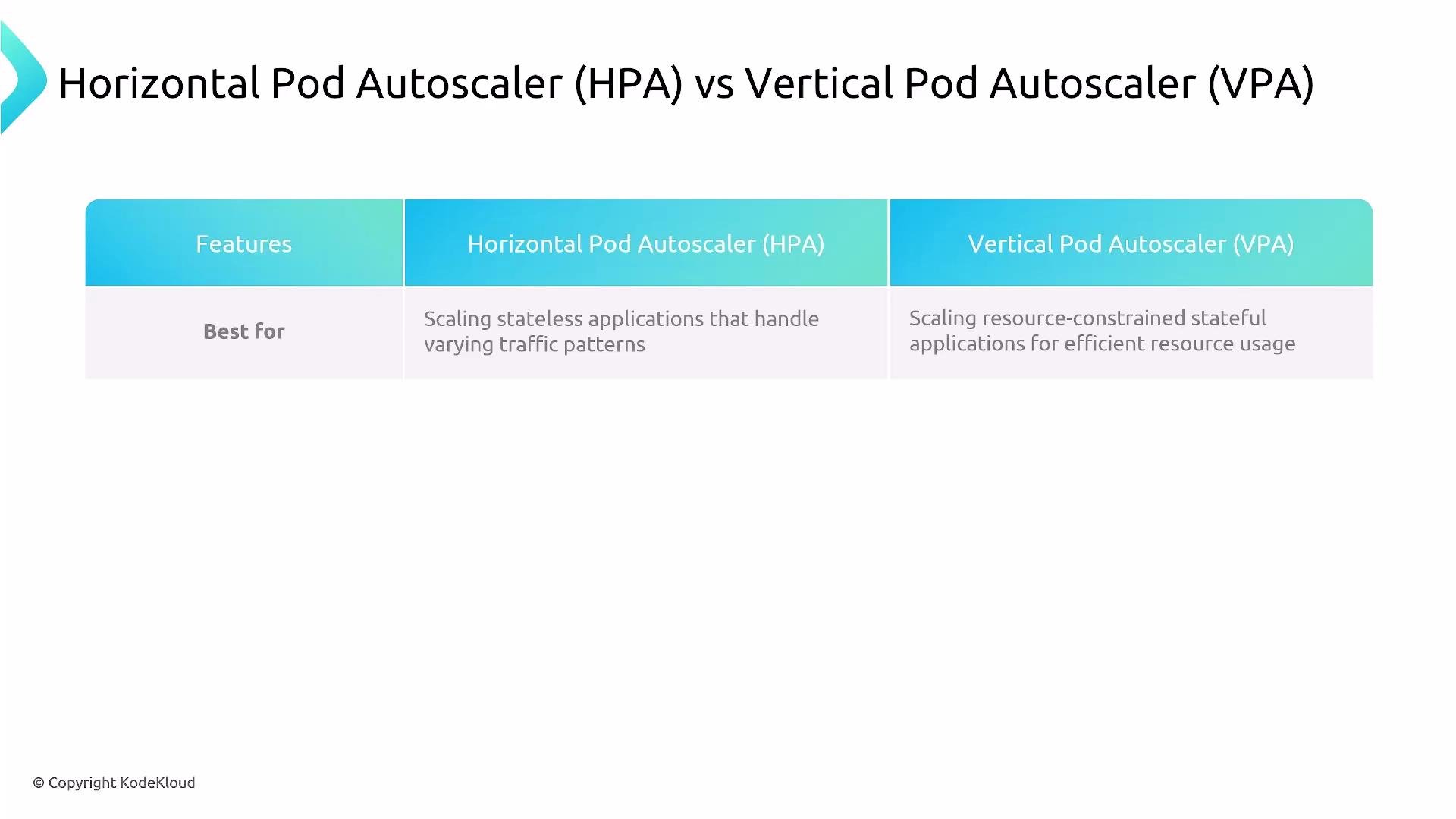 HPA vs VPA — quick comparison
| Aspect | HPA | VPA |
| ---------------- | ------------------------------------------------------------------ | ----------------------------------------------------------------------------------------- |
| Primary action | Scale replicas horizontally | Adjust CPU/memory requests vertically |
| Typical use case | Stateless, load-driven services | Stateful or single-replica services, tuning requests |
| Metrics used | CPU (native) + memory/custom/external via Metrics API and adapters | CPU and memory usage (historical + live); not driven by custom metrics |
| Pod restarts | No (scales without changing pod spec) | May evict/recreate pods when applying new requests |
| Controller scope | Any pods managed by controllers | Only updates controller-managed pods (Deployments, StatefulSets, DaemonSets, ReplicaSets) |
Key technical details and gotchas
Metrics support
* HPA:
* Natively supports CPU (via the metrics-server).
* Can use memory and custom/external metrics via the Kubernetes Metrics API and adapters (for example, Prometheus Adapter or KEDA).
* Use HPA v2+ for multiple metric types (CPU, memory, object/external/custom metrics).
* VPA:
* Focuses on CPU and memory recommendations and enforcement.
* Uses historical and current resource usage to recommend or set requests.
* VPA does not consume custom metrics to drive resizing.
How VPA applies changes
* VPA supports different update modes:
| Mode | Behavior |
| ---------- | --------------------------------------------------------------------------------------------------------------- |
| `Off` | Only supplies recommendations; does not change pod specs. |
| `Initial` | Applies recommendations only at pod creation time via the admission controller; existing pods are not evicted. |
| `Recreate` | Evicts pods so controllers can recreate them with updated requests; VPA does not perform in-place live updates. |
| `Auto` | VPA will evict and recreate pods automatically to apply new resource requests. |
* The VPA Admission Controller can inject recommended resource requests at pod creation time so new pods start with the recommended values.
* Because VPA adjusts pod resource requests by evicting and recreating pods, it can cause service disruption for workloads sensitive to restarts.
Controller-managed pods only
* VPA will only update pods that are managed by a controller (Deployments, StatefulSets, DaemonSets, ReplicaSets). Standalone/unmanaged Pods are not supported.
Interaction and potential conflicts between HPA and VPA
* HPA commonly computes CPU utilization relative to the pod’s CPU request. If VPA changes those requests while HPA is using CPU-based scaling, you can get feedback loops, oscillations, or unpredictable scaling.
* Recommended patterns to avoid conflicts:
* Use VPA in `Off` or `Initial` mode to set reasonable requests, then let HPA handle replica scaling.
* Or, run HPA on custom or external metrics (not CPU/memory) while VPA manages CPU/memory requests.
* If both must run on CPU/memory, test extensively in staging to observe interactions and tune policies.
* Always validate combined HPA+VPA behavior in a representative environment.
Avoid running HPA on CPU/memory while VPA is in an active update mode without careful testing — concurrent changes to pod requests can create unstable or unpredictable autoscaling behavior.
Operational considerations
Out-of-memory and cluster capacity
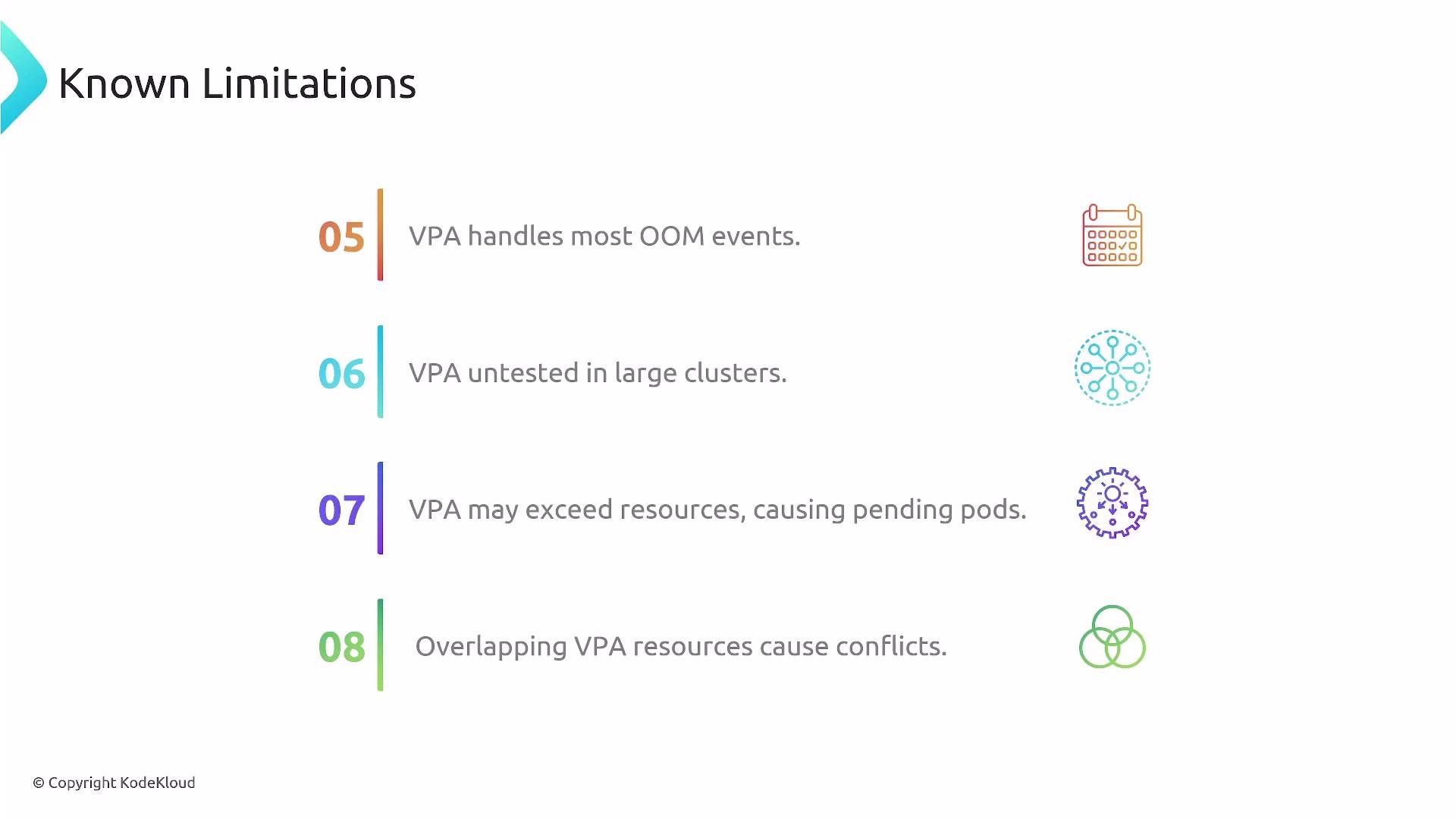
* VPA can reduce OOM events by increasing resource requests to match observed usage.
* If VPA increases requests across many pods simultaneously, scheduling capacity may be exhausted and pods can become `Pending`.
* Use a Cluster Autoscaler or other cluster-scaling solution to provision additional nodes when VPA-driven increases are expected. Still, verify behavior at production-like scale.
Overlapping VPAs
* Multiple VPA objects selecting the same pods will conflict. Ensure a single VPA controls a given set of pods or that selectors do not overlap.
Where VPA is most appropriate
* VPA is best for workloads where horizontal scaling is impractical: single-instance stateful services, databases, or apps with large per-pod state.
* For typical stateless web services, HPA (or KEDA for event-driven scaling) is usually the preferred approach.
* For complex stateful platforms, operators or custom controllers are often used instead of, or in addition to, VPA.
HPA vs VPA — quick comparison
| Aspect | HPA | VPA |
| ---------------- | ------------------------------------------------------------------ | ----------------------------------------------------------------------------------------- |
| Primary action | Scale replicas horizontally | Adjust CPU/memory requests vertically |
| Typical use case | Stateless, load-driven services | Stateful or single-replica services, tuning requests |
| Metrics used | CPU (native) + memory/custom/external via Metrics API and adapters | CPU and memory usage (historical + live); not driven by custom metrics |
| Pod restarts | No (scales without changing pod spec) | May evict/recreate pods when applying new requests |
| Controller scope | Any pods managed by controllers | Only updates controller-managed pods (Deployments, StatefulSets, DaemonSets, ReplicaSets) |
Key technical details and gotchas
Metrics support
* HPA:
* Natively supports CPU (via the metrics-server).
* Can use memory and custom/external metrics via the Kubernetes Metrics API and adapters (for example, Prometheus Adapter or KEDA).
* Use HPA v2+ for multiple metric types (CPU, memory, object/external/custom metrics).
* VPA:
* Focuses on CPU and memory recommendations and enforcement.
* Uses historical and current resource usage to recommend or set requests.
* VPA does not consume custom metrics to drive resizing.
How VPA applies changes
* VPA supports different update modes:
| Mode | Behavior |
| ---------- | --------------------------------------------------------------------------------------------------------------- |
| `Off` | Only supplies recommendations; does not change pod specs. |
| `Initial` | Applies recommendations only at pod creation time via the admission controller; existing pods are not evicted. |
| `Recreate` | Evicts pods so controllers can recreate them with updated requests; VPA does not perform in-place live updates. |
| `Auto` | VPA will evict and recreate pods automatically to apply new resource requests. |
* The VPA Admission Controller can inject recommended resource requests at pod creation time so new pods start with the recommended values.
* Because VPA adjusts pod resource requests by evicting and recreating pods, it can cause service disruption for workloads sensitive to restarts.
Controller-managed pods only
* VPA will only update pods that are managed by a controller (Deployments, StatefulSets, DaemonSets, ReplicaSets). Standalone/unmanaged Pods are not supported.
Interaction and potential conflicts between HPA and VPA
* HPA commonly computes CPU utilization relative to the pod’s CPU request. If VPA changes those requests while HPA is using CPU-based scaling, you can get feedback loops, oscillations, or unpredictable scaling.
* Recommended patterns to avoid conflicts:
* Use VPA in `Off` or `Initial` mode to set reasonable requests, then let HPA handle replica scaling.
* Or, run HPA on custom or external metrics (not CPU/memory) while VPA manages CPU/memory requests.
* If both must run on CPU/memory, test extensively in staging to observe interactions and tune policies.
* Always validate combined HPA+VPA behavior in a representative environment.
Avoid running HPA on CPU/memory while VPA is in an active update mode without careful testing — concurrent changes to pod requests can create unstable or unpredictable autoscaling behavior.
Operational considerations
Out-of-memory and cluster capacity
* VPA can reduce OOM events by increasing resource requests to match observed usage.
* If VPA increases requests across many pods simultaneously, scheduling capacity may be exhausted and pods can become `Pending`.
* Use a Cluster Autoscaler or other cluster-scaling solution to provision additional nodes when VPA-driven increases are expected. Still, verify behavior at production-like scale.
Overlapping VPAs
* Multiple VPA objects selecting the same pods will conflict. Ensure a single VPA controls a given set of pods or that selectors do not overlap.
Where VPA is most appropriate
* VPA is best for workloads where horizontal scaling is impractical: single-instance stateful services, databases, or apps with large per-pod state.
* For typical stateless web services, HPA (or KEDA for event-driven scaling) is usually the preferred approach.
* For complex stateful platforms, operators or custom controllers are often used instead of, or in addition to, VPA.
 Practical recommendations
* Prefer HPA for stateless workloads that scale horizontally with variable traffic.
* Use VPA for resource-constrained or stateful workloads where increasing per-pod resources makes sense.
* If you need both vertical tuning and horizontal autoscaling:
* Use VPA in `Off` or `Initial` mode to establish recommended requests, then use HPA to scale replicas based on traffic or external metrics.
* If HPA must scale on custom/external metrics, integrate via the Kubernetes Metrics API and adapters (for example, Prometheus Adapter, KEDA, or other external metrics providers).
* Always test autoscaling behavior in a staging environment that matches production load patterns and cluster size. Monitor for pod evictions, pending pods, and scheduler limitations.
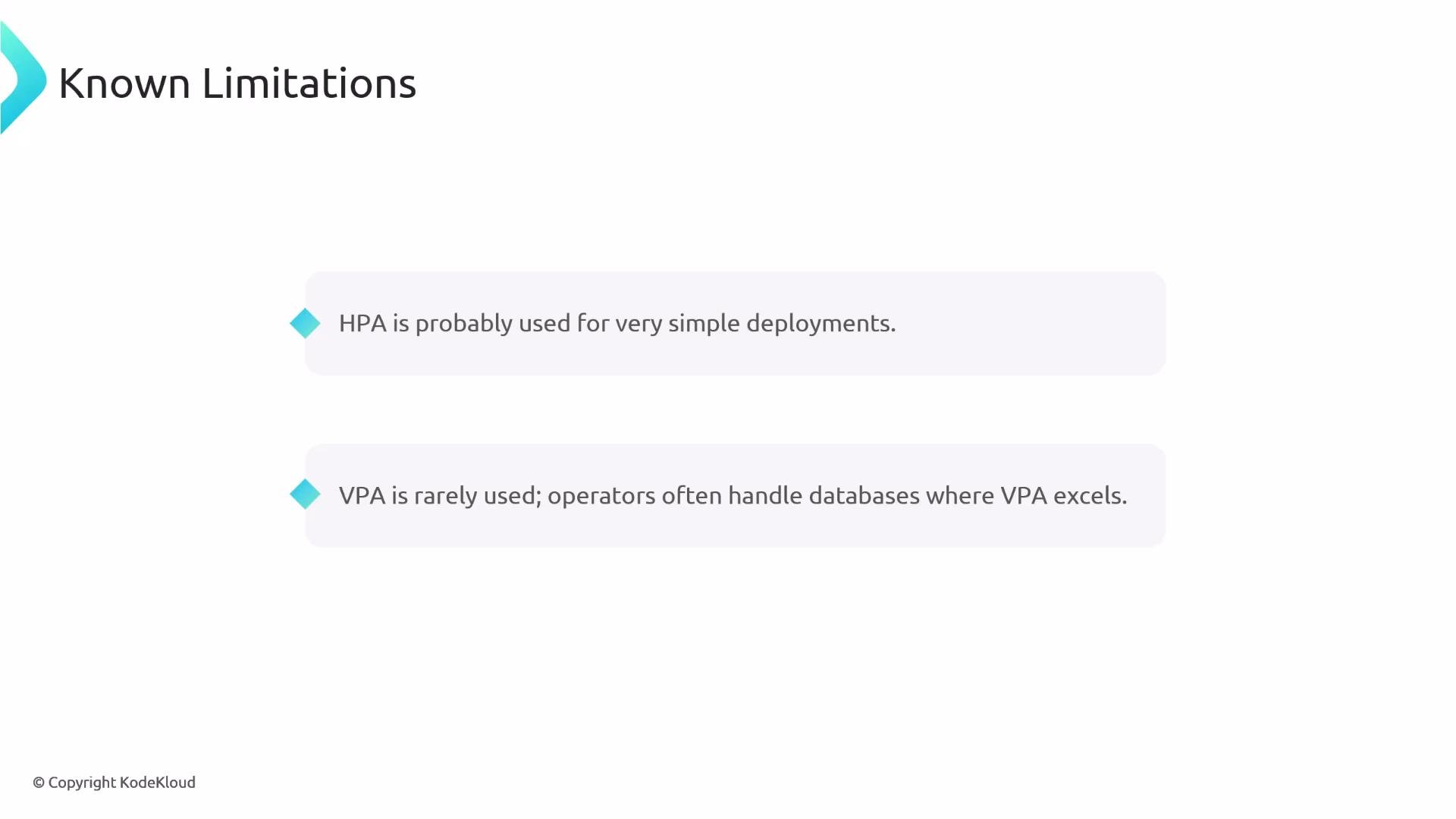
As of 2025, HPA remains widely used for simple, stateless deployments. VPA is less common for general-purpose deployments but is valuable for specialized workloads (for example, databases) where operators or custom controllers often complement or replace VPA functionality.
Practical recommendations
* Prefer HPA for stateless workloads that scale horizontally with variable traffic.
* Use VPA for resource-constrained or stateful workloads where increasing per-pod resources makes sense.
* If you need both vertical tuning and horizontal autoscaling:
* Use VPA in `Off` or `Initial` mode to establish recommended requests, then use HPA to scale replicas based on traffic or external metrics.
* If HPA must scale on custom/external metrics, integrate via the Kubernetes Metrics API and adapters (for example, Prometheus Adapter, KEDA, or other external metrics providers).
* Always test autoscaling behavior in a staging environment that matches production load patterns and cluster size. Monitor for pod evictions, pending pods, and scheduler limitations.
As of 2025, HPA remains widely used for simple, stateless deployments. VPA is less common for general-purpose deployments but is valuable for specialized workloads (for example, databases) where operators or custom controllers often complement or replace VPA functionality.
 Short checklist — choosing and combining autoscalers
| Question | Guidance |
| ---------------------------------------------------- | ------------------------------------------------------------------------------- |
| Is the workload stateless and horizontally scalable? | Prefer HPA (scale replicas). |
| Is the workload stateful or single-replica? | Consider VPA for better per-pod sizing. |
| Will HPA use CPU/memory metrics? | Avoid if VPA actively mutates requests; prefer custom/external metrics instead. |
| Do you expect VPA to increase requests cluster-wide? | Plan for cluster autoscaling and test capacity. |
| Are there multiple VPAs targeting the same pods? | Ensure selectors don’t overlap; keep one VPA per pod set. |
Final summary
* Choose the tool based on workload characteristics: HPA for horizontal scaling of stateless apps; VPA for vertical resizing of resource-constrained or stateful apps.
* Be aware of VPA’s pod restart behavior and its controller-only scope.
* Avoid direct conflicts by separating the metrics driving HPA and VPA, or run VPA in recommendation/initial modes.
* Test thoroughly and consider cluster autoscaling when VPA increases pod resource requests.
Autoscaling is about balancing performance and cost. Validate autoscalers together in realistic environments and choose the approach that meets availability, performance, and cost goals for your workload.
Thanks for reading.
Links and references
* Kubernetes Horizontal Pod Autoscaler: [https://kubernetes.io/docs/tasks/run-application/horizontal-pod-autoscale/](https://kubernetes.io/docs/tasks/run-application/horizontal-pod-autoscale/)
* Kubernetes Metrics API: [https://kubernetes.io/docs/tasks/run-application/horizontal-pod-autoscale/#support-for-metrics](https://kubernetes.io/docs/tasks/run-application/horizontal-pod-autoscale/#support-for-metrics)
* metrics-server: [https://github.com/kubernetes-sigs/metrics-server](https://github.com/kubernetes-sigs/metrics-server)
* Prometheus Adapter: [https://github.com/kubernetes-sigs/prometheus-adapter](https://github.com/kubernetes-sigs/prometheus-adapter)
* KEDA (Kubernetes Event-Driven Autoscaling): [https://keda.sh/](https://keda.sh/)
* Cluster Autoscaler: [https://cluster-autoscaler.kubernetes.io/](https://cluster-autoscaler.kubernetes.io/)
Short checklist — choosing and combining autoscalers
| Question | Guidance |
| ---------------------------------------------------- | ------------------------------------------------------------------------------- |
| Is the workload stateless and horizontally scalable? | Prefer HPA (scale replicas). |
| Is the workload stateful or single-replica? | Consider VPA for better per-pod sizing. |
| Will HPA use CPU/memory metrics? | Avoid if VPA actively mutates requests; prefer custom/external metrics instead. |
| Do you expect VPA to increase requests cluster-wide? | Plan for cluster autoscaling and test capacity. |
| Are there multiple VPAs targeting the same pods? | Ensure selectors don’t overlap; keep one VPA per pod set. |
Final summary
* Choose the tool based on workload characteristics: HPA for horizontal scaling of stateless apps; VPA for vertical resizing of resource-constrained or stateful apps.
* Be aware of VPA’s pod restart behavior and its controller-only scope.
* Avoid direct conflicts by separating the metrics driving HPA and VPA, or run VPA in recommendation/initial modes.
* Test thoroughly and consider cluster autoscaling when VPA increases pod resource requests.
Autoscaling is about balancing performance and cost. Validate autoscalers together in realistic environments and choose the approach that meets availability, performance, and cost goals for your workload.
Thanks for reading.
Links and references
* Kubernetes Horizontal Pod Autoscaler: [https://kubernetes.io/docs/tasks/run-application/horizontal-pod-autoscale/](https://kubernetes.io/docs/tasks/run-application/horizontal-pod-autoscale/)
* Kubernetes Metrics API: [https://kubernetes.io/docs/tasks/run-application/horizontal-pod-autoscale/#support-for-metrics](https://kubernetes.io/docs/tasks/run-application/horizontal-pod-autoscale/#support-for-metrics)
* metrics-server: [https://github.com/kubernetes-sigs/metrics-server](https://github.com/kubernetes-sigs/metrics-server)
* Prometheus Adapter: [https://github.com/kubernetes-sigs/prometheus-adapter](https://github.com/kubernetes-sigs/prometheus-adapter)
* KEDA (Kubernetes Event-Driven Autoscaling): [https://keda.sh/](https://keda.sh/)
* Cluster Autoscaler: [https://cluster-autoscaler.kubernetes.io/](https://cluster-autoscaler.kubernetes.io/)