> ## Documentation Index
> Fetch the complete documentation index at: https://notes.kodekloud.com/llms.txt
> Use this file to discover all available pages before exploring further.
# Controller Runtime Concepts Manager Controller Reconciler
> Explains Manager, Controller, and Reconciler roles in controller-runtime Kubernetes operators and how they coordinate to reconcile desired cluster state using shared cache, informers, and workqueues.
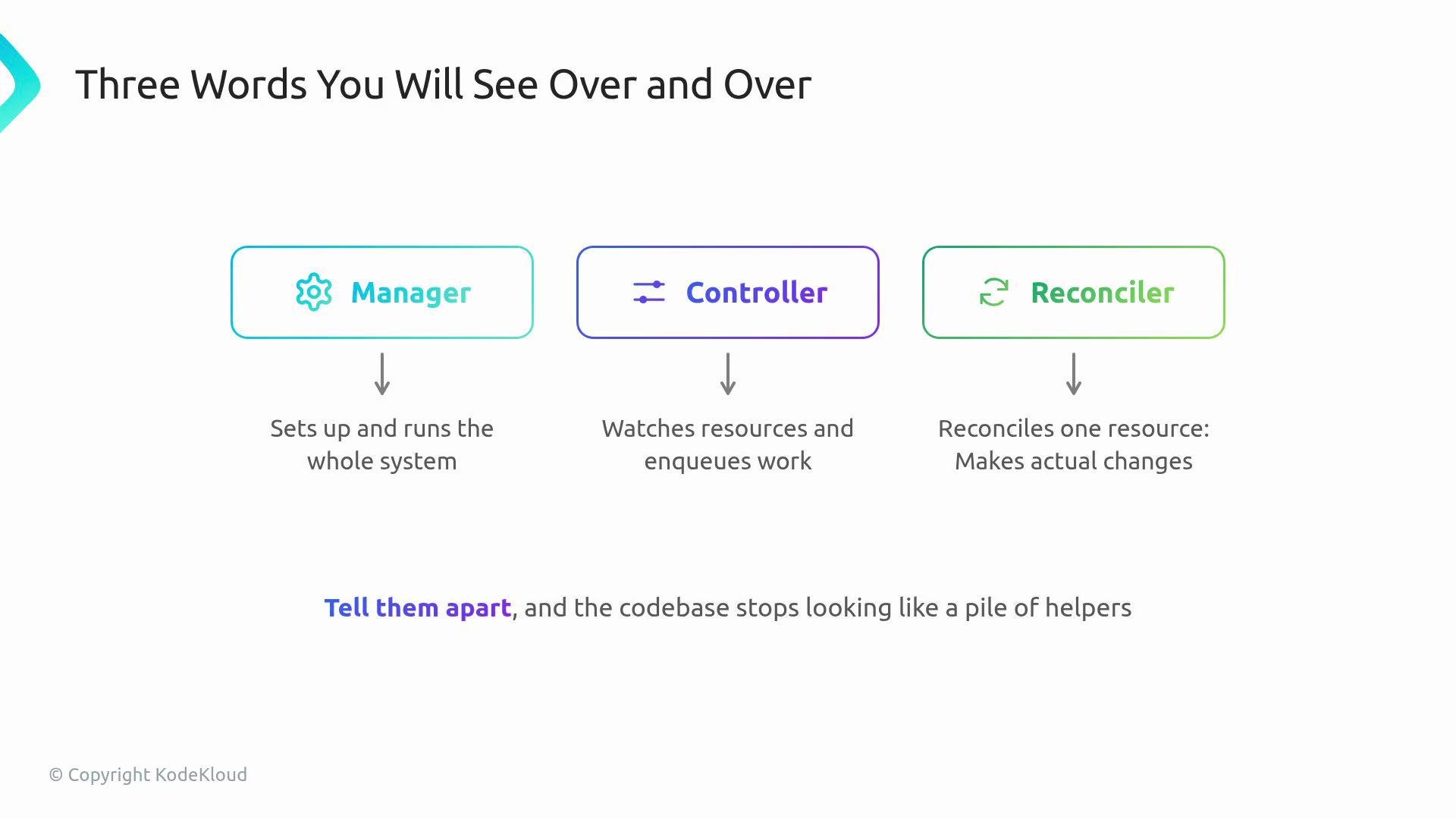
You will see three words appear over and over in operator code: Manager, Controller, and Reconciler.
They can sound interchangeable at first, but each has a distinct responsibility. Once you can tell them apart, the rest of the codebase stops looking like a pile of helpers. This article builds a clear mental model for each piece and shows how they fit together in a controller-runtime based operator.
Let's start with the manager.
 What the manager is (and is not)
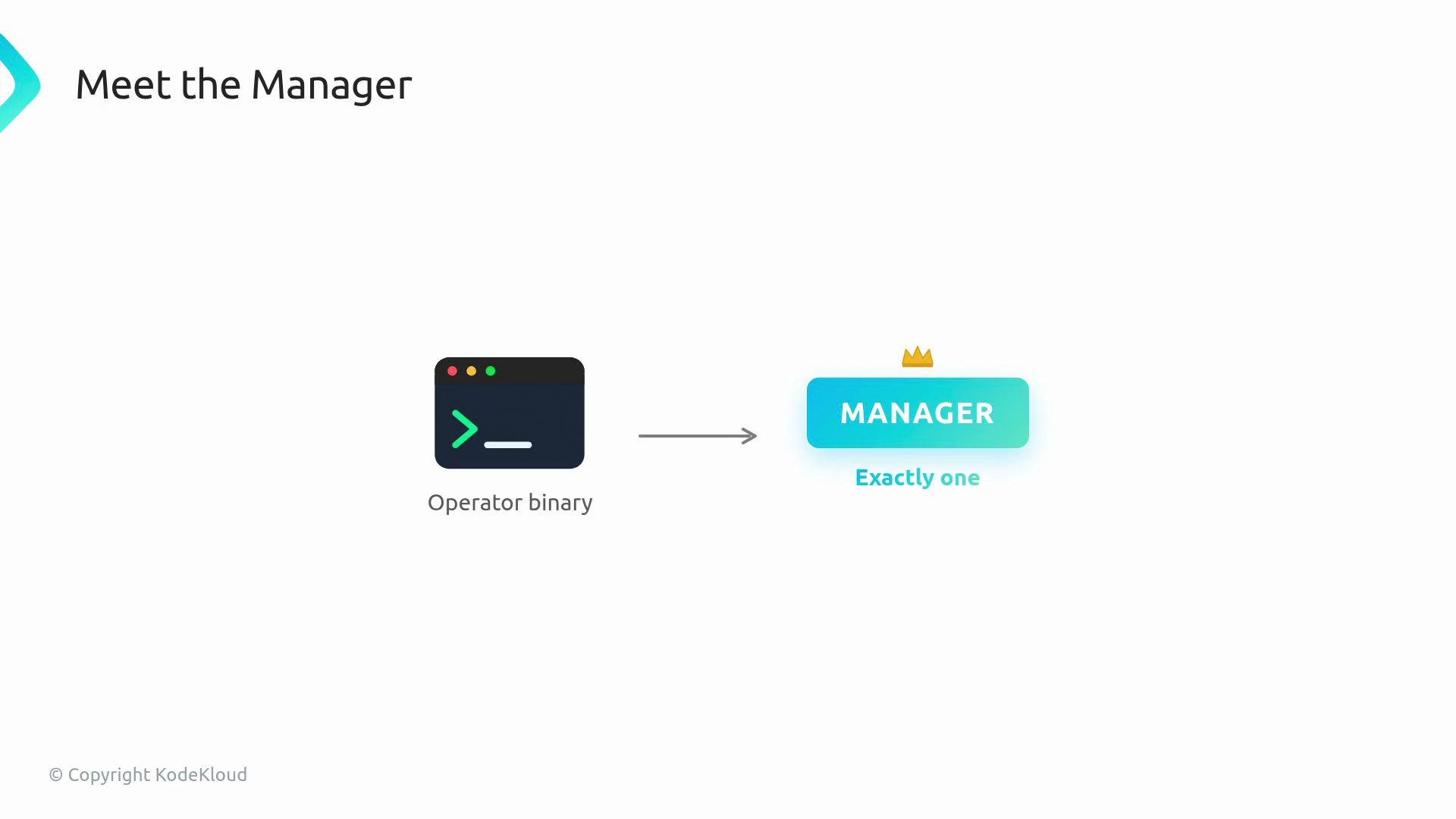
* The manager is the front desk of the building your operator runs in: one process-wide owner of shared infrastructure.
* Exactly one manager runs inside your operator binary. It bootstraps and owns the shared pieces that all controllers use.
What the manager is (and is not)
* The manager is the front desk of the building your operator runs in: one process-wide owner of shared infrastructure.
* Exactly one manager runs inside your operator binary. It bootstraps and owns the shared pieces that all controllers use.
 Core manager-owned resources
* Shared client — the single connection used to read and write Kubernetes objects.
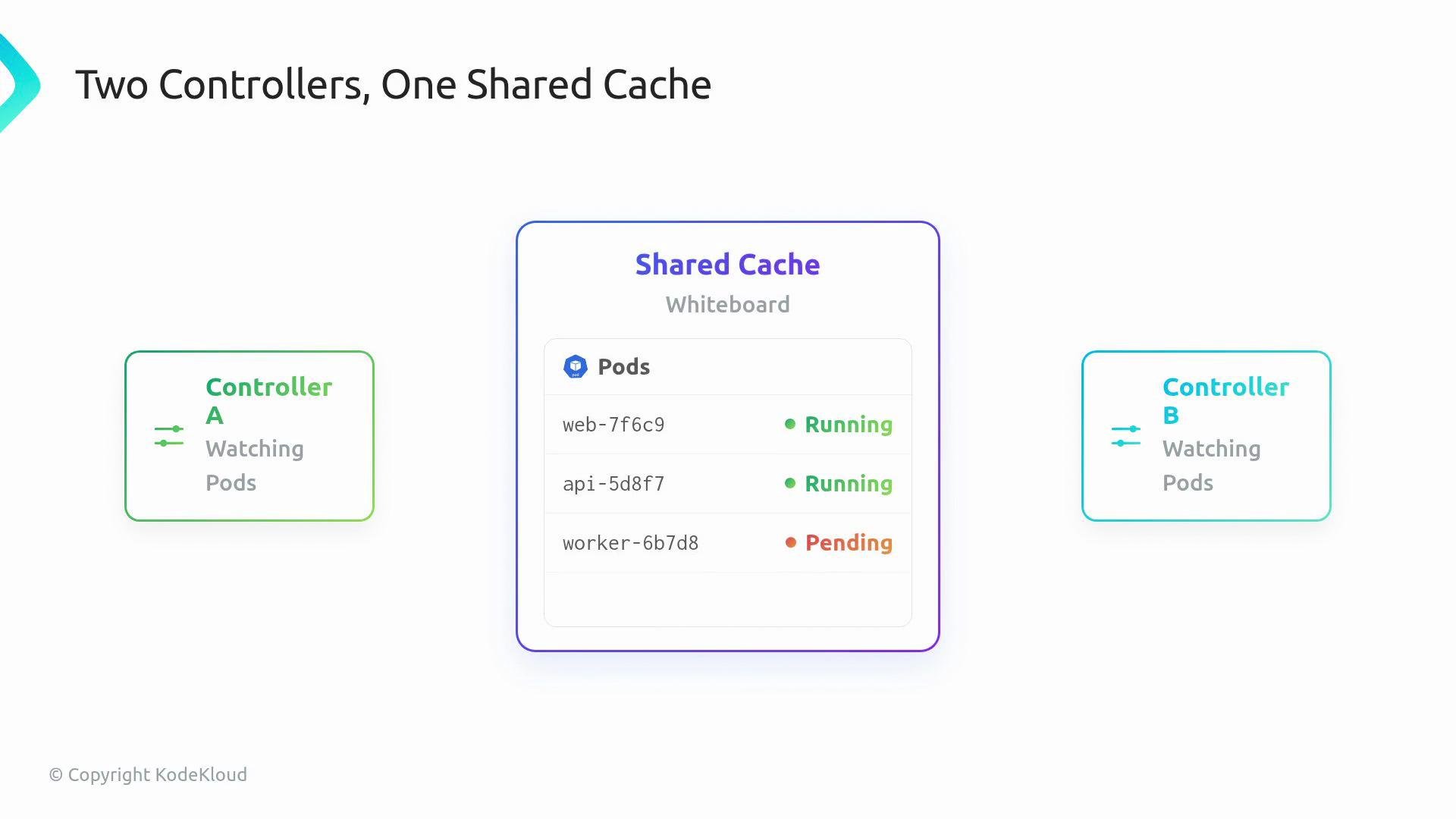
* Shared cache — an in-memory, continuously-updated view of the objects your controllers care about (so you don't query the API server for every read).
* Scheme, logger, metrics server, health probes, webhook server, leader election — all registered and owned by the manager so controllers can share them.
Core manager-owned resources
* Shared client — the single connection used to read and write Kubernetes objects.
* Shared cache — an in-memory, continuously-updated view of the objects your controllers care about (so you don't query the API server for every read).
* Scheme, logger, metrics server, health probes, webhook server, leader election — all registered and owned by the manager so controllers can share them.
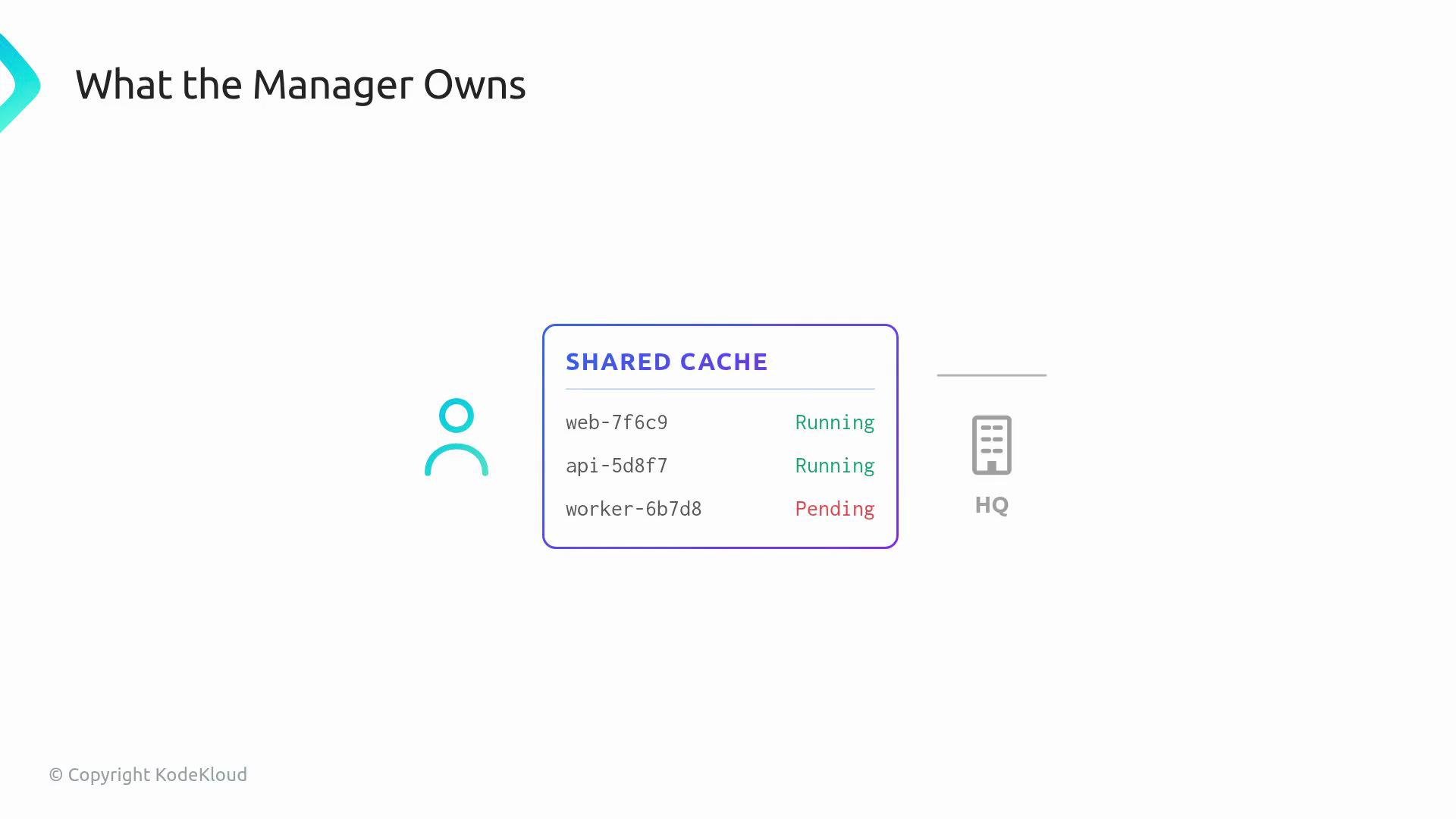
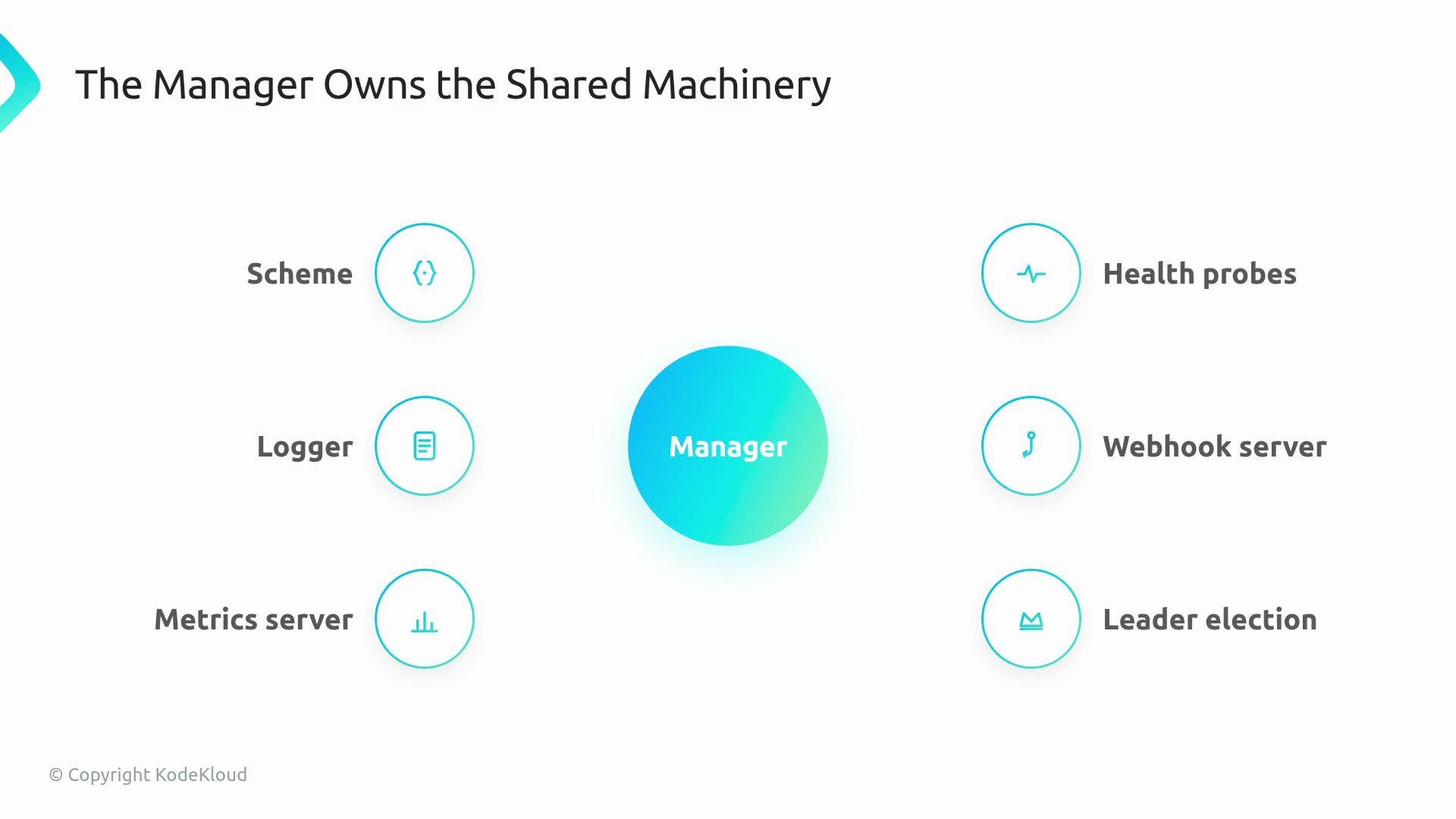 Because controllers share the manager-owned cache and client, multiple controllers watching the same resource type do not each open individual watches against the API server. They read from the same shared cache instead.
 Next: the controller
If the manager is the front desk, a controller is a staff member assigned to watch a specific set of rooms. You tell the controller: "watch WebApp objects and also watch the Deployments and Services I own."
Under the hood, a controller wires up informers and workqueues:
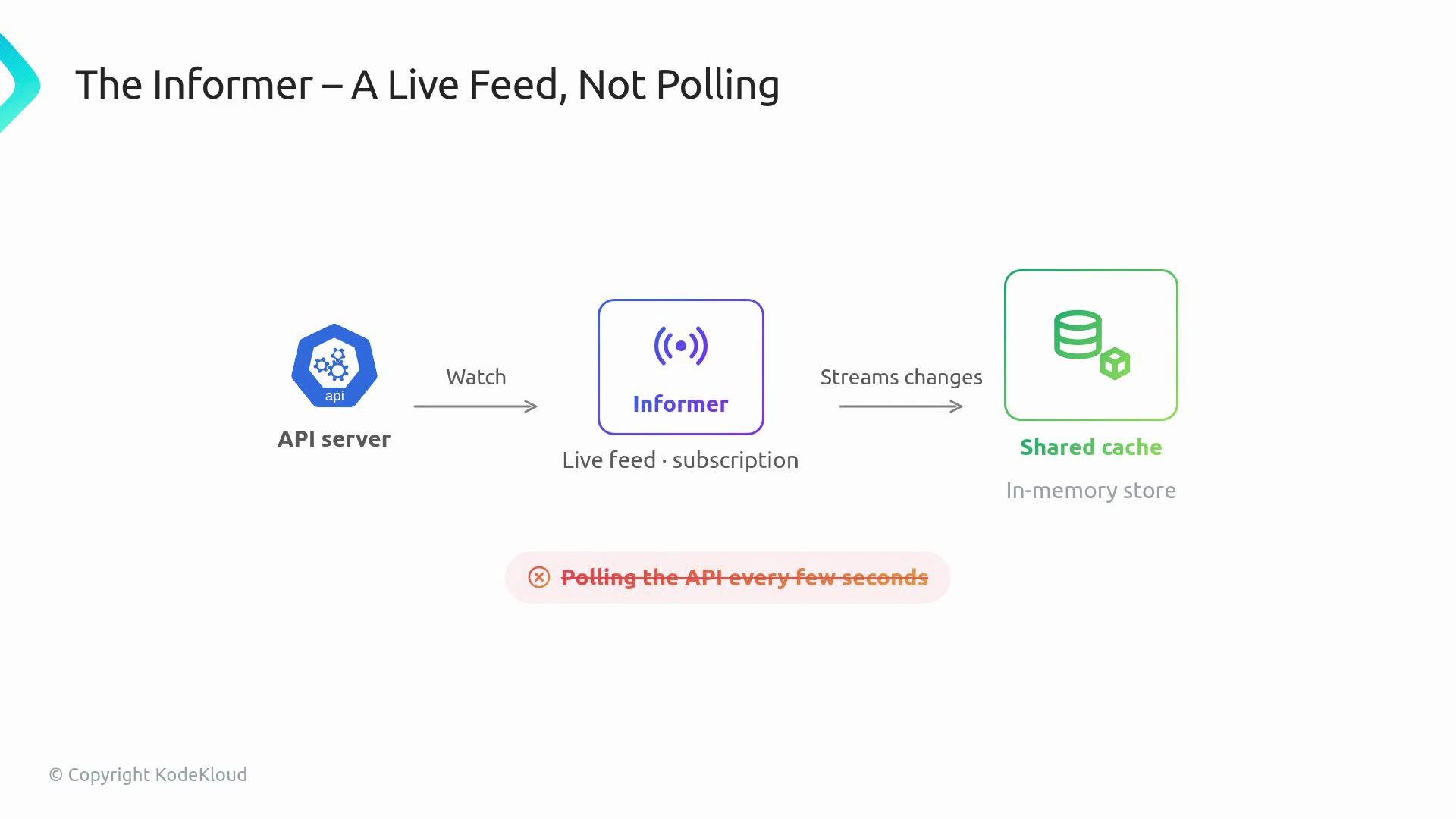
* Informer: a live feed — a subscription that streams changes from the API server into the shared cache (no periodic polling required).
* Predicate: a true/false filter (think of it as a bouncer). Only events that pass predicates get queued.
* Workqueue: an ordered queue of work items with retries and rate-limiting. Items are typically just `namespace/name` keys — not the full object or the event payload.
Next: the controller
If the manager is the front desk, a controller is a staff member assigned to watch a specific set of rooms. You tell the controller: "watch WebApp objects and also watch the Deployments and Services I own."
Under the hood, a controller wires up informers and workqueues:
* Informer: a live feed — a subscription that streams changes from the API server into the shared cache (no periodic polling required).
* Predicate: a true/false filter (think of it as a bouncer). Only events that pass predicates get queued.
* Workqueue: an ordered queue of work items with retries and rate-limiting. Items are typically just `namespace/name` keys — not the full object or the event payload.
 Reconciler: the single method you implement
You almost never instantiate a controller directly. Instead, you implement a reconciler that provides one method: `Reconcile`. The controller runtime calls this method with a context and a request; your job is to make the cluster match the desired state.
Example Reconcile signature in Go:
```go theme={null}
func (r *WebAppReconciler) Reconcile(
ctx context.Context,
req ctrl.Request,
) (ctrl.Result, error) {
// the reconciliation loop:
// 1. read current state from the cache/client
// 2. compute desired state
// 3. create/update/delete resources so the cluster matches desired state
return ctrl.Result{}, nil
}
```
Important: `req` is just a namespaced name (`namespace/name`) — no object, no event, no diff. This is deliberate.
Reconciler: the single method you implement
You almost never instantiate a controller directly. Instead, you implement a reconciler that provides one method: `Reconcile`. The controller runtime calls this method with a context and a request; your job is to make the cluster match the desired state.
Example Reconcile signature in Go:
```go theme={null}
func (r *WebAppReconciler) Reconcile(
ctx context.Context,
req ctrl.Request,
) (ctrl.Result, error) {
// the reconciliation loop:
// 1. read current state from the cache/client
// 2. compute desired state
// 3. create/update/delete resources so the cluster matches desired state
return ctrl.Result{}, nil
}
```
Important: `req` is just a namespaced name (`namespace/name`) — no object, no event, no diff. This is deliberate.
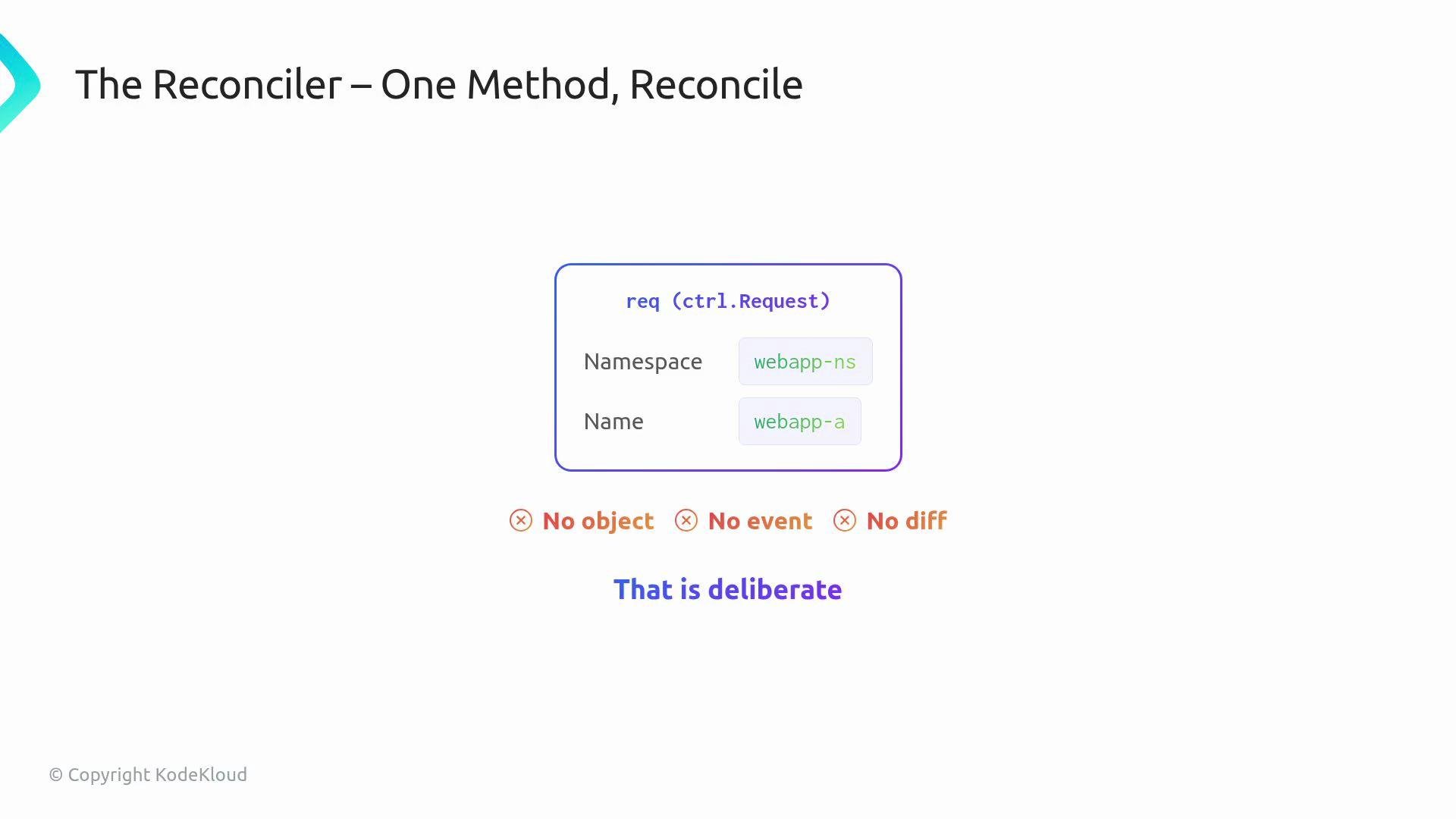 Think of the `req` like a kitchen ticket at a restaurant: it has a table number, not the meal. The controller gives you the table number; your Reconcile must look up the current state and ensure the right resources are present.
If you return an error or a `ctrl.Result` that requests requeueing (for example, `return ctrl.Result{RequeueAfter: time.Minute}, nil`), the workqueue will schedule the request again.
Putting it all together: the operator heartbeat
* The manager starts and registers controllers.
* Each controller's informer keeps the shared cache fresh.
* An API server change triggers an event; predicates filter it; the namespaced key is enqueued.
* A worker pulls the key off the workqueue and calls your Reconcile.
* Your Reconcile reads from the cache, uses the client to write, and returns a result.
Think of the `req` like a kitchen ticket at a restaurant: it has a table number, not the meal. The controller gives you the table number; your Reconcile must look up the current state and ensure the right resources are present.
If you return an error or a `ctrl.Result` that requests requeueing (for example, `return ctrl.Result{RequeueAfter: time.Minute}, nil`), the workqueue will schedule the request again.
Putting it all together: the operator heartbeat
* The manager starts and registers controllers.
* Each controller's informer keeps the shared cache fresh.
* An API server change triggers an event; predicates filter it; the namespaced key is enqueued.
* A worker pulls the key off the workqueue and calls your Reconcile.
* Your Reconcile reads from the cache, uses the client to write, and returns a result.
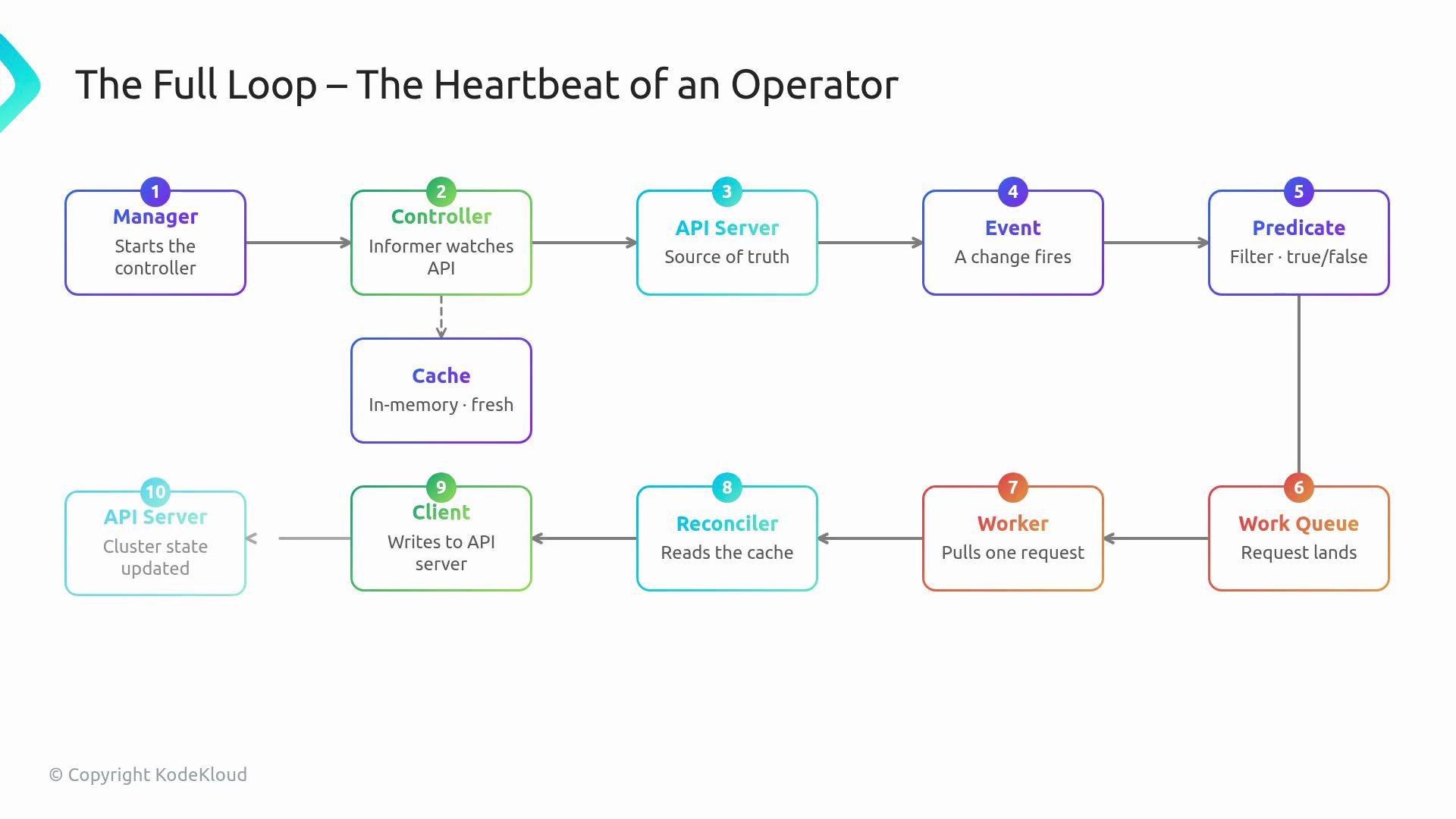 This cycle repeats indefinitely; it is the heartbeat of every operator.
Three essential rules for writing Reconcile
* Reconcile is level-based, not edge-based — read the current state and make it match the desired state. You may be called once for many rapid events; that's okay.
* Reconcile must be idempotent — running it multiple times should be safe and converge to the same result.
* Reconcile should be fast — long-running tasks belong in a goroutine, background job, or separate controller. Blocking Reconcile delays the workqueue.
This cycle repeats indefinitely; it is the heartbeat of every operator.
Three essential rules for writing Reconcile
* Reconcile is level-based, not edge-based — read the current state and make it match the desired state. You may be called once for many rapid events; that's okay.
* Reconcile must be idempotent — running it multiple times should be safe and converge to the same result.
* Reconcile should be fast — long-running tasks belong in a goroutine, background job, or separate controller. Blocking Reconcile delays the workqueue.
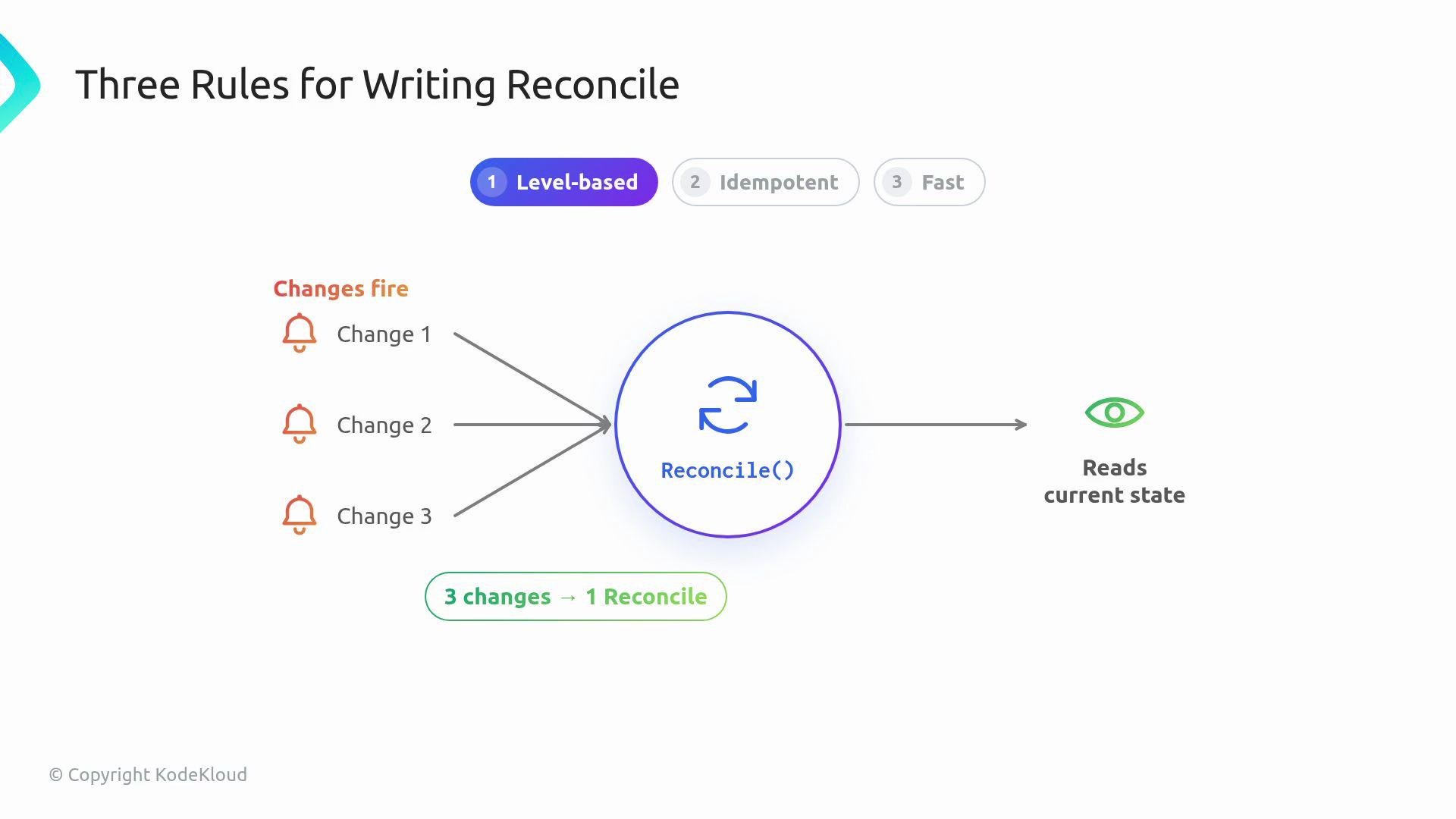 Three quick tips: 1) Design Reconcile to read current state (level-based). 2) Make it idempotent. 3) Keep it short — move long tasks out of the reconcile loop.
Quick reference: Manager vs Controller vs Reconciler
| Component | Responsibility | Example / Notes |
| ---------- | --------------------------------------------------------------------------------------------- | ----------------------------------------------------------------------- |
| Manager | Bootstraps and owns shared infrastructure (client, cache, scheme, logger, webhooks, metrics). | Single per operator process. |
| Controller | Wires informers, predicates, and the workqueue for a specific resource set. | Registers with manager; sets up watches. |
| Reconciler | Implements the `Reconcile(ctx, req)` method to make cluster state match desired state. | `req` is a `namespace/name` key. Reconcile must be idempotent and fast. |
Links and references
* [Controller Runtime (sigs.k8s.io/controller-runtime)](https://pkg.go.dev/sigs.k8s.io/controller-runtime)
* [Kubernetes: Writing an Operator (official docs)](https://kubernetes.io/docs/concepts/extend-kubernetes/operator/)
* [Client-go Informers and Workqueues](https://github.com/kubernetes/client-go)
* [Design Patterns for Kubernetes Operators](https://kubernetes.io/blog/2019/03/06/building-operators-with-kubernetes/)
That's it for this lesson.
Three quick tips: 1) Design Reconcile to read current state (level-based). 2) Make it idempotent. 3) Keep it short — move long tasks out of the reconcile loop.
Quick reference: Manager vs Controller vs Reconciler
| Component | Responsibility | Example / Notes |
| ---------- | --------------------------------------------------------------------------------------------- | ----------------------------------------------------------------------- |
| Manager | Bootstraps and owns shared infrastructure (client, cache, scheme, logger, webhooks, metrics). | Single per operator process. |
| Controller | Wires informers, predicates, and the workqueue for a specific resource set. | Registers with manager; sets up watches. |
| Reconciler | Implements the `Reconcile(ctx, req)` method to make cluster state match desired state. | `req` is a `namespace/name` key. Reconcile must be idempotent and fast. |
Links and references
* [Controller Runtime (sigs.k8s.io/controller-runtime)](https://pkg.go.dev/sigs.k8s.io/controller-runtime)
* [Kubernetes: Writing an Operator (official docs)](https://kubernetes.io/docs/concepts/extend-kubernetes/operator/)
* [Client-go Informers and Workqueues](https://github.com/kubernetes/client-go)
* [Design Patterns for Kubernetes Operators](https://kubernetes.io/blog/2019/03/06/building-operators-with-kubernetes/)
That's it for this lesson.