> ## Documentation Index
> Fetch the complete documentation index at: https://notes.kodekloud.com/llms.txt
> Use this file to discover all available pages before exploring further.
# Kubebuilder Vs Operator SDK
> Comparison of Kubebuilder and Operator SDK, their shared controller-runtime foundation, differences in scaffolding and tooling, and guidance on choosing based on Helm, Ansible, OLM and learning goals
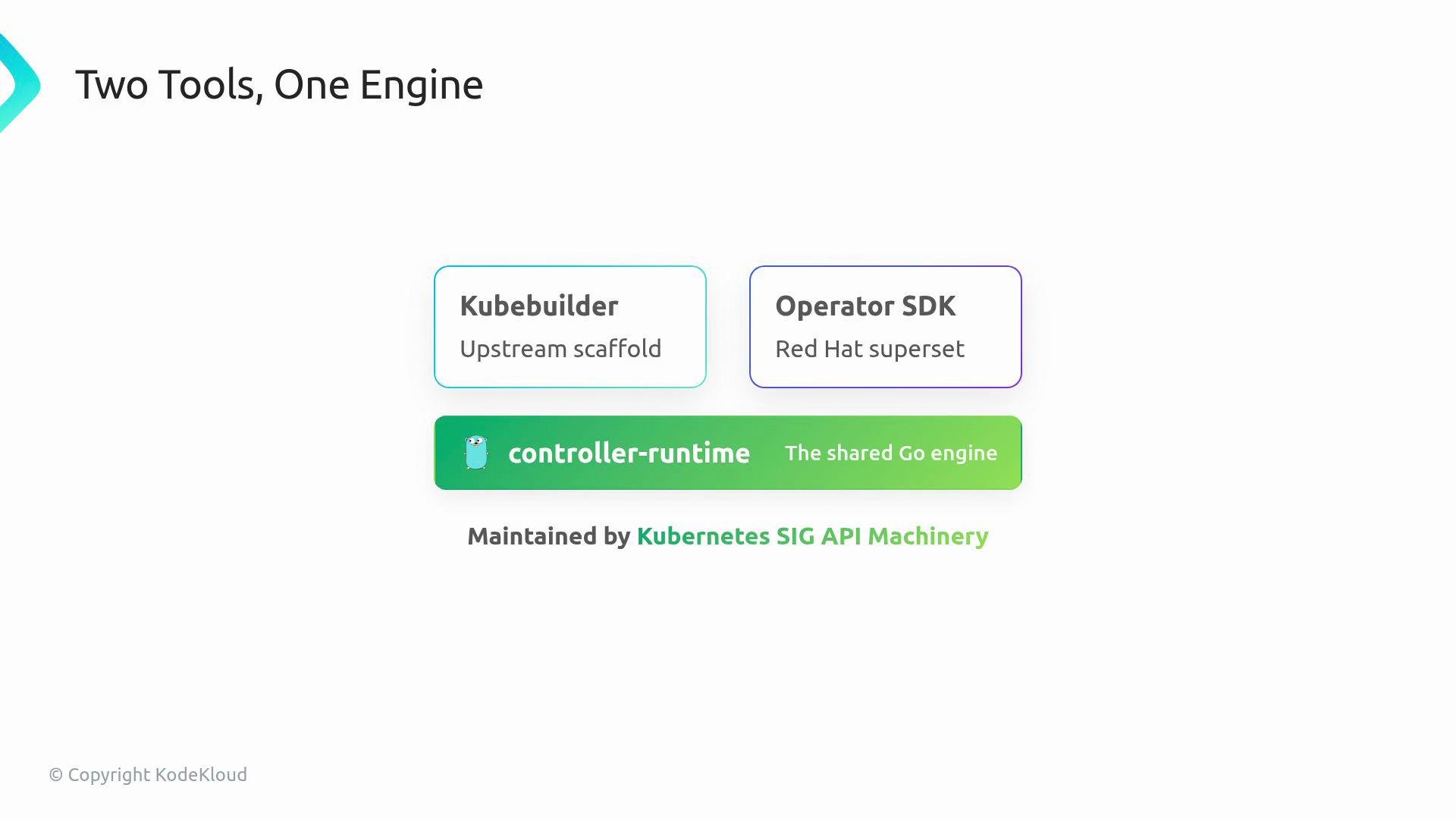
When building a Kubernetes operator you’ll typically choose between two main toolchains: Kubebuilder and the Operator SDK. They look and behave similarly because both are built on the same Go library: controller-runtime.
Both tools share the same foundation and runtime behavior, so understanding what they have in common makes the decision straightforward.
 ## Shared foundation: controller-runtime
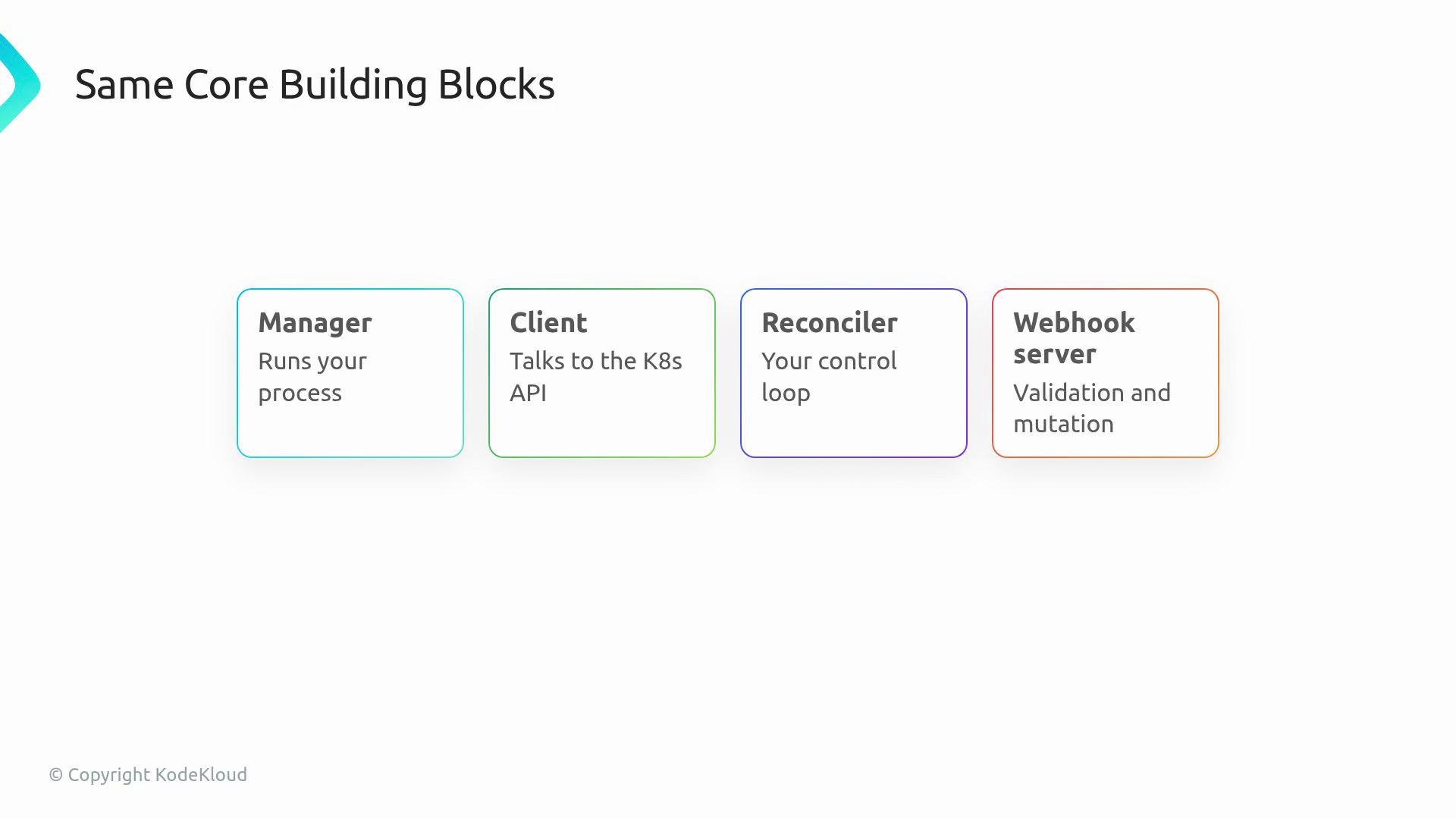
controller-runtime provides the core building blocks used by both Kubebuilder and the Operator SDK:
* Manager: runs your operator process, sets up shared caches, and starts controllers.
* Client: typed/untyped client used to read and write Kubernetes API objects.
* Reconciler: where your reconciliation logic (the control loop) lives.
* Webhook server: handles admission webhooks for validation and mutation.
At runtime, an operator generated by either project calls the same controller-runtime APIs and behaves the same way.
## Shared foundation: controller-runtime
controller-runtime provides the core building blocks used by both Kubebuilder and the Operator SDK:
* Manager: runs your operator process, sets up shared caches, and starts controllers.
* Client: typed/untyped client used to read and write Kubernetes API objects.
* Reconciler: where your reconciliation logic (the control loop) lives.
* Webhook server: handles admission webhooks for validation and mutation.
At runtime, an operator generated by either project calls the same controller-runtime APIs and behaves the same way.
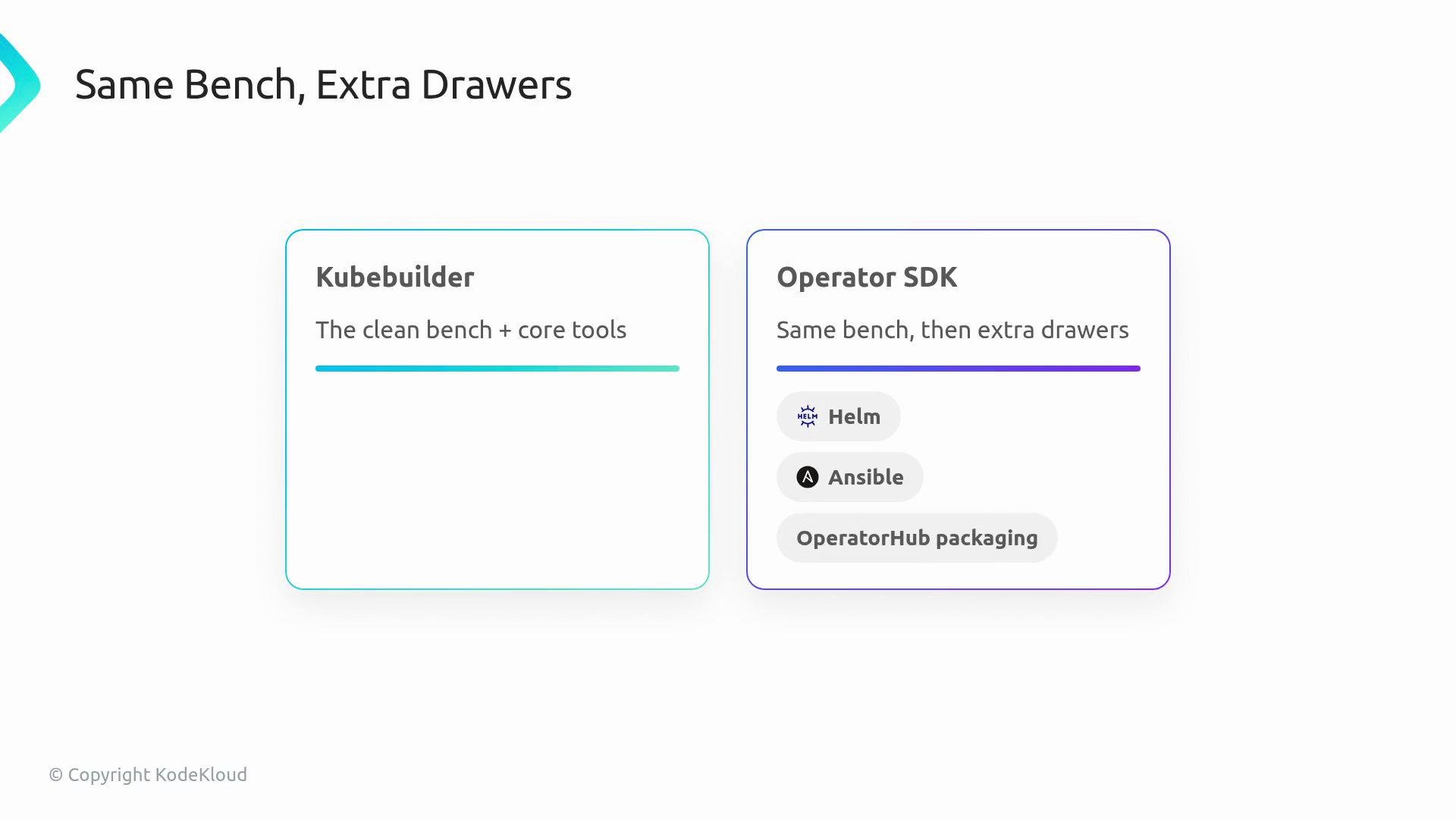
 Think of controller-runtime as a shared workbench. Kubebuilder gives you a clean bench with core tools and minimal scaffolding. Operator SDK starts from the same bench but adds extra drawers and adapters for Helm, Ansible, and OperatorHub/OLM packaging. The distinction boils down to what each tool wraps around controller-runtime.
 ## Kubebuilder: minimal, upstream, SIG-owned
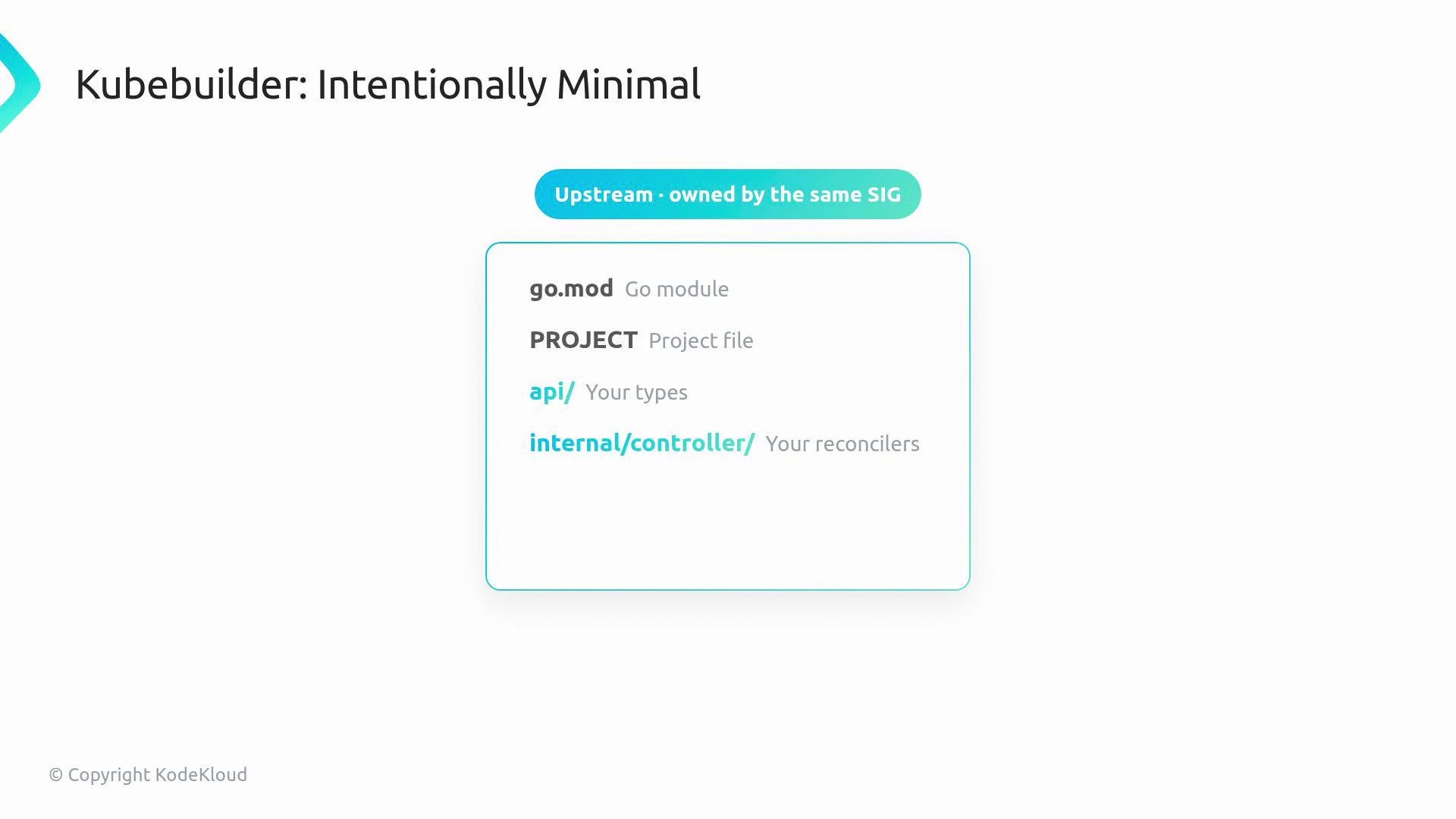
Kubebuilder is the upstream project maintained by the Kubernetes SIG that also owns controller-runtime. It intentionally keeps the CLI and scaffolding minimal:
* A Go module and `go.mod`.
* A `PROJECT` file.
* `api/` for CRD type definitions.
* `controllers/` (or `internal/controller/`) for reconcilers.
* A `Makefile` and `Dockerfile`.
This minimal structure maps directly to controller-runtime concepts and keeps distractions to a minimum.
## Kubebuilder: minimal, upstream, SIG-owned
Kubebuilder is the upstream project maintained by the Kubernetes SIG that also owns controller-runtime. It intentionally keeps the CLI and scaffolding minimal:
* A Go module and `go.mod`.
* A `PROJECT` file.
* `api/` for CRD type definitions.
* `controllers/` (or `internal/controller/`) for reconcilers.
* A `Makefile` and `Dockerfile`.
This minimal structure maps directly to controller-runtime concepts and keeps distractions to a minimum.
 ## Operator SDK: a superset for multiple workflows
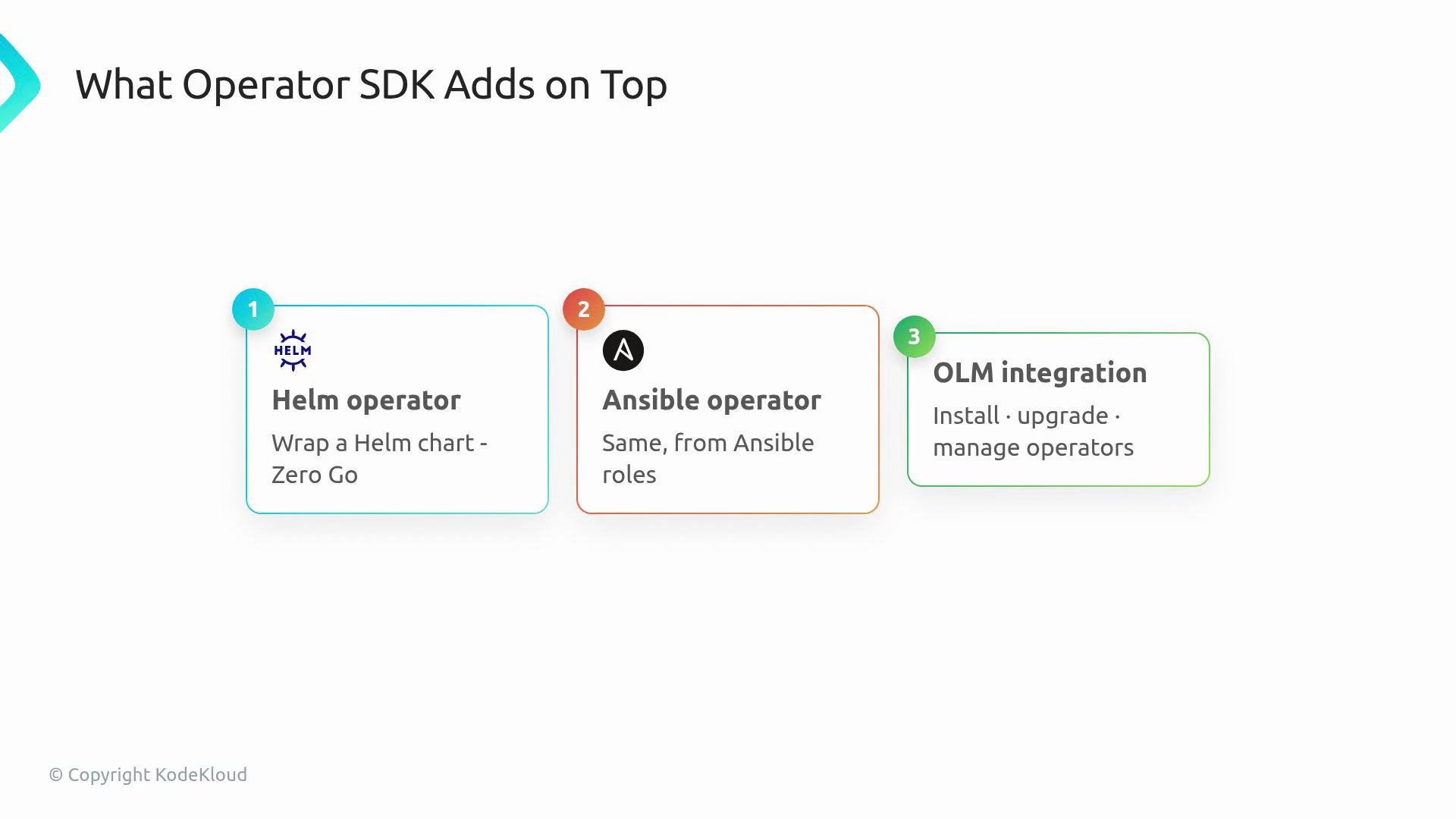
Maintained by Red Hat, the Operator SDK builds on top of Kubebuilder for Go projects (it uses Kubebuilder plugins under the hood) and adds first-class support for alternative operator implementations and distribution tooling:
* Helm operator: wrap a Helm chart as an operator with minimal or no Go code.
* Ansible operator: run Ansible roles/playbooks as operator logic.
* OLM integration: tooling to produce bundles and ClusterServiceVersion metadata for Operator Lifecycle Manager (OLM) and OperatorHub.
## Operator SDK: a superset for multiple workflows
Maintained by Red Hat, the Operator SDK builds on top of Kubebuilder for Go projects (it uses Kubebuilder plugins under the hood) and adds first-class support for alternative operator implementations and distribution tooling:
* Helm operator: wrap a Helm chart as an operator with minimal or no Go code.
* Ansible operator: run Ansible roles/playbooks as operator logic.
* OLM integration: tooling to produce bundles and ClusterServiceVersion metadata for Operator Lifecycle Manager (OLM) and OperatorHub.
 Operator SDK also provides Makefile targets to build OLM bundles and generate the ClusterServiceVersion (CSV) and other metadata required to publish an operator to OperatorHub.
Example: build an OLM bundle for your operator:
```bash theme={null}
$ make bundle
```
OperatorHub and OLM expect these files to list, install, and manage your operator on clusters.
## Which should you choose?
The right choice depends on your goals and distribution needs.
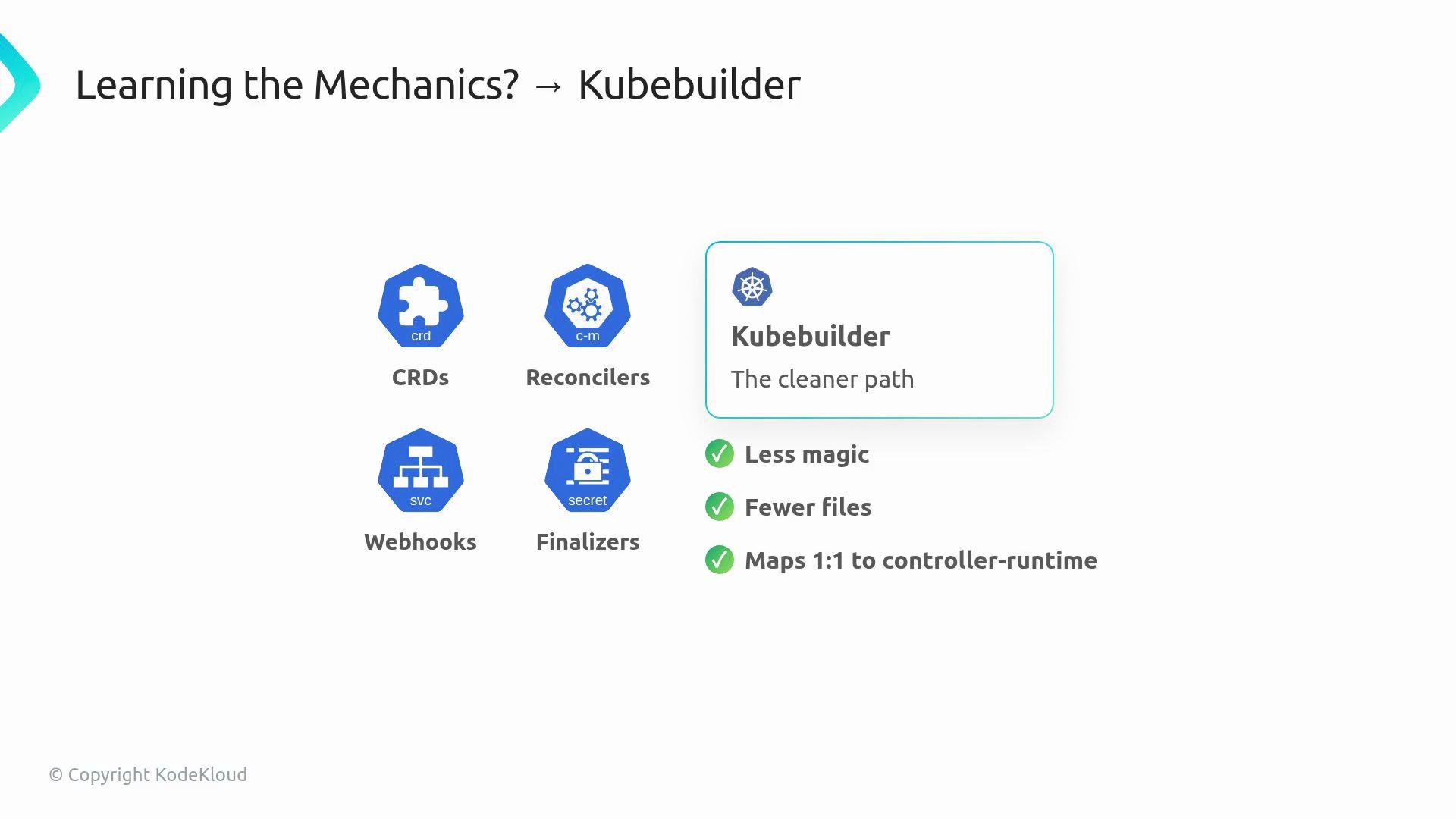
* Use Kubebuilder if your objective is to learn controller patterns: CRDs, reconcilers, webhooks, and finalizers. Its minimal scaffold surfaces controller-runtime concepts directly and reduces complexity. This makes Kubebuilder ideal for learning or building custom Go-based operators from scratch.
Operator SDK also provides Makefile targets to build OLM bundles and generate the ClusterServiceVersion (CSV) and other metadata required to publish an operator to OperatorHub.
Example: build an OLM bundle for your operator:
```bash theme={null}
$ make bundle
```
OperatorHub and OLM expect these files to list, install, and manage your operator on clusters.
## Which should you choose?
The right choice depends on your goals and distribution needs.
* Use Kubebuilder if your objective is to learn controller patterns: CRDs, reconcilers, webhooks, and finalizers. Its minimal scaffold surfaces controller-runtime concepts directly and reduces complexity. This makes Kubebuilder ideal for learning or building custom Go-based operators from scratch.
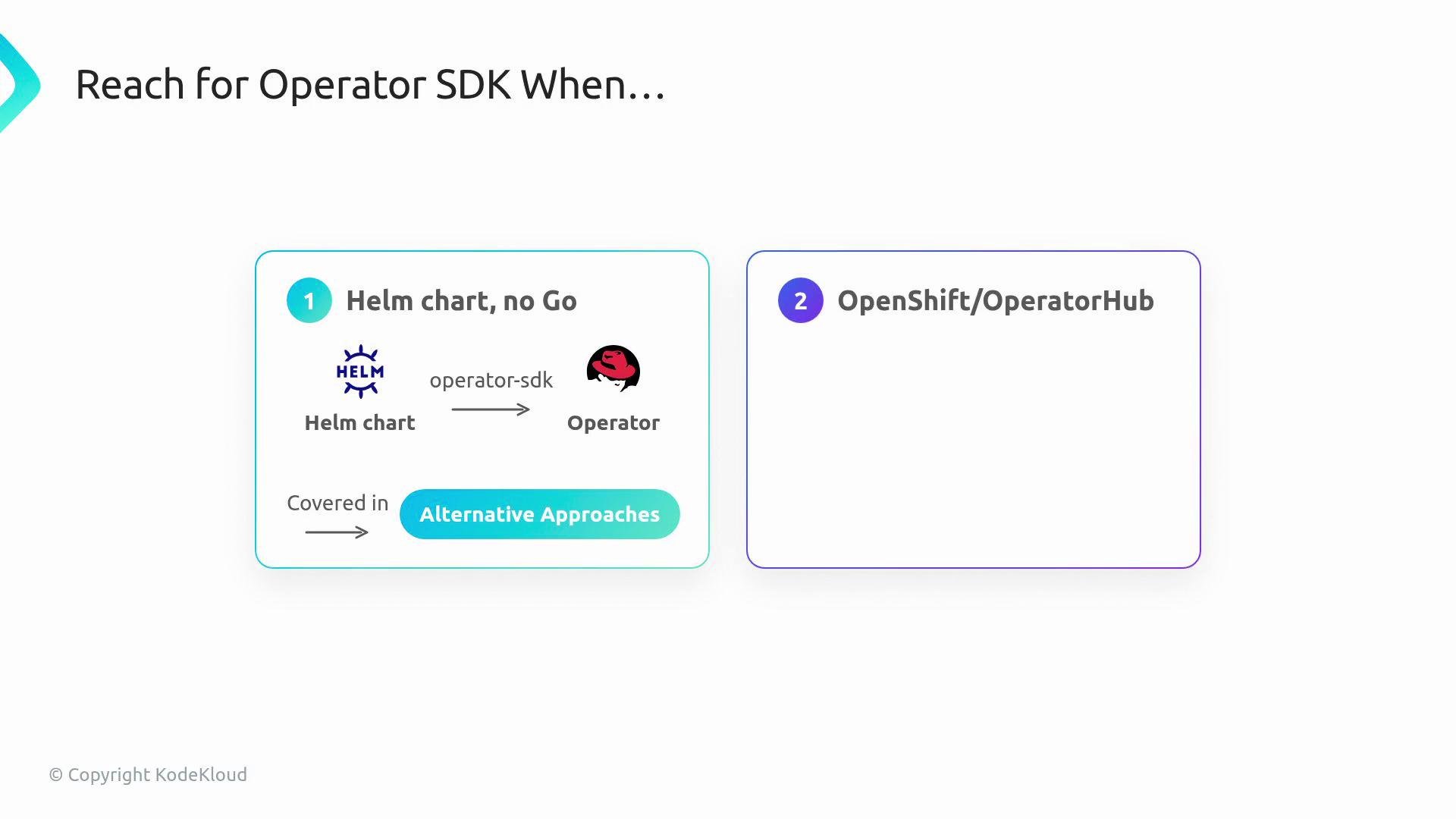
 * Use Operator SDK in two common scenarios:
1. You have an existing Helm chart and want to ship it as an operator with little or no Go code (Helm operator).
2. You need OLM/OperatorHub bundle generation and metadata out-of-the-box — common for OpenShift or when publishing to OperatorHub.
* Use Operator SDK in two common scenarios:
1. You have an existing Helm chart and want to ship it as an operator with little or no Go code (Helm operator).
2. You need OLM/OperatorHub bundle generation and metadata out-of-the-box — common for OpenShift or when publishing to OperatorHub.
 ### Quick decision table
| Goal / Constraint | Recommended tool | Why |
| ----------------------------------------------------------- | ---------------------: | --------------------------------------------------- |
| Learn controller-runtime internals and write Go reconcilers | Kubebuilder | Minimal scaffolding exposes the core concepts. |
| Ship an operator from an existing Helm chart | Operator SDK (Helm) | Wraps existing charts without Go. |
| Run Ansible playbooks/roles as operator logic | Operator SDK (Ansible) | Native Ansible integration. |
| Publish to OperatorHub / OpenShift with OLM metadata | Operator SDK | Built-in bundle and CSV generation (`make bundle`). |
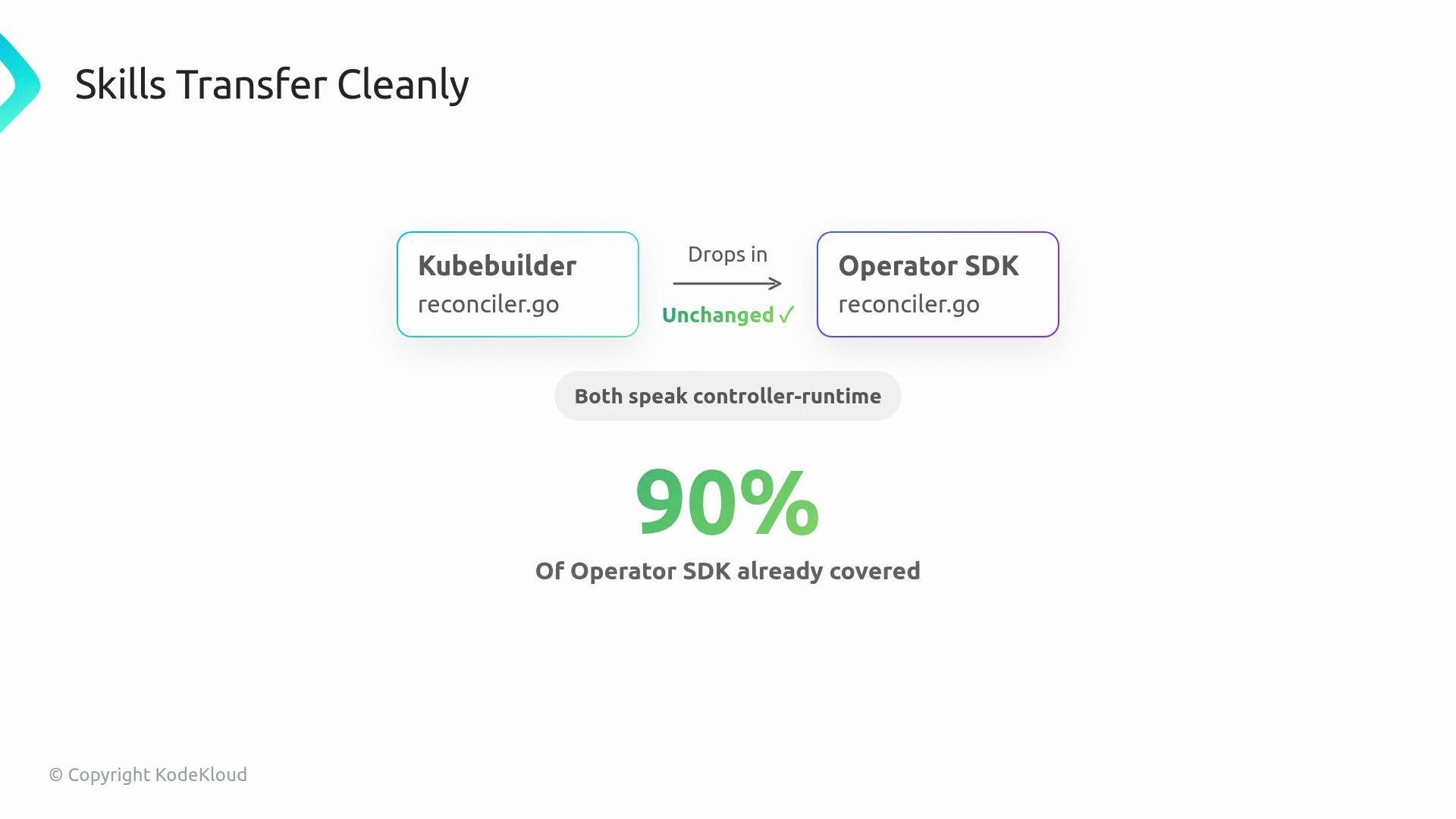
Skills and code transfer cleanly between the two: a reconciler written for Kubebuilder will generally drop into an Operator SDK project unchanged, because both target controller-runtime. Learn Kubebuilder first and you’ll already have covered most of what Operator SDK uses for Go-based operators.
### Quick decision table
| Goal / Constraint | Recommended tool | Why |
| ----------------------------------------------------------- | ---------------------: | --------------------------------------------------- |
| Learn controller-runtime internals and write Go reconcilers | Kubebuilder | Minimal scaffolding exposes the core concepts. |
| Ship an operator from an existing Helm chart | Operator SDK (Helm) | Wraps existing charts without Go. |
| Run Ansible playbooks/roles as operator logic | Operator SDK (Ansible) | Native Ansible integration. |
| Publish to OperatorHub / OpenShift with OLM metadata | Operator SDK | Built-in bundle and CSV generation (`make bundle`). |
Skills and code transfer cleanly between the two: a reconciler written for Kubebuilder will generally drop into an Operator SDK project unchanged, because both target controller-runtime. Learn Kubebuilder first and you’ll already have covered most of what Operator SDK uses for Go-based operators.
 If your goal is to understand the internals and controller patterns, start with Kubebuilder. If you need quick Helm/Ansible integration or automatic OLM bundle generation for distribution, choose Operator SDK.
## Links and references
* controller-runtime: [https://github.com/kubernetes-sigs/controller-runtime](https://github.com/kubernetes-sigs/controller-runtime)
* Operator SDK docs: [https://sdk.operatorframework.io/docs/](https://sdk.operatorframework.io/docs/)
* Kubebuilder docs: [https://book.kubebuilder.io/](https://book.kubebuilder.io/)
* Operator Lifecycle Manager (OLM): [https://sdk.operatorframework.io/docs/olm-integration/](https://sdk.operatorframework.io/docs/olm-integration/)
* OperatorHub: [https://operatorhub.io/](https://operatorhub.io/)
* OpenShift: [https://www.openshift.com/](https://www.openshift.com/)
If your goal is to understand the internals and controller patterns, start with Kubebuilder. If you need quick Helm/Ansible integration or automatic OLM bundle generation for distribution, choose Operator SDK.
## Links and references
* controller-runtime: [https://github.com/kubernetes-sigs/controller-runtime](https://github.com/kubernetes-sigs/controller-runtime)
* Operator SDK docs: [https://sdk.operatorframework.io/docs/](https://sdk.operatorframework.io/docs/)
* Kubebuilder docs: [https://book.kubebuilder.io/](https://book.kubebuilder.io/)
* Operator Lifecycle Manager (OLM): [https://sdk.operatorframework.io/docs/olm-integration/](https://sdk.operatorframework.io/docs/olm-integration/)
* OperatorHub: [https://operatorhub.io/](https://operatorhub.io/)
* OpenShift: [https://www.openshift.com/](https://www.openshift.com/)