> ## Documentation Index
> Fetch the complete documentation index at: https://notes.kodekloud.com/llms.txt
> Use this file to discover all available pages before exploring further.
# Condition Based Status Design
> Explains using Kubernetes status conditions to report resource health, mapping gauges to machine and human friendly condition fields with best practices for Ready, Progressing, and Degraded
A number can tell you the gauge reading. A condition tells you what the reading means.
In Kubernetes controllers, numeric status fields (for example, `ReadyReplicas`) are gauges — they show measurements. Conditions are the dashboard lights beside those gauges. If a web app's spec requests three replicas but only one is ready, `ReadyReplicas` gives the count. A condition answers the human questions that follow:
* Is this still rolling out?
* Is it healthy enough?
* Or is something stuck?
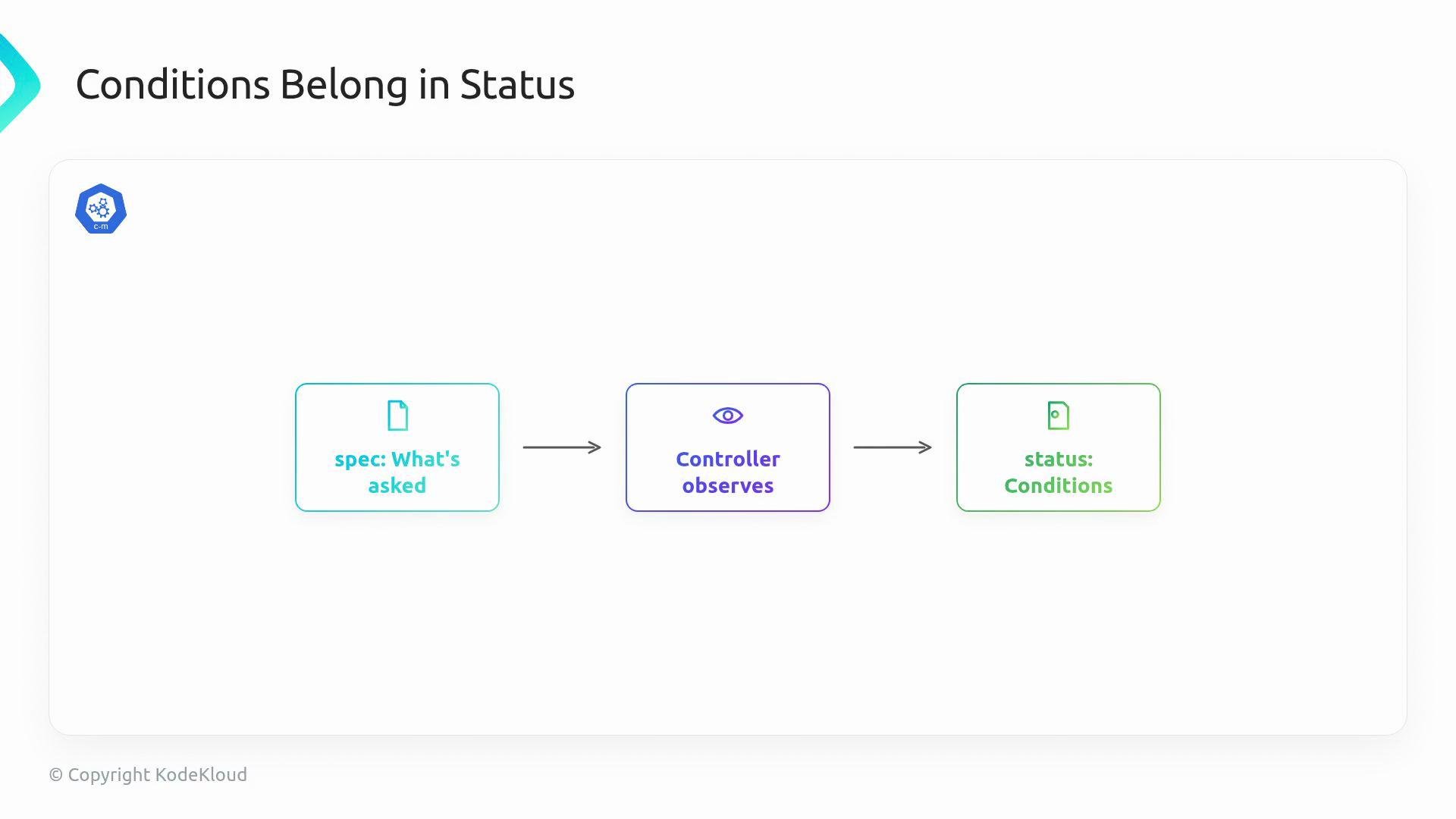
Think of conditions as compact, machine- and human-friendly health signals. They belong in `status` because status is the controller’s report about the real cluster: `spec` is the user’s intent; `status` is what the controller actually observes. Kubernetes provides a shared shape for these reports via `metav1.Condition`.
 What is a condition? At its simplest, a condition is one dashboard light with:
* Type — a name for the light
* Status — the current state (`True`, `False`, `Unknown`)
* Reason — a short, stable, machine-friendly label
* Message — a human-readable sentence explaining the observation
* LastTransitionTime — when the condition last changed
* ObservedGeneration — which `metadata.generation` the status reflects
A real-world example in Go:
```go theme={null}
metav1.Condition{
Type: "Ready",
Status: metav1.ConditionTrue,
Reason: "DeploymentAvailable",
Message: "Deployment has the requested ready replicas.",
LastTransitionTime: metav1.Now(),
ObservedGeneration: webapp.Generation,
}
```
Fields mapped to intent and usage:
| Field | Purpose | Example |
| -------------------- | ---------------------------------------------------------------------------------- | ---------------------------------- |
| `Type` | The short name of the question being asked (the light). | `Ready`, `Progressing`, `Degraded` |
| `Status` | The current answer: `True`, `False`, or `Unknown`. | `True` |
| `Reason` | Short, stable machine label for automation and alerts. Keep predictable. | `DeploymentAvailable` |
| `Message` | Human-friendly explanation for operators. | `1 of 3 replicas are ready.` |
| `LastTransitionTime` | Timestamp when the condition last changed state. Do not update on every reconcile. | `2024-07-01T12:34:56Z` |
| `ObservedGeneration` | The `metadata.generation` that the controller observed for this status. | `webapp.Generation` |
Do not confuse `LastTransitionTime` with frequent reconciles: it should only change when the condition flips. That allows operators to know how long a resource has been in a particular state. `ObservedGeneration` prevents stale green lights: if `Ready` is `True` but `ObservedGeneration` is older than the latest `metadata.generation`, the status refers to a previous spec.
Example YAML snippet that separates machine- and human-facing fields:
```yaml theme={null}
type: Ready
status: "False"
reason: DeploymentNotReady
message: "1 of 3 replicas are ready."
# reason: for tools
# message: for humans
```
Core condition types to keep in most controllers
* Ready — Does the resource meet the requested state (e.g., deployment has required ready replicas)?
* Progressing — Is the controller still moving toward that state (e.g., during a rollout)?
* Degraded — Has the controller observed a problem that blocks normal operation?
These three lights provide a focused view without turning `status` into a crowded control panel.
What is a condition? At its simplest, a condition is one dashboard light with:
* Type — a name for the light
* Status — the current state (`True`, `False`, `Unknown`)
* Reason — a short, stable, machine-friendly label
* Message — a human-readable sentence explaining the observation
* LastTransitionTime — when the condition last changed
* ObservedGeneration — which `metadata.generation` the status reflects
A real-world example in Go:
```go theme={null}
metav1.Condition{
Type: "Ready",
Status: metav1.ConditionTrue,
Reason: "DeploymentAvailable",
Message: "Deployment has the requested ready replicas.",
LastTransitionTime: metav1.Now(),
ObservedGeneration: webapp.Generation,
}
```
Fields mapped to intent and usage:
| Field | Purpose | Example |
| -------------------- | ---------------------------------------------------------------------------------- | ---------------------------------- |
| `Type` | The short name of the question being asked (the light). | `Ready`, `Progressing`, `Degraded` |
| `Status` | The current answer: `True`, `False`, or `Unknown`. | `True` |
| `Reason` | Short, stable machine label for automation and alerts. Keep predictable. | `DeploymentAvailable` |
| `Message` | Human-friendly explanation for operators. | `1 of 3 replicas are ready.` |
| `LastTransitionTime` | Timestamp when the condition last changed state. Do not update on every reconcile. | `2024-07-01T12:34:56Z` |
| `ObservedGeneration` | The `metadata.generation` that the controller observed for this status. | `webapp.Generation` |
Do not confuse `LastTransitionTime` with frequent reconciles: it should only change when the condition flips. That allows operators to know how long a resource has been in a particular state. `ObservedGeneration` prevents stale green lights: if `Ready` is `True` but `ObservedGeneration` is older than the latest `metadata.generation`, the status refers to a previous spec.
Example YAML snippet that separates machine- and human-facing fields:
```yaml theme={null}
type: Ready
status: "False"
reason: DeploymentNotReady
message: "1 of 3 replicas are ready."
# reason: for tools
# message: for humans
```
Core condition types to keep in most controllers
* Ready — Does the resource meet the requested state (e.g., deployment has required ready replicas)?
* Progressing — Is the controller still moving toward that state (e.g., during a rollout)?
* Degraded — Has the controller observed a problem that blocks normal operation?
These three lights provide a focused view without turning `status` into a crowded control panel.
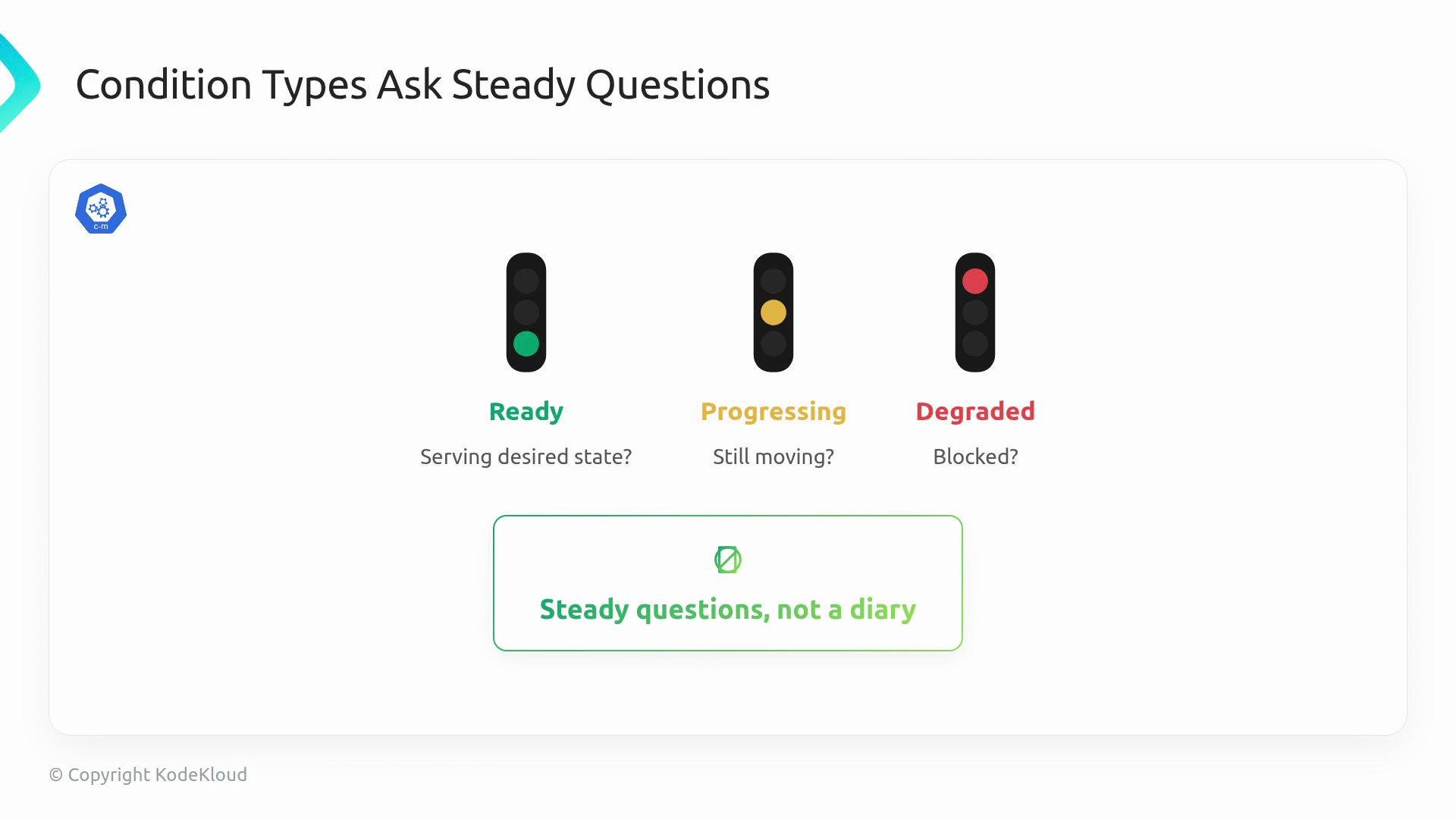 Keep condition types steady and focused: they should ask continuous health questions (Ready, Progressing, Degraded), not log every event or reconcile step.
Design guidance and best practices
* Keep condition types stable and few. They are part of your API's contract and are used by alerts, dashboards, and other controllers.
* Make `Reason` predictable and machine-friendly; use `Message` for human context.
* Only update `LastTransitionTime` when the condition value actually changes.
* Populate `ObservedGeneration` so users can detect stale status.
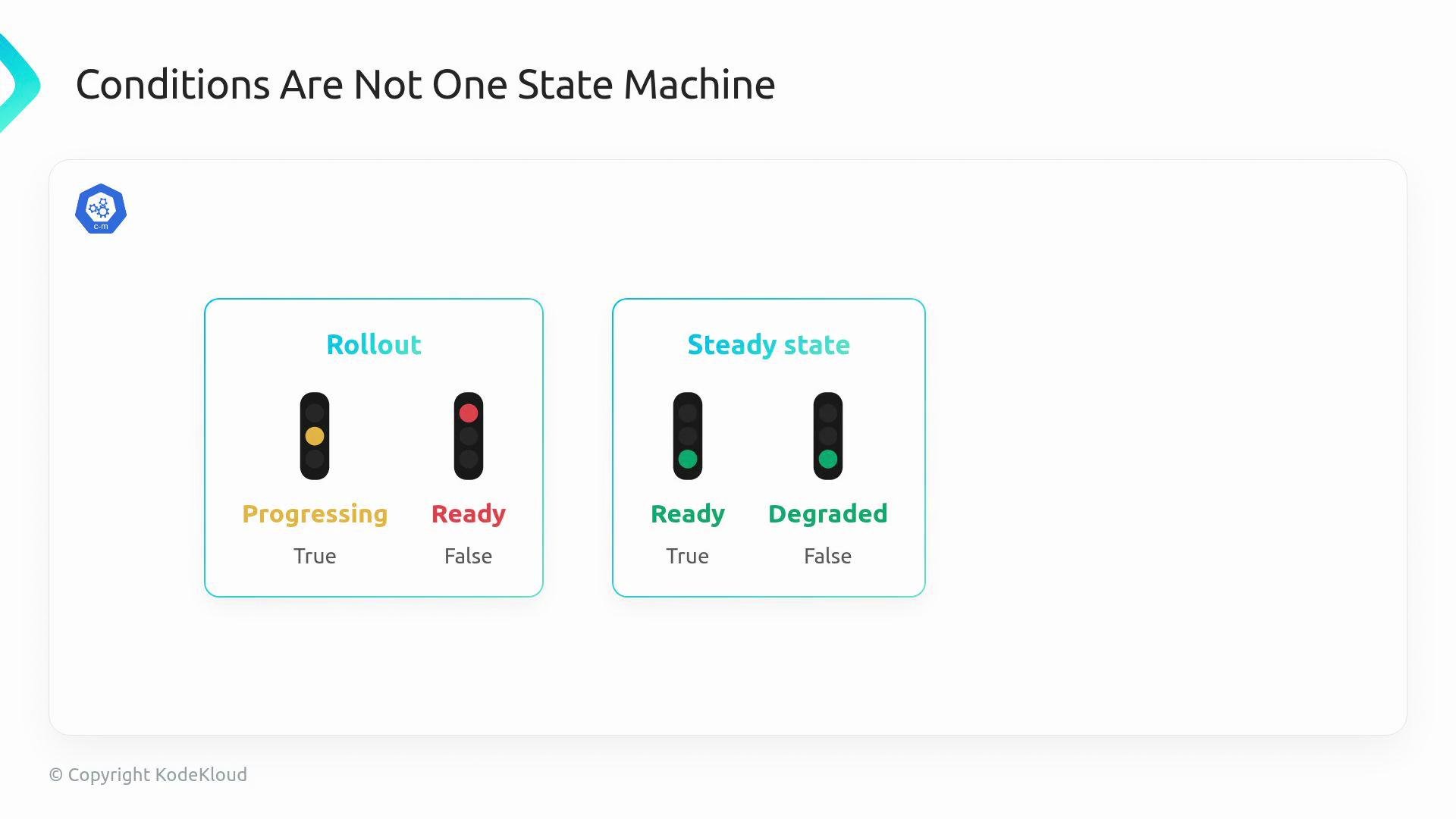
A single resource can show multiple lights at once. Conditions are not a single giant state machine — they answer independent questions. For example, during a rollout:
* `Progressing` can be `True` while `Ready` is `False`.
* In steady state, `Ready` can be `True` while `Degraded` is `False`.
Keep condition types steady and focused: they should ask continuous health questions (Ready, Progressing, Degraded), not log every event or reconcile step.
Design guidance and best practices
* Keep condition types stable and few. They are part of your API's contract and are used by alerts, dashboards, and other controllers.
* Make `Reason` predictable and machine-friendly; use `Message` for human context.
* Only update `LastTransitionTime` when the condition value actually changes.
* Populate `ObservedGeneration` so users can detect stale status.
A single resource can show multiple lights at once. Conditions are not a single giant state machine — they answer independent questions. For example, during a rollout:
* `Progressing` can be `True` while `Ready` is `False`.
* In steady state, `Ready` can be `True` while `Degraded` is `False`.
 Do not overload conditions with transient or debug-level events. Conditions should answer steady-state health questions, not act as a message log.
Keep the dashboard small and pragmatic. For a typical web app controller, the three lights (Ready, Progressing, Degraded) give operators and tools the context they need without forcing them to interpret raw gauges alone.
Next demo: we’ll start with the simplest gauge — ready replicas — and show how to map that measurement into the `Ready` condition. Good status design makes controllers and clusters easier to understand, debug, and operate.
Links and further reading
* [Kubernetes API Conventions: Conditions](https://github.com/kubernetes/community/blob/master/contributors/devel/sig-architecture/api-conventions.md#condition-typing)
* [metav1.Condition Go type reference](https://pkg.go.dev/k8s.io/apimachinery@v0.29.0/pkg/apis/meta/v1#Condition)
* [Golang course reference used above](https://learn.kodekloud.com/user/courses/golang)
Do not overload conditions with transient or debug-level events. Conditions should answer steady-state health questions, not act as a message log.
Keep the dashboard small and pragmatic. For a typical web app controller, the three lights (Ready, Progressing, Degraded) give operators and tools the context they need without forcing them to interpret raw gauges alone.
Next demo: we’ll start with the simplest gauge — ready replicas — and show how to map that measurement into the `Ready` condition. Good status design makes controllers and clusters easier to understand, debug, and operate.
Links and further reading
* [Kubernetes API Conventions: Conditions](https://github.com/kubernetes/community/blob/master/contributors/devel/sig-architecture/api-conventions.md#condition-typing)
* [metav1.Condition Go type reference](https://pkg.go.dev/k8s.io/apimachinery@v0.29.0/pkg/apis/meta/v1#Condition)
* [Golang course reference used above](https://learn.kodekloud.com/user/courses/golang)